
SoFi Technologies announces expanded partnership with Mastercard, positioning its full reserve US dollar stablecoin SoFiUSD as a settlement currency within the global payment network. Under the agreement, both parties will explore how issuing and acquiring banks can use SoFiUSD to settle credit and debit card transactions, with SoFiUSD expected to receive technical support from Mastercard’s multi-token network.
SoFiUSD Integration with Mastercard’s Technical Architecture and Core Goals
SoFiUSD was issued by SoFi Bank last December. The bank is a federally chartered depository institution regulated by the Office of the Comptroller of the Currency (OCC) and insured by the Federal Deposit Insurance Corporation (FDIC), with the token deployed on Ethereum. Fully backed 1:1 by cash reserves, SoFiUSD is positioned as the first stablecoin issued by a nationally chartered bank on a public blockchain.
This partnership integrates SoFiUSD into traditional financial settlement infrastructure, focusing on: issuing and acquiring banks exploring replacing fiat currency with SoFiUSD for transaction settlement; connecting traditional payment channels and digital asset ecosystems via Mastercard’s multi-token network; and Galileo platform providing SoFiUSD settlement options to payment card customers and issuing banks.
SoFi CEO Anthony Noto stated, “SoFiUSD is at the core of our strategy, aiming to enable faster, cheaper, and more secure money transfers worldwide. With SoFiUSD as the settlement currency on the Mastercard network, issuing and acquiring banks can more easily help millions of businesses globally achieve real-time, 24/7 settlement.”
Key Elements of SoFiUSD Integration with Mastercard’s Global Network
Unique Background: The first stablecoin issued by a nationally chartered bank regulated by OCC on the Ethereum public blockchain
Technical Integration: Connecting to Mastercard’s multi-token network to explore interoperability between fiat, stablecoins, and tokenized deposits
Use Cases: Cross-border remittances, inter-business transfers, 24/7 real-time transaction settlement
Platform Role: Galileo as an early adopter providing SoFiUSD settlement options to issuing banks
Programmable Payments: Both parties will explore programmable fund management and new payment transfer solutions (subject to regulatory approval)
Market Context and Industry Significance of Stablecoin Settlement
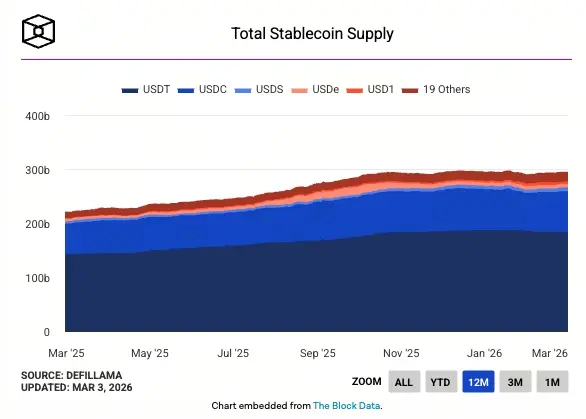 (Source: The Block)
This partnership exemplifies the rapid growth of the global stablecoin market. According to McKinsey, daily stablecoin trading volume is approximately $30 billion, with issuance doubling by 2025 compared to the previous year. A global study by BVNK in collaboration with Coinbase and Artemis shows over half of crypto holders have held stablecoins in the past 12 months, and more than 75% of respondents would open a stablecoin wallet if offered by their bank.
Sherri Haymond, Mastercard’s Head of Global Digital Commerce, said this collaboration will expand the operational capabilities of regulated stablecoins in the real world, making regulated digital currencies more reliable, secure, and widely accessible for consumers, businesses, and financial institutions.
Frequently Asked Questions
What is SoFiUSD, and what makes it special?
SoFiUSD is a full reserve US dollar stablecoin issued by SoFi Bank, fully backed 1:1 by cash reserves, deployed on Ethereum. Its uniqueness lies in being the first stablecoin issued by a federally regulated, FDIC-insured national bank on a public blockchain, combining traditional banking compliance with blockchain transparency.
What does the integration of SoFiUSD with Mastercard mean for global payments?
This integration allows SoFiUSD to serve as a settlement currency within Mastercard’s global payment network, enabling issuing and acquiring banks to explore replacing traditional fiat with stablecoins for settlement, unlocking faster, 24/7 settlement capabilities for cross-border remittances and inter-business transfers.
What is Mastercard’s Multi-Token Network (MTN)?
Mastercard’s Multi-Token Network is a digital asset platform designed to connect traditional payment channels with the digital asset ecosystem, enhancing interoperability between fiat, stablecoins, and tokenized deposits to provide more settlement options across the payment ecosystem.
Disclaimer: The information on this page may come from third parties and does not represent the views or opinions of Gate. The content displayed on this page is for reference only and does not constitute any financial, investment, or legal advice. Gate does not guarantee the accuracy or completeness of the information and shall not be liable for any losses arising from the use of this information. Virtual asset investments carry high risks and are subject to significant price volatility. You may lose all of your invested principal. Please fully understand the relevant risks and make prudent decisions based on your own financial situation and risk tolerance. For details, please refer to
Disclaimer.
Related Articles
Ethereum transaction fees hit a new low! Averaging under $0.10, L2 scaling enters the ultra-low fee era
Ethereum transaction fees drop to approximately $0.09, thanks to the Dencun upgrade and the promotion of EIP-4844, which facilitate the widespread adoption of Layer-2 and achieve high throughput. Although ETH burn rates have decreased, network activity has reached new highs, indicating that Ethereum has entered a low-fee new era, opening up new opportunities for future application scenarios.
CryptoCity46m ago
SharpLink reports a book loss of $734 million: ETH staking business hits a new all-time high, institutions increase their investments
SharpLink reported a net loss of $734.6 million in fiscal year 2025, primarily due to non-cash accounting expenses and unrealized losses from ETH price declines. Despite strong performance in staking operations and significant growth in operating revenue, there was no noticeable appreciation in the ETH per share metric, and institutional ownership increased. Market interpretations vary, and future development depends on a rebound in ETH prices.
GateNews1h ago
Bitmine transferred 9,600 ETH to the institutional platform, possibly for internal asset rebalancing, staking, or OTC trading.
Bitmine Immersion Technologies recently transferred approximately 9,600 ETH into CEX hot wallets through two transactions, demonstrating confidence in Ethereum. The company's chairman stated that the increased purchases are due to a positive market outlook, and the transferred tokens may be used for internal asset management rather than selling. The company currently estimates an unrealized loss of about $7.8 billion.
GateNews1h ago
Bitmine wallet transferred 9,257 ETH to a CEX today, worth 18.79 million USD.
Gate News Report: On March 10, the wallet labeled as Bitmine (0xD99...555e) transferred an additional 4,308 ETH to a certain CEX two hours ago, worth $8.74 million. Today, this wallet has transferred a total of 9,257 ETH to that CEX, valued at $18.79 million, and the wallet has now been emptied.
GateNews1h ago
Beware of crypto scams: Political organizations report impersonators soliciting Bitcoin and Ethereum donations related to Iran issues
The Russian "All-Russian People's Front" warns that scammers are forging donation documents to induce supporters of Iran to donate cryptocurrencies, claiming that the funds will be used to aid Ukrainian soldiers. The organization reiterates that all crypto fundraising activities in its name are scams, and legitimate donations can only be made through official website bank transfers. Meanwhile, Russian security agencies are stepping up efforts to combat related criminal activities. Cryptocurrencies are becoming increasingly important in the political and military funding flows in the Middle East, posing new security challenges for users.
GateNews2h ago


