
Chief Investment Officer Iggy Ioppe of Theo pointed out that once the US futures market closes over the weekend, the public pricing of gold shifts to the blockchain network. Chicago Mercantile Exchange (CME) gold futures cease trading at 5 PM Eastern Time on Friday and resume at 6 PM Sunday, creating nearly a 49-hour “gold pricing gap,” making tokenized gold assets PAXG and XAUt the new global tracking assets.
CME Gold Futures Weekend Closure and Pricing Gap
(Source: CEX.IO)
Ioppe stated, “In terms of publicly visible price discovery, on-chain markets are almost 100% responsible for weekend gold price discovery.” After CME futures reopen, prices tend to align closely with the trends established on the blockchain markets over the weekend.
During CME’s closure, although OTC trading in Asia continues, these transactions are not publicly disclosed, lacking transparency. In contrast, all transactions of tokenized gold are visible on-chain in real-time, making it the only public channel for institutions to track weekend gold price movements.
This weekend’s Middle East crisis is a prime example. As the US and Israel launched military strikes on Iran, tokenized gold prices surged significantly: XAUT briefly broke above $5,450, and PAXG approached $5,536, while Bitcoin declined, demonstrating the independent safe-haven function of tokenized gold amid geopolitical crises.
Advantages and Use Cases of Tokenized Gold’s Weekend Pricing
Unique Public Pricing: During CME weekend closures, PAXG and XAUt nearly monopolize the public gold price discovery function.
Institutional Signal Tracking: Macro and cross-asset trading desks monitor on-chain markets to track gap risks before CME reopens.
Real-Time Rebalancing: Traders can immediately adjust positions during geopolitical events when traditional markets are closed.
Arbitrage-Driven Liquidity: Market makers maintain pricing efficiency by arbitraging price differences between digital and traditional markets.
Explosive Growth and Future Outlook of the Tokenized Gold Market
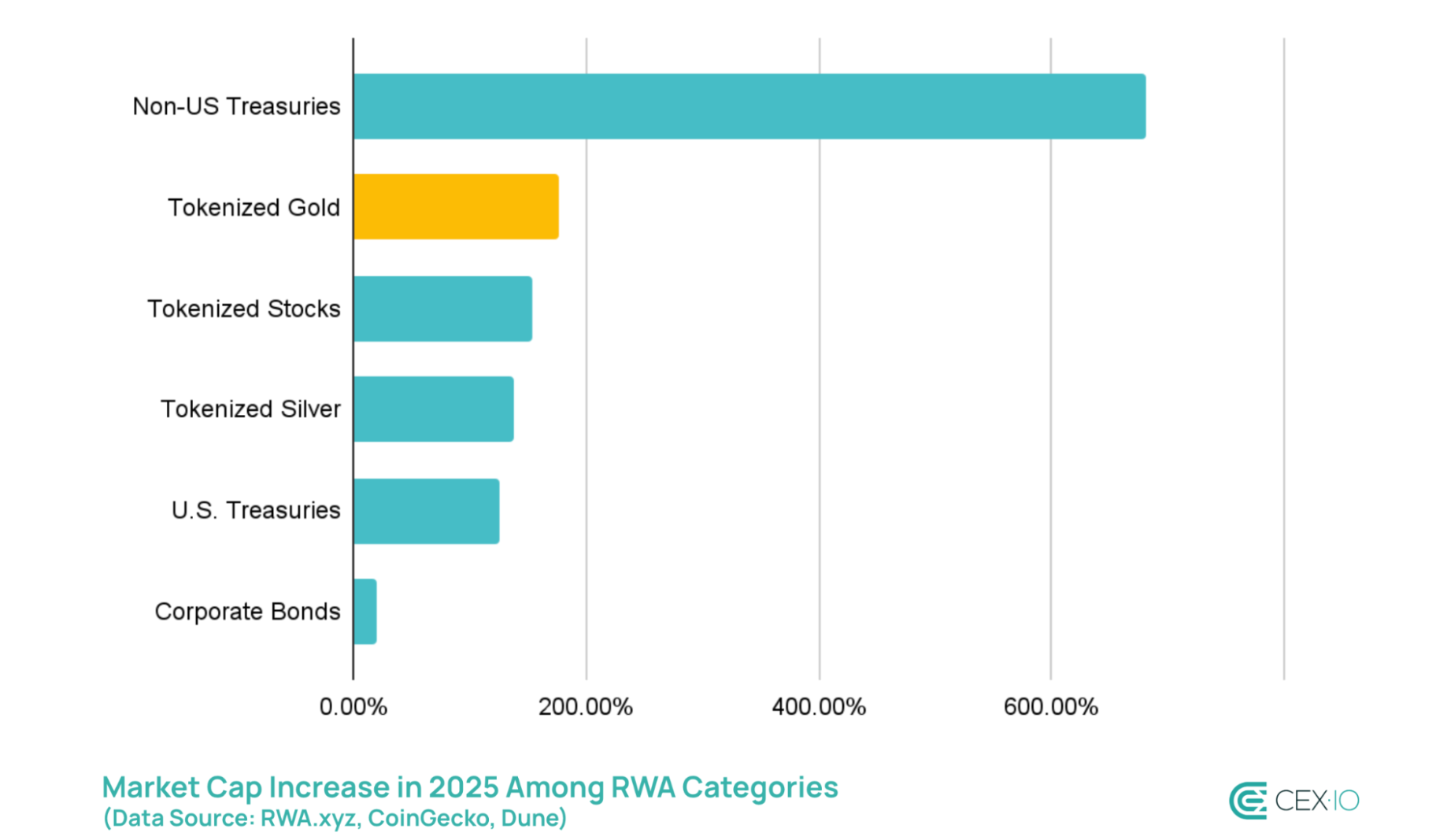
The market cap of tokenized gold grew from about $1.6 billion to $4.4 billion over the past year, an increase of 177%, far surpassing the overall gold market growth and most major physical gold ETFs. The number of holders nearly tripled, adding over 115,000 wallets, accounting for about a quarter of net inflows in the RWA sector, exceeding the combined growth of tokenized stocks, corporate bonds, and non-US government bonds.
In terms of trading volume, tokenized gold is projected to reach approximately $178 billion by 2025, with a peak of over $126 billion in Q4, making it the second-largest gold investment product globally, after SPDR Gold Trust.
However, Ioppe noted that there are still obstacles: liquidity for tokenized gold remains below that of futures or ETFs, making large transactions difficult; regulatory frameworks vary significantly across jurisdictions, hindering large-scale institutional adoption. He expects the tokenized market and traditional markets to coexist, each serving different functions.
Frequently Asked Questions
Q: Why is tokenized gold important during CME weekend closures?
CME gold futures are closed for nearly 49 hours over the weekend. During this period, Asian OTC trading continues but is not publicly disclosed. Tokenized gold (PAXG, XAUt) is among the few assets that continue trading and are publicly visible, thus nearly 100% responsible for weekend gold price discovery.
Q: How fast has the market cap of tokenized gold grown?
Over the past year, the market cap surged from about $1.6 billion to $4.4 billion, an increase of 177%, far exceeding most major gold ETFs’ growth during the same period. The number of holders nearly tripled, adding over 115,000 wallets, making it one of the largest growth engines in the RWA sector.
Q: What are the main challenges facing tokenized gold?
Major challenges include: liquidity still below that of traditional futures and ETFs, making large trades difficult; significant regulatory differences across jurisdictions; and disparities in custody, accounting, and capital rules worldwide, hindering large-scale institutional deployment.
Disclaimer: The information on this page may come from third parties and does not represent the views or opinions of Gate. The content displayed on this page is for reference only and does not constitute any financial, investment, or legal advice. Gate does not guarantee the accuracy or completeness of the information and shall not be liable for any losses arising from the use of this information. Virtual asset investments carry high risks and are subject to significant price volatility. You may lose all of your invested principal. Please fully understand the relevant risks and make prudent decisions based on your own financial situation and risk tolerance. For details, please refer to
Disclaimer.
Related Articles
SHIB Price Drops Despite 53,000% Burn Increase — Understanding the Disconnect
Burn Impact: 172 million SHIB burned reduces supply by 0.00003 percent, too small to move price.
Market Pressure: Bitcoin retreat drags SHIB lower despite burn spike and headlines.
Technical Signals: Price tests $0.00000545 support; break below $0.00000530 could trigger further
CryptoNewsLand16m ago
CPI Data Preview: Bitcoin Approaching $70,000 Key Resistance, Crypto Market May Experience Volatile Fluctuations
As the US CPI data is about to be released, the cryptocurrency market is entering a wait-and-see mode. Bitcoin, after experiencing a correction, is approaching $70,000, and market sentiment has improved, but it faces a short-term key resistance level. CPI data will be the main factor driving short-term market volatility.
GateNews16m ago
Is Bitcoin About to Break Through? Peter Brandt's "Banana Split" Pattern Indicates a Potential Significant Rise in BTC
Senior trader Peter Brant pointed out that Bitcoin is forming a "banana split" chart pattern, indicating potential significant volatility and a breakout from historical price ranges. The recent appearance of the "little banana" may be building momentum for a bull market. He predicts that Bitcoin will experience a price surge by October 2026. Global market sentiment is warming, fueling a 3.2% intraday increase in Bitcoin, currently trading at $69,803. Investors should pay attention to key price ranges to assess market trends.
GateNews29m ago
CRCL stock price increased by 87% in a month, driven by short squeeze and the dual factors of US-Iran conflict
CRCL stock price rose about 10% on March 9, with a total increase of 87.18% over the past month. Mizuho Bank analysts pointed out that this surge was driven by Middle East geopolitical conflicts leading to high oil prices, which boosted inflation expectations and increased the earnings of stablecoin issuers. Another analysis suggests that the stock price increase was mainly due to short covering. Valuation analysis indicates that CRCL's current stock price is above its intrinsic value, posing a risk of overvaluation.
MarketWhisper29m ago
Dogecoin Price Analysis: DOGE Rebound Faces Resistance, Short-term Downward Risk May Quickly Return
Dogecoin (DOGE) recent rebound momentum has weakened, and the current price is facing resistance around $0.0930. Technical analysis shows that the bulls are encountering resistance at $0.0950 and $0.0972, with downside support levels at $0.090 and $0.0884. Market sentiment influences the price, and there is still a risk of volatility in the short term.
GateNews30m ago
Bitcoin Valuation Model Revealed: PlanB Predicts an Average Price of $500,000 per Cycle, Sparking Market Debate
Bitcoin's current trading price is close to $67,300. Analyst PlanB predicts that the average price from 2024 to 2028 could reach $500,000, with a fluctuation range of $250,000 to $1,000,000. However, other analysts like Bobby A believe the price will be below this forecast. They point out that the model is difficult to accurately predict in the short term, and market factors are complex. Investors should focus on supply and demand changes and overall dynamics.
GateNews31m ago


