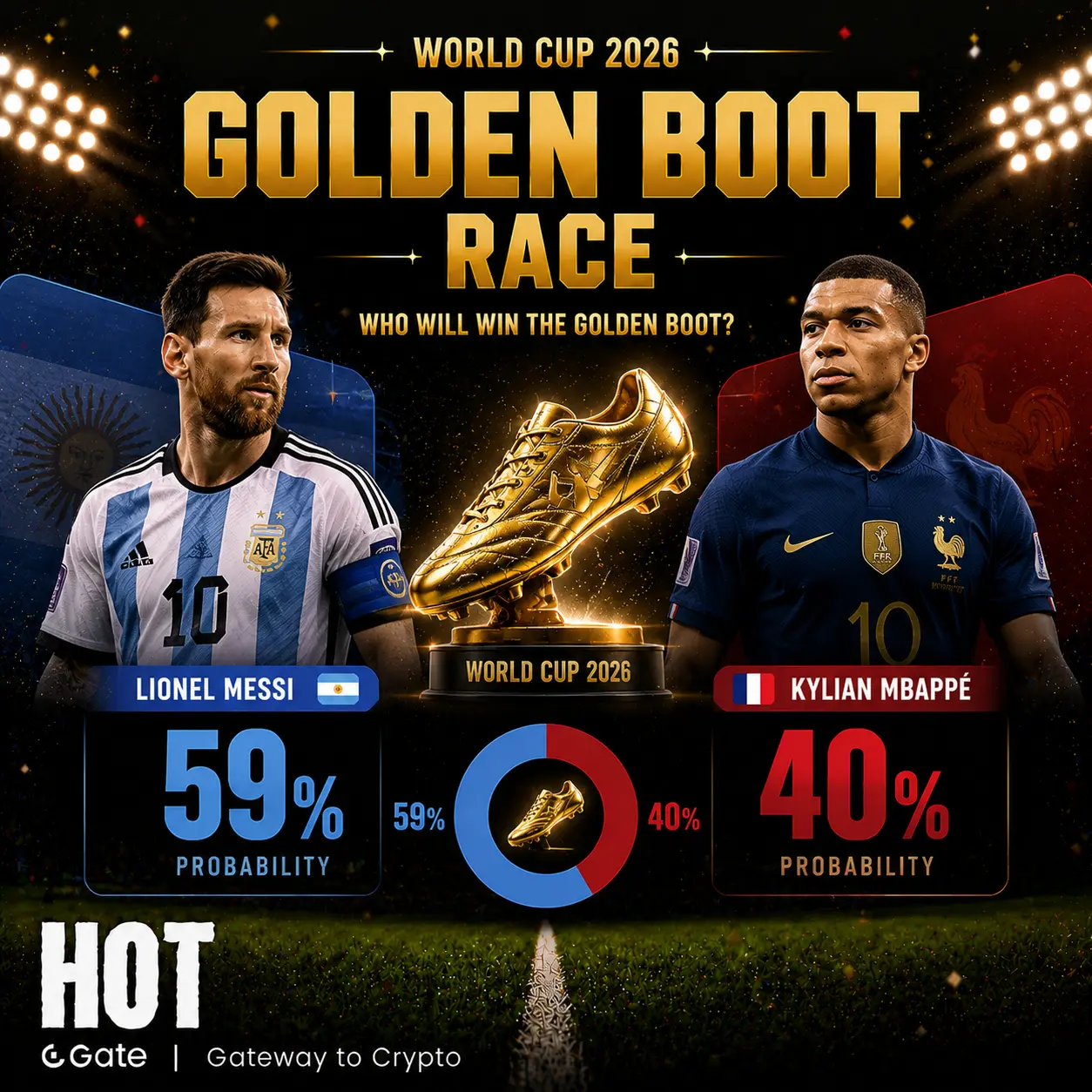
The 2026 World Cup in the US, Canada, and Mexico has reached the final stage—deciding both the champion and the third-place winner—through the title match and the third-place playoff. In the race for the Golden Boot, Argentina star Lionel Messi and France captain Kylian Mbappé are tied for the top of the scoring charts with 8 goals each. Based on Gate prediction market data as of July 17, 2026, Messi has a 59% probability of winning the Golden Boot at this World Cup, Mbappé has 40%, and England captain Harry Kane has just 1%. This probability distribution reflects the market’s overall assessment of which of the two elite forwards will ultimately take the award.
How do Golden Boot selection rules affect the final winner?
The FIFA World Cup Golden Boot selection rules are not based purely on the number of goals. When multiple players finish with the same number of goals, the number of assists becomes the first tiebreaker. If assists are also the same, the comparison moves to total minutes played, with the player who played fewer minutes winning. This rule is decisive in the case where both Messi and Mbappé have scored 8 goals.
Currently, Messi has contributed 4 assists at this World Cup, while Mbappé has 3. With the goal tally level, Messi is temporarily ahead for the Golden Boot because he has 1 more assist. That means that even if both players score the same number of goals in the remaining matches, Messi may still win thanks to his assist advantage. Understanding this rule is the key premise for interpreting the prediction market’s probability distribution.
What level are Messi and Mbappé’s goal totals at?
Heading into the eve of the World Cup final, Messi and Mbappé have each scored 8 goals—tied for the top of the scoring charts. Messi’s total World Cup career goals have reached 21, keeping him at the top of the all-time World Cup scorers list, while Mbappé has 20 total World Cup goals, placing him second on the all-time scorers list.
In terms of goal distribution, Messi’s goals in this tournament came in both the group stage and the knockout rounds. He scored his tournament-leading 7th goal against Cabo Verde, then his 8th against Egypt in the quarterfinals. Mbappé, meanwhile, scored his tournament-leading 8th goal against Morocco in the quarterfinals. Both players’ scoring efficiency remains extremely high; Mbappé is even the first player to reach 8 goals in two separate World Cups.
On shooting data, Messi has recorded 34 shots in total, including 18 on target, while Mbappé has 33 shots with 19 on target. Both players’ shot-conversion rates reflect the efficiency level of top-tier strikers.
Why do remaining-match opportunities become a key variable?
Who wins the Golden Boot depends not only on completed data, but also on how much playing time and how many scoring chances players can generate in the remaining matches. Argentina will play in the final against Spain, while France will play the third-place playoff against England.
Based on the schedule, the France side Mbappé is on will play the third-place match first, while the Argentina side Messi is on will appear in the final. That means Mbappé has the first chance to reshape the goal statistics—if he scores in the third-place match, he could temporarily move ahead of Messi and take sole possession of first place on the scoring chart. However, there is also the possibility of rotation for key players in the third-place match; whether France goes all out after a semifinal loss will directly affect Mbappé’s goal opportunities.
Messi will face Spain in the final. The intensity of the matchup and the focus on defense in the final are typically higher than in the third-place match, making goals comparatively harder. On the other hand, as defending champions, Argentina’s attacking system relies heavily on Messi—he remains the team’s most central scoring threat.
How important are assists in a tie-break scenario?
As mentioned earlier, when goal totals are tied, assists are the Golden Boot’s first-place tiebreaker. Currently, Messi leads Mbappé with 4 assists to Mbappé’s 3. Even though the gap is small, it could be decisive if their goal totals end up level.
Of Messi’s four assists, two came in the semifinal against England. When he failed to score in that semifinal, those two assists not only helped Argentina reach the final, but also reinforced Messi’s rule-based advantage in the Golden Boot race. Mbappé’s three assists are spread across both the group stage and the knockout rounds.
From a probability perspective, the likelihood that Messi can extend his lead through assists in the remaining matches—alongside the likelihood that Mbappé can narrow the gap by scoring—together form the core variables behind the prediction market’s pricing.
What information does the prediction market’s probability distribution reflect?
Gate prediction market data shows Messi has a 59% probability of winning the Golden Boot, Mbappé has 40%, and Kane has only 1%. This probability distribution largely aligns with the pricing direction of mainstream prediction markets.
Prediction market probabilities are not simply a judgment of “who is stronger,” but a consensus price that factors in multiple elements such as goal data, the assist advantage, remaining-match opportunities, schedule difficulty, and the overall strength of the teams. Messi’s lead in assists, the increased exposure and opportunities that come from Argentina reaching the final, and the fact that he continues to deliver key performances in the knockout stage all support his higher probability.
Mbappé’s 40% probability also reflects the market’s full recognition of his ability. As the Golden Boot winner from the last World Cup, Mbappé has the capacity to decide matches in key games. France playing the third-place match means he has one more match opportunity than Messi, which to some extent offsets Messi’s advantage in assists.
Kane’s 1% probability accurately reflects the real predicament he faces—despite having scored 6 goals, for him to overtake Messi and Mbappé in the remaining matches, he would not only need to score multiple goals in the third-place match himself, but also need both of his competitors to fail to score. Given the strength of the opponents in the third-place match and the final, the threshold to make this scenario happen is extremely high.
How do historical records and personal honors affect match drive?
Both Messi and Mbappé are near the top of the all-time World Cup scorers list. Messi leads the all-time scorers list with 21 goals, and Mbappé follows with 20. The Golden Boot is not only about personal honors in this tournament—it also helps further cement one’s place in history.
For Messi, who is 39 years old, this is very likely his last World Cup. The drive to win the Golden Boot for the first time, combined with the motivation to defend the World Cup title, creates exceptionally strong momentum. For Mbappé, defending the Golden Boot—becoming the player to win the Golden Boot in two consecutive World Cups—is also a historic achievement.
The personal motivations of both players may translate into a higher level of offensive investment in the remaining matches. This is both a factor that increases goal probabilities and a softer variable that prediction market pricing needs to account for.
Does Kane still have a theoretical comeback possibility?
Kane currently has 6 goals and 1 assist. From a mathematical probability standpoint, Kane could produce a hat trick (or score more) in the third-place match, while Messi fails to score in the final and Mbappé also fails to add to his goal total in the third-place match—in that case, Kane would still have a theoretical chance to mount a comeback.
However, the Gate prediction market gives Kane only a 1% probability, reflecting the market’s assessment of how likely this scenario is. Kane would need to score at least 2 more goals in a single match, and he would also need both competitors to finish with zero goals. Considering the quality of the opponents in the third-place match and the final, the likelihood is extremely slim.
In addition, Kane is far behind Messi and Mbappé in assists as well (1 compared with their higher totals), meaning that even if Kane eventually ties their goal totals, he would still lose on the assist comparison.
How do the different formats of the final and the third-place match affect goal probabilities?
There are significant differences between the final and the third-place playoff in both format and psychology. The third-place match is often viewed as more open offensively, with relatively lower defensive intensity; historically, goal totals in third-place matches have often been higher than in the final. That creates a comparatively favorable environment for Mbappé to score in the third-place match.
The final, however, comes with the highest level of competitive pressure and defensive focus. Spain, the other finalist from this World Cup, has had its defensive system fully tested in the knockout stage. In the final, Messi faces the toughest level of defensive opposition of the tournament, making the marginal difficulty of scoring higher.
That said, the final stage can also push players to reach their limits. Messi’s record of scoring in major finals, along with the fact that Argentina’s overall attacking system relies heavily on him, means he remains one of the most dangerous scoring threats in the final.
FAQ
Q: What are the rules for selecting the World Cup Golden Boot?
The Golden Boot first compares players’ total goals. If goal totals are tied, assists are compared, and the player with more assists ranks higher. If assists are still equal, total minutes played are compared, and the player who played fewer minutes wins.
Q: How many goals have Messi and Mbappé scored so far?
As of July 17, 2026, both Messi and Mbappé have scored 8 goals in this World Cup and are tied for the top of the scoring chart.
Q: What Golden Boot probabilities does the Gate prediction market give?
Gate prediction market data shows Messi has a 59% probability of winning the Golden Boot, Mbappé has 40%, and Kane has 1%.
Q: Why is Messi’s probability higher than Mbappé’s?
The main reason is that their goal totals are the same (both have 8 goals), but Messi has 4 assists compared to Mbappé’s 3. Under the Golden Boot selection rules, when goal totals are tied, assists become the deciding tiebreaker.
Q: Does Kane still have a chance to win the Golden Boot?
Kane currently has 6 goals. He would need to dramatically increase his goal total in the last match of this World Cup, while Messi and Mbappé both fail to score, to have a chance to overtake them. The Gate prediction market gives Kane a 1% probability.
Q: How do the remaining matches affect who wins the Golden Boot?
France will play the third-place match (against England), and Argentina will play the final (against Spain). Mbappé has one more match opportunity than Messi, but there is a possibility of rotation for key players in the third-place match; the final has higher defensive intensity and greater difficulty scoring.


