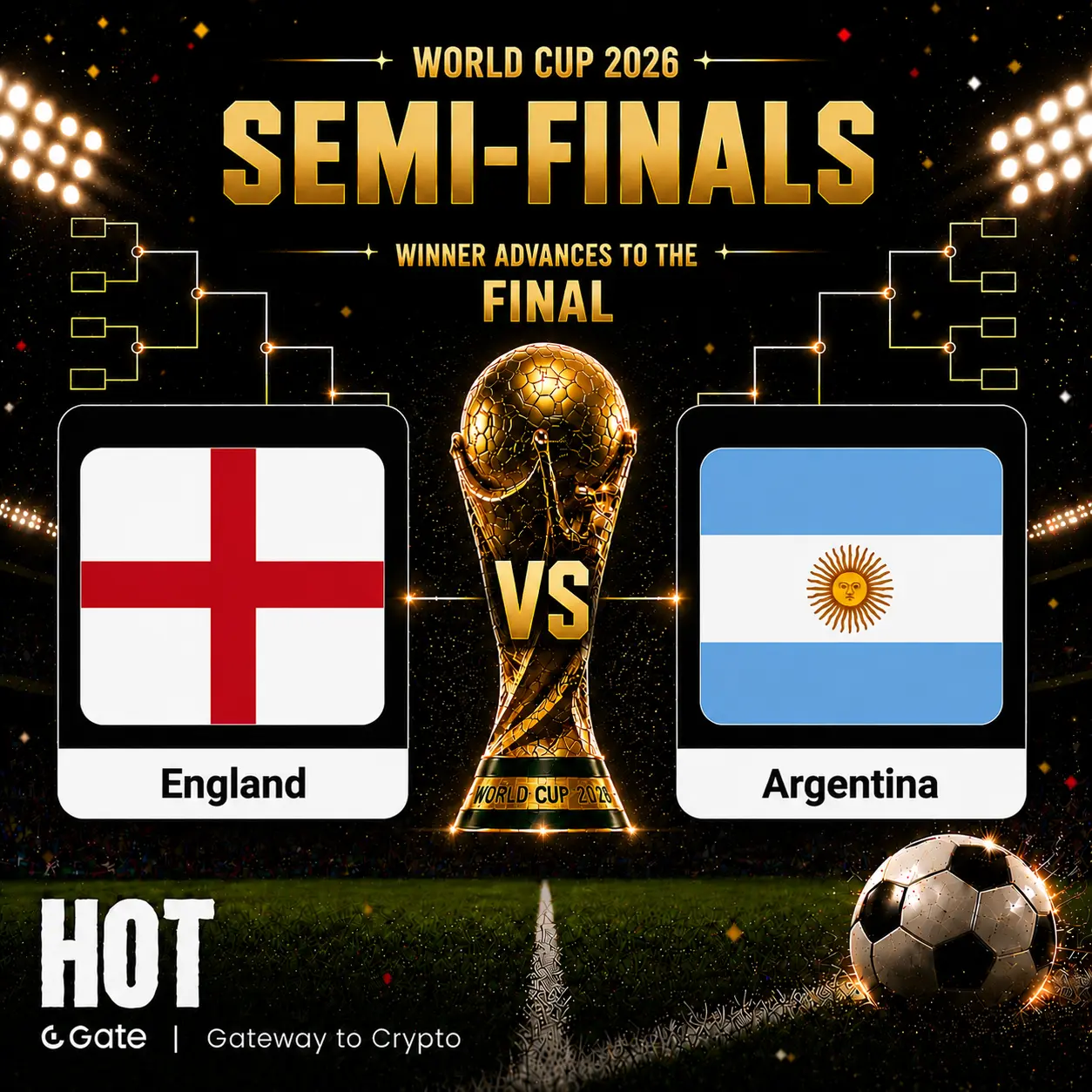
On July 15, 2026, the second World Cup semifinal between the U.S., Canada, and Mexico will kick off at Mercedes-Benz Stadium in Atlanta, USA. England and Argentina—two teams carrying decades of mutual grudges—will battle for the final ticket to this edition’s championship match. Spain already defeated France 2-0 in the first semifinal, securing a spot in the final.
For Argentina, looking to defend their title, and for England, eager to return to the final for the first time in 60 years, the outcome of this match will directly determine who will face Spain on July 19 in the New Jersey final stage for the coveted trophy.
The probability distribution provided by the prediction market—England 35%, draw 34%, Argentina 32%—clearly shows this is a near coin-flip showdown. But a probability edge doesn’t guarantee victory, especially in a semifinal brimming with historical grudges and emotional tension, where even tiny details—one call, one mistake, one moment of brilliance—can completely change the course of the match.
Head-to-Head World Cup History: Six Meetings in a Battle of Rivals
The World Cup grudge between England and Argentina can be traced back to 1962. The two teams have met five times previously in World Cup competition: England won 3 matches and Argentina won 2. This will be their sixth meeting on the World Cup stage and their first clash in the semifinal stage.
Several iconic moments have emerged from these meetings: in 1966, Argentina captain Latín was sent off; in 1986, Maradona’s “Hand of God,” followed by a century-defining goal in which he ran through five players; in 1998, Beckham’s retaliation against Simeone ended with him receiving a red card; in 2002, Beckham converted a penalty to complete his revenge. Each time the two sides meet goes beyond football itself, becoming a narrative where sport, politics, and history intertwine.
Looking at the broader head-to-head record, the two sides have met 14 times in history, with England holding the advantage at 6 wins, 5 draws, and 3 losses. However, in the five prior World Cup meetings, Argentina is slightly behind with 2 wins and 3 losses, including a victory in a penalty shootout after a draw. Notably, their last official meeting dates back to the 2002 World Cup group stage, while their most recent encounter was a friendly in November 2005.
Comparing the Road to Qualification: Whose Journey Has More Value
In this World Cup, England topped Group L with 7 points from 2 wins and 1 draw. They first defeated Croatia and Panama, then drew with Ghana. In the knockout stage, all three matches for the Three Lions were decided by a one-goal margin: they beat Congo (DR) 2-1, eliminated host Mexico 3-2, and then overturned Norway 2-1 in stoppage time. Kane and Bellingham accounted for 12 of the team’s 13 goals, becoming the absolute core of England’s attack.
Argentina’s group-stage performance was relatively easier: three straight wins, scoring 8 goals and conceding just 1. But once the knockout stage began, the defending champions’ path to qualification proved just as twisty: they narrowly beat Cape Verde 3-2 in extra time, overturned Egypt 3-2, and then eliminated Switzerland 3-1 in extra time. Argentina has reached the semifinals for four consecutive World Cups, but each win in the knockout phase has come with difficulty.
From a statistical perspective, across their six matches Argentina have had 50 shots, 14 shots on target, and conceded 6 goals; England have had 65 shots, 19 shots on target, and also conceded 6. Both teams have clear defensive vulnerabilities, meaning the direction of the semifinal may depend even more on attacking efficiency and the performance of key players on the day.
The Clash of Key Players: Kane & Bellingham vs. Messi
England’s attacking engine is driven by the two-man core of captain Kane and midfield centerpiece Bellingham. Both have scored 6 goals, tying for the top spot on the team’s scoring charts. Kane is set to make his 121st appearance for England, surpassing Rooney to become the non-goalkeeper with the most appearances for the Three Lions. Bellingham, meanwhile, has scored two goals in each of the last two matches and is in excellent form.
For Argentina, the 39-year-old Messi still leads this World Cup’s scoring charts with 8 goals, and he has also provided 2 assists. He has directly participated in goals for consecutive World Cups, reaching double digits. This will be the first time Messi has faced England in his career. For a five-time World Cup veteran, the significance of this match is self-evident. Since Argentina’s first match loss at the 2022 Qatar World Cup, they have remained unbeaten in 12 straight World Cup matches, and in every match they’ve scored at least two goals.
Both teams’ attacking firepower is concentrated among a small group of core players—out of England’s 13 goals, 12 have come from Kane and Bellingham. Argentina’s attack is also highly dependent on Messi’s creativity and finishing. When the core players are neutralized, who can provide attacking support from other positions may be the key variable that decides the direction of the game.
Tactical Styles and Lineup Risks: A Clash of Two Football Philosophies
England’s overall squad is young and full of energy, excelling in high pressing and attacks down the flanks, with extremely fast transitions between defense and attack. Breakthrough ability from wide players like Gordon and Saka gives the team a variety of attacking options. However, England’s backline has a risk of shortage—right-back Kunsa continues to be suspended for a red card, and James is still in the recovery period from an injury. Under high-pressure tactics, gaps in the back are easy for opponents to exploit.
Argentina, meanwhile, designs its tactics centered on Messi. The team has extensive experience in major tournaments and very strong team cohesion. But their lineup also clearly has a weakness: the overall squad is older, and their pace in both attack and defense is slower. After several consecutive high-intensity matches, including Messi, fitness concerns for multiple core players are gradually becoming visible. England’s fitness advantage and Argentina’s experience advantage will each matter at different stages of the match.
In terms of the FIFA rankings, Argentina are world No. 2 and England are world No. 4. The four teams in this World Cup semifinals are exactly the top 4 ranked sides in the world, which has never happened before in the history of the World Cup. The ranking gap is small, meaning there is essentially no clear paper advantage or disadvantage between these teams for this match.
Reading the Prediction Market Data: What Signals the Probability Distribution Sends
Based on data from the Gate prediction market, the current market bets show England’s probability of winning in regular time is 35%, a draw is 34%, and Argentina’s win rate is 32%. This distribution displays a rare level of balance—market-assigned probabilities give all three outcomes nearly one-third weight, reflecting extremely high uncertainty in this semifinal.
From a broader set of prediction models, Opta’s supercomputer forecasts show England’s win probability in regular time is 39.1%, Argentina’s is 31.6%, and the draw probability is 29.3%. Considering the entire match (including extra time and penalty shootouts), England’s qualification probability is about 52.9%, while Argentina is 47.1%. The prediction market believes England has a slight edge to reach the final with a 55% probability, while Argentina remains a dangerous contender (45%).
A high probability of draws suggests this match is very likely to turn into a tactical contest, and the chance of it reaching extra time or even a penalty shootout cannot be ignored. For investors who follow prediction markets, this highly uncertain distribution of outcomes itself becomes a game window worth monitoring continuously.
Final Preview: What Kind of Spain Will the Winner Face
Whoever wins this semifinal will face a Spain team that is firing on all cylinders. Spain defeated France 2-0 in the semifinal and have now maintained an unbeaten run in regular time for 37 straight matches, continuing to set a new record for the longest unbeaten streak in the team’s history. As European champions, Spain have shown tremendous dominance under their possession-based system.
In terms of World Cup winner odds, Spain lead with 58.1%, followed by England at 22.4% and Argentina at 19.1%. The market broadly sees Spain as the biggest favorite to win this World Cup. For England, if they advance to the final, they will face an opponent that beat them in the 2024 European Championship final; for Argentina, the last hurdle on the road to defending their title will be one of today’s most dominant possession-and-control teams.
FAQ
Q: How many times have England and Argentina met in World Cup history, and what are their records?
The two sides have met 5 times in World Cup history: England has 3 wins, and Argentina has 2. The 2026 semifinal will be the teams’ sixth World Cup meeting and their first clash at the semifinal stage. Across all competitions, the two sides have met 14 times, with England leading 6 wins, 5 draws, and 3 losses.
Q: Has Messi played against England before?
No. This will be Messi’s first match against England in his career. Although Messi has participated in five World Cups, Argentina have never met England on the World Cup stage before.
Q: What are the advancement probabilities shown by the Gate prediction market?
As of July 15, 2026, the Gate prediction market shows England’s probability of advancing to the final is 55% and Argentina’s is 45%. The probabilities for the three regular-time results are: England to win 35%, draw 34%, and Argentina to win 32%.
Q: When was the last time England reached a World Cup final?
England’s last World Cup final appearance was 1966, when they won the tournament as hosts. After that, the Three Lions reached the semifinals twice in 1990 and 2018, but were unable to go further.
Q: How has Argentina performed on its path to qualification in this World Cup?
Argentina won all three group-stage matches, scoring 8 goals and conceding just 1. In the knockout stage, their three matches were all hard-fought: Cape Verde 3-2 in extra time, Egypt overturned 3-2, and Switzerland eliminated 3-1 in extra time. The team has remained unbeaten in 12 consecutive World Cup matches.