Polish prosecutors have opened a fraud investigation into cryptocurrency exchange Zondacrypto after chief executive Przemysław Kral departed for Israel, where his citizenship could prevent extradition, leaving up to 30,000 users facing losses tied to an inaccessible cold wallet holding 4,500 bitcoin.
Key Takeaways:
- Polish prosecutors launched a fraud investigation into Zondacrypto, identifying losses of at least 350 million PLN ($97M) affecting up to 30,000 users.
- CEO Przemysław Kral is reportedly in Israel, where his citizenship may prevent extradition as Israel does not extradite its own citizens.
- Kral’s last public communication confirmed 4,500 BTC in an inaccessible cold wallet before he went silent.
A $97M Black Hole and a CEO Out of Reach
Zondacrypto was among Poland’s largest cryptocurrency exchanges before a sequence of disclosures revealed deep reserve and governance problems at the platform.
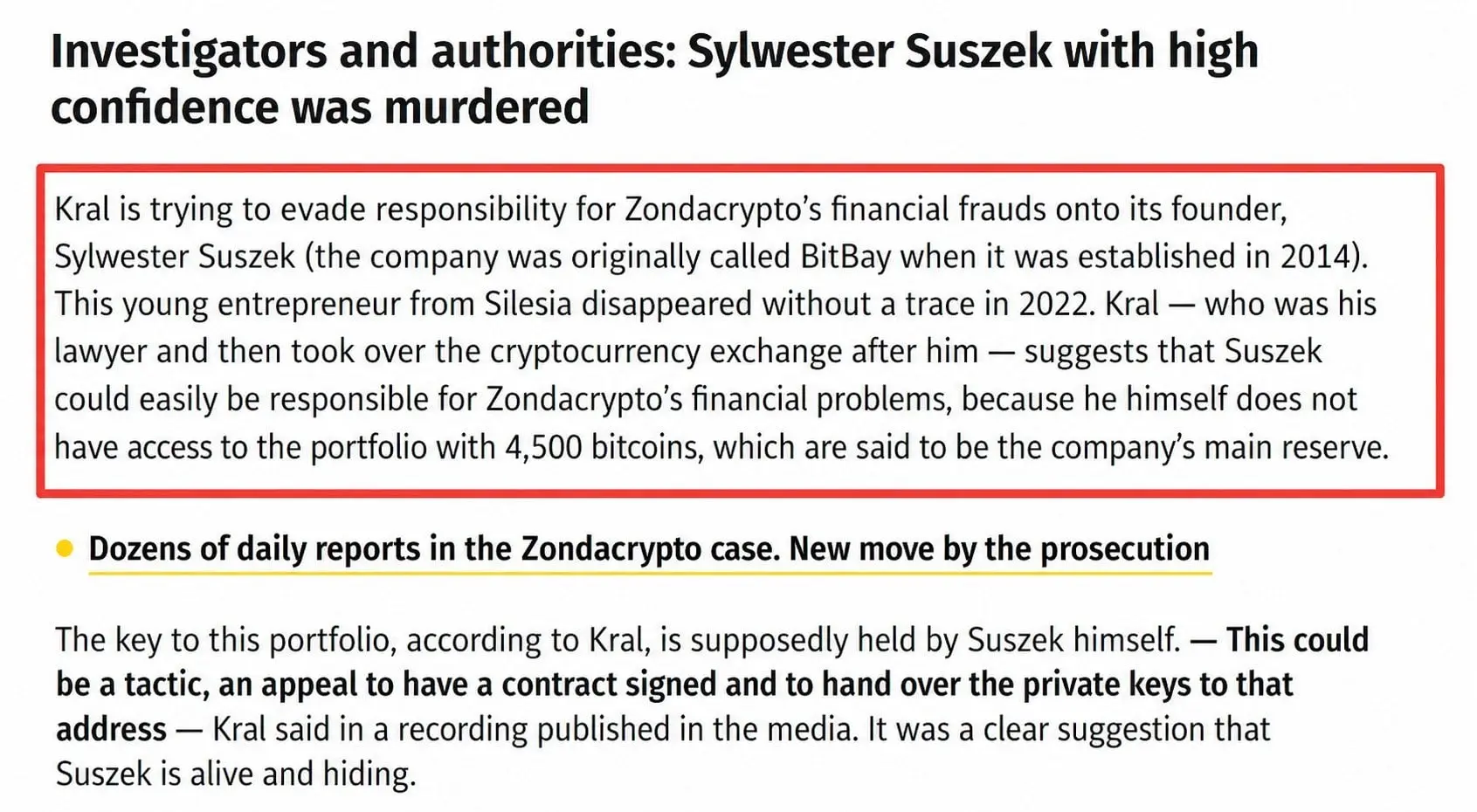 Image source: Onet media
In his last documented public communication, Kral confirmed that a cold wallet holding 4,500 BTC had become inaccessible. He has not issued a public statement since, and reports from Polish media outlet Onet indicate Kral has been in Israel for approximately one week. Polish authorities confirmed he holds Israeli citizenship, a factor that significantly complicates any extradition effort.
Image source: Onet media
In his last documented public communication, Kral confirmed that a cold wallet holding 4,500 BTC had become inaccessible. He has not issued a public statement since, and reports from Polish media outlet Onet indicate Kral has been in Israel for approximately one week. Polish authorities confirmed he holds Israeli citizenship, a factor that significantly complicates any extradition effort.
Poland has no established track record of extraditing individuals from Israel. More critically, Israel does not extradite its own citizens under Israeli law. Polish Deputy Interior Minister Czesław Mróczek acknowledged the complication directly, stating publicly that Poland has no experience handling extradition requests of this kind.
The Scale of Potential Harm is Significant
Prosecutors have identified losses of at least 350 million Polish zloty, equivalent to roughly $100 million. Polish Prime Minister Donald Tusk, too, has confirmed that up to 30,000 Zondacrypto users may have been affected, comparing the case to major financial scandals from Poland’s past.
Hundreds of potential victims have been identified as the investigation expands, with the inaccessibility of the bitcoin cold wallet remaining central to the probe. No official timeline has been provided for when or whether users may be able to access their funds.
Zondacrypto has not issued any public communication addressing the criminal probe or Kral’s reported departure since his last known statement.
The collapse follows a pattern seen in other exchange failures, where once reserve shortfalls are disclosed, executives become unreachable, and users are left with limited legal recourse across jurisdictions (as seen in the aftermath of the FTX collapse). Polish authorities have not confirmed whether an international arrest warrant or Interpol red notice has been filed, leaving the status of enforcement efforts unclear.
Disclaimer: The information on this page may come from third parties and does not represent the views or opinions of Gate. The content displayed on this page is for reference only and does not constitute any financial, investment, or legal advice. Gate does not guarantee the accuracy or completeness of the information and shall not be liable for any losses arising from the use of this information. Virtual asset investments carry high risks and are subject to significant price volatility. You may lose all of your invested principal. Please fully understand the relevant risks and make prudent decisions based on your own financial situation and risk tolerance. For details, please refer to
Disclaimer.
Related Articles
Brazil Bans Polymarket, Kalshi in Prediction Market Crackdown
Brazil has enacted a sweeping ban on prediction markets and betting platforms, including the two leading platforms Polymarket and Kalshi, according to local media and government filings. The Banco Central do Brasil issued a resolution prohibiting the platforms due to non-compliance with local
CryptoFrontier1h ago
Litecoin Reorg Undoes MWEB Privacy Layer Exploit
Litecoin underwent a deep chain reorganization on Saturday after attackers exploited a zero-day vulnerability in its MimbleWimble Extension Block (MWEB) privacy layer, according to the Litecoin Foundation. The incident resulted in a three-hour reorg that erased invalid transactions from the
CryptoFrontier4h ago
US Sanctions Iran-Linked Crypto Wallets Holding $344M Frozen by Tether
U.S. Treasury Secretary Scott Bessent announced sanctions on multiple wallets linked to Iran as part of President Donald Trump's efforts to increase economic pressure on the country, according to CNN. The move follows Tether's freeze of $344 million in USDT on Tron, which has been linked to
CryptoFrontier4h ago
CFTC Sues New York as 38 AGs Back Kalshi Prediction Market Ban
New York Attorney General Letitia James joined a bipartisan coalition of 37 other attorneys general and the District of Columbia on Friday in urging Massachusetts' top court to uphold a preliminary injunction against prediction market platform Kalshi, while the U.S. Commodity Futures Trading Commiss
CryptoFrontier5h ago
CFTC sues New York State: Defend the federal exclusive jurisdiction over prediction markets
CFTC4/24 filed a lawsuit against the State of New York in the U.S. Federal Court for the Southern District of New York, arguing that the event contracts are subject to federal exclusive jurisdiction, and seeking a permanent injunction to stop state law from interfering with CFTC-registered entities. The core issue is field preemption; if they win, Polymarket, Kalshi, and others in the U.S. will have compliance and market positioning dominated by the federal framework, and the influence of state law will be weakened.
ChainNewsAbmedia6h ago
North Korean IT Workers Laptop Farm Scam: US Co-Conspirator Sentenced to 7–9 Years, Netting $2.8 Billion Over Two Years
Fortune reported that North Korea used laptop farms inside the United States, generating about $2.8 billion in revenue over two years to support nuclear weapons; annual tribute is $250–600 million. The U.S. citizen suspects Kejia Wang and Zhenxing Wang were each sentenced to 7.5 years and 9 years, respectively, for involvement exceeding 100 companies and 80 cases of identity theft. North Korea operated in the U.S. using U.S. identities and fixed devices, with funds mostly being converted via cryptocurrencies. Experts warn that an accomplice network still exists inside the country, and companies must strengthen identity verification, address tracking, and time zone/IP analysis.
ChainNewsAbmedia7h ago


