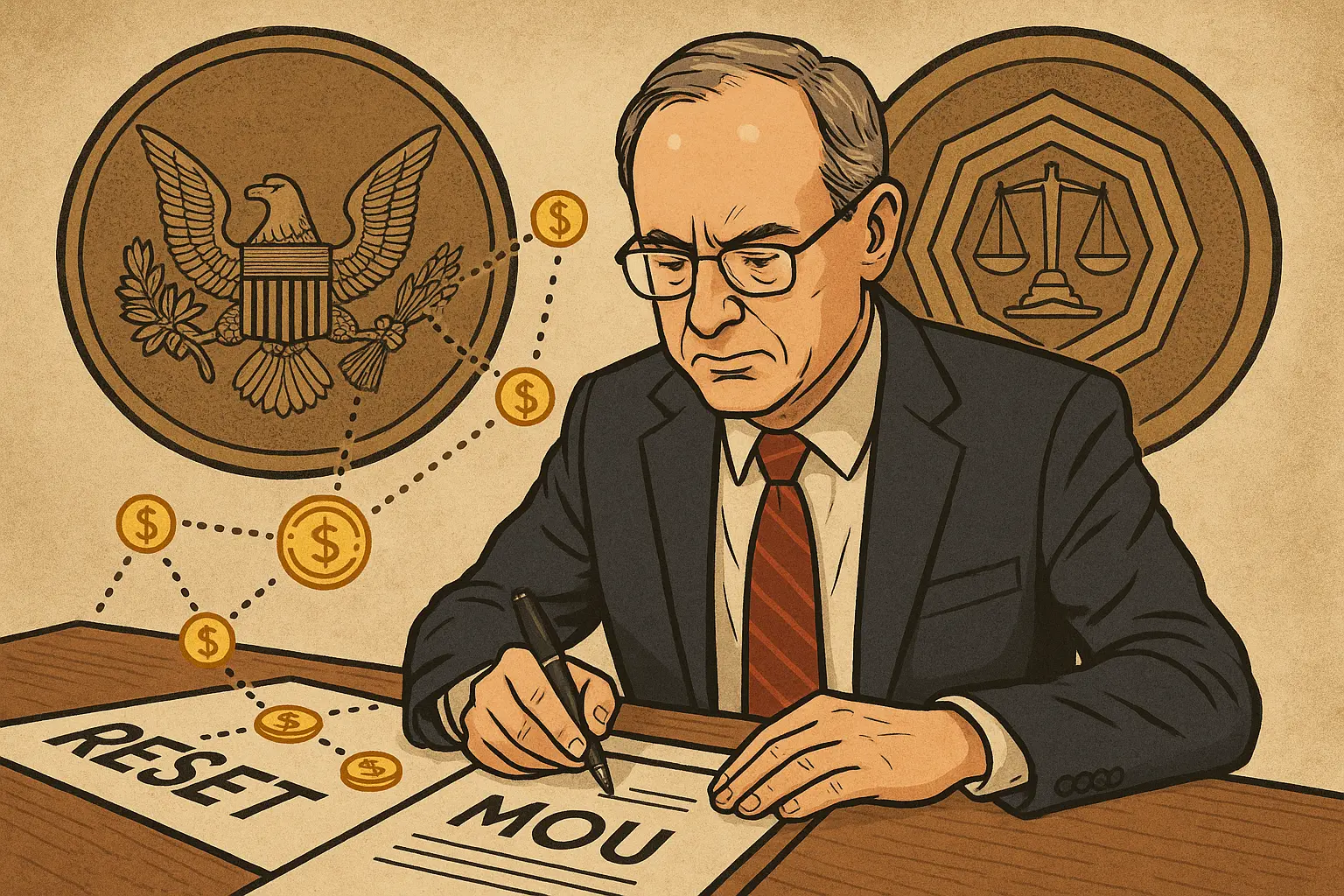
On April 21, Paul Atkins, Chair of the U.S. Securities and Exchange Commission (SEC), announced a “reset” plan for the digital-asset oversight of its “A-C-T” strategy (advance, clarify, transform) in a keynote address at the Economic Club of Washington, marking the one-year anniversary since he took office. The core elements include an “innovation exemption” mechanism, a five-category token classification framework, and a memorandum of understanding (MoU) signed with the U.S. Commodity Futures Trading Commission (CFTC).
Five-category token framework: Narrowing the SEC’s jurisdiction
(Source: SEC)
According to Atkins’ speech, the SEC’s five-category token framework explicitly places four of the five token types outside the scope of securities laws, leaving only a small portion of crypto assets subject to regulation under existing securities laws—thereby narrowing the SEC’s direct jurisdiction. In his speech, Atkins said, “Our goal is to help market participants categorize crypto assets clearly, rather than making them guess after the fact whether the SEC will determine that certain assets are securities.”
Atkins also emphasized the principle of “form not changing the substance,” noting that whether stocks exist in traditional paper form, are registered through the DTCC, or take the form of blockchain tokens, their nature remains that of stocks, but not all tokens used for financing should be viewed as securities forever.
Innovation exemption: 12 to 36 months of relief
Based on Atkins’ speech and the SEC’s prior guidance in “Project Crypto,” the “innovation exemption” allows eligible issuers and trading venues, during a 12- to 36-month relief period, to issue and trade tokenized securities on-chain under comparatively more lenient regulatory conditions, without having to comply with all immediate registration requirements. After the relief period ends, the relevant parties must demonstrate that they have achieved “sufficient decentralization,” or transition to a standard securities regulatory regime.
Atkins said this exemption is intended to keep the tokenization of stocks, bonds, and other real-world assets within the U.S. market, and he said the new roadmap is meant to “restore regulatory clarity, strengthen competitiveness, and accelerate innovation.”
SEC and CFTC memorandum of understanding
According to the SEC’s public statement, the SEC has signed an MoU with the CFTC, committing to jointly interpret crypto assets, coordinate rulemaking, and establish a regulatory framework tailored to the needs of on-chain markets. The expansion work of Project Crypto also focuses in parallel on modernizing on-chain clearing, margin, and collateral rules, with the goal of formally bringing the tokenized market within an expanded regulatory framework of U.S. capital markets.
Frequently asked questions
What are the key terms of the SEC’s “innovation exemption”?
According to the SEC Chair Atkins’ speech and the Project Crypto guidance, the “innovation exemption” allows eligible issuers and trading venues to trade tokenized securities on-chain on more lenient terms during a 12- to 36-month relief period. After the relief period, they must demonstrate “sufficient decentralization” or transition to a standard securities regulatory regime.
How does the SEC’s five-category token framework affect the scope of crypto-asset regulation?
According to Atkins’ speech, the five-category token framework places four of the five token types outside the scope of securities law regulation, leaving only a small portion of crypto assets regulated under existing securities laws. The aim is to provide clear categorization for market participants, rather than relying on after-the-fact enforcement determinations.
What core issues are covered in the SEC-CFTC memorandum of understanding?
According to the SEC’s public statement, the SEC and CFTC’s memorandum of understanding commits them to jointly interpret crypto assets, coordinate rulemaking, and establish a regulatory framework suited to the needs of on-chain tools, covering the modernization of clearing, margin, and collateral rules.
Disclaimer: The information on this page may come from third parties and does not represent the views or opinions of Gate. The content displayed on this page is for reference only and does not constitute any financial, investment, or legal advice. Gate does not guarantee the accuracy or completeness of the information and shall not be liable for any losses arising from the use of this information. Virtual asset investments carry high risks and are subject to significant price volatility. You may lose all of your invested principal. Please fully understand the relevant risks and make prudent decisions based on your own financial situation and risk tolerance. For details, please refer to
Disclaimer.
Related Articles
Trump Reaffirms Support for CLARITY Act Amid Senate Delays on Crypto Regulation
Gate News message, April 27 — Donald Trump reaffirmed his support for the CLARITY Act at a private gathering at Mar-a-Lago on April 27, stating he would not allow banks to block crypto legislation. The event, which hosted major holders of the Trump-themed memecoin $TRUMP, underscored the political b
GateNews6m ago
CLARITY Bill enters a critical 28-day window! Polymarket: Probability of passing drops to 38%
According to data from Polymarket prediction markets on April 27, the probability that the “Digital Asset Market Clarity Act” (CLARITY Act) will be completed into law in 2026 has fallen from a previous peak of 70% to 38-50%. As of April 27, there are only 28 days left until May 25, 2026, Memorial Day holiday in the United States.
MarketWhisper11m ago
Chainalysis: The EU's 20th round of sanctions covers RUBx, the digital ruble, and Meer exchanges
According to an analysis published by blockchain intelligence firm Chainalysis on April 24, the EU has recently released its 20th round of sanctions against Russia. For the first time, it treats the entire Russian cryptocurrency industry as a whole for sanctions purposes, rather than targeting only individual entities. The scope of this round of sanctions includes the Kyrgyz exchange Meer, the ruble-backed stablecoin RUBx, and Russia’s central bank digital currency (CBDC), “Digital Ruble.”
MarketWhisper44m ago
Chainalysis: EU's New Sanctions on Russia Mark 'a New Era' of Crypto Enforcement
The blockchain intelligence agency highlighted that the recently issued sanctions package against Russia was perhaps the most comprehensive crypto-focused action by the EU, targeting the whole Russian cryptocurrency sector rather than individual actors, including the digital ruble in full and the
Coinpedia3h ago
IMF's Former Chief Economist Warns Double Deregulation Could Trigger Systemic Financial Crisis
Gate News message, April 27 — Kenneth Rogoff, former chief economist of the International Monetary Fund, has warned that the Trump administration's push for financial deregulation—particularly loosening bank capital requirements and regulatory transparency—is significantly raising the risk of a
GateNews4h ago
Mike Novogratz: The 《CLARITY Act》 was submitted to the committee for review in May, with an estimated approval rate of 50%
Galaxy Digital CEO Mike Novogratz said in a podcast episode he posted on YouTube on April 25 that the U.S. “CLARITY Act” will be submitted to a Senate committee for review during the first week of May, and it is expected that Trump will complete the signing in June. Alex Thorn, head of research at the firm, estimates the probability that the bill will pass in 2026 at 50%.
MarketWhisper4h ago


