In a new report, TRM Labs stated that while illicit finance threats remain in Latam, including cartel-linked OTC brokers, Venezuelan sanctioned flows, and Chinese laundering networks, regulations are encircling these threats, with every major Latam market increasing its compliance efforts.
Key Takeaways:
- TRM Labs reports stablecoins drive 95% of illicit Latam inflows, forcing VASPs to upgrade tech next.
- The Sinaloa Cartel laundered $103B in 2025, pushing governments to enforce upcoming AML laws.
- Following these reports, Latam countries are enhancing their compliance standards.
TRM Labs: Regulation is Narrowing Threat Windows In Latam
Crypto regulations are advancing internationally, and Latam is not an exception, even with numerous documented threats. According to TRM Labs, a blockchain intelligence firm, regulations are coming to make cryptocurrency transactions and flows more secure in the region.
In a recent report, TRM Labs disclosed that stablecoins have become the dominant payment rails across Latam, accounting for 95% of inflows to sanctioned entities globally in a region that, due to its economic traits, is open to the adoption of these new technologies.
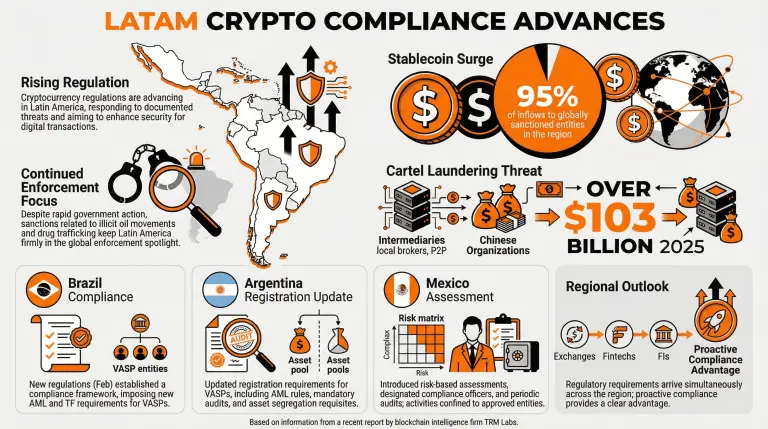
TRM Labs states that the threats are well-documented in the region, including flows linked to the Sinaloa Cartel, leveraging local brokers and P2P exchanges to launder funds using Chinese organizations as intermediaries to process over $103 billion in 2025 alone.
In addition, the institution highlighted that sanctions that remain in place related to illicit oil movements and drug trafficking keep Latam in the enforcement spotlight. Nonetheless, governments are moving quickly to plug these holes and strengthen compliance across the sector.
In Brazil, new regulations passed in February establish a compliance framework that includes new anti-money laundering (AML) and terrorism financing (TF) requirements for virtual asset service providers (VASPs) to receive authorization to operate.
Argentina also tightened oversight over the crypto market, with updated registration requirements for VASPs that include AML rules, audit, and asset segregation requisites.
Mexico also introduced risk-based assessments, designated compliance officers, and periodic compliance audits for entities, as virtual asset activities are still confined to organizations approved by the Central Bank of Mexico (Banxico).
TRM Labs concluded that “for exchanges, fintechs, and financial institutions operating in Latin America, regulatory requirements are arriving across the region simultaneously. Institutions building compliance infrastructure ahead of enforcement deadlines carry a clear operating advantage.”
Disclaimer: The information on this page may come from third parties and does not represent the views or opinions of Gate. The content displayed on this page is for reference only and does not constitute any financial, investment, or legal advice. Gate does not guarantee the accuracy or completeness of the information and shall not be liable for any losses arising from the use of this information. Virtual asset investments carry high risks and are subject to significant price volatility. You may lose all of your invested principal. Please fully understand the relevant risks and make prudent decisions based on your own financial situation and risk tolerance. For details, please refer to
Disclaimer.
Related Articles
Chainalysis: EU's New Sanctions on Russia Mark 'a New Era' of Crypto Enforcement
The blockchain intelligence agency highlighted that the recently issued sanctions package against Russia was perhaps the most comprehensive crypto-focused action by the EU, targeting the whole Russian cryptocurrency sector rather than individual actors, including the digital ruble in full and the
Coinpedia52m ago
IMF's Former Chief Economist Warns Double Deregulation Could Trigger Systemic Financial Crisis
Gate News message, April 27 — Kenneth Rogoff, former chief economist of the International Monetary Fund, has warned that the Trump administration's push for financial deregulation—particularly loosening bank capital requirements and regulatory transparency—is significantly raising the risk of a
GateNews1h ago
Mike Novogratz: The 《CLARITY Act》 was submitted to the committee for review in May, with an estimated approval rate of 50%
Galaxy Digital CEO Mike Novogratz said in a podcast episode he posted on YouTube on April 25 that the U.S. “CLARITY Act” will be submitted to a Senate committee for review during the first week of May, and it is expected that Trump will complete the signing in June. Alex Thorn, head of research at the firm, estimates the probability that the bill will pass in 2026 at 50%.
MarketWhisper2h ago
Japan's FSA Outlines Dual-Track Strategy for Digital Assets: Investor Protection and Financial Infrastructure
Gate News message, April 26 — Japan's Financial Services Agency is pursuing a two-pronged approach to digital asset regulation, balancing investor protection with infrastructure innovation, according to remarks by Shigeru Shimizu, Head of Risk Analysis at the FSA, delivered April 21 at a
GateNews4h ago
Tennessee Becomes Second U.S. State to Ban Crypto ATMs Statewide
Gate News message, April 26 — Tennessee has become the second U.S. state to outright ban cryptocurrency ATMs, with Gov. Bill Lee signing House Bill 2505 into law on April 13 after unanimous passage in both chambers. The law will take effect on July 1 and makes it a misdemeanor to operate or host
GateNews4h ago
Study Finds Only 3% of Polymarket Traders Are Skilled, Capturing Over 30% of Gains
Gate News message, April 26 — A new academic paper analyzing Polymarket transactions from 2023 through 2025 concludes that the platform's accuracy reflects "the wisdom of an informed minority, not the wisdom of the crowd." The research, revised April 25 by scholars from London Business School and
GateNews5h ago


