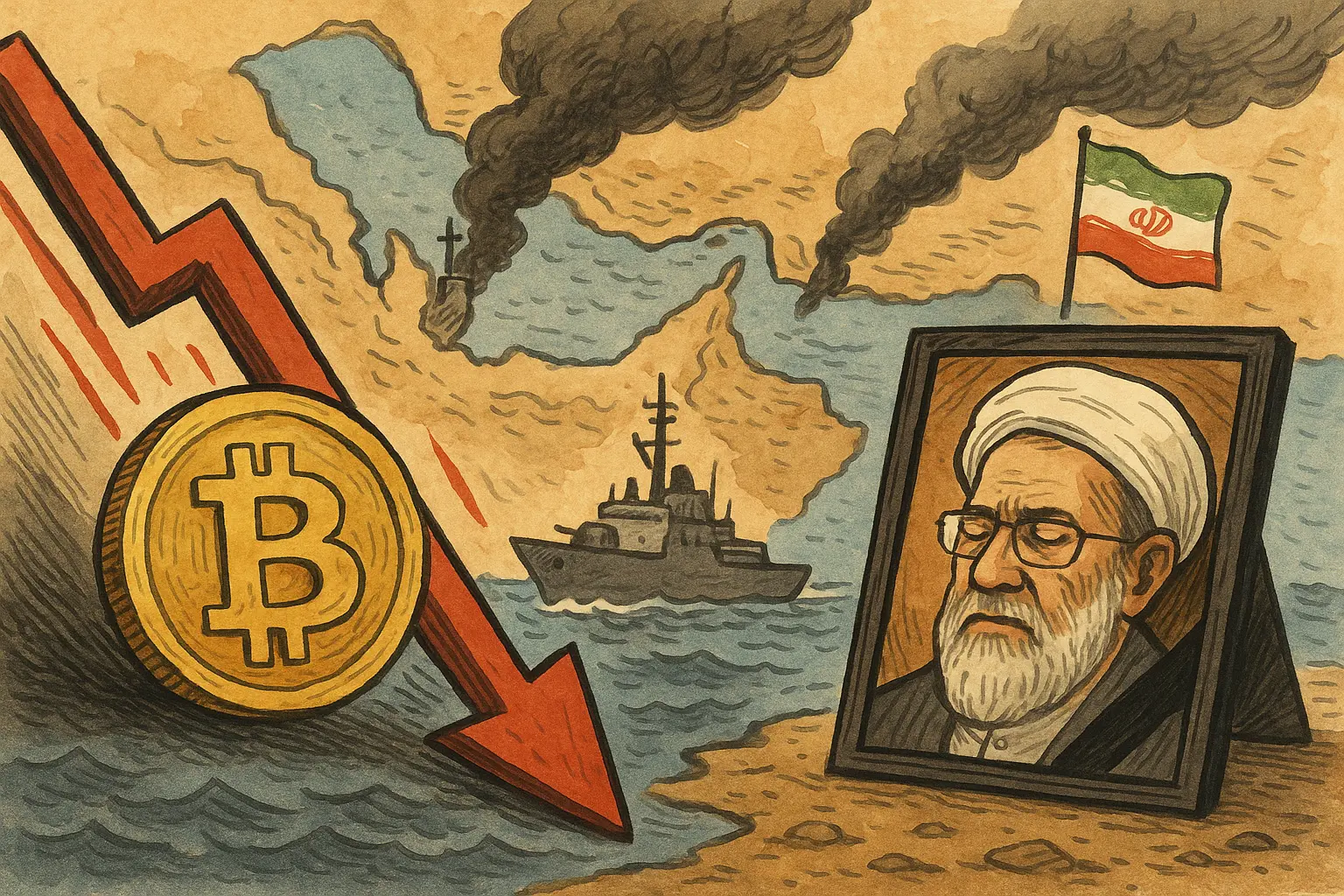
Bitcoin (BTC) was quoted at approximately $73,500 on March 18, pausing its early-week rally. Iran’s official confirmed that Ali Larijani, Secretary of the Supreme National Security Council, was killed in the airstrike, becoming one of the highest-level wartime figures Iran has lost since the assassination of Qasem Soleimani; the Strait of Hormuz has been declared blocked, cutting off about 20% of global maritime oil shipments, with crude oil prices breaking above $100 per barrel.
Worsening Iran War Situation: Larijani’s Death Tightens Negotiation Space

(Source: The Guardian)
The Office of Iran’s Supreme National Security Council confirmed that Larijani was killed early Tuesday along with his son Murtaza, Security Deputy Alireza Bayat, and several bodyguards. Iranian media had previously denied and released handwritten letters in an attempt to refute, but the official later confirmed the news, indicating a major change in the situation in a short period.
Larijani served as Speaker of the Iranian Parliament for over 12 years, deeply involved in nuclear negotiations and cross-faction coordination. Analysts see him as one of the few central figures capable of bridging the Revolutionary Guards and pragmatic factions within Iran’s political landscape. His death is interpreted as a signal on two levels: a severe weakening of Iran’s wartime power core and further compression of the already fragile ceasefire and negotiation prospects.
Internal contradictions within the U.S. have also become public. Joe Kent, Director of the National Counterterrorism Center (NCTC), resigned, becoming the first senior official in the Trump administration to publicly resign over the Iran conflict, stating he “cannot support this ongoing war with a clear conscience,” and claiming Iran does not pose an “imminent threat” to the U.S. The White House denied Kent’s motives for resignation, but the move highlights growing internal divisions in Washington.
Strait of Hormuz Blockade and Oil Prices: The Macroeconomic Logic Behind Bitcoin’s Decline
Multiple macro pressures are simultaneously intensifying Bitcoin’s downward pressure:
- Strait of Hormuz blockade: Cutting off about 20% of global maritime oil supply, with systemic market pricing reflecting energy supply disruption risks.
- Oil prices surpass $100 per barrel: Before the February CPI reached 2.4% and before the full impact of oil shocks is reflected in data, inflation expectations have already risen significantly.
- Hawkish Fed expectations intensify: Rising oil prices sharply narrow the room for rate cuts. Traders are closely watching Powell’s speech on Wednesday; any signals of tightening could trigger risk asset sell-offs.
- Institutional capital withdrawal: Facing high uncertainty, institutional funds continue to flow out of Bitcoin, but on-chain data shows some speculative funds are rotating into high-beta, low-market-cap tokens.
Meanwhile, Trump is pressuring NATO allies to help secure the Strait of Hormuz and has stated on social media that the U.S. has “degraded” Iran’s military capabilities, further increasing market uncertainty.
Technical Analysis: $72,000 Is the Critical Support/Resistance Line
(Source: TradingView)
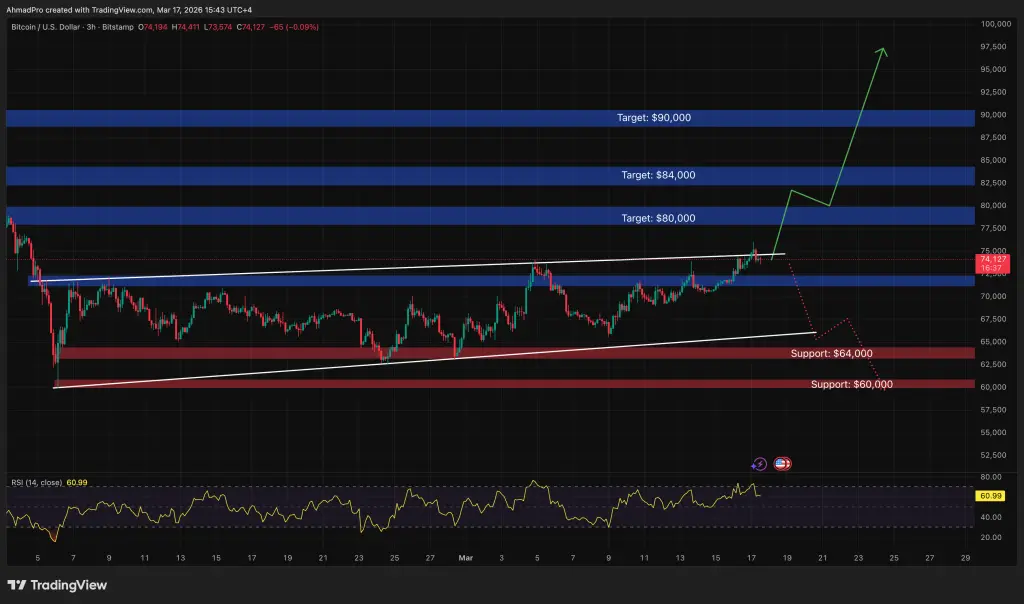
Technical indicators show that BTC previously briefly broke above the ascending wedge’s upper trendline to $75,000 but then retreated back into the channel—similar to the late February pattern, when after a pullback, it dropped to $64,000.
Technical analysts point out that $72,000 is the most critical support level: a break below could target $64,000; if that level is also lost, $60,000 becomes the final meaningful bottom support.
For bulls to reverse the trend, BTC needs to close above the upper trendline on the daily chart and sustain that move, with target levels at $80,000, $84,000, and $90,000. The market is currently facing this decision for the third time, with the outcome still uncertain.
FAQs
Why did Bitcoin decline today, and what are the main drivers?
The core drivers include: the death of Iran’s wartime leader Larijani increasing geopolitical uncertainty, the Strait of Hormuz blockade pushing oil prices above $100 per barrel, inflation pressures reducing the Fed’s rate cut expectations, and institutional capital continuing to exit high-risk assets.
What is the technical significance of $72,000 for Bitcoin?
Technical analysts see $72,000 as a key support/resistance level: holding this level suggests the current correction is healthy; breaking below points to a target of $64,000, with $60,000 as the ultimate support.
How does the Strait of Hormuz blockade affect Bitcoin prices?
The blockade pushes up oil prices, intensifies inflation pressures, and sharply reduces expectations for Fed rate cuts. In a high-inflation environment, tightening liquidity generally suppresses risk assets, including Bitcoin, making this macro backdrop a significant factor in the current downward pressure.
Disclaimer: The information on this page may come from third parties and does not represent the views or opinions of Gate. The content displayed on this page is for reference only and does not constitute any financial, investment, or legal advice. Gate does not guarantee the accuracy or completeness of the information and shall not be liable for any losses arising from the use of this information. Virtual asset investments carry high risks and are subject to significant price volatility. You may lose all of your invested principal. Please fully understand the relevant risks and make prudent decisions based on your own financial situation and risk tolerance. For details, please refer to
Disclaimer.


