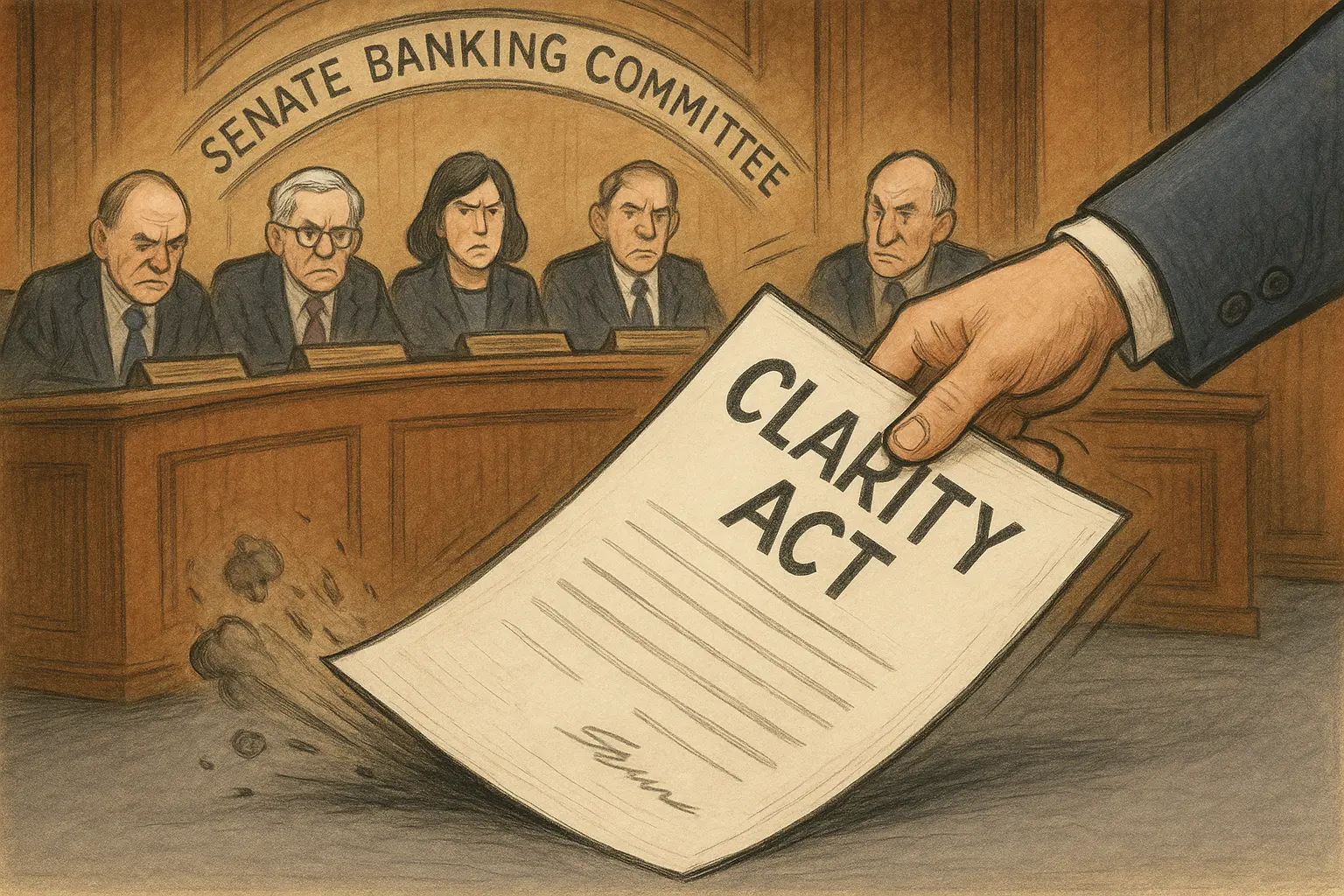
Senate Banking Committee Chair Tim Scott did not put the “CLARITY Act” on the Senate’s agenda for the week of April 20, 2026; the bill is currently not scheduled for consideration. Senator Tom Tillis is expected to release the final draft of the bill this week; the draft includes the latest compromise provisions regarding stablecoin yield issues. Coinbase and several banking groups still hold opposing positions on the yield limitations in the proposal.
Current Status of Agenda Exclusion: Latest Updates from Tim Scott and Tom Tillis
After the Senate Banking Committee completed its recess period, Chair Tim Scott did not place the “CLARITY Act” on the agenda for the week of April 20.
Senator Tom Tillis is expected to release the “CLARITY Act” final draft this week. The draft covers the latest revisions reached between lawmakers and various stakeholders. After the final draft is released, the bill still needs to go through the “Markup” process—where the committee formally reviews the bill’s contents and makes line-by-line changes—before it can move to the next legislative stage.
Stablecoin Yield Controversy: Compromise Terms in the Final Draft
According to related reports, the current draft of the “CLARITY Act” adopts the following framework for stablecoin yields:
Bans passive yields, including fixed interest forms such as stablecoin simple interest
Allows incentive yields linked to payment activity or platform engagement
With respect to the above provisions, after Coinbase raised concerns earlier, it has shifted to a supportive position on the bill. Multiple banking groups still oppose the yield limitation provisions in the bill. According to related reports, the two sides’ differences have not yet been resolved.
Remaining Legislative Steps for the “CLARITY Act”
Under the U.S. congressional legislative process, after the “CLARITY Act” is approved by the Senate Banking Committee’s markup, the following steps still need to be completed:
· Coordinate jurisdictional coverage with the Senate Agriculture Committee (crypto regulatory rules involve multiple committees)
· Obtain at least 60 votes in favor in a full Senate vote, requiring support from both parties
· Perform text comparison and coordination with the House version; only then can the bill be submitted for the President’s signature to become law
Frequently Asked Questions
Why was the “CLARITY Act” removed from the Senate agenda for the week of April 20?
According to related reports, Senate Banking Committee Chair Tim Scott did not put the “CLARITY Act” on the Senate’s agenda for the week of April 20, 2026. The report did not specify the specific reason; the bill is currently not on the committee’s near-term schedule.
What key provisions are included in the final draft Tom Tillis is expected to release?
According to related reports, the final draft Tom Tillis is expected to release this week will include a compromise proposal for stablecoin yields. It bans passive interest yields but allows incentive yields tied to payment activity or platform engagement.
What are Coinbase and banking groups’ current positions on the “CLARITY Act”?
According to related reports, after raising concerns earlier, Coinbase has shifted to a supportive position on the “CLARITY Act.” Multiple banking groups still oppose the stablecoin yield limitation provisions in the bill; the differences between the two sides have not yet been resolved.
Disclaimer: The information on this page may come from third parties and does not represent the views or opinions of Gate. The content displayed on this page is for reference only and does not constitute any financial, investment, or legal advice. Gate does not guarantee the accuracy or completeness of the information and shall not be liable for any losses arising from the use of this information. Virtual asset investments carry high risks and are subject to significant price volatility. You may lose all of your invested principal. Please fully understand the relevant risks and make prudent decisions based on your own financial situation and risk tolerance. For details, please refer to
Disclaimer.
Related Articles
JPMorgan: U.S. CLARITY Act Negotiations Near Completion, Crypto Regulatory Framework in Sight
JPMorgan's recent report indicates that negotiations on the U.S. CLARITY Act are close to finalization, with only 2-3 issues remaining. The act seeks to clarify regulations for digital assets but lacks a formal text and scheduled vote, leaving its future uncertain, especially if political shifts occur in 2026.
GateNews25m ago
Bank of England governor warns: Global stablecoin standards are lagging, calls for a unified regulatory framework
Bank of England Governor Andrew Bailey said at an IIF event that the effective functioning of stablecoins depends on users’ confidence in full redemption mechanisms, calling for the development of international standards. The United States has meanwhile released the GENIUS Act, requiring stablecoin issuers to meet compliance requirements. In South Korea, Circle’s CEO said there are no plans to launch a won-pegged stablecoin, and that the company is currently watching local legislative debates.
MarketWhisper2h ago
Cato Institute Recommends U.S. Eliminate Capital Gains Tax on Cryptocurrencies to Promote Monetary Competition
The Cato Institute urges the U.S. to abolish capital gains taxes on cryptocurrencies to simplify tax filing and enhance monetary competition. This move aims to encourage cryptocurrency use in transactions by lessening tax-related complexities.
GateNews2h ago
Senator Warren Presses Musk on X Money Risks, Citing Stablecoin Concerns and Regulatory Gaps
Senator Elizabeth Warren has asked Elon Musk for details on X Money, a payments feature for X, raising concerns about stablecoin risks, regulatory issues, financial stability, and data privacy, with a response due by April 21, 2026.
GateNews3h ago
South Korea’s Ministry of Economy and Finance announces a pilot for a “Blockchain Treasury,” launching in Sejong City in the fourth quarter
On April 16, the Ministry of Economy and Finance of South Korea announced that the “pilot project to use blockchain digital currency to execute treasury funds” has been selected as the regulatory sandbox program hosted by the National Affairs Coordination Office for 2026. According to the Ministry of Economy and Finance’s notice, the pilot program allows government agencies to use blockchain “deposit tokens” to execute part of their commercial promotion expenses, replacing the current government procurement card. The plan is to prioritize launching in Sejong City in the fourth quarter of 2026, and expand the scope afterward based on an assessment of the results.
MarketWhisper3h ago


