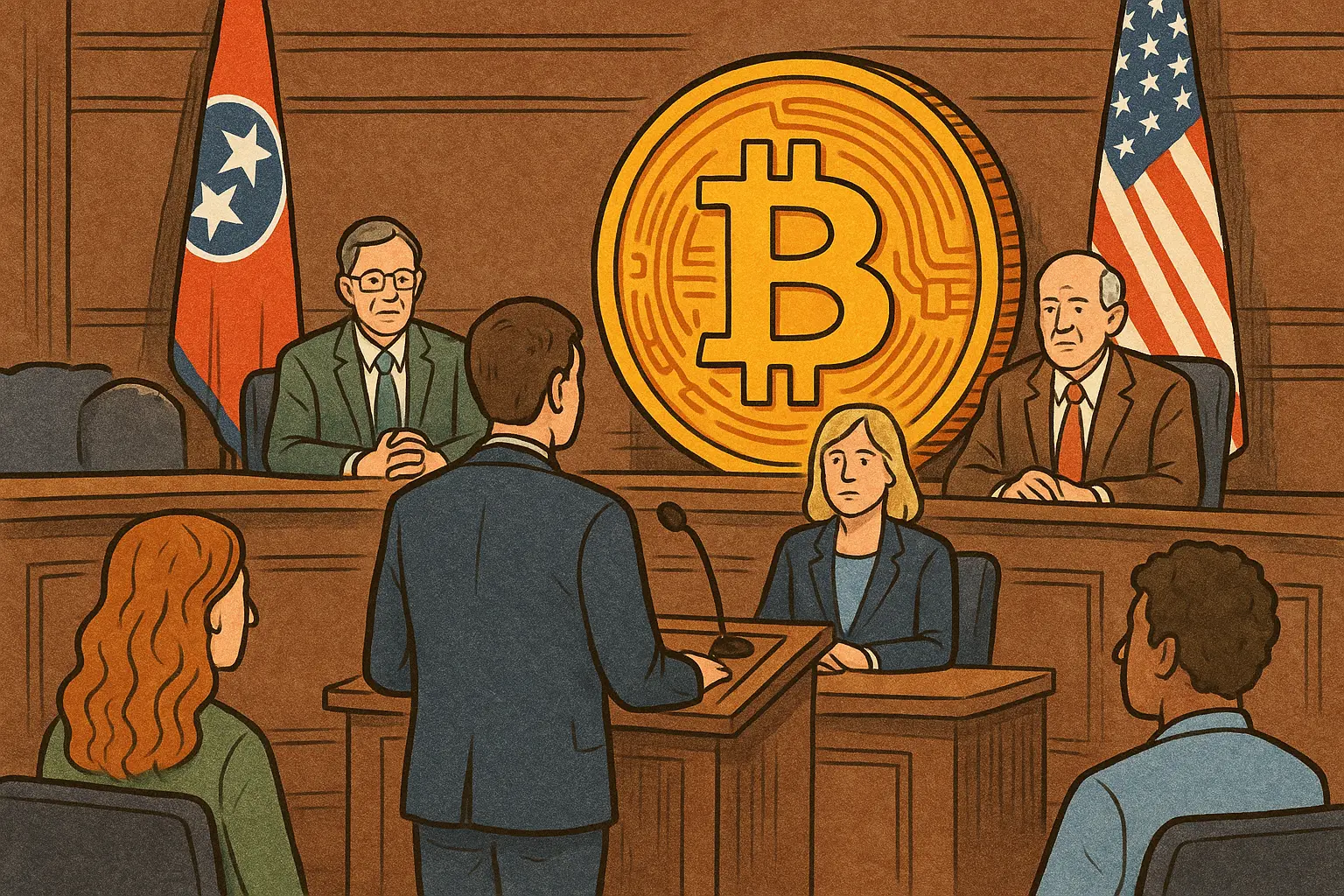
Tennessee’s “Strategic Bitcoin Reserve Act” (SB 2639) will be heard by the Senate Finance, Revenue and Appropriations Committee on April 21 (next Tuesday). The bill was introduced by Senator Kelly Roberts, has passed the Senate Business and Labor Committee, and now moves to the Finance Committee responsible for overseeing tax and spending measures. If it passes, the Tennessee State Treasurer may allocate up to 10% of eligible state funds to bitcoin (BTC).
Key Provisions of the Bill: Investment Cap, Annual Cadence, and Custody Standards
The bill sets out a complete compliance framework for a bitcoin allocation:
Summary of Key Provisions
Investment cap: No single investment may exceed 10% of the total eligible funds
Annual purchase limit: No more than 5% per fiscal year until reaching the cap
Passive appreciation exemption: When holdings increase due to market gains beyond the cap, there is no need for forced selling
Asset restrictions: Only bitcoin (BTC); investment in other cryptocurrencies or digital assets is explicitly prohibited
Custody methods: Hold directly, through an eligible custodian, or through a bitcoin-linked exchange-traded product (ETP)
Security standards: Private keys must be stored offline in cryptographic hardware located in at least two different locations; access must use encrypted channels and multi-party authorization
Transparency is also a core part of the bill’s design: the State Treasurer must publish a public report every two years, including the number of holdings, their USD value, trade summaries, and cryptographic proofs of on-chain balances encrypted in a way that allows independent third-party verification.
State-by-State Bitcoin Reserve Legislative Wave: Tennessee Joins the Race
The bill defines bitcoin as a “decentralized digital commodity with a fixed supply and global liquidity,” with the central legislative rationale being that inflation erodes the real purchasing power of state fiscal funds. Representative Jody Barrett, in a statement, likened bitcoin to gold and said it can serve as a tool to hedge against inflation.
Tennessee’s move is part of a broader wave of U.S. states exploring public-finance bitcoin policies. South Dakota, Kansas, Rhode Island, Florida, and others have already proposed or are pushing forward similar legislation that allows public funds to be allocated to bitcoin or digital-asset reserves.
Also in the News: Charles Schwab Opens Spot BTC and ETH Trading for Retail Traders
At the same time, Charles Schwab announced that its crypto platform, Schwab Crypto, will soon offer retail investors spot trading services for bitcoin (BTC) and ether (ETH). This further lowers the barrier for individual investors to participate in the spot crypto market, reflecting the ongoing increase in acceptance of crypto assets by mainstream financial institutions.
Frequently Asked Questions
Which stage of the legislative process is Tennessee’s Bitcoin reserve bill currently in?
Senate bill SB 2639 has passed the Business and Labor Committee and will be heard by the Finance Committee on April 21. The corresponding House bill, HB 1695, was withdrawn this week and is currently stalled, resulting in a clear divergence in progress between the two chambers. Whether the bill can pass both chambers within the current legislative session remains uncertain.
How does the bill define bitcoin custody safety standards?
The bill requires that a “secure custody solution” store private keys in cryptographic hardware in at least two different locations, using fully offline storage. Access to private keys must be carried out through encrypted channels and with multi-party authorization. The State Treasurer may choose from three methods: holding directly, using an eligible custodian, or using a bitcoin-linked ETP.
Why does the bill allow investment only in bitcoin rather than other crypto assets?
The bill explicitly defines bitcoin as a unique “decentralized digital commodity,” emphasizing its fixed supply (21 million coins) and global liquidity and arguing that these characteristics provide a basis for compliant entrusted investment. Limiting investments to bitcoin also reduces complexity at the regulatory and legal levels, creating a separation from controversies over the legal characteristics of other cryptocurrencies.
Disclaimer: The information on this page may come from third parties and does not represent the views or opinions of Gate. The content displayed on this page is for reference only and does not constitute any financial, investment, or legal advice. Gate does not guarantee the accuracy or completeness of the information and shall not be liable for any losses arising from the use of this information. Virtual asset investments carry high risks and are subject to significant price volatility. You may lose all of your invested principal. Please fully understand the relevant risks and make prudent decisions based on your own financial situation and risk tolerance. For details, please refer to
Disclaimer.
Related Articles
France's Finance Minister Calls for Expansion of Euro-Backed Stablecoins
French Finance Minister Roland Lescure advocates for euro-denominated stablecoins and urges banks to consider tokenized deposits, supporting the Qivalis alliance's plans for a euro-pegged stablecoin by 2026 to counter U.S. digital payment dominance. This signals a shift from previous French policies against private stablecoins.
GateNews22m ago
China to Strengthen Legislative Framework for AI, Digital Economy, and Blockchain
China plans to enhance its network legal system to address the needs of internet development, focusing on legislation for AI, digital economy, and other tech sectors. By December 2025, over 180 laws are expected, though current regulations still lag behind public expectations.
GateNews52m ago
Ukraine Willing to Hold Summit with Russia in Turkey, Zelensky, Putin, Erdogan, and Trump to Participate
Ukraine aims to host a leadership summit in Turkey involving Presidents Zelensky, Putin, Erdogan, and Trump to discuss peace efforts, as stated by Foreign Minister Andrii Sybiha.
GateNews1h ago
Grinex Exchange Halts All Trading After $15M Cyberattack on Wallet Systems
Grinex, a Kyrgyz crypto exchange, suspended trading after a cyberattack resulting in losses of around $15 million. The advanced nature of the attack points to organized or state-level involvement. Grinex has reported the incident to authorities and is assessing the damage.
GateNews2h ago
Ethereum Foundation Uncovers 100 North Korean Operatives Infiltrating Web3 Companies
The Ethereum Foundation's ETH Rangers Program revealed a major security threat from North Korean operatives infiltrating Web3 companies. The investigation uncovered about 100 operatives, flagged 53 projects, and recovered over $5.8 million. The foundation urges improved hiring processes and global cooperation for enhanced security.
GateNews4h ago


