
Florida Attorney General James Uthmeier announced on April 15 that the Florida Attorney General’s Cyber Fraud Enforcement Unit (CFEU) is working with the Marion County Sheriff’s Office to jointly recover $5.4 million from cryptocurrency fraudsters. The alleged scheme involved a cryptocurrency investment scam using a romantic relationship as a front, with victims across six counties in Florida and multiple areas in Massachusetts.
Allocation of Recovered Funds and Distribution of Victims
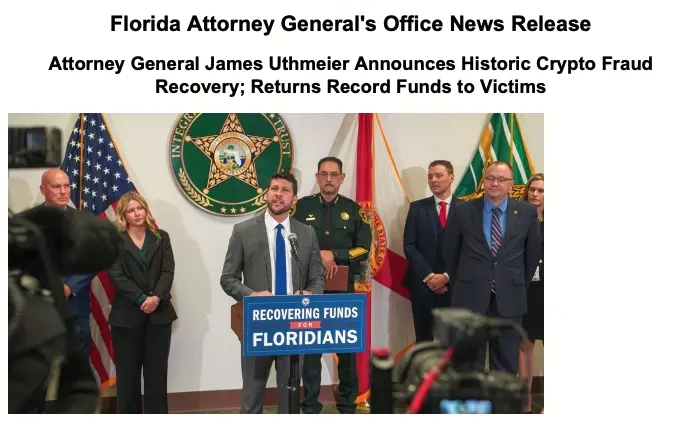 (Source: My Florida Legal)
According to a statement from the Florida Attorney General’s Office, in this $5.4 million recovery operation, $700,000 has been returned to Florida victims, $1,300,000 has been returned to Massachusetts victims, and the remaining funds will continue to support CFEU’s day-to-day enforcement operations.
One victim in Marion County suffered losses exceeding $450,000 on their own. Marion County Sheriff Billy Woods said in the statement that the Marion County Sheriff’s Office’s assistance in this case represents the largest recovery operation to date, with a total recovered amount of $6,500,000.
Uthmeier said that his office will prioritize recovering funds and returning them to victims, and that CFEU is setting an industry benchmark in the field of recovering crypto assets.
CFEU Enforcement Record and Pending Asset Size
According to a posting by the Florida Attorney General’s Office, in the first quarter of 2026, CFEU recovered $3,300,000, accounting for 45% of the agency’s total historical recovery amount of $7,200,000 since its establishment 2.5 years ago.
The announcement also disclosed that an additional $12,600,000 worth of crypto assets has been frozen, and related cases remain in ongoing judicial proceedings.
Massachusetts Enforcement Action and the Bitcoin Depot Enforcement Case
In a statement, Massachusetts Attorney General Campbell said his office has received hundreds of complaints related to cryptocurrency, shut down more than 60 scam websites, filed more than 30 lawsuits, and recovered over $6,000,000 for victims.
Campbell also referenced the enforcement action taken earlier this year against cryptocurrency ATM operator Bitcoin Depot. According to the position of the Massachusetts Attorney General’s Office, Bitcoin Depot was accused of failing to take adequate consumer protection measures despite knowing that large volumes of fraudulent transactions were being carried out through its machines.
As for Bitcoin Depot itself, on March 23 the company discovered an unauthorized access incident and, as required, filed an 8-K report with the U.S. Securities and Exchange Commission (SEC), disclosing losses of 50.9 bitcoin, which at the time was worth approximately $3,600,000. Blockchain investigator ZachXBT wrote on the X platform that the actual transfer of funds occurred on March 20, involving 19 suspicious wallet addresses. The transferred funds were tracked to KuCoin deposit addresses, totaling approximately 54 bitcoin, or about $3,900,000.
Frequently Asked Questions
Which enforcement agencies were involved in this crypto scam recovery action?
This operation was led by the Florida Attorney General’s Cyber Fraud Enforcement Unit (CFEU), carried out jointly with the Marion County Sheriff’s Office and the Massachusetts Attorney General’s Office, for a total recovered amount of $5.4 million.
How much crypto has CFEU recovered since its establishment?
According to a Florida Attorney General’s Office announcement, since CFEU was established, it has recovered $7,200,000 in total over the past 2.5 years, and an additional $12,600,000 in frozen assets remains under litigation.
What is the connection between Bitcoin Depot’s security incident and this scam case?
Bitcoin Depot is the enforcement target separately mentioned by Massachusetts Attorney General Campbell and was accused of not adequately protecting consumers from being harmed by fraudulent transactions. Bitcoin Depot also disclosed, pursuant to SEC requirements, that it itself suffered an unauthorized access incident and incurred losses of about 50.9 bitcoin. The two incidents are separate cases.
Disclaimer: The information on this page may come from third parties and does not represent the views or opinions of Gate. The content displayed on this page is for reference only and does not constitute any financial, investment, or legal advice. Gate does not guarantee the accuracy or completeness of the information and shall not be liable for any losses arising from the use of this information. Virtual asset investments carry high risks and are subject to significant price volatility. You may lose all of your invested principal. Please fully understand the relevant risks and make prudent decisions based on your own financial situation and risk tolerance. For details, please refer to
Disclaimer.


