
Crypto analyst Andrey Sergeenkov’s weekly data release shows that among approximately 2.5 million trade wallet addresses on Polymarket, only 0.015% of traders can maintain stable monthly income exceeding $5,000 for four consecutive months. Although nearly 1% of traders reached the $5,000 monthly income threshold in a single month, only 0.1% managed to hit that mark again the following month.
Data Interpretation: Each Monthly Filter Sharpens the Funnel for Profitable Traders
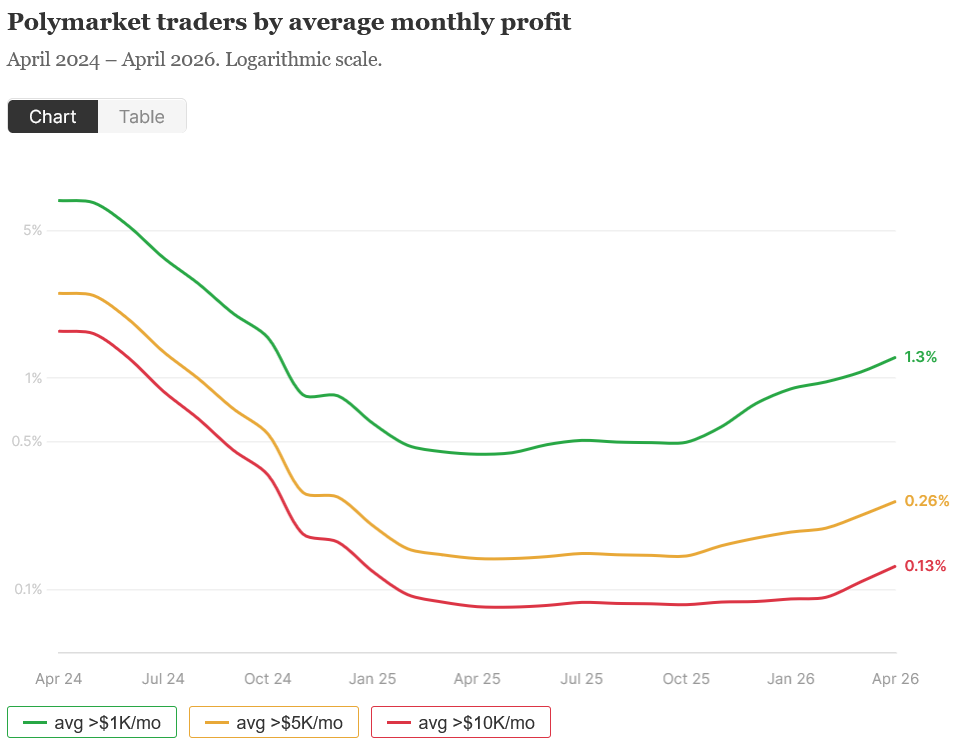 (Source: Andrey Sergeenkov)
Sergeenkov’s data presents a clear funnel structure: as you move into the next time period, the proportion of traders who can sustain target profitability shrinks dramatically.
Using an average U.S. monthly salary of about $5,220 as the benchmark, the number of traders who can consistently reach this income level on Polymarket across a data span of nearly two years is almost just statistical noise. This means that the plan to quit and shift from full-time work to prediction markets for the sake of replacing one’s income is, for the vast majority of people, a high-risk irrational decision.
Sergeenkov notes: “Most traders come in, trade for a little while, and then leave.” — Among 6,600 wallet addresses with average monthly profits exceeding $5,000, only 172 remained actively active for more than a year, accounting for 2.6%.
Who Are the 0.033%? The Real Composition of 840 High-Profit Wallets
Out of about 2.5 million wallets, there are only 840 with cumulative profits exceeding $100k, accounting for 0.033%.
Key Factors to Consider When Understanding These 840 High-Profit Wallets
Institutional accounts in the mix: Trading accounts from hedge funds and other professional financial institutions are also active on Polymarket and are included among these 840 high-profit wallets; the actual share of retail users may be lower
Misleading anecdotal reports: After financial risk analyst Logan Sudis quit, his single-month profit of $100k in December was widely publicized, but it is statistically an extreme outlier
Selection bias on social media: The former Messari analyst “Tulip King” wrote on X that “Polymarket is the easiest place in the crypto space to make six figures,” but such high-profile statements naturally attract more shares, while most failed cases stay silent
Methodological limitations: Sergeenkov’s analysis counts only realized P&L; unrealized gains/losses that were not held until settlement are outside the scope of the statistics
FAQ
Why Is Stable Profit So Difficult on Polymarket?
The essence of prediction markets is a zero-sum game—every profit must have a corresponding losing counterparty. The hedge funds and professional institutions active on Polymarket have stronger information-gathering capabilities, more mature pricing models, and much larger capital bases. Retail traders, when competing with these participants, are at a structural information disadvantage. “Users with insufficient experience often don’t trade very successfully” is Sergeenkov’s direct assessment.
Among the 840 high-profit wallets, how many are retail users?
At present, there is no precise data indicating the specific proportion of retail users versus institutions among the 840 wallets with cumulative profits exceeding $100k. Sergeenkov explicitly points out that trading accounts from hedge funds and other professional institutions are also included in this dataset, which means the real number of successful retail-user cases may be far fewer than 840.
Does Polymarket’s data reflect the shared problems common to all prediction markets?
Sergeenkov’s analysis applies only to Polymarket. The data covers April 2024 through April 1, 2026. As a relatively new crypto application scenario, prediction markets lack long-term cross-platform systematic research, but their zero-sum structural characteristics are generally present across platforms. The conclusion that “stable profitability is extremely difficult” has fairly broad applicability.
Disclaimer: The information on this page may come from third parties and does not represent the views or opinions of Gate. The content displayed on this page is for reference only and does not constitute any financial, investment, or legal advice. Gate does not guarantee the accuracy or completeness of the information and shall not be liable for any losses arising from the use of this information. Virtual asset investments carry high risks and are subject to significant price volatility. You may lose all of your invested principal. Please fully understand the relevant risks and make prudent decisions based on your own financial situation and risk tolerance. For details, please refer to
Disclaimer.


