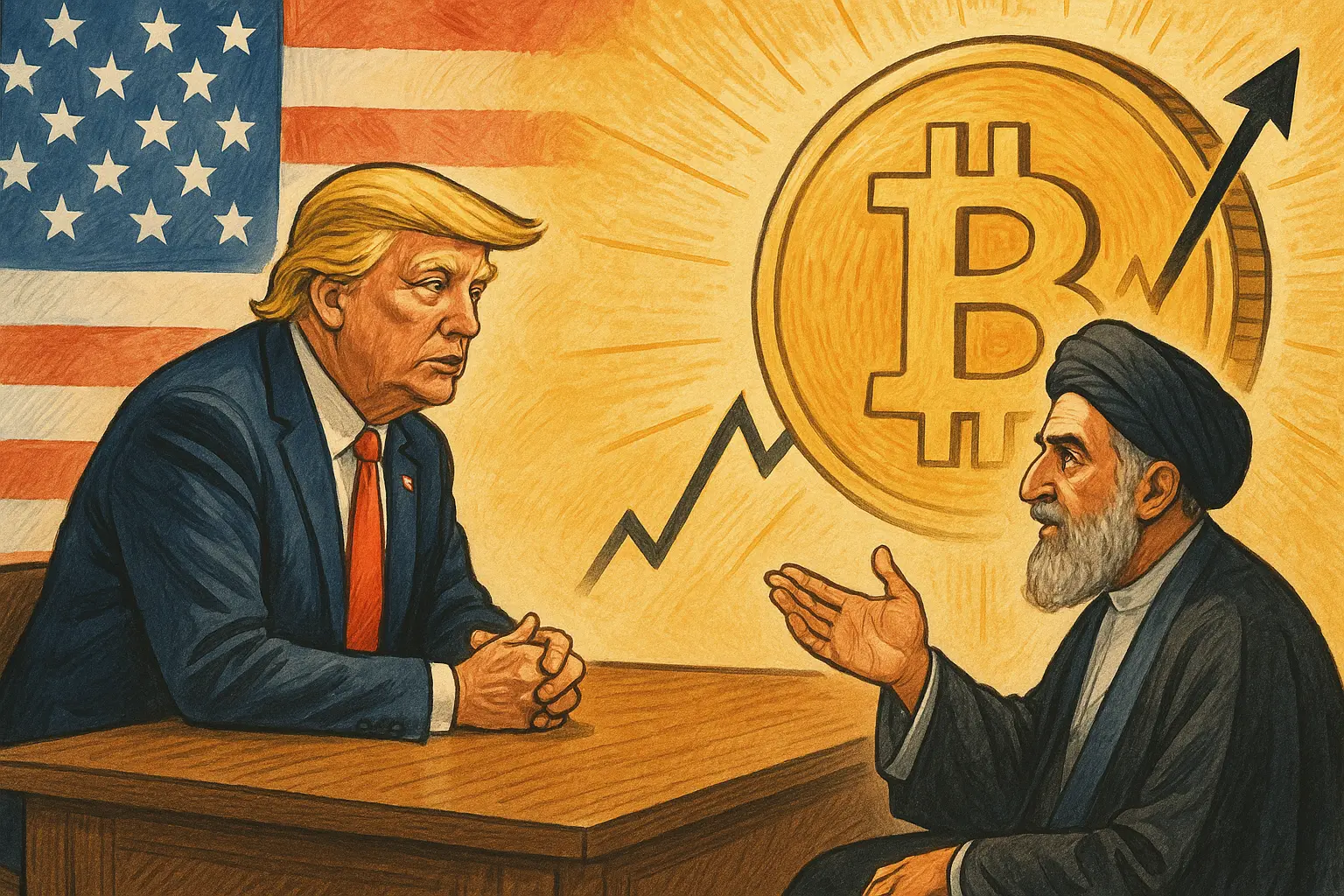
After experiencing dramatic swings over the weekend sparked by heightened U.S.-Iran tensions, Bitcoin returned around $76,000 on April 21. U.S. President Trump said that an agreement currently being negotiated between the U.S. and Iran would be “better than” the 2015 Joint Comprehensive Plan of Action (JCPOA), and that he is willing to meet directly with Iran’s leadership—comments like that briefly boosted market sentiment. However, Brent crude oil continued to fluctuate around $90 per barrel, keeping cautious sentiment in check and weighing on Bitcoin.
U.S.-Iran war developments: Trump is willing to meet directly with Iran’s top officials
In an interview with the New York Post on April 20, Trump said that if negotiations make progress, he himself would be willing to meet directly with Iran’s top leadership; Vice President Vance (JD Vance) set off for Pakistan later that day to restart peace talks.
On the diplomatic front, Mohamed Amersi, who has close ties with Iran’s negotiating representatives, said at the Antalya Diplomatic Forum in Turkey that Iran wants to reach a memorandum of understanding (MOU) as early as this week in order to extend the ceasefire through Wednesday and lay the groundwork for subsequent detailed agreement talks over the next two to three months. However, Amersi also noted that Iran believes its “ability to withstand pain” is far greater than that of the United States, and that it will not give up its missile program—meaning there is still significant uncertainty in the diplomatic outlook.
Trump also told Bloomberg that if the talks cannot produce an agreement, it is “almost impossible” for the ceasefire to be extended again.
Gold and oil: Multi-asset markets roil amid diplomatic signals
Spot gold swung sharply on Monday. In early Asian trading, it briefly touched a low of $4,736.87 per ounce. It then rebounded strongly on Trump’s optimistic remarks, and ultimately closed at $4,820.21, with the intraday decline narrowing to 0.23%. U.S. 10-year Treasury yields rose by about 2 basis points to 4.266%, increasing the opportunity cost of holding non-yielding gold. For oil, Brent crude faced downward pressure on risk assets—including Bitcoin—because rising tensions related to the Strait of Hormuz intensified worries about inflation.
Bitcoin technicals: Holding $76,000, while $79,000 is resistance
After Bitcoin earlier tested $78,000 without success, it pulled back, falling to around $75,000 over the weekend. On April 20, as diplomatic signals improved, it returned and regained $76,000. Analysts said: the resistance zone is above $79,000, while support sits between $73,000 and $75,000. With dense open interest and options positions around $75,000, Bitcoin could continue to experience sharp two-way volatility in the near term. A prior break above $76,000 triggered a large number of forced short liquidations, but the subsequent pullback then sparked a new round of liquidations—showing that bullish and bearish forces remain locked in a highly tight standoff.
Frequently Asked Questions
Why is Bitcoin so sensitive to the U.S.-Iran conflict?
In the current macro environment, Bitcoin is traded as a “risk asset sensitive to macro uncertainty,” rather than purely as a safe-haven asset. Rising oil prices intensify inflation expectations, affecting the market’s expectations for Federal Reserve monetary policy, which in turn suppresses demand for risk assets. Geopolitical tensions also prompt traders to reduce their risk tolerance and cut back exposure to high-volatility assets.
What does the U.S.-Iran ceasefire agreement expiring on Wednesday mean for Bitcoin?
If, after the ceasefire expires, no extension or diplomatic framework is reached, a renewed escalation of tensions could push up oil prices and trigger a market shift toward safe-haven sentiment, putting downward pressure on Bitcoin. Conversely, if an MOU—or a more explicit diplomatic roadmap—is reached, it could ease the geopolitical risk premium and support Bitcoin in launching another attempt toward the $79,000 resistance zone.
Where are Bitcoin’s key technical support and resistance levels right now?
The main resistance lies in the area above $79,000. $76,000 is the near-term bull-bear dividing line that has just held. The $73,000 to $75,000 range is an important support zone. If price breaks below this support, market sentiment could deteriorate significantly, increasing the risk of cascading liquidations in the derivatives market.
Disclaimer: The information on this page may come from third parties and does not represent the views or opinions of Gate. The content displayed on this page is for reference only and does not constitute any financial, investment, or legal advice. Gate does not guarantee the accuracy or completeness of the information and shall not be liable for any losses arising from the use of this information. Virtual asset investments carry high risks and are subject to significant price volatility. You may lose all of your invested principal. Please fully understand the relevant risks and make prudent decisions based on your own financial situation and risk tolerance. For details, please refer to
Disclaimer.
Related Articles
DefiLlama founder rejects claims Aave TVL is inflated by looping trades
DefiLlama founder 0xngmi says Aave's TVL isn't being "pumped" by circular borrowing, arguing the platform's metrics already strip out borrowed assets and loops.
Summary
DefiLlama's 0xngmi says Aave's TVL already strips out borrowed assets and loops.
The founder argues circular lending and
Cryptonews4m ago
Liquid Capital Founder JackYi: Market in Rally Phase, Major Pullback Expected
JackYi, founder of Liquid Capital, asserts the market is in a rally phase but anticipates a pullback due to potential triggers like declining U.S. equities and inflation data. He advises investors to focus on risk management and capital preservation.
GateNews2h ago
Gate Daily Report (April 21): Lido discloses the EarnETH exposure protection mechanism; DeFi losses exceed $600 million over the past three weeks
Bitcoin (BTC) sees a V-shaped rebound. As of April 21, it is temporarily around $76,028. U.S. President Trump says he is willing to hold direct talks with Iran’s top leadership. Lido said that the EarnETH treasury holds an exposure of about $21.6 million in rsETH, and the loss-protection mechanism is ready. DeFi has lost more than $600 million over the past three weeks, and the Kelp DAO incident has dragged DeFi TVL down to a one-year low.
MarketWhisper2h ago
Deutsche Bank Survey: U.S. Crypto Retail Participation Rate Rebounds to 12% in March
Deutsche Bank released a research report on April 20, citing db DataInsights survey data covering 3,400 consumers in the United States, the European Union, and the United Kingdom. The report shows that the retail adoption rate of cryptocurrencies in the U.S. rebounded to 12% in March, returning to the level of July 2025. The report also indicates that 70% of respondents who hold cryptocurrencies said they hold Bitcoin, the highest share among all types of crypto assets.
MarketWhisper3h ago
Any prospects for U.S.-Iran talks? Bitcoin rebounds to 75K as MicroStrategy and ETF funds continue to pour in
The U.S.–Iran ceasefire agreement expires on Wednesday, and attention is focused on whether the two sides can resume negotiations. U.S. stocks fell amid heightened tensions, while bitcoin rebounded to $75K, driven mainly by institutional capital and ETF inflows, with MicroStrategy becoming the world’s largest bitcoin-holding institution.
ChainNewsAbmedia4h ago
Crypto Fund Inflows Hit $1.4B Last Week; Solana Trades Near $85.85 With $300 Upside Potential
Digital asset investment products saw $1.4 billion in inflows, driven by eased geopolitical tensions and a Bitcoin surge above $76,000. Bitcoin led with $1.116 billion in inflows, while Ethereum attracted $328 million. Solana showed resilience despite minor outflows, with analysts predicting potential gains if key resistance levels are surpassed.
GateNews7h ago


