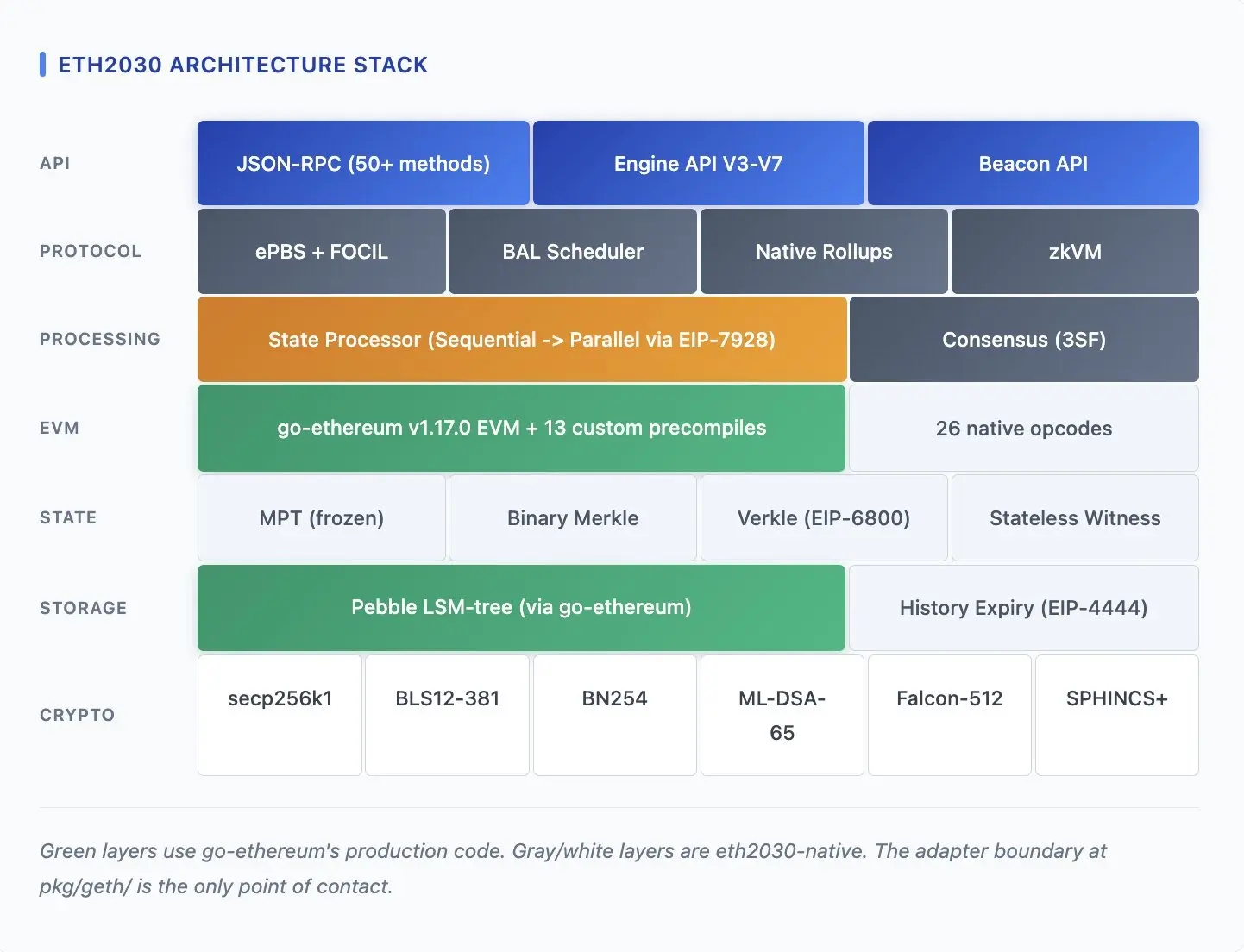
On March 2nd, Vitalik Buterin recently stated that artificial intelligence is significantly improving development efficiency. An experiment using AI to create a prototype of the Ethereum 2030 roadmap shows that the pace of core upgrades for Ethereum may accelerate far beyond previous expectations. This experiment originated from a bet between a developer and Buterin in February this year, attempting to leverage AI to quickly produce a reference implementation of Ethereum’s future roadmap.
Buterin posted on X that the developer completed the entire Ethereum 2030 technical roadmap’s “Vibe coding” in just a few weeks, which was impressive. He believes that as AI coding capabilities continue to improve, developers will achieve higher efficiency in protocol development, testing, and functionality verification, potentially speeding up Ethereum’s core upgrade process.
The so-called “Vibe coding” refers to automatically generating application code through AI models, where developers only need to provide design goals or logical descriptions to quickly build software. As AI programming tools rapidly develop, this approach is gaining attention in the blockchain development community and is seen as an important auxiliary tool for future smart contract development and blockchain infrastructure.
However, Buterin also warns that AI-generated code still carries significant risks. He points out that because AI can generate large amounts of code in a very short time, it is likely to contain serious vulnerabilities or sometimes only produce stub code that does not fully implement features. Therefore, if development teams overly rely on AI speed and neglect security audits, it could pose hidden dangers to blockchain systems.
Buterin emphasizes that a more reasonable approach is to combine the efficiency brought by AI with security processes, such as using AI to generate more test cases, performing formal verification of key functions, and developing multiple versions for cross-checking. He believes that the long-held goal of “bug-free code,” which has been considered difficult to achieve, may become a reality gradually with AI-assisted development and ultimately become a standard in the industry.
 (Source: YQ)
Meanwhile, Buterin continues to pay close attention to the Ethereum Foundation’s recent “Strawmap” technical roadmap, which outlines the protocol upgrade directions for the next four years, including scalability enhancements, account abstraction, and resistance to quantum attacks. He revealed that the account abstraction feature is expected to be gradually implemented within a year, which is considered an important step toward improving Ethereum’s user experience and the capabilities of smart wallets.
Disclaimer: The information on this page may come from third parties and does not represent the views or opinions of Gate. The content displayed on this page is for reference only and does not constitute any financial, investment, or legal advice. Gate does not guarantee the accuracy or completeness of the information and shall not be liable for any losses arising from the use of this information. Virtual asset investments carry high risks and are subject to significant price volatility. You may lose all of your invested principal. Please fully understand the relevant risks and make prudent decisions based on your own financial situation and risk tolerance. For details, please refer to
Disclaimer.
Related Articles
Bitcoin ETF Sees Daily Outflow of $16.03M While Ethereum and Solana ETFs Record Gains on April 27
Gate News message, according to the April 27 update, Bitcoin ETF recorded a daily net outflow of 209 BTC ($16.03 million), while maintaining a weekly net inflow of 9,987 BTC ($767.27 million). Ethereum ETF showed a daily net inflow of 24 ETH ($56,000) and a weekly net inflow of 41,013 ETH ($93.35 mi
GateNews2h ago
Consensys, Joseph Lubin Contribute 30,000 ETH to DeFi United
Consensys and Ethereum co-founder Joseph Lubin have confirmed they will contribute 30,000 ETH to DeFi United, a coordinated relief effort addressing losses from the Kelp DAO exploit. According to Aave's Monday announcement, this represents one of the largest offerings in the ongoing initiative, whic
CryptoFrontier3h ago
Coinshares: $1.2B Crypto Inflow, Bitcoin Leads Fund Flows
Cryptocurrency investment products received $1.2 billion in inflows last week, marking the fourth consecutive positive week, according to a Coinshares report. Bitcoin surged above $79,000 before Asian market opening, though the move was short-lived, with BTC subsequently dropping to around $77,600.
CryptoFrontier4h ago
Ethereum Outperforms S&P 500 by 1,696 Basis Points Since U.S.-Iran Conflict, Says Tom Lee
Gate News message, April 27 — Tom Lee, chairman of Bitmine, stated that Ethereum has outperformed the S&P 500 index (U.S. benchmark equity index) by 1,696 basis points since the U.S.-Iran conflict, making it the best-performing single asset globally aside from crude oil. According to Lee, ETH has de
GateNews4h ago
Bitmine increased its holdings by more than 100,000 ETH last week, and its total holdings exceeded 5 million ETH units/coins.
Bitmine’s total ETH holdings have surpassed 5 million coins, accounting for 4.21% of the supply. Last week, it increased its holdings by more than 100,000 coins. This article analyzes the cadence of institutional holdings, the impact of on-chain concentration, and market outlook scenarios.
GateInstantTrends4h ago
ETH Liquidation Levels: $1.291B Short Squeeze at $2,398, $392M Long Squeeze at $2,177
Gate News message, April 27 — According to Coinglass data, if Ethereum (ETH) breaks above $2,398, cumulative short liquidations across major centralized exchanges would reach $1.291 billion.
Conversely, if ETH falls below $2,177, cumulative long liquidations across major CEXs would reach $392 milli
GateNews4h ago


