 Trusted Editorial content, reviewed by leading industry experts and seasoned editors. Ad Disclosure
Jameson Lopp is escalating his criticism of BIP-110, arguing the proposal could trigger a disruptive Bitcoin chain split while failing to stop the behavior it is meant to curb. In a Feb. 23 post, Lopp frames the plan as a consensus-layer response to a policy and cultural dispute around transaction “spam,” with risks that extend well beyond mempool debates.
Trusted Editorial content, reviewed by leading industry experts and seasoned editors. Ad Disclosure
Jameson Lopp is escalating his criticism of BIP-110, arguing the proposal could trigger a disruptive Bitcoin chain split while failing to stop the behavior it is meant to curb. In a Feb. 23 post, Lopp frames the plan as a consensus-layer response to a policy and cultural dispute around transaction “spam,” with risks that extend well beyond mempool debates.
BIP-110 is pitched as a soft fork led by Luke Dashjr that would temporarily restrict arbitrary data in transactions. Lopp summarizes it as adding seven new transaction-validity restrictions, including limits on where data can be placed and constraints on certain script behavior, but says the tradeoffs are far more severe than supporters admit. He calls the proposal “reckless and doomed to fail,” setting the tone for a post that is less a technical explainer than a warning about governance and coordination risk.
Why Lopp Thinks The Activation Path Is Dangerous For Bitcoin
The core of Lopp’s argument is not just what BIP-110 changes, but how it tries to activate. He points to the proposal’s 55% miner-signaling threshold for a user-activated soft fork and says that low bar materially increases the probability of two competing chains if the ecosystem is not aligned.
Related Reading: Bitcoin Needs Only 2 Steps To Become Quantum-Resistant, Core Dev SaysHe also stresses that BIP-110 nodes would reject non-compliant blocks outright, which raises coordination risk compared with soft forks that old nodes can continue to follow without enforcement conflicts.
Lopp is especially pointed on the mandatory activation posture at block height 961,632. In one of the sharpest passages, he writes: “This is not a neutral, low-drama deployment posture. It’s dogmatic bullying. […] you cannot pretend it’s low-risk.” He ties that warning to a broader point: even if one views UASF tactics as legitimate, the proposal’s design increases the odds of a messy failure mode if miners, exchanges, wallets, and infrastructure providers do not converge in time.
He also pushes back on comparisons to 2017, noting that the UASF many people cite in the SegWit era never actually had to run to the edge because SegWit activated via miner signaling instead. That distinction matters in Lopp’s framing, because BIP-110 proponents are, in his view, leaning on a historical precedent that did not test the exact scenario they now describe as manageable.
Related Reading: Has Wall Street Co-Opted Bitcoin? Bloomberg Expert Sparks Heated DebateAnother major section of Lopp’s post targets the claim that BIP-110 has meaningful grassroots momentum. He argues that raw node counts (roughly 20% run Knots) are a weak proxy for consensus because signaling is cheap, node operation can be low-cost, and Tor addresses are “effectively zero” cost to create at scale. He publishes a breakdown of reachable nodes and highlights the higher Tor-to-IPv4 ratio among Knots and BIP-110 signaling nodes as a reason to treat node-count narratives cautiously.
On mining support, Lopp says the gap is more straightforward. At the time of publication, he writes miner signaling was “precisely […] zero,” and he cites public opposition from F2Pool while arguing miners have limited incentive to back a proposal that could reduce fee revenue. That point reinforces his broader thesis that BIP-110 supporters are overestimating social signaling and underestimating the role of economically significant actors in Bitcoin upgrade politics.
Lopp’s post ultimately reads as a warning that the immediate issue is not simply whether BIP-110 activates, but what the campaign reveals about where Bitcoin’s internal dispute over neutrality, censorship resistance, and block-space usage is heading. Even a failed fork push, in his framing, can still impose real costs by forcing operators and businesses to plan around low-probability but high-impact coordination failure.
At press time, Bitcoin traded at $62,791.
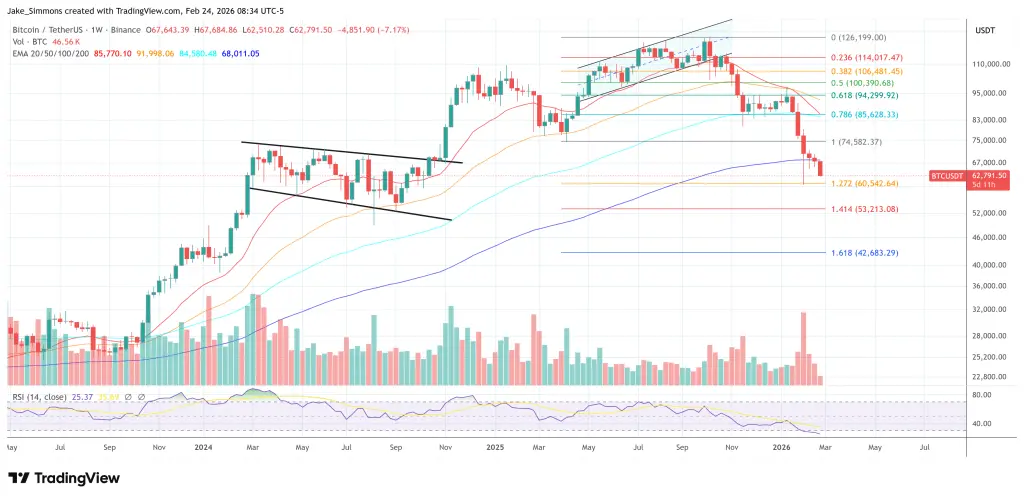 Bitcoin falls below $63,000, 1-week chart | Source: BTCUSDT on TradingView.comFeatured image created with DALL.E, chart from TradingView.com
![]() Editorial Process for bitcoinist is centered on delivering thoroughly researched, accurate, and unbiased content. We uphold strict sourcing standards, and each page undergoes diligent review by our team of top technology experts and seasoned editors. This process ensures the integrity, relevance, and value of our content for our readers.
Editorial Process for bitcoinist is centered on delivering thoroughly researched, accurate, and unbiased content. We uphold strict sourcing standards, and each page undergoes diligent review by our team of top technology experts and seasoned editors. This process ensures the integrity, relevance, and value of our content for our readers.
Disclaimer: The information on this page may come from third parties and does not represent the views or opinions of Gate. The content displayed on this page is for reference only and does not constitute any financial, investment, or legal advice. Gate does not guarantee the accuracy or completeness of the information and shall not be liable for any losses arising from the use of this information. Virtual asset investments carry high risks and are subject to significant price volatility. You may lose all of your invested principal. Please fully understand the relevant risks and make prudent decisions based on your own financial situation and risk tolerance. For details, please refer to
Disclaimer.
Related Articles
Price Predictions 3/6: BTC,ETH,BNB,XRP,SOL,DOGE,ADA,BCH,HYPE,XMR
Bitcoin (CRYPTO: BTC) faced a renewed test after a brief relief rally, sliding back below the $68,500 mark as sellers reasserted control. The move comes after the asset briefly flirted with the $74,000 threshold, a level that previously functioned as a ceiling during the latest ascent. Traders now e
CryptoBreaking23m ago
Little Robert Kennedy confirms run for U.S. President in 2028, holding at least $1 million worth of Bitcoin
Gate News Announcement: On March 8, Little Robert Kennedy confirmed his intention to run for U.S. President in 2028. Public information shows that he holds at least $1 million worth of Bitcoin and does not plan to divest this asset. Little Robert Kennedy publicly stated that he is a loyal supporter of Bitcoin, believing that decentralized, capped supply, neutral currencies, and hard assets like gold and silver can stabilize the dollar and prevent currency devaluation.
GateNews32m ago
Bitcoin experiences significant fluctuations: Ceasefire expectations and oil prices shape crypto market sentiment
The Kobeissi Letter news bulletin has just pointed out an important signal on the geopolitical chessboard. Recently, U.S. President Donald Trump posted on Truth Social that Washington demands Iran to "unconditionally surrender," a tough statement implying that any ceasefire agreement could still be at risk.
TapChiBitcoin51m ago
Willy Woo: BTC's early decline was too rapid, and it is now creating conditions for a rebound to $85,000.
On March 8th, analyst Willy Woo pointed out that Bitcoin faced resistance near $75,000, but since mid-February, capital flows have been recovering, and market sentiment may shift toward risk appetite. Although there is a short-term rebound opportunity, in the long term, Bitcoin remains in the mid-stage of a bear market and may experience sideways consolidation and test resistance levels.
GateNews1h ago
Strategy: Purchased 48,000 BTC in the first two months of 2026, investing $4.3 billion
Bitcoin Treasury Company Strategy Director Chaitanya Jain revealed that in the first two months of 2026, approximately $4.3 billion was invested to purchase 48,000 Bitcoins, far exceeding the $300 million spent in all of 2022. Jain stated that this large-scale institutional buying will change the structure of the Bitcoin market.
GateNews1h ago
A newly created wallet deposits 2 million USDC into Hyperliquid to open short positions on BTC and ETH.
Gate News Report, March 8th: According to Onchain Lens monitoring, a newly created wallet deposited 2 million USDC into Hyperliquid, opened a 5x leveraged BTC short position and a 20x leveraged ETH short position, with the current position value approximately equivalent to 10 million USD.
GateNews1h ago


