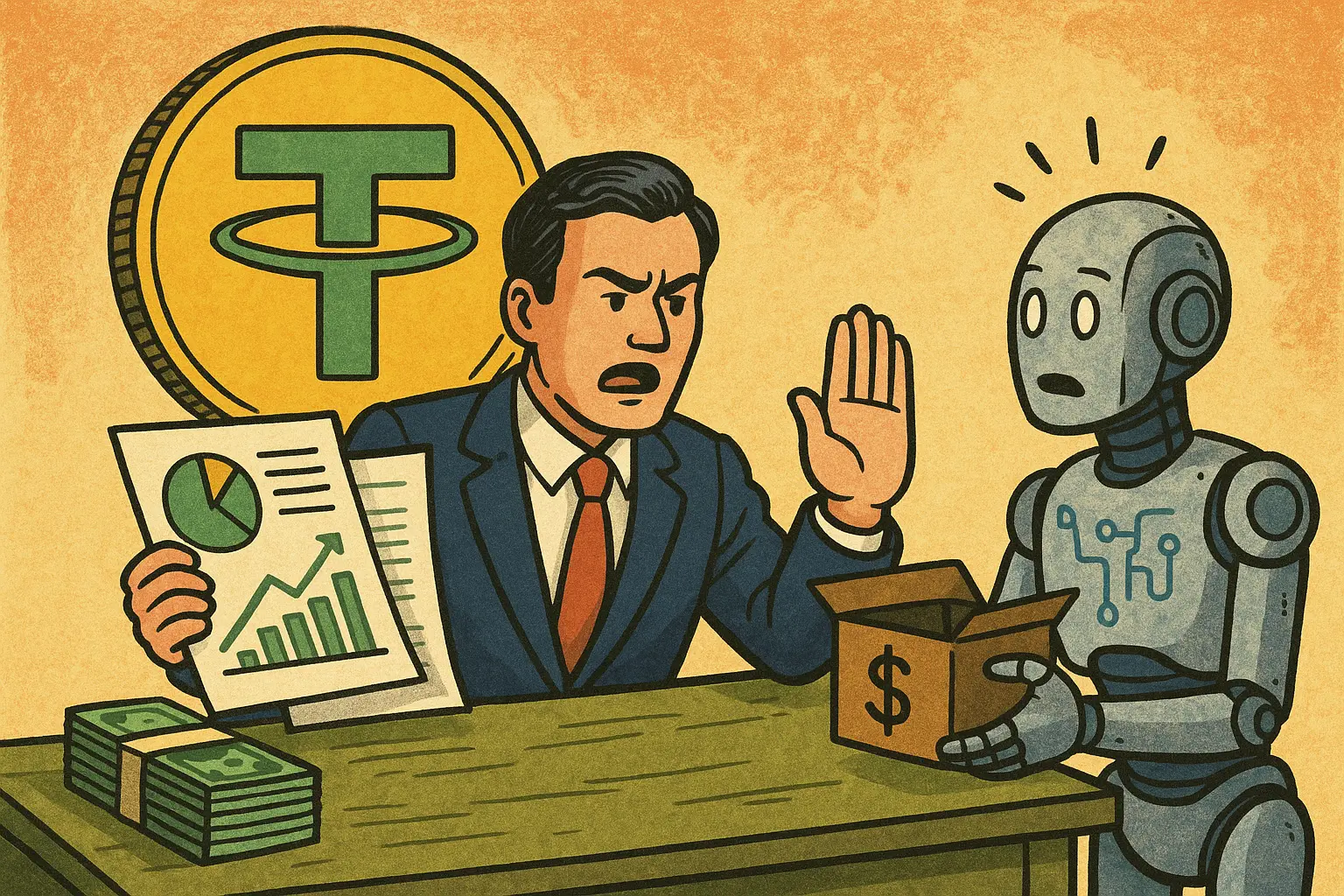
Tether CEO clarifies that the 20 billion fundraising is a misunderstanding; it is only an extreme scenario upper limit, not an actual target. Compared to AI companies with losses and a valuation of 800 billion, Tether earns over 10 billion annually, supporting a 500 billion valuation. U.S. Treasury holdings amount to 141.6 billion, making it the 18th largest holder globally, surpassing Germany and Saudi Arabia. Tether has launched the compliant stablecoin USAT, targeting the U.S. market, and has hired Bo Hines as CEO to compete with Circle.
The Rumor of 20 Billion Fundraising: A Case of Mistaken Identity
Paolo Ardoino, CEO of the leading stablecoin Tether, recently responded positively to circulating rumors of a massive fundraising. According to a previous report by the Financial Times, Tether had planned to seek up to 15 to 20 billion dollars in funding at a valuation of 500 billion dollars. Ardoino clarified in an interview that the 20 billion figure is not the company’s fundraising goal but an exaggerated “misunderstanding” by outsiders.
He explained that this amount is merely the “maximum upper limit” discussed under various extreme hypothetical scenarios, not an actual plan or target. Ardoino further emphasized that Tether’s financial discussions always focus on long-term development and core values, rather than pursuing the largest possible fundraising. He even stated that the company would be very happy if no shares were sold at all, as there is currently no urgent need for capital.
This rumor originated from market speculation in September 2025, when reports claimed Tether was considering a private sale of about 3% of its shares, which was then extrapolated to a valuation of up to 500 billion dollars. As market conditions changed and investors became more cautious, Tether’s advisory team reportedly scaled back the proposed fundraising to around 5 billion dollars. Ardoino pointed out that such information has been amplified by unnecessary noise and speculation, and the company’s fundamentals have not changed substantively.
Tether’s official statement reaffirmed that any discussions about equity sales are strictly controlled. Management has limited existing shareholders from selling holdings on the open market to ensure that capital inflows are controlled and strategic. Currently, Tether prefers to attract strategic giants like SoftBank and Ark Investment, rather than simply increasing the amount of capital.
Earning 10 Billion Annually vs. AI Losses: Valuation Logic
Despite skepticism about the high valuation of 500 billion dollars, Ardoino remains confident in this target, comparing it to the booming AI industry. He pointed out that many AI companies, even with negative profit figures, still receive valuations of hundreds of billions of dollars. In contrast, Tether’s net profit in 2025 exceeds 10 billion dollars, demonstrating strong profitability and financial stability.
Ardoino believes that if the market is willing to assign a valuation of 800 billion dollars to AI companies with massive losses, then Tether, which performs well financially, has the capacity to support a 500 billion dollar valuation. This comparison is quite persuasive. OpenAI’s valuation reached 80 billion dollars in 2024, but the company lost billions that year. At a 500 billion dollar valuation, the price-to-earnings ratio would be about 50. Considering Tether’s dominant position in the stablecoin market (USDT market share over 70%) and stable revenue model, this valuation is somewhat reasonable.
U.S. Treasury Holdings of 141.6 Billion and S&P Downgrade
According to Tether’s financial data for 2025, its exposure to U.S. Treasuries reached 141.6 billion dollars, including 122.3 billion dollars in direct holdings and overnight repurchase agreements. This makes Tether the 18th largest holder of U.S. debt globally, surpassing Germany and Saudi Arabia. Besides traditional bonds, the company holds gold reserves valued at 17.4 billion dollars, approximately 140 tons, and continues to purchase over 1 billion dollars worth of gold each month. Bitcoin holdings are valued at 8.4 billion dollars.
However, S&P Global Ratings downgraded USDT’s stability rating from level 4 to level 5, citing an increase in high-risk assets from 17% in 2024 to 24% in 2025. S&P pointed out that Bitcoin holdings now account for 5.6% of total reserves, exceeding the 3.9% safety buffer.
USAT Targeting the U.S. Regulatory Market to Counter Circle
Under the new geopolitical and legal framework, Tether is actively positioning itself in the U.S. market to challenge Circle. Following Trump’s signing of the GENIUS Act, Tether has officially launched the USAT stablecoin, designed specifically for the U.S. market and compliant with federal regulations. The product is developed under the framework of the GENIUS Act, aiming to provide the highest standards of transparency and compliance. Tether has hired Bo Hines, a former White House crypto policy advisor, as CEO of USAT to oversee all U.S. operations.
Currently, USDT’s circulating supply is as high as 186 billion dollars, far ahead of Circle’s USDC, which is about 70 billion dollars. With the launch of USAT, Tether plans to use it as a settlement mechanism among U.S. financial institutions and has begun contacting multiple banking partners to build a complete ecosystem. This strategic shift is not only to return to the U.S. direct service market after exiting in 2021 but also to ensure the dollar’s absolute dominance in the digital age.
Ardoino emphasized that although USDT remains a leader in emerging markets and payment industries, USAT will become a key weapon for Tether to compete with Circle in regulated markets, providing a stable underlying support for various decentralized finance applications in the U.S.
Disclaimer: The information on this page may come from third parties and does not represent the views or opinions of Gate. The content displayed on this page is for reference only and does not constitute any financial, investment, or legal advice. Gate does not guarantee the accuracy or completeness of the information and shall not be liable for any losses arising from the use of this information. Virtual asset investments carry high risks and are subject to significant price volatility. You may lose all of your invested principal. Please fully understand the relevant risks and make prudent decisions based on your own financial situation and risk tolerance. For details, please refer to
Disclaimer.
Related Articles
Tether's QVAC Workbench releases version 0.4.1, with multiple upgrades focused on AI localization
Tether CEO Paolo Ardoino announced on the X platform that the smart development platform QVAC Workbench 0.4.1 has been released. The new version enhances the serverless experience, optimizes delegated inference and RAG capabilities, supports more document formats, and has been optimized for mobile devices. It is currently in Alpha testing, with the full mode coming soon.
GateNews4h ago
Mega Financial Chairman: No one can profit from the three major pitfalls of stablecoins? Clearly states "Banks can't find advantages in issuing them"
Mega Financial Holding Chairman Dong Rui-bin pointed out that issuing stablecoins in Taiwan faces three major challenges: insufficient payment demand, limited influence of bank brands, and strict regulatory requirements. The model of banks issuing stablecoins is difficult to profit from, and future legislation will be led by financial institutions, but market demand remains uncertain.
動區BlockTempo6h ago
Circle Faces Upgraded Stablecoin Competition: Tether and Wall Street Enter the Market, Can USDC Continue to Lead?
As competition in the global stablecoin market intensifies, Circle faces challenges from Tether and traditional financial institutions, but its advantages in compliance, partnerships, and technology remain promising. Research predicts that Circle's stock price is expected to rise, while USDC's growth trend and revenue are expanding rapidly. Circle is also exploring the integration of AI and blockchain in payment scenarios, and future competitive dynamics will depend on compliance capabilities and the expansion of its payment network.
GateNews8h ago
Tether mints an additional 50 million USDT on the Plasma chain
Gate News Report, March 10th, according to Whale Alert monitoring, Tether issued an additional 50,000,000 USDT on the Plasma blockchain, worth approximately $50.01 million at current prices.
GateNews03-10 12:58
Tether's BrainWhisperer brain signal decoding accuracy reaches 98.3%, ranking fourth in the Kaggle competition.
The BrainWhisperer project under Tether achieved an accuracy of 98.3% in converting brain signals to text, ranking fourth in the Brain-to-Text '25 competition. The system combines the OpenAI Whisper model and LoRA technology and is currently developing cross-individual signal decoding and non-invasive brain-computer interfaces.
GateNews03-10 08:31


