I. Why does using a “value logic” to understand Memes almost always lead to mistakes?
In traditional assets or infrastructure-based crypto projects, prices typically fluctuate around certain value expectations, such as:
- Whether the technology is truly implemented
- Whether it can generate sustainable cash flow
- Whether it has long-term adoption and network effects
Even with short-term price volatility, there is still a long-term anchor called the “fundamental.”
But in the Meme market, this logic almost completely fails. Meme coin prices are not determined by answering “how much is it worth,” but rather by answering just one question: At this moment, how much capital is willing to enter the market simultaneously for the same sentiment and narrative? In other words, the Meme market measures not value, but the density of instantaneous liquidity.
- No stable cash flow
- No technological moat
- No long-term valuation range
There is only one ever-changing variable: “Are there enough people willing to participate in this sentiment right now?”
That’s why in the Meme market:
- Prices can multiply within a few hours
- Prices can also quickly go to zero once sentiment shifts
- None of this requires any “fundamental change” as a reason
II. How Is Sentiment “Monetized”?
Sentiment itself cannot be traded directly, but the meme market provides a clear pathway for transforming sentiment into price.
This pathway typically consists of five consecutive steps.
1.Sentiment is activated by narrative
An extremely simple, easily spread symbol with low understanding cost appears:
- An image
- A phrase
- A satire or projection onto reality
It doesn’t need logical consistency—just the ability to be forwarded quickly.
- Attention begins to concentrate
The same keyword repeatedly appears on social platforms, group chats, and communities:
- Discussion density increases
- Entry barriers are extremely low
- The fear of missing out begins to form
Attention itself is the first layer of liquidity in the Meme market.
3.Small capital enters first
Early participants aren’t seeking certainty—they’re probing:
- Gaining emotional exposure at minimal cost
- Testing if the market “responds”
At this stage, trading is more about testing the speed of sentiment spread rather than price range.
4.Price movements reinforce sentiment
Once prices start rising noticeably, logic reverses:
- The price surge itself becomes the strongest narrative
- “It’s going up” matters more than “what it is”
Price becomes a tool for spreading, not just an outcome.
5.More capital joins in relay fashion
New participants aren’t drawn by narrative but by the returns already achieved.
At this point, sentiment completes its transformation from “feeling” to “price.” In the Meme market, price is part of sentiment transmission, not the end goal.
III. Typical Stages of Meme Capital Flow
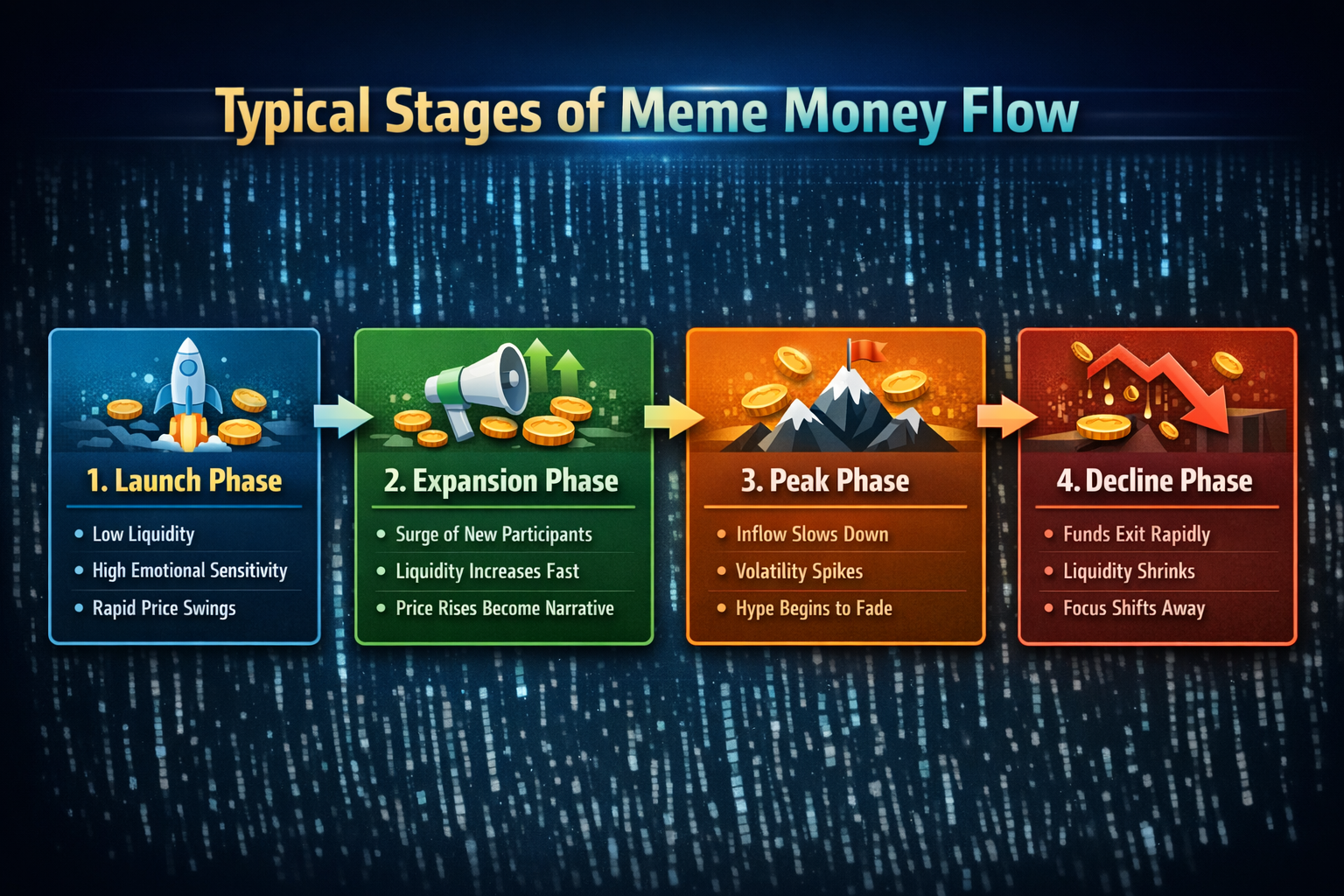
From a capital flow perspective, most Meme coins don’t move randomly—they follow a highly similar stage structure.
1. Launch Stage: Low Liquidity + High Sentiment Sensitivity
- Total capital is very small
- Any single trade can cause dramatic price swings
- Sentiment changes are amplified by price
This is the “most dangerous but most resilient” stage.
2. Diffusion Stage: Relay-style Capital Inflow
- More participants join
- Liquidity grows rapidly
- Price increases become the main promotional material
Market behavior is highly consistent at this stage with a strong trend.
3. Climax Stage: Sentiment and Capital Peak Together
- New capital inflow slows down
- Volatility increases significantly
- Positive news has less effect on price
At this point, the market shifts from “consensus-driven” to “competitive divergence.”
4. Decline Stage: Capital Outflows Faster Than Sentiment Fades
- Price drops usually precede sentiment collapse
- Liquidity dries up quickly
- Market attention shifts to the next narrative
Sentiment remains, but capital has left. Understanding this structure helps avoid a common mistake: mistaking Meme’s periodic collapses for “random or inexplicable crashes.”
IV. Why is Meme capital “faster,” but not “deeper”?
Compared to mainstream assets, Meme market capital flow has two distinct features:
- Speed: Entry and exit decisions are highly emotional and react quickly.
- Shallow Depth: Large capital finds it hard to stay for long and easily triggers price shocks.
That’s why Meme coins often see:
- Rapid surges
- Sharp pullbacks
- High-frequency rotations
In such markets, timing matters more than valuation models.
V. Capital Doesn’t “Disappear”—It Rotates Between Memes
A common misconception is that after a Meme collapses, the capital simply “disappears.” In reality, in most cases, funds just move from one Meme to another. Sentiment doesn’t vanish—it seeks new carriers:
- New images
- New memes
- New narratives
This creates an obvious “rotation feature” in the Meme market, rather than isolated events.
VI. Gate Platform’s Meme Market Section Overview
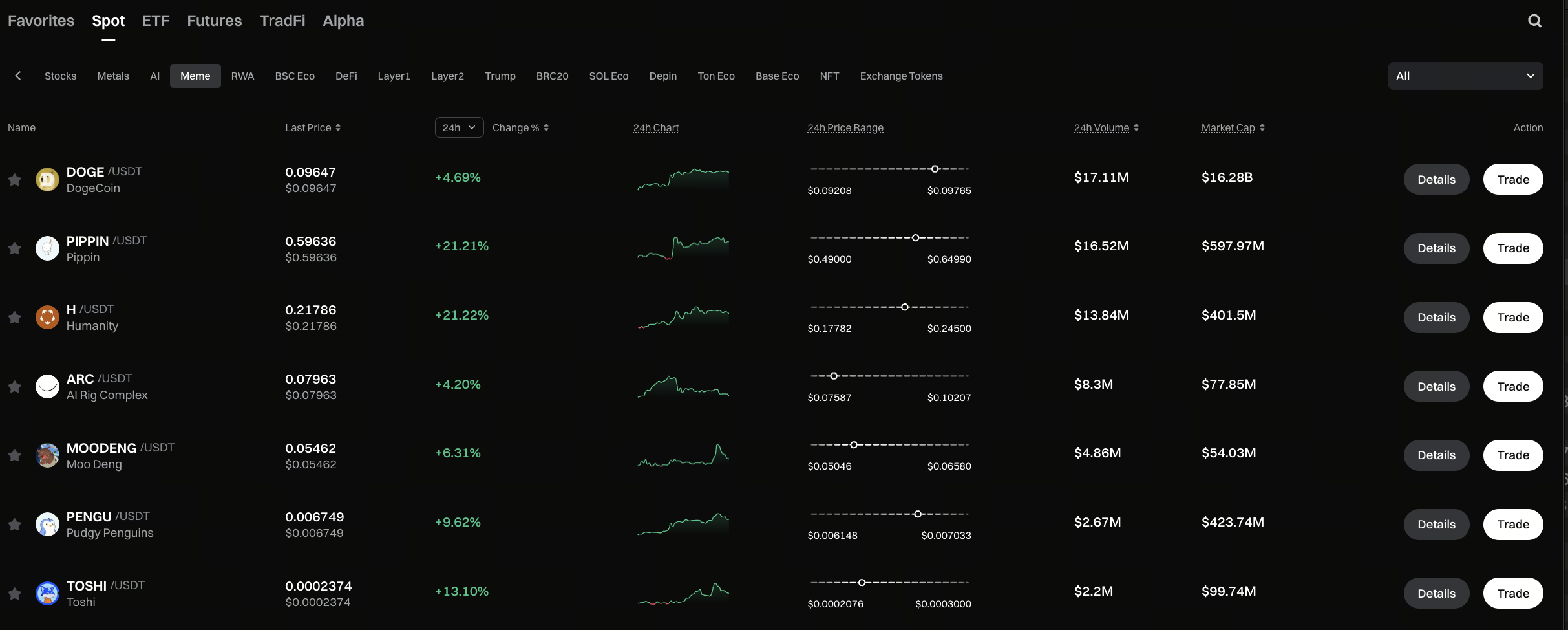
After understanding how Memes operate and behave on-chain, an easy entry point for observing overall market dynamics is the Gate platform’s Meme Market section. This section aggregates all currently active Meme assets and can be used to sense market heat and capital rotation at a macro level.
Access (Chinese site): https://www.gate.com/price/category-meme
Through this interface, learners can:
- View current Meme asset prices and their performance
- Observe trading volume and depth for different Meme assets
- Compare performance rhythms across multiple Meme assets
- Quickly identify which Memes are attracting market attention
This section serves as a supplementary tool for macro sentiment assessment in this course—not as specific “trading guidance.” Combined with earlier on-chain behavior analysis, you can use this section in the following ways:
- As a first-level filter for sentiment gathering: When most Meme assets on this page are rising overall and trading volumes are active, it indicates that overall market sentiment is spreading with more attention focused on Memes.
- To compare and judge relative heat of individual Memes: If a particular Meme is more active than others, it may mean its narrative or capital cycle is more attractive.
- To cross-validate with on-chain tools: When the Gate Meme section shows an asset’s heat rising, Trackers show increased key wallet activity, and that asset ranks high on MemeGo, you can consider that Meme in a sentiment diffusion phase.
Note that the price info on the Meme section does not equate to behavioral judgment. It serves as a sentiment indicator layer within our sentiment finance framework, helping learners grasp overall market rhythms at a macro level.
VII. Summary: How should you properly view Meme capital flow?
This lesson can be summed up in one sentence: Meme coin prices are the result of capital migration driven by sentiment—not value assessment conclusions.
Understanding Meme capital flow logic helps learners:
- Identify the real source of price volatility
- Avoid misjudging short-term sentiment markets using long-term valuation models
- Build foundational knowledge for next lesson’s “on-chain behavior analysis”