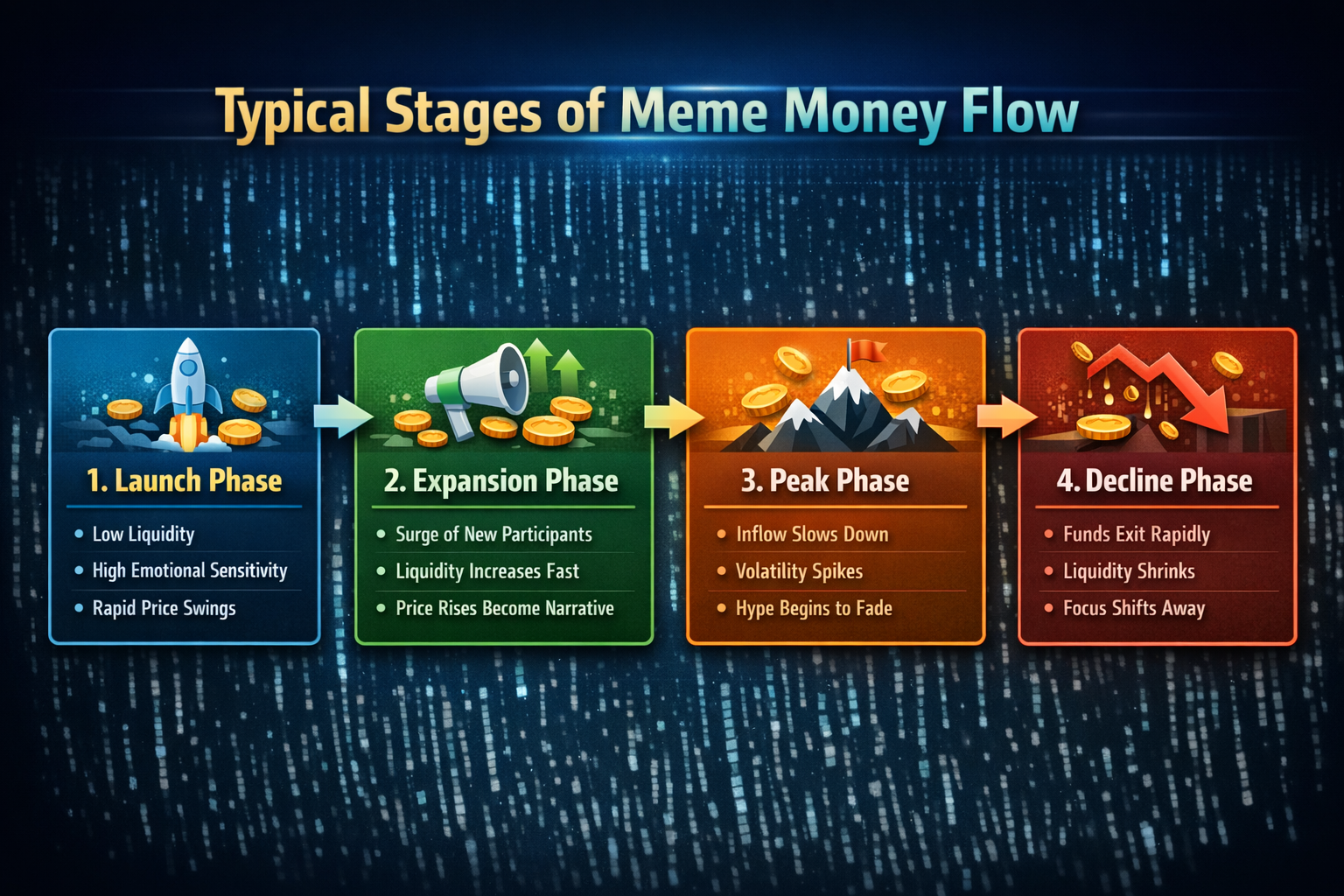
In the meme market, the real challenge is not whether you can catch the next 100x token, but whether you can survive in an environment that is highly emotional, noisy, and structurally asymmetric.
Most users do not fail because of a single mistake. They fail because they remain in participation positions that are fundamentally unsuitable for them—often without realizing it. The meme market does not punish those who “do not understand it.” Instead, it gradually drains those who repeatedly participate at the wrong game level without possessing any real advantage.
This lesson will construct a user survival strategy for the Meme market from three dimensions: participation boundaries, behavioral constraints, and risk awareness.
1. First, Decide What You Should NOT Do
In Meme trends, most losses don’t stem from poor judgment, but from playing the wrong role. The most common mistake for regular users is trying to act as:
- Early participant
- Insider capital
- So-called “smart money”
Without possessing any of these advantages:
- Information edge
- Capital advantage
- Execution speed advantage
When the trend has entered large-scale emotional diffusion and you chase high volatility, you’re essentially taking on an extremely asymmetric risk structure:
- Limited upside potential
- Uncontrollable drawdown risk
- The risks you bear far outweigh possible returns
Therefore, the first survival principle is: do not participate in the earliest, most intense, least transparent stage with the biggest information gaps.
2. Use Tools to Limit Emotions, Not Amplify Them
Many users mistakenly believe that chain scanning tools are for “finding opportunities.” In the Meme market, their real purpose is to set boundaries for your emotions.
For example:
- Use MemeGo to determine if a Meme has reached overexposure
- Use Trackers to observe whether key wallets are still clearly accumulating
- Use Gate Fun to confirm if participation structure has shifted toward late-stage emotional capital
These tools aren’t here to tell you “should you FOMO,” but to help you answer a more important question: Is this point driven only by self-reinforcing emotion? When different tools start to show obvious divergence or even contradictory information, it often means one thing: the market is shifting from “structural drive” to “emotional hype.” This is exactly where regular users are most vulnerable to systematic depletion.
3. Clarify “Participable Range” and “Must Avoid Range”
Not all Meme trends are unsuitable for user participation, but the participable range is extremely limited. A relatively manageable stage typically features:
- Capital forming initial consensus
- Emotion not yet fully diffused
- Discussion focused on structure and behavior rather than price gains
But when you notice:
- Price gains dominate discussions
- Participant numbers surge rapidly
- New capital inflows aren’t expanding in sync
Risks tend to increase exponentially. Users must clearly distinguish three states:
- Only observe
- Participate with small positions
- Must exit
The key to survival isn’t how many times you participate, but whether you know clearly when not to participate.
4. Accept the Irrational Nature of the Meme Market
Meme tokens are not value investment targets; they are highly emotional market phenomena.
Trying to use:
- Long-term logic
- Fundamental analysis
- Narrative rationality
To find “security” in Meme trends will almost always lead to cognitive mismatch. In the Meme market, irrationality is not abnormal—it is the norm. A real advantage for users does not come from prediction ability, but from flexibility and restraint. In a market driven by emotion, the ability to remain clear-headed is itself a competitive edge.
5. Treat Meme as a Training Ground, Not a Main Battlefield
For most users, the Meme market is better suited as:
- A training ground for understanding on-chain behavior
- A lab for observing emotional market dynamics
- A real-world sample for identifying capital structures
—rather than a place for long-term heavy investment or repeated emotional drain. What truly matters is not whether you made money from a single Meme trend, but whether you learned:
- Risk identification
- Position control
- Expectation management
When a user can exit the Meme market unscathed—not merely by luck—they have truly developed the fundamental skills needed to participate in more complex markets.