
# USMilitaryMaduroBettingScandal

573.63K
#USMilitaryMaduroBettingScandal
The US Military Maduro Betting Scandal and Its Crypto Market Shockwaves:
The so-called US Military Maduro Betting Scandal has rapidly evolved into one of the most controversial intersections of geopolitics, military intelligence, decentralized prediction markets, and cryptocurrency speculation, raising not only legal and ethical questions but also forcing the entire crypto ecosystem to confront a difficult reality: what happens when real-world classified information collides with permissionless financial systems that never sleep.
At the center of the controver
HighAmbition
#USMilitaryMaduroBettingScandal
The US Military Maduro Betting Scandal and Its Crypto Market Shockwaves:
The so-called US Military Maduro Betting Scandal has rapidly evolved into one of the most controversial intersections of geopolitics, military intelligence, decentralized prediction markets, and cryptocurrency speculation, raising not only legal and ethical questions but also forcing the entire crypto ecosystem to confront a difficult reality: what happens when real-world classified information collides with permissionless financial systems that never sleep.
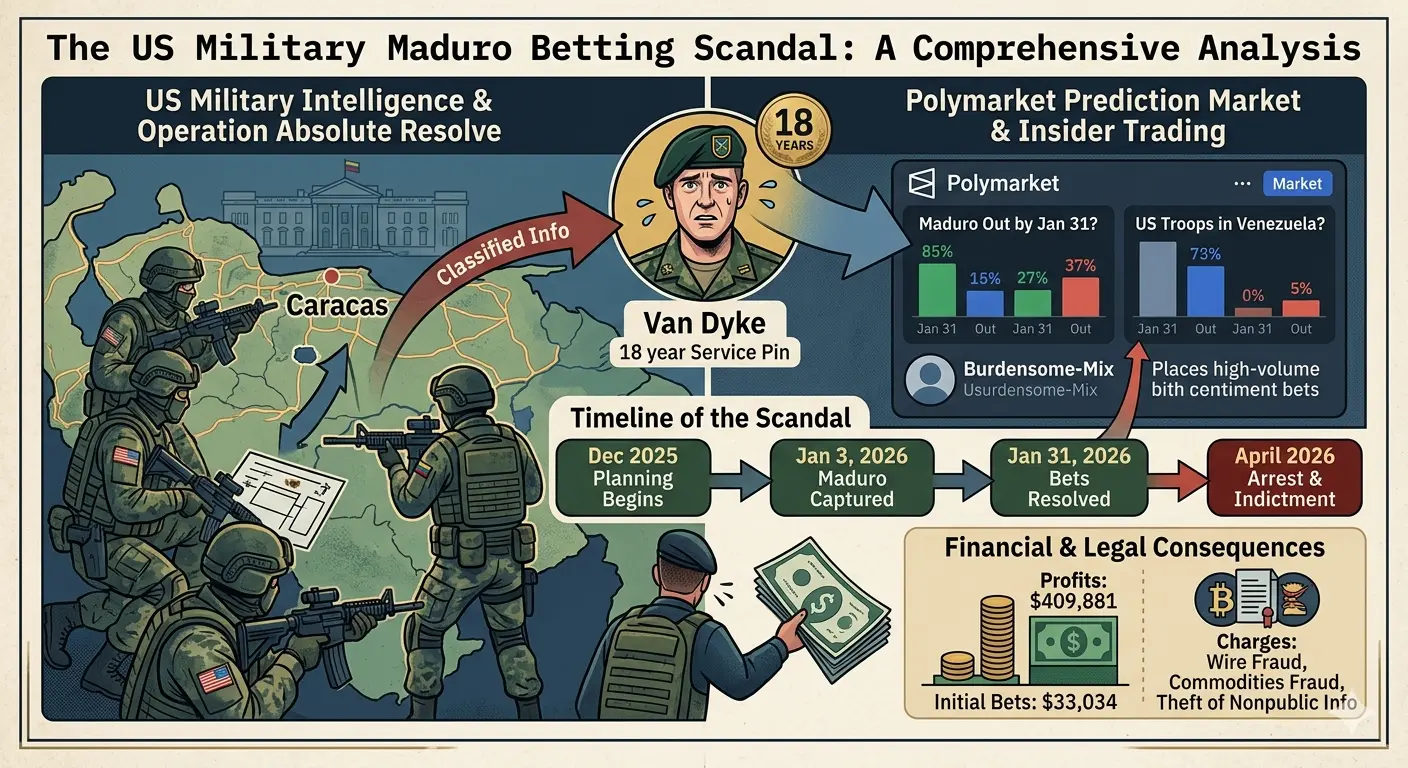
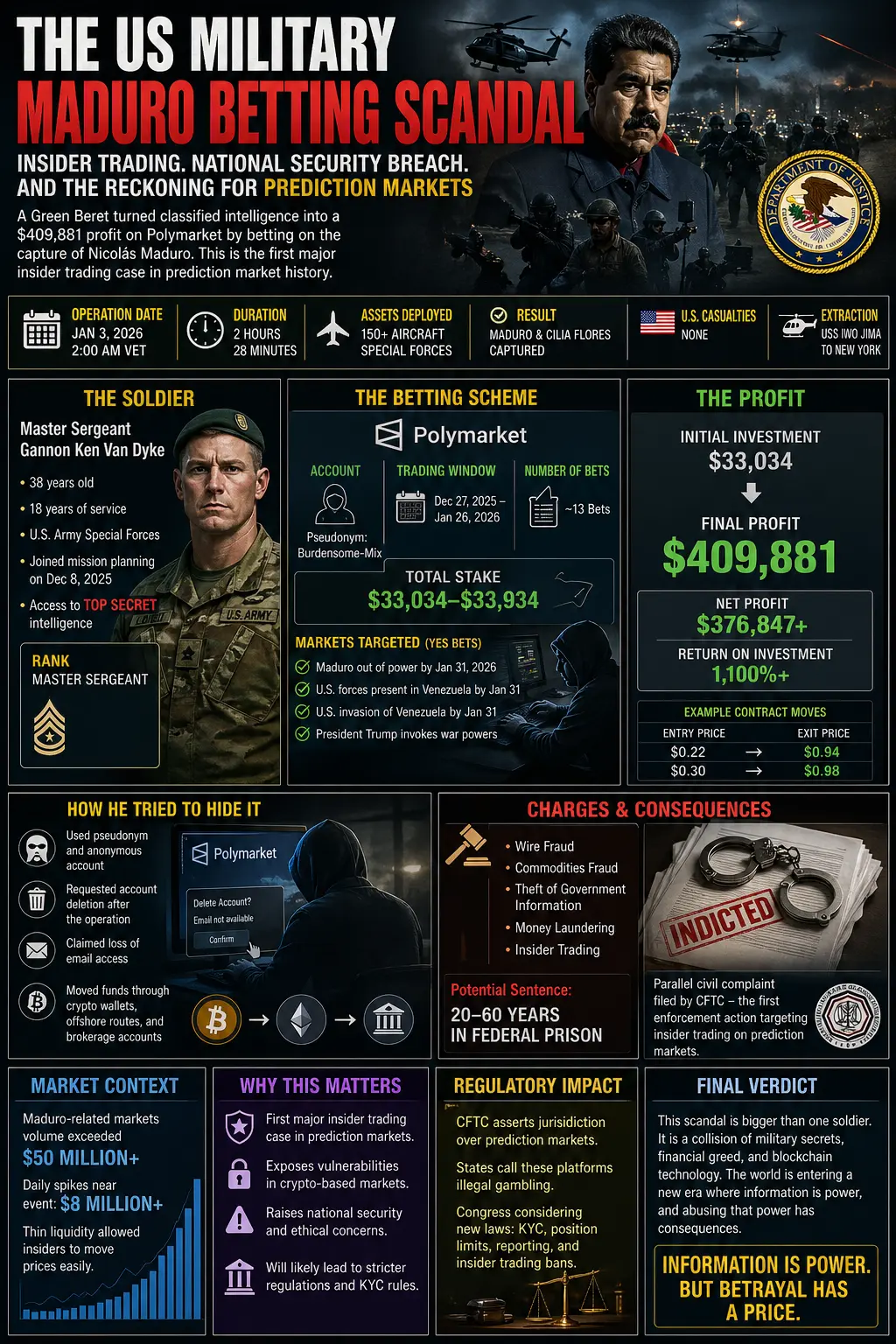
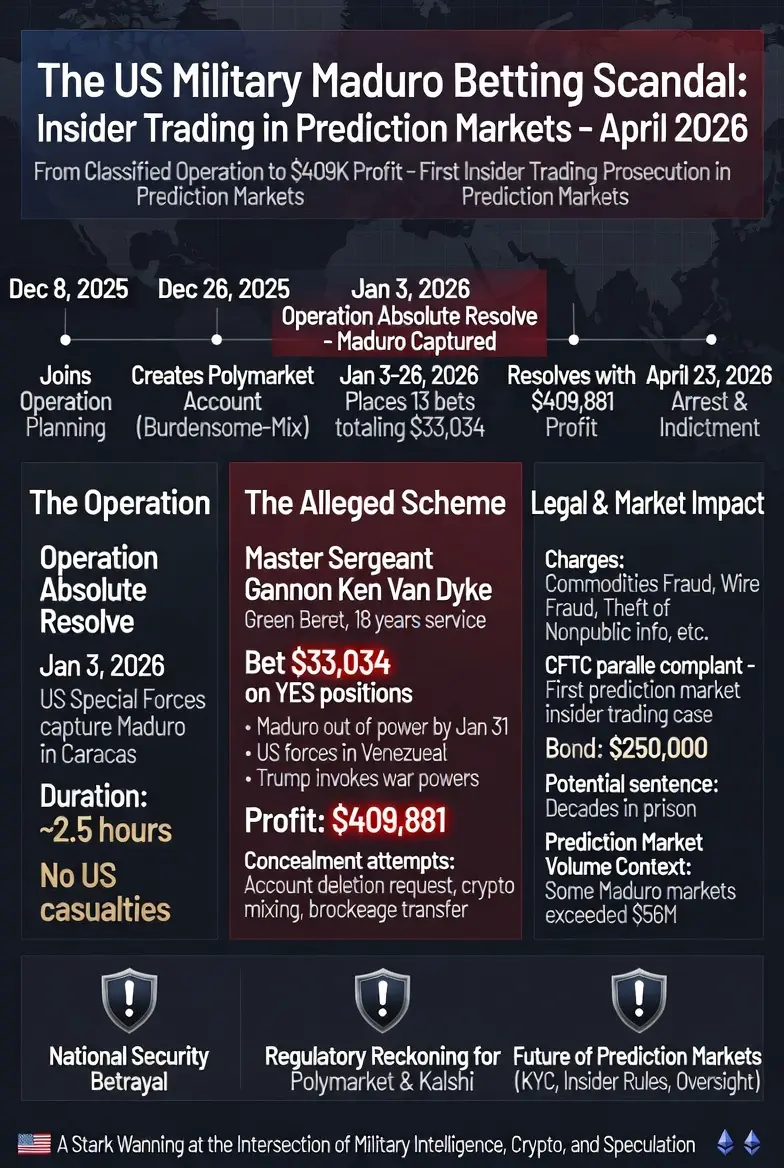
At the center of the controversy lies an extraordinary allegation that a U.S. Special Forces soldier allegedly transformed approximately $33,034 in total wagers into nearly $409,881 in profit, by placing strategic bets on a crypto-based prediction platform (Polymarket) linked to geopolitical outcomes surrounding a covert military operation against Venezuelan President Nicolás Maduro.
1. The Core Event: From Classified Operation to Market Catalyst
The turning point of this entire narrative begins with Operation Absolute Resolve, a highly sensitive and coordinated U.S. military mission reportedly executed on January 3, 2026, involving elite units such as Special Forces, Delta Force, Navy SEALs, Marines, Air Force support, cyber warfare teams, and intelligence divisions, operating in a synchronized, multi-domain strike environment involving more than 150 aircraft and advanced electronic warfare systems.
The mission allegedly resulted in the swift capture and extraction of Nicolás Maduro and Cilia Flores, a development that was later publicly acknowledged at the highest political level, immediately reshaping geopolitical expectations and triggering shockwaves across both traditional financial markets and crypto-native prediction platforms.
However, the scandal does not revolve around the military operation itself, but rather what allegedly happened before the operation became public knowledge.
2. The Alleged Betting Structure and Exact Financial Exposure
According to investigative filings, Master Sergeant Gannon Ken Van Dyke allegedly accessed non-public operational intelligence and used it to place approximately 13 separate trades on prediction markets between late December 2025 and January 2026.
The financial structure of these trades is critical:
Total capital deployed: ~$33,034
Platform: Polymarket (via VPN and multiple accounts)
Strategy: concentrated “YES” positions on low-probability geopolitical outcomes
Key contracts reportedly included:
“Maduro removed by January 31, 2026”
“U.S. military presence in Venezuela confirmed”
“U.S. invasion-related probability markets”
“War Powers authorization involving Venezuela”
At the time of entry, these markets were priced with extremely low implied probabilities—some reportedly near 6% or even lower, meaning YES shares were heavily discounted and only profitable under rare or extreme geopolitical escalation.
When the operation succeeded and markets resolved accordingly, the outcome was explosive:
Total payout: ~$442,915
Net profit: ~$409,881
Return multiple: approximately 12x to 13x+ overall capital efficiency
This kind of return is rare even in crypto markets, and almost unheard of in traditional finance, which is why it immediately triggered both fascination and regulatory alarm.
3. The Core Debate: Insider Advantage or Market Inefficiency?
This is where the controversy becomes intellectually and financially complex.
One argument suggests:
If prediction markets are truly efficient, then any correct foresight—regardless of source—should be rewarded by price discovery.
However, the opposing argument is far stronger from a regulatory standpoint:
If the foresight comes from classified military intelligence, then the market is no longer reflecting public probability—it is reflecting privileged access, which destroys fairness and market integrity.
This creates a fundamental contradiction in decentralized systems:
Crypto ideology promotes open access and permissionless participation
Regulatory frameworks demand fairness and equal information distribution
When these two collide, as allegedly seen in this case, the entire structure becomes legally and ethically unstable.
4. Crypto Market Impact: Beyond Prediction Markets
While the scandal did not directly crash Bitcoin or Ethereum, it created secondary ripple effects across the crypto ecosystem, particularly in sentiment-sensitive and infrastructure-related assets.
A. Prediction Market Sector Pressure
Tokens and protocols associated with decentralized forecasting systems, including governance and dispute-resolution layers such as UMA, experienced increased volatility pressure as traders began pricing in regulatory intervention risk and potential legal restructuring of event-based markets.
Even without direct selling pressure, valuation models shifted because investors started discounting future adoption assumptions, replacing them with uncertainty premiums linked to compliance risk.
B. Ethereum Ecosystem Reaction
Since most prediction markets operate on Ethereum-based infrastructure, the broader ETH ecosystem experienced a subtle behavioral shift:
Reduced speculative flow into high-risk event trading
Temporary slowdown in aggressive on-chain betting activity
Slight reallocation of liquidity toward more stable DeFi strategies
Ethereum itself remained structurally stable, but the risk appetite layer of the ecosystem clearly contracted, showing how narrative shocks can influence capital behavior without triggering price collapse.
C. Stablecoin Flow Disruption
A less visible but highly important effect occurred in stablecoin circulation patterns, particularly USDC-based betting flows.
Reduced deposits into prediction markets
More cautious capital deployment into geopolitical contracts
Increased monitoring of transaction flows by compliance teams
This reflects a broader structural truth:
Prediction markets are not isolated gambling tools—they are liquidity sinks connected to the entire crypto settlement layer.
5. Market Psychology Shift: The Trust Shock
Perhaps the most important impact was not price-based but psychological.
Before the scandal:
Traders treated prediction markets as crowd-sourced probability engines
Risk was primarily seen as volatility-driven
After the scandal:
Traders began questioning whether probabilities are truly “crowd-derived”
Fear of hidden informational advantages increased
Confidence in fairness of geopolitical contracts weakened
This shift changes behavior permanently because crypto markets are heavily narrative-driven, and once trust assumptions break, they are difficult to restore.
6. Wider Regulatory and Structural Consequences
Regulators across multiple jurisdictions responded rapidly:
Increased scrutiny from the CFTC
Legal disputes between federal and state authorities in the U.S.
Brazil blocking 27 prediction platforms, restricting political and war-related contracts
Global push toward tighter KYC, geofencing, and contract restrictions
This suggests a future where prediction markets may evolve into:
Highly regulated forecasting tools
Or fragmented offshore speculative ecosystems
The direction depends on whether regulators prioritize innovation or risk containment.
7. Final Analytical Debate: Innovation vs Control
This scandal forces the crypto industry into a deep philosophical conflict:
On one side:
Prediction markets are powerful truth engines
They transform information into price discovery
They democratize forecasting globally
On the other side:
They are vulnerable to insider asymmetry
They can be influenced by non-public intelligence
They may unintentionally monetize classified knowledge
The Maduro betting case becomes a real-world stress test of this contradiction.
8. Conclusion
The alleged transformation of ~$33,034 into ~$409,881 profit is not just a financial anomaly—it is a symbolic event representing the collision of three systems:
Military intelligence operations
Decentralized crypto prediction markets
Global regulatory enforcement frameworks
While Bitcoin and Ethereum did not experience direct structural shocks, the broader crypto ecosystem absorbed a clear sentiment shift toward caution, compliance awareness, and reduced appetite for politically sensitive speculation.
Ultimately, this case demonstrates a critical truth about modern crypto markets:
In decentralized systems, information is no longer just power—it is liquidity, and when that information is asymmetric at a state level, even “free markets” begin to lose their definition of fairness.
repost-content-media
  • Reward
  • Comment
  • Repost
  • Share
#USMilitaryMaduroBettingScandal
The US Military Maduro Betting Scandal and Its Crypto Market Shockwaves:
The so-called US Military Maduro Betting Scandal has rapidly evolved into one of the most controversial intersections of geopolitics, military intelligence, decentralized prediction markets, and cryptocurrency speculation, raising not only legal and ethical questions but also forcing the entire crypto ecosystem to confront a difficult reality: what happens when real-world classified information collides with permissionless financial systems that never sleep.
At the center of the controver
HighAmbition
#USMilitaryMaduroBettingScandal
The US Military Maduro Betting Scandal and Its Crypto Market Shockwaves:
The so-called US Military Maduro Betting Scandal has rapidly evolved into one of the most controversial intersections of geopolitics, military intelligence, decentralized prediction markets, and cryptocurrency speculation, raising not only legal and ethical questions but also forcing the entire crypto ecosystem to confront a difficult reality: what happens when real-world classified information collides with permissionless financial systems that never sleep.
At the center of the controversy lies an extraordinary allegation that a U.S. Special Forces soldier allegedly transformed approximately $33,034 in total wagers into nearly $409,881 in profit, by placing strategic bets on a crypto-based prediction platform (Polymarket) linked to geopolitical outcomes surrounding a covert military operation against Venezuelan President Nicolás Maduro.
1. The Core Event: From Classified Operation to Market Catalyst
The turning point of this entire narrative begins with Operation Absolute Resolve, a highly sensitive and coordinated U.S. military mission reportedly executed on January 3, 2026, involving elite units such as Special Forces, Delta Force, Navy SEALs, Marines, Air Force support, cyber warfare teams, and intelligence divisions, operating in a synchronized, multi-domain strike environment involving more than 150 aircraft and advanced electronic warfare systems.
The mission allegedly resulted in the swift capture and extraction of Nicolás Maduro and Cilia Flores, a development that was later publicly acknowledged at the highest political level, immediately reshaping geopolitical expectations and triggering shockwaves across both traditional financial markets and crypto-native prediction platforms.
However, the scandal does not revolve around the military operation itself, but rather what allegedly happened before the operation became public knowledge.
2. The Alleged Betting Structure and Exact Financial Exposure
According to investigative filings, Master Sergeant Gannon Ken Van Dyke allegedly accessed non-public operational intelligence and used it to place approximately 13 separate trades on prediction markets between late December 2025 and January 2026.
The financial structure of these trades is critical:
Total capital deployed: ~$33,034
Platform: Polymarket (via VPN and multiple accounts)
Strategy: concentrated “YES” positions on low-probability geopolitical outcomes
Key contracts reportedly included:
“Maduro removed by January 31, 2026”
“U.S. military presence in Venezuela confirmed”
“U.S. invasion-related probability markets”
“War Powers authorization involving Venezuela”
At the time of entry, these markets were priced with extremely low implied probabilities—some reportedly near 6% or even lower, meaning YES shares were heavily discounted and only profitable under rare or extreme geopolitical escalation.
When the operation succeeded and markets resolved accordingly, the outcome was explosive:
Total payout: ~$442,915
Net profit: ~$409,881
Return multiple: approximately 12x to 13x+ overall capital efficiency
This kind of return is rare even in crypto markets, and almost unheard of in traditional finance, which is why it immediately triggered both fascination and regulatory alarm.
3. The Core Debate: Insider Advantage or Market Inefficiency?
This is where the controversy becomes intellectually and financially complex.
One argument suggests:
If prediction markets are truly efficient, then any correct foresight—regardless of source—should be rewarded by price discovery.
However, the opposing argument is far stronger from a regulatory standpoint:
If the foresight comes from classified military intelligence, then the market is no longer reflecting public probability—it is reflecting privileged access, which destroys fairness and market integrity.
This creates a fundamental contradiction in decentralized systems:
Crypto ideology promotes open access and permissionless participation
Regulatory frameworks demand fairness and equal information distribution
When these two collide, as allegedly seen in this case, the entire structure becomes legally and ethically unstable.
4. Crypto Market Impact: Beyond Prediction Markets
While the scandal did not directly crash Bitcoin or Ethereum, it created secondary ripple effects across the crypto ecosystem, particularly in sentiment-sensitive and infrastructure-related assets.
A. Prediction Market Sector Pressure
Tokens and protocols associated with decentralized forecasting systems, including governance and dispute-resolution layers such as UMA, experienced increased volatility pressure as traders began pricing in regulatory intervention risk and potential legal restructuring of event-based markets.
Even without direct selling pressure, valuation models shifted because investors started discounting future adoption assumptions, replacing them with uncertainty premiums linked to compliance risk.
B. Ethereum Ecosystem Reaction
Since most prediction markets operate on Ethereum-based infrastructure, the broader ETH ecosystem experienced a subtle behavioral shift:
Reduced speculative flow into high-risk event trading
Temporary slowdown in aggressive on-chain betting activity
Slight reallocation of liquidity toward more stable DeFi strategies
Ethereum itself remained structurally stable, but the risk appetite layer of the ecosystem clearly contracted, showing how narrative shocks can influence capital behavior without triggering price collapse.
C. Stablecoin Flow Disruption
A less visible but highly important effect occurred in stablecoin circulation patterns, particularly USDC-based betting flows.
Reduced deposits into prediction markets
More cautious capital deployment into geopolitical contracts
Increased monitoring of transaction flows by compliance teams
This reflects a broader structural truth:
Prediction markets are not isolated gambling tools—they are liquidity sinks connected to the entire crypto settlement layer.
5. Market Psychology Shift: The Trust Shock
Perhaps the most important impact was not price-based but psychological.
Before the scandal:
Traders treated prediction markets as crowd-sourced probability engines
Risk was primarily seen as volatility-driven
After the scandal:
Traders began questioning whether probabilities are truly “crowd-derived”
Fear of hidden informational advantages increased
Confidence in fairness of geopolitical contracts weakened
This shift changes behavior permanently because crypto markets are heavily narrative-driven, and once trust assumptions break, they are difficult to restore.
6. Wider Regulatory and Structural Consequences
Regulators across multiple jurisdictions responded rapidly:
Increased scrutiny from the CFTC
Legal disputes between federal and state authorities in the U.S.
Brazil blocking 27 prediction platforms, restricting political and war-related contracts
Global push toward tighter KYC, geofencing, and contract restrictions
This suggests a future where prediction markets may evolve into:
Highly regulated forecasting tools
Or fragmented offshore speculative ecosystems
The direction depends on whether regulators prioritize innovation or risk containment.
7. Final Analytical Debate: Innovation vs Control
This scandal forces the crypto industry into a deep philosophical conflict:
On one side:
Prediction markets are powerful truth engines
They transform information into price discovery
They democratize forecasting globally
On the other side:
They are vulnerable to insider asymmetry
They can be influenced by non-public intelligence
They may unintentionally monetize classified knowledge
The Maduro betting case becomes a real-world stress test of this contradiction.
8. Conclusion
The alleged transformation of ~$33,034 into ~$409,881 profit is not just a financial anomaly—it is a symbolic event representing the collision of three systems:
Military intelligence operations
Decentralized crypto prediction markets
Global regulatory enforcement frameworks
While Bitcoin and Ethereum did not experience direct structural shocks, the broader crypto ecosystem absorbed a clear sentiment shift toward caution, compliance awareness, and reduced appetite for politically sensitive speculation.
Ultimately, this case demonstrates a critical truth about modern crypto markets:
In decentralized systems, information is no longer just power—it is liquidity, and when that information is asymmetric at a state level, even “free markets” begin to lose their definition of fairness.
repost-content-media
  • Reward
  • Comment
  • Repost
  • Share
#USMilitaryMaduroBettingScandal
🚨 The US Military Maduro Betting Scandal: A Deep Structural Analysis of Power, Information, and Crypto Markets
There are rare moments when two completely different worlds collide in a way that forces everyone — from policymakers to traders — to rethink the systems they rely on, and this scandal is exactly one of those moments, where the lines between military intelligence, financial markets, and decentralized technology did not just blur, but fully intersect in a way that exposed both the power and the vulnerability of modern financial infrastructure.
The arre
HighAmbition
#USMilitaryMaduroBettingScandal
🚨 The US Military Maduro Betting Scandal: A Deep Structural Analysis of Power, Information, and Crypto Markets
There are rare moments when two completely different worlds collide in a way that forces everyone — from policymakers to traders — to rethink the systems they rely on, and this scandal is exactly one of those moments, where the lines between military intelligence, financial markets, and decentralized technology did not just blur, but fully intersect in a way that exposed both the power and the vulnerability of modern financial infrastructure.
The arrest of Master Sergeant Gannon Ken Van Dyke is not simply a legal case, nor is it just a story about one individual making unethical decisions — it is a case study in how privileged information, when combined with emerging financial tools like blockchain-based prediction markets, can create a completely new category of risk that traditional systems were never designed to handle.
🔥 The Operation and the Bet — Where Intelligence Became Opportunity
At the center of this case lies Operation Absolute Resolve, a covert US military mission executed on January 3, 2026, targeting Venezuelan President Nicolás Maduro — an operation that, in traditional contexts, would have remained within classified channels and strategic briefings, far removed from public speculation or financial exploitation — but in this instance, something fundamentally different happened.
Van Dyke, who was not merely an observer but an active participant in planning and execution, possessed access to highly sensitive, nonpublic information, including precise timelines, operational scope, and intended outcomes — information that, under normal circumstances, would carry immense national security implications — yet instead of treating this knowledge as a responsibility, it was allegedly converted into a financial edge.
Over a period spanning late December 2025 to early January 2026, he engaged with a blockchain-based prediction platform, placing multiple positions totaling approximately 33,000 USDC, strategically targeting outcomes that were not uncertain to him, but already known — effectively transforming classified intelligence into predictable market outcomes, which ultimately generated profits exceeding 400,000 USDC within days.
And this is where the case shifts from being unusual to being historically significant — because this is not just insider trading, but insider trading executed on a decentralized, transparent, and globally accessible financial layer.
⚖️ Legal Framework — Old Laws, New Battlefield
The charges brought forward — including wire fraud, commodities fraud, and misuse of confidential information — are rooted in traditional financial law, yet they are now being applied to a completely new environment, where transactions are recorded on public ledgers, identities can be pseudonymous, and platforms operate across jurisdictions.
This creates a fascinating tension:
👉 The law is old
👉 The technology is new
👉 And enforcement is adapting in real time
What makes this case particularly powerful is that it demonstrates that decentralization does not eliminate accountability — instead, it transforms how accountability is enforced, because while blockchain systems offer pseudonymity, they also create permanent, traceable records that can be analyzed, reconstructed, and linked back to real-world identities when sufficient investigative resources are applied.
🔍 Blockchain Transparency — A Double-Edged Reality
One of the most misunderstood aspects of cryptocurrency is the belief that it guarantees anonymity, when in reality it offers something far more complex — transparency without immediate identity, which can create a temporary illusion of privacy, but not absolute invisibility.
In this case, investigators were able to track transaction flows, analyze timing patterns, correlate wallet activity with external behavior, and ultimately build a narrative that connected digital actions to a physical individual — highlighting a critical truth that many market participants overlook:
👉 Blockchain does not hide activity
👉 It records it forever
And in situations involving high-value, high-confidence trades tied to real-world events, those records become extremely powerful evidence.
🏛️ Political and Regulatory Shockwaves
The response from political leadership, including comments from Donald Trump, reflects a broader uncertainty about how to approach this emerging space, where prediction markets can serve as tools for information aggregation on one hand, while simultaneously creating opportunities for exploitation on the other.
This duality is at the heart of the regulatory challenge — because banning such platforms outright may limit innovation, but ignoring them entirely creates systemic vulnerabilities that can be exploited by individuals with privileged access to information.
As a result, regulators are now being forced into a position where they must define clear boundaries for behavior in decentralized environments, rather than relying on assumptions that existing systems will naturally regulate themselves.
🏢 Platform Evolution — From Freedom to Controlled Integrity
Platforms like Polymarket and Kalshi are now entering a new phase of development, where pure decentralization is being balanced against the need for market integrity, surveillance, and compliance mechanisms that can prevent abuse without completely undermining accessibility.
This shift represents a broader trend within crypto:
👉 Early phase: Innovation without restriction
👉 Current phase: Innovation with accountability
👉 Future phase: Innovation with structured compliance
And the Van Dyke case may accelerate this transition significantly.
📊 Implications for the Crypto Market — Structural, Not Temporary
This scandal does not just impact prediction markets — it sends signals across the entire cryptocurrency ecosystem, particularly in areas like DeFi, derivatives, and event-based contracts, where information asymmetry can create unfair advantages if left unchecked.
It reinforces several key realities:
• Markets are not just driven by data — they are driven by who has access to that data first
• Decentralization reduces barriers — but does not eliminate ethical responsibility
• Transparency increases accountability — but only if enforcement follows
For institutional players, this case acts as both a warning and a validation — a warning that compliance risks are real, and a validation that enforcement mechanisms are becoming more effective.
🌍 Broader Market Dynamics — The Hidden Pattern
What makes this case even more important is that it is unlikely to be isolated, as similar trading patterns have already been observed around geopolitical and macro events, suggesting that prediction markets may increasingly attract participants who possess informational advantages — turning these platforms into battlegrounds between public speculation and private knowledge.
This raises a deeper question:
👉 Can a market truly be fair if some participants already know the outcome?
And more importantly:
👉 How do you regulate that in a decentralized system?
🚀 Future Outlook — Regulation Meets Reality
Looking forward, the impact of this case will likely extend far beyond the individuals involved, influencing regulatory frameworks, platform design, and user behavior across the crypto space.
We can expect:
• Increased monitoring of large, high-confidence trades
• Stronger collaboration between platforms and regulators
• Clearer legal definitions around insider activity in crypto
• Greater emphasis on identity-linked participation in certain markets
And while this may reduce some of the openness that defined early crypto, it may also increase trust, stability, and long-term adoption.
💬 Final Thought — The Real Lesson Behind The Scandal
This is not just a story about misuse of information, and it is not just a case about crypto regulation — it is a reflection of a deeper truth about modern markets:
👉 Technology evolves faster than behavior
👉 Access expands faster than understanding
👉 And opportunity often appears before rules are fully defined
The real question is not whether such incidents will happen again —
because they will —
The real question is:
👉 How quickly can systems adapt to ensure that innovation does not come at the cost of integrity?
repost-content-media
  • Reward
  • Comment
  • Repost
  • Share
#USMilitaryMaduroBettingScandal
The US Military Maduro Betting Scandal and Its Crypto Market Shockwaves:
The so-called US Military Maduro Betting Scandal has rapidly evolved into one of the most controversial intersections of geopolitics, military intelligence, decentralized prediction markets, and cryptocurrency speculation, raising not only legal and ethical questions but also forcing the entire crypto ecosystem to confront a difficult reality: what happens when real-world classified information collides with permissionless financial systems that never sleep.
At the center of the controver
HighAmbition
#USMilitaryMaduroBettingScandal
The US Military Maduro Betting Scandal and Its Crypto Market Shockwaves:
The so-called US Military Maduro Betting Scandal has rapidly evolved into one of the most controversial intersections of geopolitics, military intelligence, decentralized prediction markets, and cryptocurrency speculation, raising not only legal and ethical questions but also forcing the entire crypto ecosystem to confront a difficult reality: what happens when real-world classified information collides with permissionless financial systems that never sleep.
At the center of the controversy lies an extraordinary allegation that a U.S. Special Forces soldier allegedly transformed approximately $33,034 in total wagers into nearly $409,881 in profit, by placing strategic bets on a crypto-based prediction platform (Polymarket) linked to geopolitical outcomes surrounding a covert military operation against Venezuelan President Nicolás Maduro.
1. The Core Event: From Classified Operation to Market Catalyst
The turning point of this entire narrative begins with Operation Absolute Resolve, a highly sensitive and coordinated U.S. military mission reportedly executed on January 3, 2026, involving elite units such as Special Forces, Delta Force, Navy SEALs, Marines, Air Force support, cyber warfare teams, and intelligence divisions, operating in a synchronized, multi-domain strike environment involving more than 150 aircraft and advanced electronic warfare systems.
The mission allegedly resulted in the swift capture and extraction of Nicolás Maduro and Cilia Flores, a development that was later publicly acknowledged at the highest political level, immediately reshaping geopolitical expectations and triggering shockwaves across both traditional financial markets and crypto-native prediction platforms.
However, the scandal does not revolve around the military operation itself, but rather what allegedly happened before the operation became public knowledge.
2. The Alleged Betting Structure and Exact Financial Exposure
According to investigative filings, Master Sergeant Gannon Ken Van Dyke allegedly accessed non-public operational intelligence and used it to place approximately 13 separate trades on prediction markets between late December 2025 and January 2026.
The financial structure of these trades is critical:
Total capital deployed: ~$33,034
Platform: Polymarket (via VPN and multiple accounts)
Strategy: concentrated “YES” positions on low-probability geopolitical outcomes
Key contracts reportedly included:
“Maduro removed by January 31, 2026”
“U.S. military presence in Venezuela confirmed”
“U.S. invasion-related probability markets”
“War Powers authorization involving Venezuela”
At the time of entry, these markets were priced with extremely low implied probabilities—some reportedly near 6% or even lower, meaning YES shares were heavily discounted and only profitable under rare or extreme geopolitical escalation.
When the operation succeeded and markets resolved accordingly, the outcome was explosive:
Total payout: ~$442,915
Net profit: ~$409,881
Return multiple: approximately 12x to 13x+ overall capital efficiency
This kind of return is rare even in crypto markets, and almost unheard of in traditional finance, which is why it immediately triggered both fascination and regulatory alarm.
3. The Core Debate: Insider Advantage or Market Inefficiency?
This is where the controversy becomes intellectually and financially complex.
One argument suggests:
If prediction markets are truly efficient, then any correct foresight—regardless of source—should be rewarded by price discovery.
However, the opposing argument is far stronger from a regulatory standpoint:
If the foresight comes from classified military intelligence, then the market is no longer reflecting public probability—it is reflecting privileged access, which destroys fairness and market integrity.
This creates a fundamental contradiction in decentralized systems:
Crypto ideology promotes open access and permissionless participation
Regulatory frameworks demand fairness and equal information distribution
When these two collide, as allegedly seen in this case, the entire structure becomes legally and ethically unstable.
4. Crypto Market Impact: Beyond Prediction Markets
While the scandal did not directly crash Bitcoin or Ethereum, it created secondary ripple effects across the crypto ecosystem, particularly in sentiment-sensitive and infrastructure-related assets.
A. Prediction Market Sector Pressure
Tokens and protocols associated with decentralized forecasting systems, including governance and dispute-resolution layers such as UMA, experienced increased volatility pressure as traders began pricing in regulatory intervention risk and potential legal restructuring of event-based markets.
Even without direct selling pressure, valuation models shifted because investors started discounting future adoption assumptions, replacing them with uncertainty premiums linked to compliance risk.
B. Ethereum Ecosystem Reaction
Since most prediction markets operate on Ethereum-based infrastructure, the broader ETH ecosystem experienced a subtle behavioral shift:
Reduced speculative flow into high-risk event trading
Temporary slowdown in aggressive on-chain betting activity
Slight reallocation of liquidity toward more stable DeFi strategies
Ethereum itself remained structurally stable, but the risk appetite layer of the ecosystem clearly contracted, showing how narrative shocks can influence capital behavior without triggering price collapse.
C. Stablecoin Flow Disruption
A less visible but highly important effect occurred in stablecoin circulation patterns, particularly USDC-based betting flows.
Reduced deposits into prediction markets
More cautious capital deployment into geopolitical contracts
Increased monitoring of transaction flows by compliance teams
This reflects a broader structural truth:
Prediction markets are not isolated gambling tools—they are liquidity sinks connected to the entire crypto settlement layer.
5. Market Psychology Shift: The Trust Shock
Perhaps the most important impact was not price-based but psychological.
Before the scandal:
Traders treated prediction markets as crowd-sourced probability engines
Risk was primarily seen as volatility-driven
After the scandal:
Traders began questioning whether probabilities are truly “crowd-derived”
Fear of hidden informational advantages increased
Confidence in fairness of geopolitical contracts weakened
This shift changes behavior permanently because crypto markets are heavily narrative-driven, and once trust assumptions break, they are difficult to restore.
6. Wider Regulatory and Structural Consequences
Regulators across multiple jurisdictions responded rapidly:
Increased scrutiny from the CFTC
Legal disputes between federal and state authorities in the U.S.
Brazil blocking 27 prediction platforms, restricting political and war-related contracts
Global push toward tighter KYC, geofencing, and contract restrictions
This suggests a future where prediction markets may evolve into:
Highly regulated forecasting tools
Or fragmented offshore speculative ecosystems
The direction depends on whether regulators prioritize innovation or risk containment.
7. Final Analytical Debate: Innovation vs Control
This scandal forces the crypto industry into a deep philosophical conflict:
On one side:
Prediction markets are powerful truth engines
They transform information into price discovery
They democratize forecasting globally
On the other side:
They are vulnerable to insider asymmetry
They can be influenced by non-public intelligence
They may unintentionally monetize classified knowledge
The Maduro betting case becomes a real-world stress test of this contradiction.
8. Conclusion
The alleged transformation of ~$33,034 into ~$409,881 profit is not just a financial anomaly—it is a symbolic event representing the collision of three systems:
Military intelligence operations
Decentralized crypto prediction markets
Global regulatory enforcement frameworks
While Bitcoin and Ethereum did not experience direct structural shocks, the broader crypto ecosystem absorbed a clear sentiment shift toward caution, compliance awareness, and reduced appetite for politically sensitive speculation.
Ultimately, this case demonstrates a critical truth about modern crypto markets:
In decentralized systems, information is no longer just power—it is liquidity, and when that information is asymmetric at a state level, even “free markets” begin to lose their definition of fairness.
repost-content-media
  • Reward
  • Comment
  • Repost
  • Share
#USMilitaryMaduroBettingScandal
The US Military Maduro Betting Scandal and Its Crypto Market Shockwaves:
The so-called US Military Maduro Betting Scandal has rapidly evolved into one of the most controversial intersections of geopolitics, military intelligence, decentralized prediction markets, and cryptocurrency speculation, raising not only legal and ethical questions but also forcing the entire crypto ecosystem to confront a difficult reality: what happens when real-world classified information collides with permissionless financial systems that never sleep.
At the center of the controver
post-image
post-image
post-image
post-image
  • Reward
  • 13
  • Repost
  • Share
Miss_1903:
To The Moon 🌕
View More
#USMilitaryMaduroBettingScandal
The Collapse of Information Boundaries and the Rise of Intelligence-Driven Financial Systems in the Modern Era
The alleged US Military Maduro betting scandal represents more than a geopolitical controversy or a case of misconduct involving sensitive information. It is increasingly being interpreted as a structural signal of something far deeper: the collapse of traditional boundaries between intelligence, financial markets, and decentralized digital infrastructure.
In earlier financial systems, information flowed through clearly
  • Reward
  • Comment
  • Repost
  • Share
🚨 #USMilitaryMaduroBettingScandal | When Classified Intel Meets Crypto Betting
This isn’t just a scandal — it’s a warning shot.
A U.S. Army Special Forces sergeant has been arrested for allegedly using top-secret military intelligence to place high-stakes bets on a crypto prediction market.
💥 What Happened • Access to classified Maduro operation details
• Placed ~$33K in bets before public disclosure
• Reportedly turned it into $400K+ profit
• Used VPN to bypass restrictions
⚖️ Charges Wire fraud. Misuse of classified intel. Financial crimes.
Potential sentence: decades in prison
🧠 Why This
post-image
  • Reward
  • Comment
  • Repost
  • Share
#USMilitaryMaduroBettingScandal
US Military Maduro Betting Scandal and the Collapse of Information Boundaries in Modern Markets
The alleged US Military Maduro betting scandal has rapidly evolved into a landmark case that sits at the intersection of geopolitics, decentralized finance, prediction markets, and blockchain transparency. While the surface narrative appears to revolve around misconduct linked to a single individual, the deeper significance lies in what this incident reveals about the modern information economy—where sensitive geopolitical intelligence can indirectly interact with fi
MrFlower_XingChen
#USMilitaryMaduroBettingScandal
US Military Maduro Betting Scandal and the Collapse of Information Boundaries in Modern Markets
The alleged US Military Maduro betting scandal has rapidly evolved into a landmark case that sits at the intersection of geopolitics, decentralized finance, prediction markets, and blockchain transparency. While the surface narrative appears to revolve around misconduct linked to a single individual, the deeper significance lies in what this incident reveals about the modern information economy—where sensitive geopolitical intelligence can indirectly interact with financial systems in real time.
This case is not simply about illegal trading behavior. It is about how the structure of today’s digital financial infrastructure has fundamentally changed the way information moves, is priced, and is exploited across global markets.
A New Type of Financial Incident: Intelligence Meets Markets
At the center of the controversy is the alleged use of non-public or classified information tied to a sensitive US military operation involving Venezuela. Such operations are typically restricted to highly secure channels due to their strategic and geopolitical importance.
However, what makes this case unprecedented is the alleged interaction between that information and blockchain-based prediction markets. These platforms allow users to speculate on real-world outcomes such as political events, conflicts, and economic decisions by assigning market-driven probabilities.
The key concern is that trades may have been executed using knowledge that was not available to the general public. This transforms the nature of participation—from probabilistic speculation into informationally advantaged positioning, where outcomes are partially or fully known in advance by certain participants.
The Breakdown of Market Symmetry
Prediction markets are designed under a foundational assumption: all participants operate with unequal interpretations of the same public information, not unequal access to private truth.
This case challenges that assumption directly.
When private intelligence enters a prediction system, the market no longer functions as a forecasting tool. Instead, it becomes a pricing mechanism for asymmetric knowledge. This creates a structural distortion:
Some participants are interpreting probabilities
Others are acting on intelligence
And a small subset may already know outcomes with high certainty
This imbalance undermines the core principle of fair price discovery, replacing collective forecasting with hidden informational advantage.
Blockchain Transparency and the Paradox of Visibility
One of the most critical aspects of this case is how blockchain technology reshapes investigative capability.
Contrary to common perception, blockchain does not conceal activity—it permanently records it.
Every transaction, wallet interaction, and timing pattern is immutably stored. While identities may initially be pseudonymous, behavioral analysis can still reveal correlations between on-chain activity and real-world events.
In this case, investigators reportedly reconstructed transaction patterns that aligned closely with geopolitical developments. This demonstrates a key paradox:
Blockchain does not guarantee privacy—it guarantees permanence.
Once behavior is recorded, it can be analyzed indefinitely, often revealing patterns that traditional financial systems would obscure.
Legal Systems Facing a Technological Mismatch
The legal dimension of this scandal highlights a growing structural issue: modern decentralized markets are evolving faster than regulatory frameworks.
Traditional insider trading laws were designed for centralized institutions—banks, exchanges, and regulated brokers. In contrast, blockchain-based systems operate globally, pseudonymously, and continuously.
This creates a mismatch:
The behavior is digital and decentralized
The laws are analog and jurisdictional
Enforcement becomes reactive rather than preventive
As a result, regulators are increasingly forced to reinterpret legacy legal definitions for environments they were never designed to govern.
The Prediction Market Paradox
This case reignites a long-standing debate about prediction markets themselves.
In theory, they are powerful tools for aggregating distributed knowledge and producing accurate forecasts. They have been used to estimate election outcomes, economic indicators, and geopolitical probabilities.
However, their effectiveness depends on a critical assumption: informational symmetry.
When participants have unequal access to sensitive or classified information, prediction markets stop being neutral forecasting systems and begin reflecting hidden knowledge flows.
This raises a fundamental question:
Can a prediction market remain meaningful if some participants are effectively trading on known outcomes?
Geopolitical Spillover into Financial Infrastructure
Although the incident originates in a geopolitical context, its implications extend deeply into financial systems, particularly decentralized ones.
Three major spillover effects are becoming increasingly visible:
Markets are reacting faster to geopolitical intelligence than traditional news cycles
Blockchain systems allow forensic reconstruction of trading behavior
Prediction markets are increasingly exposed to real-world intelligence asymmetries
This creates a new class of risk where financial systems are no longer isolated from geopolitical information flows—they are directly embedded within them.
Systemic Risk: When Knowledge Becomes Capital
One of the most important lessons from this case is the growing value of information advantage in modern markets.
Execution speed and liquidity access still matter, but they are increasingly secondary to informational positioning.
In environments where real-world events can be partially known in advance by select actors, markets begin to shift from probabilistic systems into asymmetric extraction systems.
This introduces systemic risk:
If markets consistently price events already known to some participants, trust in the price discovery process erodes over time.
Regulatory and Institutional Response
Governments and regulatory bodies are now facing a difficult challenge. They must decide how to respond to decentralized systems that operate outside traditional oversight structures while still influencing global financial behavior.
Three competing pressures are emerging:
Restrict prediction markets to prevent misuse of privileged information
Preserve innovation in decentralized financial systems
Maintain global competitiveness in blockchain infrastructure
The result is likely to be a hybrid regulatory model combining compliance tracking, behavioral analytics, and selective access controls rather than outright prohibition.
Platform Evolution: From Open Markets to Monitored Systems
Prediction markets and decentralized financial platforms are entering a new phase of evolution:
Open Experimentation Phase – minimal oversight, rapid growth
Transition Phase – increased adoption and early regulatory pressure
Controlled Integration Phase – compliance tools and monitoring systems embedded into infrastructure
This trajectory mirrors broader trends across the crypto ecosystem, where systems initially designed for openness gradually evolve toward structured governance as their influence expands.
Market Implications for Crypto and Prediction Systems
While the scandal is geopolitical in origin, its implications for crypto markets are significant.
Key takeaways include:
On-chain transparency enables advanced behavioral analysis
Information asymmetry is becoming a central trading variable
Regulatory attention on DeFi-adjacent systems is increasing
Prediction markets may shift toward identity-linked participation models
For traders and institutions, this reinforces a new reality:
In modern markets, information structure is becoming as important as liquidity structure.
Conclusion: A Structural Turning Point
The US Military Maduro betting scandal is not simply an isolated legal or political event. It represents a structural turning point in how information, markets, and decentralized systems interact.
It exposes a fundamental tension:
Markets are designed to predict the future
But some participants may already know parts of it
As blockchain systems continue to expand and prediction markets become more integrated with real-world data flows, this tension will only intensify.
The long-term outcome will likely not be the collapse of these systems, but their transformation. Stronger compliance layers, improved monitoring tools, and more sophisticated market design will emerge to preserve integrity while maintaining openness.
Ultimately, this case highlights a defining challenge of the modern financial era: building systems that can remain fair, transparent, and functional in a world where information itself moves faster than regulation, and where the boundary between knowledge and capital is becoming increasingly blurred.
#GateSquare
#ContentMining
repost-content-media
  • Reward
  • 2
  • Repost
  • Share
CryptoDiscovery:
Diamond Hands 💎
View More
#USMilitaryMaduroBettingScandal US Army Sergeant Arrested for Using Classified Maduro Operation Intel to Place $400K Bet
A serving Green Beret allegedly leveraged secret military plans to profit on a crypto prediction market.
[WASHINGTON D.C.] – In one of the most bizarre national security scandals in recent years, a 38-year-old U.S. Army Special Forces sergeant has been arrested for allegedly using classified information about a covert mission to capture Venezuelan leader Nicolás Maduro — to place winning bets on the crypto prediction platform Polymarket.
The case has sparked outrage across m
post-image
post-image
  • Reward
  • 2
  • Repost
  • Share
HighAmbition:
good 👍 good 👍 good
View More
#USMilitaryMaduroBettingScandal
The US Military Maduro Betting Scandal represents one of the most striking intersections of classified military operations, cryptocurrency prediction markets, and federal prosecution in recent memory. At the center stands Army Master Sergeant Gannon Ken Van Dyke, a 38-year-old Special Forces communications specialist assigned to Joint Special Operations Command at Fort Bragg, North Carolina.
The timeline begins in late December 2025 when Van Dyke allegedly leveraged his position within the planning apparatus of Operation Absolute Resolve, the classified US mili
post-image
post-image
  • Reward
  • 4
  • Repost
  • Share
ybaser:
Just charge forward 👊Just charge forward 👊
View More
Load More