Strategy execution chairman Michael Saylor and Blockstream CEO Adam Back oppose the BIP-110 proposal. Saylor said that, compared with Bitcoin, there are 110 things more dangerous than spam, and claimed that BIP-110 could make network transactions invalid. Back described BIP-110 as an attempt to “regulate others.”
BIP-110 background: aims to stop Ordinals “spamming” the Bitcoin network
According to reports, BIP-110 (Bitcoin Improvement Proposal 110) was introduced in December 2025 by a Bitcoin developer using the pseudonym “Dathon Ohm,” and Ocean Protocol founder Luke Dashjr expressed support. The proposal aims to prevent similar NFT-like Ordinals and other arbitrary data from being sent as spam to the Bitcoin network by creating a temporary fork, in order to preserve Bitcoin’s main use as a peer-to-peer cash system.
BIP-110 is seen as one of the most closely watched protocol-level disputes in the Bitcoin development community since the block size debate from 2015 to 2017. Dashjr and BIP-110 supporters say that data bloat driven by Ordinals poses a “serious threat” to the network, and that BIP-110 is only a one-year temporary restriction—it will not make long-term paid transactions invalid and will not cause a chain split.
Low odds of BIP-110 activation: only 1% of blocks supported in period 475
According to reports, the activation conditions for BIP-110 are as follows: within a Bitcoin block period, 55% of Bitcoin nodes must validate blocks and support the proposal. In the last period—period 475 (between blocks 955,584 and 957,599)—only 1% of blocks showed support for BIP-110, far from the 55% threshold, making activation unlikely.
Ordinals activity near historic lows: fewer than 10,000 per day over the past month
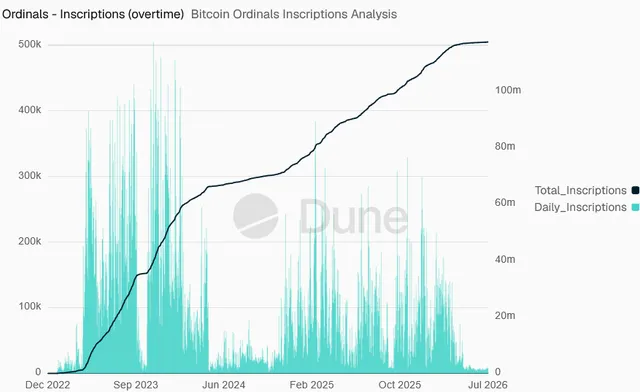 (Source: Dune)
Based on Dune Analytics data, Ordinals activity is currently close to historic lows. Over the past month, fewer than 10,000 Ordinals were inscribed into the Bitcoin blockchain per day, while the peak in August 2023 was more than 400,000.
Despite Ordinals activity dropping significantly, Saylor and Back still worry that BIP-110 could cause more harm than good to the Bitcoin network’s reputation, arguing that even in periods of low activity, introducing such a fork proposal still carries potential risk.
FAQ
Why do Michael Saylor and Adam Back oppose BIP-110?
According to reports, Saylor said on X that “there are 110 things more dangerous than spam,” and is concerned that BIP-110 could render ordinary transactions on the network invalid. Adam Back described BIP-110 as an attempt to “regulate others,” saying it is incompatible with the permissionless, censorship-resistant cypherpunk spirit of Bitcoin.
What is the current progress on BIP-110 activation?
According to reports, BIP-110 activation requires 55% of Bitcoin nodes to support the proposal within a period, but in period 475 (blocks 955,584 to 957,599), only 1% of blocks showed support, making activation unlikely.
What is BIP-110, and what problem is it meant to solve?
According to reports, BIP-110 is a Bitcoin Improvement Proposal introduced in December 2025, aiming to prevent Ordinals and other arbitrary data from being sent to the Bitcoin network as spam by creating a temporary fork, in order to preserve Bitcoin’s main use as a peer-to-peer cash system. It is promoted by a developer using the pseudonym “Dathon Ohm” and Luke Dashjr.


