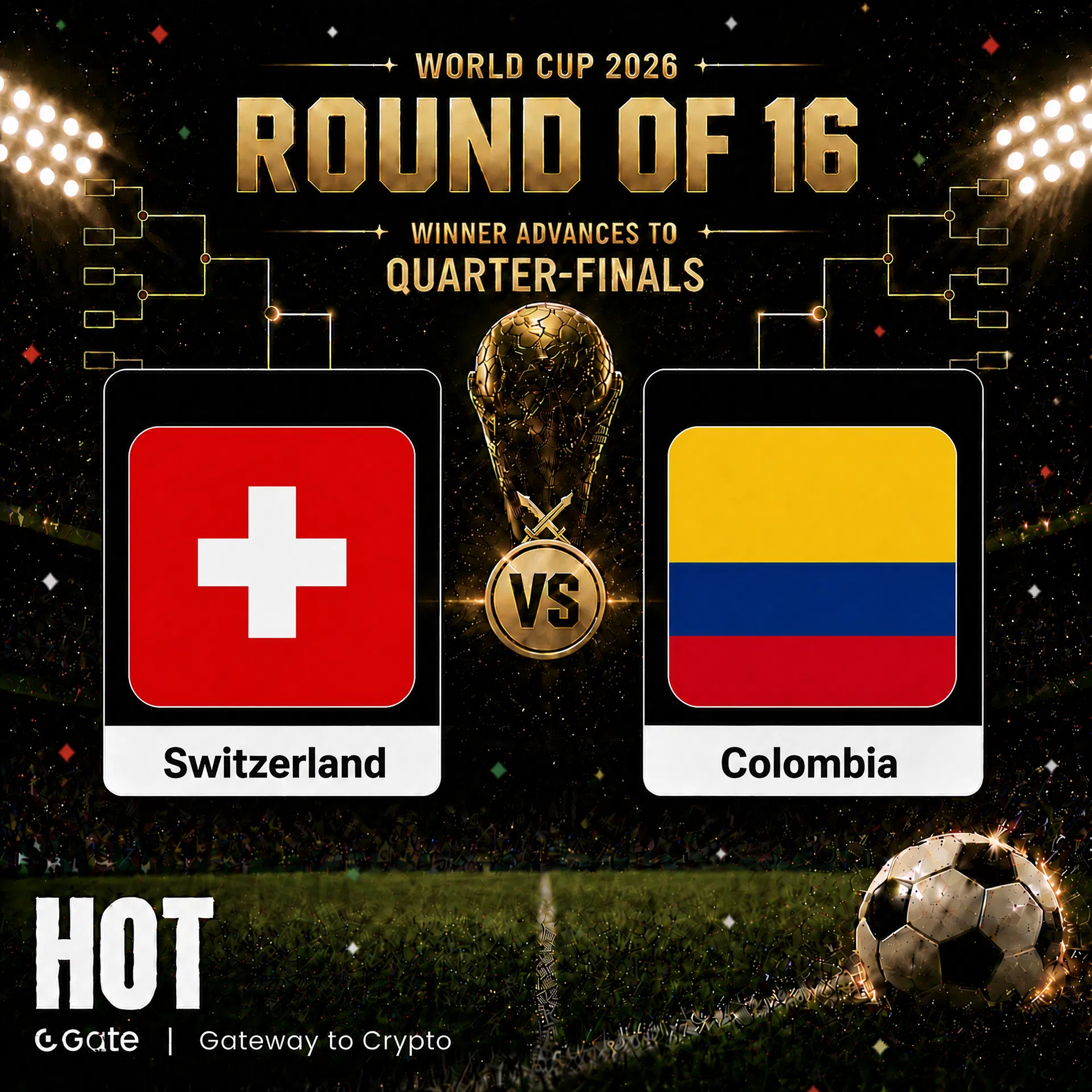
As the World Cup enters the do-or-die stage, Gate has simultaneously launched the limited-time event "Gate 世界杯预言王者赛", where users can participate in prediction trading in the Gate Polymarket World Cup zone to compete for a total prize pool of 100,000 USDT.
From a trading logic perspective, we break down the probability gap between 43% and 27%, the meaning of the 32% draw signal, and how live variables affect market pricing, providing a structured analytical reference for users focused on this match.
Between 43% and 27%: A Knockout Match Redefined by Probability
In the 2026 World Cup Round of 16, Switzerland and Colombia will face off at BC Place Stadium. The prediction market pricing is: Colombia win probability 43%, Switzerland win probability 27%, draw 32%, total volume $2.84M.
The information conveyed by this pricing structure is far more complex than simply 'Colombia is favored'. 43% is not an overwhelming number — in the knockout context, it remains a considerable distance from the 50% breakeven line. Compared to Argentina's 72% support in another Round of 16 match, Colombia's 43% is more like a 'conditional favoritism' rather than a market confirmation of the outcome.
As the World Cup enters the knockout stage, the prediction market continues to heat up. Gate's limited-time event 'Gate World Cup Prediction King Competition' allows users to participate in prediction trading in the Gate Polymarket World Cup zone, earning points based on the payout multiplier of successful predictions. A total prize pool of 100,000 USDT across two leaderboards awaits distribution. Every trade in the prediction market is not just an expression of opinion but can directly translate into a position on the leaderboard — further increasing the value of attention on this pricing data for Switzerland vs. Colombia.
The support logic behind 43% is built on several verifiable dimensions. Colombia advanced as Group K winners, with 2 wins and 1 draw in the group stage (7 points), scoring 5 goals and conceding only 1. After a 1-0 victory over Ghana in the Round of 32, the team has remained unbeaten in four consecutive matches. Bayern winger Luis Díaz is the team's most threatening attacking weapon, with his one-on-one dribbling on the flank repeatedly proven during the group stage. James Rodríguez orchestrates from the attacking midfield position, with set pieces and through balls remaining key methods for Colombia to break the deadlock.
But the market did not push Colombia into a higher probability range, for equally clear reasons. Colombia only managed a narrow 1-0 win over Ghana in the Round of 32, with poor attacking conversion efficiency. Against European teams this year, Colombia has yet to win (1 draw, 2 losses). Additionally, starting center-forward Córdova is absent due to injury, and several players suffered from flu before the match — these factors have marginally weakened market confidence in Colombia.
Switzerland's 27% represents a different pricing logic. Switzerland advanced as Group B winners, with 2 wins and 1 draw (7 points), scoring 9 goals and conceding 3. A 2-0 victory over Algeria in the Round of 32 marked the first time Switzerland has achieved consecutive wins in the World Cup knockout stage. The team has reached the Round of 16 in four consecutive World Cups, boasting rich tournament experience.
Switzerland's tactical system is based on a 4-2-3-1 formation, with Zakaria and Freuler forming a double pivot that creates a high-intensity interception barrier in midfield. The backline is led by Akanji, conceding less than 1 goal per game on average in the group stage. The team has been the first to score in all four World Cup matches so far, showing strong execution in the opening phase. These characteristics give Switzerland sufficient resilience when facing technical teams.
However, the 27% probability also reflects the market's cautious stance. Switzerland's creativity in settled attacks is limited, heavily relying on transition opportunities and set pieces. Facing Colombia's high press and wide attacking threats, Switzerland's defensive system will face greater pressure than in the group stage. The market believes Switzerland is not without chances, but needs to follow a specific path — scoring first, controlling the tempo, and dragging the match into extra time — to convert probability into results.
32% Draw Probability: The Most Critical Signal in the Knockout Pricing Structure
The 32% draw probability is the most noteworthy number in this pricing set.
In the group stage, the draw probability is usually below 25% — because both sides have the motivation to earn points, with stronger attacking intent. But entering the knockout stage, the systematic increase in draw probability is a verifiable market rule. Higher defensive priority, lower risk appetite in teams, and the existence of extra time mechanisms collectively push up the likelihood of no decisive result within 90 minutes.
Specifically for this match, the 32% draw probability means the market believes:
The gap in strength between the two sides is limited. The 16-percentage-point gap between 43% and 27% does not constitute a significant disparity in the knockout context. Switzerland is ranked 19th in the world, Colombia 13th — the difference in FIFA rankings is itself within a narrow range.
The match may enter a low-scoring stalemate. The over/under line is set at 2.5 goals, with under at 59% and over at 41%. This means the market expects the goal tally not to be too high. Switzerland concedes an average of 0.75 goals per game in the group stage, Colombia only 0.25 — both sides have defensive statistics at a high level.
The possibility of no result after 90 minutes is given high weight by the market. A 32% draw probability means that in the market's pricing model, there is nearly a one-third chance that the match remains tied after regular time. This probability is significantly higher than the average draw level for ordinary matches.
From a trading perspective, whether the 32% draw probability is overvalued depends on judgments at two levels. First, whether the actual attacking efficiency of both sides is as low as the market expects; second, whether the defensive intensity can be sustained for 90 minutes. If live variables such as key player absences, weather factors, or capital flows toward one side occur, the draw price will adjust accordingly.
The Market Game Behind $2.84M in Volume
The $2.84M volume means this match has attracted a considerable scale of capital participation in the prediction market. The volume size itself is a signal — the market is divided on the outcome of this match, rather than having a consensus expectation.
The first variable worth watching is whether Colombia's 43% win probability will continue to rise. If capital keeps flowing into Colombia's direction, it indicates the market further confirms its advantage, potentially pushing the win probability toward the 45%-46% range. Conversely, if the win probability declines, it means the market begins to reassess Switzerland's defensive value and the risk of Colombia's insufficient attacking efficiency.
The second variable is whether the 32% draw probability can be maintained. If the market believes both sides' attacking methods are insufficient to break the opponent's defense, the draw probability may continue to stay high above 30%. However, if there are live lineup changes — for example, Switzerland forced to adjust its defense or Colombia's flu issues affecting the starting lineup — capital may concentrate on one side, and the draw price will adjust accordingly.
The third variable is the timing of the first goal. In the knockout stage, the timing of the first goal often determines the match's direction. If no goal is scored in the first half, both sides' conservatism will increase further in the second half, providing additional support for the draw probability. If Colombia fails to break the deadlock in the first 60 minutes, its 43% win probability will face downward pressure.
These variables not only affect trading decisions but also directly impact the point-earning path for participants in the 'Gate World Cup Prediction King Competition'. In this event, users participate in prediction trading in the Gate Polymarket World Cup zone and earn points based on the payout multiplier of successful predictions. The event features two major leaderboards — the Match Prediction Leaderboard and the World Cup Fun Quiz Leaderboard — each with a prize pool of 50,000 USDT. Users can participate in both leaderboards simultaneously, competing for a total prize pool of 100,000 USDT. The event runs from July 2, 2026, 16:00 to July 21, 2026, 16:00 (UTC+8). For traders focused on the Switzerland vs. Colombia match, every judgment on win probability fluctuations and trade execution can directly affect their ranking on the leaderboards.
The Underlying Logic of Prediction Market Pricing
From a broader perspective, the Switzerland vs. Colombia pricing reflects the general pricing framework of prediction markets in the knockout stage.
The pricing logic of knockout matches differs systematically from group stage matches. In the group stage, a draw may be an acceptable result for both sides, so the draw probability is often suppressed. But in the knockout stage, a draw means extra time, which itself is an event with an independent probability distribution. When pricing knockout matches, the market must consider the possibility of extra time and penalty shootouts, directly pushing up the probability of a draw in regular time.
Furthermore, the risk appetite of teams undergoes a structural change in the knockout stage. Risky actions in attack decrease, while investment in defense increases. This change is particularly evident in high-intensity matches — when both sides possess sufficient defensive capability, the probability of a stalemate naturally rises.
Colombia's 43% win probability is not high in absolute terms, but within the knockout pricing framework, it already represents a clear market endorsement of a South American team. Switzerland's 27% win probability represents a complete 'low probability but high feasibility' pricing logic — the market believes Switzerland needs to follow a specific path to win, but that path is not infeasible. The 32% draw probability is the most informative number in this pricing set, revealing the market's core judgment on this match: this is not a match where goals come easily, but a war of attrition likely to remain balanced over 90 minutes.
FAQ
Q1: The prediction market data shows Colombia 43%, Switzerland 27%, draw 32%. How are these probabilities calculated?
The probabilities in the prediction market are jointly determined by participants' buying and selling behavior. When buy orders exceed sell orders, the price rises, and the corresponding implied probability also rises. These probabilities are not released by a single institution but are the result of market participants voting with real funds, reflecting the collective wisdom's comprehensive judgment on the match outcome.
Q2: Why is the draw probability in the knockout stage usually higher than in the group stage?
In the knockout stage, teams' defensive priority significantly increases and risk appetite decreases. A draw means extra time, which in itself is an acceptable path. Additionally, both sides are reluctant to take risky mistakes in regular time, slowing down the match pace, reducing goals, and consequently increasing the draw probability.
Q3: Does the 32% draw probability mean this match is likely to go to extra time?
The 32% probability means the market believes there is nearly a one-third chance of no winner within 90 minutes. This is a significantly higher value than ordinary matches, but does not constitute a deterministic judgment. The actual outcome depends on live tactical execution, goal efficiency, and the performance of key players.
Q4: What impact does the volume of $2.84M have on the prediction market pricing?
Volume reflects the market's liquidity and participation depth. The scale of $2.84M means this pricing set has undergone relatively sufficient capital gaming, and the price discovery process is relatively effective. The larger the volume, the lower the possibility of price manipulation by a single capital direction, and the credibility of the pricing increases accordingly.
Q5: What live variables could change the current prediction market price?
Key variables include: confirmation of starting lineups (especially injuries and flu effects), weather and field conditions, and abnormal changes in pre-match capital flows. Any information that could affect either side's attacking efficiency or defensive stability will be quickly reflected in the price.
Q6: How to participate in the Gate World Cup Prediction King Competition?
The participation steps are as follows: Step 1, log in to the Gate App, enter the event page and click '立即报名'; Step 2, enter the Gate Polymarket World Cup zone (path: Home → Market Categories → Alpha Predictions → Polymarket → World Cup Zone); Step 3, select knockout-stage related predictions or World Cup fun quiz special prediction markets; Step 4, complete a single prediction trade of ≥ 10 USDT; Step 5, after the prediction market settles, the system calculates points based on the payout multiplier and updates the leaderboard. Users can participate in both the Match Prediction Leaderboard and the World Cup Fun Quiz Leaderboard simultaneously, each with a prize pool of 50,000 USDT. If ranked on both boards, rewards can be stacked. The event runs until July 21, 2026, 16:00 (UTC+8).