
Evernorth has filed an amended combined registration statement with the U.S. Securities and Exchange Commission (SEC), advancing its merger plan with special purpose acquisition company Armada Acquisition Corp II. After the merger, the combined entity intends to be listed on Nasdaq under the ticker symbol “XRPN” and to run its financial operations with XRP as its core asset, with the goal of becoming a publicly traded XRP treasury company.
SPAC MERGER STRUCTURE: Evernorth’s Path to the Public Markets
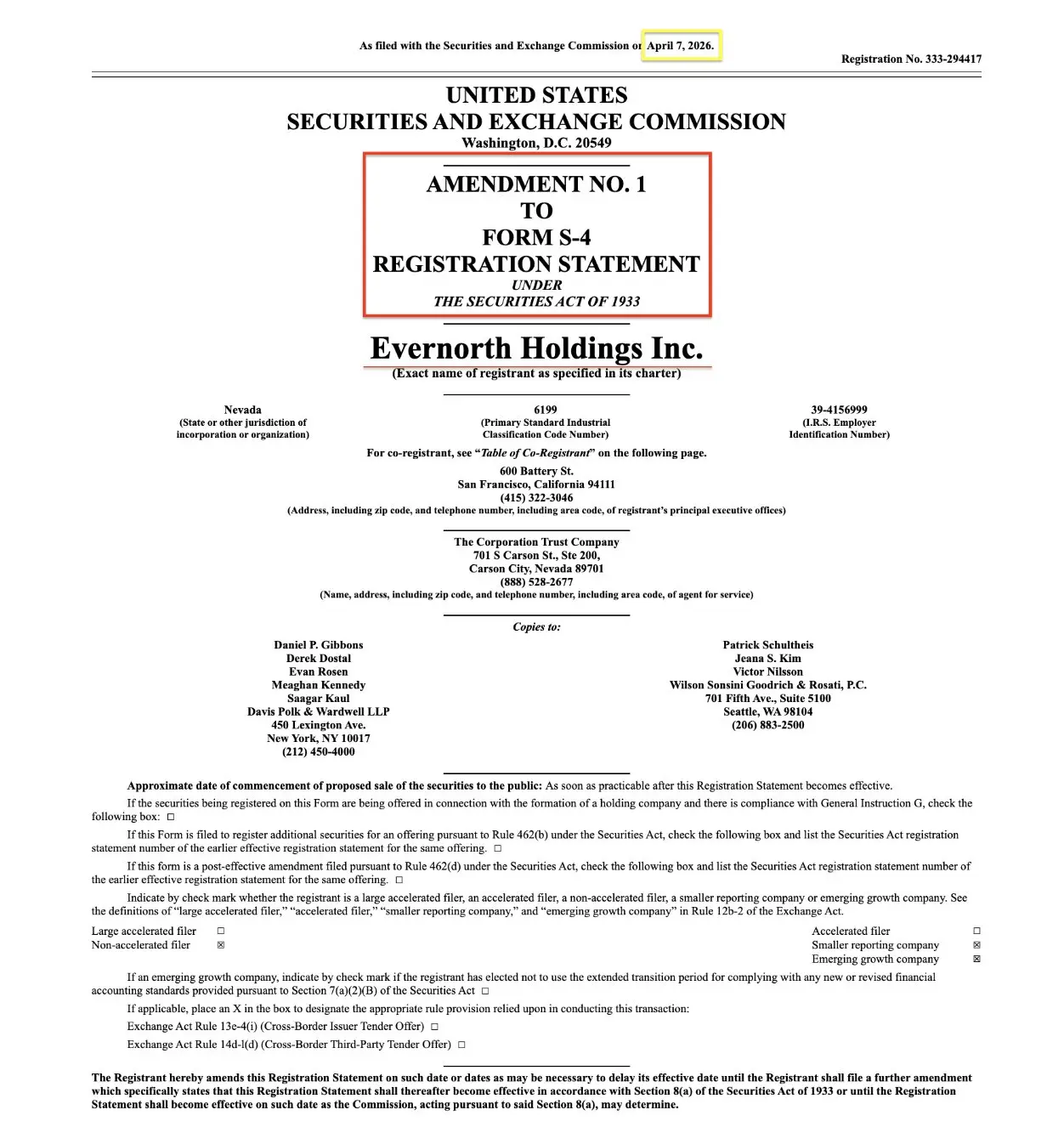 (Source: SEC)
Evernorth chose to complete its going-public process through a merger with Armada Acquisition Corp II rather than a traditional initial public offering (IPO). The SPAC route has become a common choice in recent years for crypto-related companies to enter the public markets, thanks to its flexible process and faster listing timeline, especially during periods when the regulatory environment is not yet fully clear and listing certainty is needed.
After the merger closes, the combined entity’s stock ticker will be XRPN, traded on Nasdaq. The updated registration statement filed with the SEC is a necessary regulatory step to complete the final merger, indicating that the merger process is moving forward according to the planned schedule.
The Business Logic of an XRP Treasury Strategy: Not Just Holding Coins
The post-merger XRPN entity will hold a substantial amount of XRP on its balance sheet. Its business model takes cues from companies such as MicroStrategy, which hold bitcoin as a core corporate reserve asset. XRP focuses on cross-border payments and financial settlement use cases, offering an institutional allocation logic distinct from bitcoin—an appeal that is independently attractive to institutional investors seeking to diversify their digital-asset allocations.
Four Strategic Significances of Listing an XRP Treasury Company
Indirect entry channel: By holding XRPN shares, investors gain exposure to XRP, overcoming compliance restrictions that prevent traditional investors from directly purchasing cryptoassets, while also covering the population of traditional institutional investors
Reduce circulating supply: If the company holds a large amount of XRP long term, it will reduce the amount of XRP circulating in the market, which in theory can support XRP’s price stability or support a long-term pump
Institutional confidence endorsement: A listed company publicly committing to XRP as its core asset strengthens market recognition of XRP as an institutional-grade asset
Bridging traditional and digital finance: Using Nasdaq’s mature trading framework further extends crypto assets to mainstream investor groups
Broader Market Implications: Accelerating XRP Institutionalization
Evernorth’s move reflects a deeper market transformation trend—institutional capital’s interest in XRP is shifting from observation to tangible allocations, and the role of digital assets is evolving from a speculative tool into a legitimate component of institutional financial portfolios. If XRPN ultimately succeeds in completing its Nasdaq listing, it will provide an important precedent reference for other companies seeking to replicate an XRP reserve model, further driving deep integration between Wall Street and the blockchain ecosystem.
Frequently Asked Questions
What is an XRP treasury company, and how does its business model differ from a bitcoin treasury company?
An XRP treasury company is a business that uses holding a large amount of XRP as its core asset balance-sheet strategy, building reserve value through long-term holding rather than short-term trading. Its model is similar to MicroStrategy’s strategy of using bitcoin as its core reserve. The main difference lies in the positioning of the underlying asset: XRP is focused on cross-border payment scenarios, while bitcoin is focused on value storage. As a result, the institutional investor groups attracted to each are different.
Compared with a traditional IPO, what advantages does a SPAC merger offer?
The SPAC route enables a going-public listing by merging with an already listed shell company, without needing a complete IPO underwriting process. It offers a faster listing timeline and greater certainty. For crypto-related companies, SPAC can effectively shorten the time to enter the public markets and reduce pricing uncertainty of a traditional IPO during periods of market volatility.
After XRPN is listed, what impact could it have on XRP market dynamics?
If large-scale XRP holdings are locked in the company’s balance sheet, the market’s circulating supply would decrease accordingly, which in theory can support XRP’s price. At the same time, a listed company’s public commitment to hold XRP can strengthen institutional investors’ confidence and may have a positive effect on overall market sentiment, though the actual impact will still depend on the final size of the holdings and market liquidity conditions.
Disclaimer: The information on this page may come from third parties and does not represent the views or opinions of Gate. The content displayed on this page is for reference only and does not constitute any financial, investment, or legal advice. Gate does not guarantee the accuracy or completeness of the information and shall not be liable for any losses arising from the use of this information. Virtual asset investments carry high risks and are subject to significant price volatility. You may lose all of your invested principal. Please fully understand the relevant risks and make prudent decisions based on your own financial situation and risk tolerance. For details, please refer to
Disclaimer.


