
Según los datos de Farside, durante la semana de operaciones en horario de la costa este de EE. UU. del 13 al 17 de abril, los ETF de Bitcoin spot en EE. UU. registraron 996 millones de dólares de entradas netas, el nivel semanal más alto desde mediados de enero de 2026, y al mismo tiempo la tercera semana consecutiva con entradas netas.
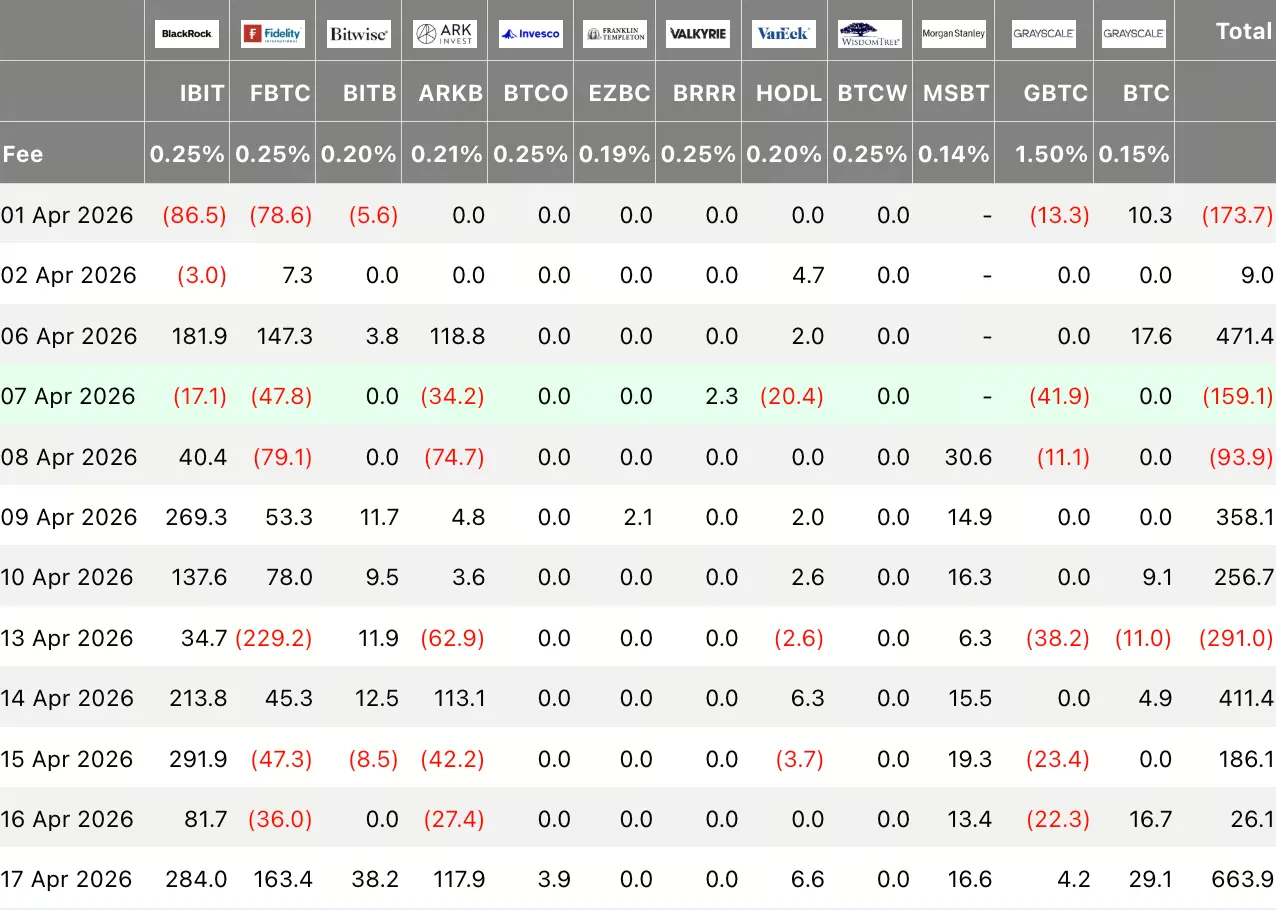
Fuente de la imagen: Farside
Desde la distribución intradía, estos 996 millones de dólares no se repartieron de manera uniforme entre los cinco días de negociación. El ritmo de entradas netas mostró una característica evidente de “aceleración en el tramo del fin de semana”: el viernes registró una entrada neta de 664 millones de dólares, la más alta de la semana; el martes y el miércoles registraron 412 millones y 186 millones de dólares, respectivamente; el jueves el flujo se desaceleró hasta 26 millones de dólares; mientras que el lunes se registró aproximadamente una salida neta de 291 millones de dólares. Pasar de una salida neta a una entrada neta récord en un solo día dentro de una misma semana sugiere que el sentimiento del mercado aún estaba dividido al inicio de la semana, pero a medida que cambiaron las expectativas macro, las instituciones alcanzaron rápidamente un consenso en el tramo de mitad a final de semana.
En cuanto a los productos, la semana pasada un total de 7 ETF de Bitcoin spot registraron entradas netas, entre ellos, el IBIT de BlackRock registró una entrada neta semanal de 906 millones de dólares, que representa el 91% del total de entradas netas de la semana, mostrando una alta concentración de fondos. El ARKB de ARK & 21 Shares registró 98,5 millones de dólares de entradas netas semanales, ocupando el segundo lugar; mientras que el FBTC de Fidelity registró una salida neta semanal de 104 millones de dólares.
¿Cómo impulsó el trasfondo macrofavorable la recuperación del apetito por el riesgo en esta ronda?
Los momentos de las entradas netas coinciden estrechamente con los cambios marginales en el entorno macro. En la semana del 13 de abril de horario de la costa este, el estrecho de Ormuz se reabrió brevemente por parte de Irán, lo que en cierta medida alivió las expectativas de tensión en el suministro global de energía, y los traders aprovecharon la situación para rotar hacia activos de riesgo, incluido Bitcoin. Al mismo tiempo, los datos de contratos de Polymarket muestran que la probabilidad de que Bitcoin alcance un máximo histórico antes del 31 de diciembre de 2026 ha subido hasta el 17,5%, desde el 14% de una semana antes.
El impulso más macro provino de las señales de datos de inflación. Los datos de CPI de marzo en EE. UU. muestran que el CPI subyacente interanual fue de 2,6%, por debajo de la expectativa del mercado (2,7%); y el CPI subyacente intermensual fue solo 0,2%, también por debajo de la expectativa del 0,3%. Esta combinación de datos liberó una señal clave: el alza de la inflación en marzo estuvo casi en su totalidad impulsada por los precios de la energía, mientras que la persistencia de la inflación “base” no parece tan preocupante como sugiere el nivel general de datos. Esto hizo que las expectativas del mercado sobre que la Reserva Federal mantendría una política restrictiva se enfriaran en el margen, desencadenando directamente la vuelta de capital a los activos de riesgo.
Cabe destacar que el doble efecto de la distensión geopolítica y las señales de inflación constituye la base macro del regreso de capital institucional en esta ronda. Sin embargo, ambos son variables de corto plazo, y su sostenibilidad aún debe observarse de cerca.
¿Qué significa la fortaleza de las entradas netas del IBIT de BlackRock?
El IBIT de BlackRock registró 906 millones de dólares de entrada neta semanal, lo que representa más de nueve décimas partes del total de entradas netas de la semana. Esta concentración, por sí misma, es una señal estructural que merece atención. La entrada neta acumulada histórica del IBIT ya ha alcanzado los 64.630 millones de dólares, muy por delante de todos los ETF de Bitcoin spot.
Mirando desde una dimensión de tiempo más larga, la posición de mercado del IBIT no se consolidó recientemente. En el primer trimestre de 2026, el IBIT registró 8.400 millones de dólares en entradas netas, más del doble que cualquier producto competidor en el mismo período. Al 30 de marzo de 2026, los ETF de Bitcoin spot listados en EE. UU. tenían en conjunto aproximadamente 1,29 millones de BTC, con un tamaño total de alrededor de 86.900 millones de dólares; dentro de ellos, el IBIT de BlackRock, por sí solo, concentraba aproximadamente el 60% de los activos de la categoría.
El significado de esta tendencia hacia la concentración merece un análisis en profundidad. En el mercado de ETF de Bitcoin spot con estrategias de inversión altamente homogéneas, la diferencia en comisiones se convierte en el indicador central de diferenciación. La comisión de gestión del IBIT de BlackRock es del 0,25%, superior al 0,14% del MSBT de Morgan Stanley y al 0,15% del mini trust de Bitcoin de Grayscale. Sin embargo, el IBIT sigue siendo capaz de captar la mayor porción de fondos institucionales, lo que sugiere que dentro del marco de decisión de los inversores institucionales, la credibilidad de la marca, la profundidad de la red de distribución y la profundidad de la liquidez suelen superar a los factores meramente relacionados con el costo. Esto implica que la competencia en el mercado de ETF de Bitcoin ya pasó de una “guerra de comisiones” a una etapa integral de “competencia por confianza y escala”.
¿Las entradas netas consecutivas durante tres semanas forman una señal de tendencia?
Los datos de entradas netas durante tres semanas consecutivas deben evaluarse dentro de un marco de tiempo más largo. En el primer trimestre de 2026, el total de activos del ETF de Bitcoin llegó a retroceder casi un 35% desde el máximo de mediados de enero de 1.280 millones de dólares. El gran retroceso del primer trimestre contrasta con las salidas de fondos desde el inicio del año, mientras que las entradas netas consecutivas recientes, al observar la dirección, constituyen una señal de reversión de tendencia.
Pero en términos de escala, esta reversión aún se encuentra en una etapa temprana. En la semana del 7 al 13 de abril, los ETF de Bitcoin spot registraron una entrada neta total de aproximadamente 786 millones de dólares; y en la semana del 13 al 17 de abril se amplió aún más hasta 996 millones de dólares. El tamaño de las entradas semanales viene expandiéndose semana a semana, pero desde la estructura del capital, la diversificación dentro del mercado sigue siendo notable: la semana pasada el FBTC de Fidelity registró una salida neta de 104 millones de dólares, en contraste con la entrada fuerte del IBIT. Esta diferenciación indica que las entradas netas actuales están impulsadas principalmente por un solo producto, el IBIT, y no por una afluencia generalizada del conjunto del mercado. La consolidación de una señal de tendencia requiere como condición de verificación una entrada sincronizada de más productos.
Después de superar 1 billón de dólares en activos totales, ¿cómo se mide la profundidad de la institucionalización?
Al 17 de abril, el valor liquidativo total de los ETF de Bitcoin spot ya alcanzó los 101.450 millones de dólares. La proporción de activos netos de los ETF (el valor de mercado de los ETF como proporción del valor de mercado total de Bitcoin) subió al 6,55%. Esta proporción implica que, de cada aproximadamente 15 Bitcoins en el mundo, 1 se mantiene a través del canal de ETF spot.
Mirando desde un marco más macro de asignación de activos, esta penetración aún es relativamente baja, pero la pendiente de crecimiento merece atención. Cuando los ETF de Bitcoin spot se aprobaron para cotizar en 2024, su tamaño total era solo de aproximadamente 56.000 millones de dólares; para abril de 2026, los cinco grandes gestores de criptoactivos ya habían superado los 100.000 millones de dólares en activos bajo gestión. En unos 18 meses, el tamaño se ha acercado a duplicarse; y el crecimiento proviene principalmente de entradas netas continuas de fondos institucionales, más que de impulsar el precio. Esto en sí mismo constituye una evidencia directa de la aceleración del proceso de institucionalización.
Cabe señalar que el ratio actual de activos netos del 6,55% no significa que la asignación institucional de Bitcoin ya esté saturada. Por el contrario, este ratio aún se encuentra en la etapa temprana de la curva de asignación institucional: el Comité de Inversiones Global de Morgan Stanley recomienda asignar a clientes entre 0 y 4% de activos cripto; esta recomendación por sí sola indica que las instituciones financieras tradicionales todavía están explorando el límite de la proporción de asignación, en lugar de haber llegado ya al límite.
¿Qué variables de riesgo podrían afectar el ritmo de las entradas de fondos en el futuro?
Aunque los datos recientes muestran una tendencia positiva, las variables de riesgo que afectan el flujo de fondos hacia los ETF también merecen un análisis sistemático.
El riesgo geopolítico es la principal variable. La persistencia del acuerdo de cese de hostilidades entre EE. UU. e Irán determina directamente el entorno de precios de los activos de riesgo. Si el acuerdo se rompe nuevamente, el sentimiento de refugio podría intensificarse rápidamente, con riesgo de salidas de fondos en dirección contraria. Existe una cadena de transmisión estrecha entre las condiciones de navegación en el estrecho de Ormuz y las expectativas sobre precios de la energía; y el precio de la energía es una de las variables clave en las expectativas de inflación. La complejidad de esta ruta de transmisión implica que el impacto del riesgo geopolítico en el flujo de fondos hacia los ETF no es lineal.
La orientación de la política monetaria es la segunda variable clave. La dirección de las señales de recortes de tasas de la Reserva Federal afectará directamente la fijación de precios por parte de los inversores sobre el tipo de interés libre de riesgo, y de ahí se transmitirá a la atractividad de la asignación de activos de riesgo como Bitcoin. Si la persistencia de la inflación excede las expectativas y el momento de los recortes se retrasa, podría presionar las entradas de fondos hacia los ETF.
La estructura de fondos internos es la tercera variable que no debe pasarse por alto. Como se mencionó antes, las entradas netas actuales están altamente concentradas en un solo producto, el IBIT de BlackRock; mientras que el resto de varios ETF aún permanecen en estado de salida neta. Esta estructura de “concentración en el frente y salidas en la cola” significa que el sentimiento del capital en todo el mercado sigue dividido. Si el impulso de entradas del IBIT se ralentiza y los demás productos no logran reemplazarlo a tiempo, el tamaño total de entradas netas podría experimentar un retroceso temporal.
El análisis técnico y el sentimiento del mercado también merecen atención. Existe un mecanismo de retroalimentación bidireccional entre el precio de Bitcoin y las entradas a los ETF: el alza de precios normalmente atrae más capital que busca perseguir el movimiento (追涨), y las entradas continuas también brindan soporte al precio. Si este ciclo de retroalimentación positiva se rompe, podría desencadenar presión por salidas de fondos en dirección contraria.
Resumen
Los ETF de Bitcoin spot registraron 996 millones de dólares de entradas netas durante la semana del 13 al 17 de abril de 2026, estableciendo el nivel semanal más alto desde mediados de enero y señalando la consecución de entradas netas por tercera semana consecutiva. El IBIT de BlackRock lideró el mercado con 906 millones de dólares de entradas netas; sus entradas netas históricas acumuladas ya suman 64.630 millones de dólares, lo que representa alrededor del 60% de la cuota de activos de la categoría de ETF de Bitcoin spot. El valor de los activos netos totales superó los 101.450 millones de dólares, y el ratio de activos netos de los ETF subió al 6,55%; a nivel global, de cada aproximadamente 15 Bitcoins, 1 se mantiene a través del canal de ETF. Los impulsores macro de esta ronda de entradas de fondos incluyen la distensión de riesgos geopolíticos y datos de inflación subyacente por debajo de lo esperado; ambos impulsaron conjuntamente el apetito por el riesgo del mercado. Sin embargo, la sostenibilidad de la situación geopolítica, la incertidumbre sobre el momento de los recortes de tasas de la Reserva Federal y las características estructurales de la alta concentración de fondos en un solo producto siguen siendo las variables de riesgo clave que afectan el ritmo de las entradas de fondos posteriores. La tendencia de la asignación institucional a criptoactivos continúa, pero la sostenibilidad de la tendencia aún debe seguirse y validarse de forma continua.
Preguntas frecuentes
P: ¿Qué significa una entrada neta semanal de 996 millones de dólares en ETF de Bitcoin spot?
Este es el nivel semanal más alto desde mediados de enero de 2026; además, marca la tercera semana consecutiva con entradas netas. En comparación con los datos semanales anteriores, durante la semana del 7 al 13 de abril la entrada neta fue de aproximadamente 786 millones de dólares, y el tamaño de esta semana se amplió aún más.
P: ¿Por qué el IBIT de BlackRock puede seguir atrayendo continuamente la mayor parte de los fondos?
El IBIT atrae de manera sostenida la asignación de fondos de inversores institucionales gracias al aval de la mayor gestora de activos a nivel global, a una gran red de distribución institucional y a una sólida profundidad de liquidez. Al 17 de abril, la entrada neta total histórica del IBIT alcanzó 64.630 millones de dólares, muy por delante de todos los ETF de Bitcoin spot.
P: ¿Qué significa el ratio de activos netos de ETF del 6,55%?
Este ratio indica la proporción del valor de mercado de Bitcoin mantenido actualmente a través de ETF spot, que es del 6,55% del valor de mercado total de Bitcoin; es decir, de cada aproximadamente 15 Bitcoins en el mundo, 1 se mantiene a través del canal de ETF. Un aumento continuo de este ratio suele considerarse un indicador importante de la aceleración de la adopción institucional.
P: ¿Qué factores podrían afectar hacia dónde se dirigen las entradas de fondos en los ETF en el futuro?
Los principales factores de riesgo incluyen: la persistencia del acuerdo de cese de hostilidades entre EE. UU. e Irán (afecta directamente el sentimiento de los activos de riesgo), el calendario de recortes de tasas de la Reserva Federal (el entorno de tipos de interés afecta directamente el apetito por el riesgo de los inversores), y la evolución del análisis técnico del propio Bitcoin. Además, la característica estructural de que los fondos estén altamente concentrados en el único producto IBIT también significa que, si las entradas del IBIT se ralentizan y los demás productos no logran relevarlo, las entradas netas totales podrían enfrentar un retroceso temporal.
P: ¿Esta ronda de entradas de fondos significa que las instituciones están “comprando en el fondo” (抄底)?
Según los datos, estas entradas de fondos ocurrieron después de una fuerte corrección en el mercado durante el primer trimestre. El tamaño total de activos de los ETF de Bitcoin se redujo casi un 35% desde el máximo de 1.280 millones de dólares a mediados de enero; y las entradas netas consecutivas recientes de tres semanas reflejan, en cierta medida, la reasignación de fondos institucionales después del ajuste de precios. No obstante, hay que tener en cuenta que las decisiones de asignación institucional suelen basarse en marcos de activos de mayor plazo, y no deben equipararse de forma simple con una conducta de “comprar en el fondo” de corto plazo.


