I. Why Is Watching On-Chain Behavior Essential?
For many mainstream crypto assets, on-chain data primarily helps verify:
- Long-term usage
- Protocol health
However, in the meme market, on-chain behavior itself represents the core market activity.
This is because:
- There are no long-term fundamentals
- Prices depend heavily on participant actions
- Sentiment changes are immediately reflected in trading behavior
Therefore, understanding meme markets requires observing on-chain behavior patterns rather than relying solely on price charts.
II. What Is “Chain Scanning” Behavior?
In the meme market, chain scanning refers to identifying potential meme opportunities by monitoring new tokens, capital inflows, and trading activities in real time.
Typical chain scanning behaviors include:
- Monitoring newly created tokens
- Tracking early trading addresses
- Observing small but frequent exploratory trades
The objective is simple: Enter before sentiment spreads widely.
III. Early Participants vs Relay Participants
On-chain participants typically fall into two groups.
1. Early Participants
- Relatively small capital size
- Fast decision-making
- High risk tolerance
- More exploratory behavior
Their trading often determines whether a Meme can advance to the next stage.
2. Relay Participants
- Motivation leans toward sentiment confirmation
- Rely on price trends and social signals
- Focus more on whether consensus has formed
On-chain, these two participant types show clearly different behavioral rhythms, forming the most typical game structure in the Meme market.
IV. How Is “Sentiment Gaming” Reflected On-Chain?
Sentiment games aren’t shown in slogans or community atmosphere but directly reflected in these on-chain signals:
- Change in holding concentration: During high sentiment, concentration often rises first then disperses.
- Trade frequency and volume: In warming-up phases, small transactions surge.
- Address behavioral synchronization: Multiple addresses execute similar operations within similar timeframes.
These actions aren’t deliberate coordination but the natural spread of sentiment within the group.
V. Why Is the Rhythm of Games in the Meme Market So Fast?
Compared with mainstream assets, the game rhythm in the Meme market is significantly faster due to:
- Low participation threshold
- Low decision cost
- Relatively limited failure penalty
This leads participants to:
- Enter quickly
- Verify quickly
- Exit quickly
In this environment, on-chain behavior itself becomes one of the earliest signals of sentiment shifts.
VI. Common Misconceptions: Treating On-Chain Behavior as “Definitive Signals”
It’s important to emphasize that on-chain behavior does not equate to deterministic conclusions. Common misunderstandings include:
- Viewing early capital activity as “smart money”
- Treating address concentration as long-term support
- Mistaking short-term activity for sustained consensus
In the Meme market, on-chain data is more for understanding structure—not for predicting outcomes.
VII. Using Gate DEX to Observe Meme Chain Scanning and Capital Behavior
Gate DEX integrates tools like MemeGo, Trackers, and Gate Fun. In a Meme market cycle, “chain scanning” isn’t just about tracking prices—it’s about using these tools to quickly spot new token launches, capital inflow timing, and how market sentiment is gathering. Each tool corresponds to a different phase: discovery, confirmation, and sentiment assessment.
1. Using MemeGo to Discover Early Meme Projects
MemeGo aggregates information about newly emerged Meme tokens. On the MemeGo page, learners should focus first on lists like “newly created tokens” or projects with recently rising trading activity. The key at this stage isn’t to judge quality but to narrow the observation scope.
Common actions include:
- Checking token creation time to filter for newly launched projects
- Seeing if initial liquidity exists rather than zero-liquidity shells
- Comparing transaction counts among multiple new Memes rather than just price increases
MemeGo is best suited for the discovery stage before chain scanning.
2. Using Trackers to Observe Capital and Address Behavior
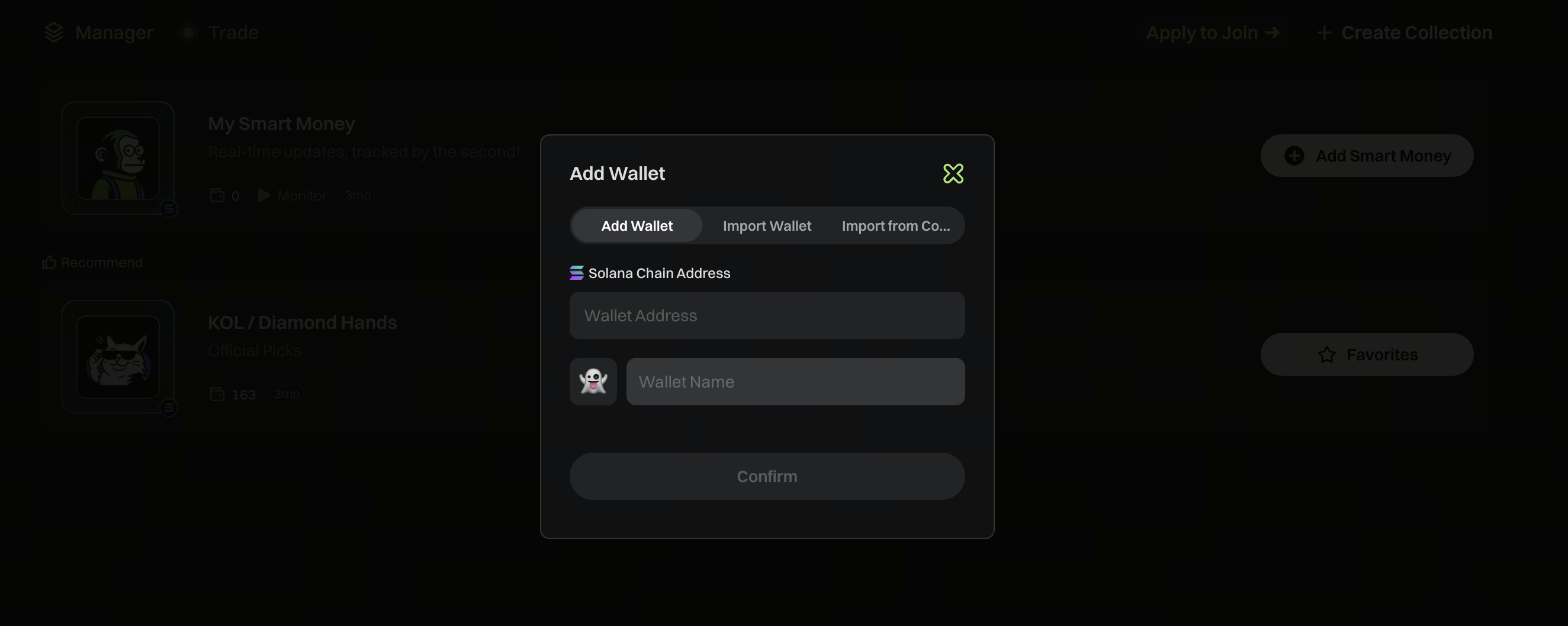
Image: https://web3.gate.com/trackers
Once you’ve identified observation targets, Trackers’ core function is to let you customize tracking of key on-chain addresses’ behavioral changes—not just look at all transaction records broadly. With Trackers, learners can continuously monitor buy/sell activity and holding changes among Smart Money, KOLs, and Diamond Hands wallets.
Key dimensions when using Trackers:
- Address structure: Are marked key addresses starting to participate, or are multiple key wallets entering the same Meme project around the same time?
- Trading rhythm: Are these addresses building positions through staggered, small-amount, continuous buys?
- Behavioral consistency: Do tracked addresses show high similarity in trade amounts and operation paths?
When multiple key wallets show similar buy actions in a short timeframe on Trackers, it usually signals market consensus forming. Such on-chain signals often precede sharp price moves but may also indicate risks of subsequent sentiment amplification. Thus, Trackers are best for behavior confirmation and risk assessment during chain scanning.
3. Using Gate Fun to Participate and Observe Early Meme Launch Phases
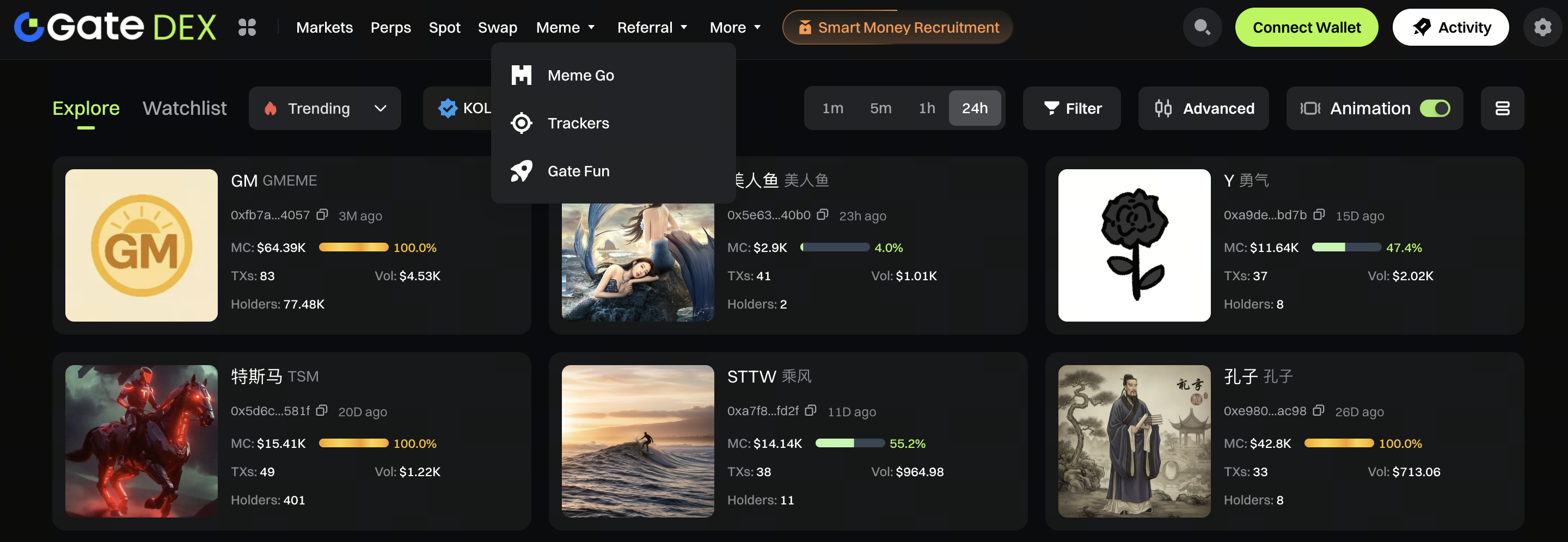
Image: https://web3.gate.com/gatefun?tab=explore
Gate Fun is Gate DEX’s Meme launchpad for creating, launching, and early trading of new Meme projects. In the Meme market cycle, Gate Fun doesn’t correspond to secondary market chasing but is where sentiment and capital first take effect. Through Gate Fun, learners can see which Memes are being rapidly created, whether participant numbers are concentrating quickly, and if early trading shows obvious asymmetry. For example, if buy address counts rise quickly but trade sizes remain small in early launch stages, retail sentiment is likely building; if a few addresses occupy large shares early on, beware of concentration risks.
Compared with MemeGo and Trackers, Gate Fun focuses more on “participation structure” than price trends. It’s suitable for judging whether a Meme project is in sentiment cold start, acceleration phase, or has entered a high-risk overheated stage. Thus, Gate Fun is best for launch observation and early risk identification before and after chain scanning—not as a trend confirmation tool.
Basic Logic for Combining Tools
- MemeGo: Discover “just-created Memes”
- Trackers: Track “who’s moving money”
- Gate Fun: Judge “who’s participating earliest and whether structure is healthy”
With this combination, learners focus not on “can I profit,” but rather whether the high-risk zone is approaching—one of the most crucial skills in Meme education.