From Single-Market Traders to Cross-Market Allocators
In traditional environments, markets were clearly segregated:
- Stocks in securities accounts
- Futures in futures accounts
- Forex in bank or broker systems
- Crypto assets in on-chain wallets or exchanges
Slow fund transfers, differing regulatory frameworks, and varying trading hours naturally limited cross-market operations.
Now, as stablecoins become a settlement medium and on-chain protocols can map gold, forex, stock indices, and treasury yields, different markets are brought together within the same settlement environment for the first time.
This shift does not simply increase the number of assets—it expands the dimensions of strategy.
Traders begin to focus on:
- The relative relationship between US Treasury yields and ETH staking returns
- The hedging correlation between gold prices and BTC volatility
- The linkage between Nasdaq futures volatility and risk appetite in crypto markets
- Arbitrage opportunities between forex interest rate spreads and on-chain lending rates
At this stage, the core of trading is no longer predicting price movements, but identifying inconsistencies in risk pricing across markets.
TradFi × Crypto: The Trend Toward Strategy Integration
The new generation of trading strategies often employs both TradFi and Crypto tools in combination, rather than choosing one over the other.
Common forms of integrated strategies include:
- Using on-chain stablecoins as margin to participate in mapped contracts for gold, forex, or stock indices
- Going long on spot assets in TradFi markets while shorting their price-mapped contracts on-chain for hedging
- Leveraging efficient on-chain clearing mechanisms for high-frequency margin management and risk control
- Combining DeFi yield strategies (staking, lending) with TradFi low-volatility asset allocation
- Hedging price risks during TradFi market closures through the 24/7 crypto market
The essence of this integration is that Crypto offers efficiency and liquidity, while TradFi provides depth and asset anchoring. They are no longer competitors but are gradually becoming functionally complementary.
Structural Changes and Possible Paths for Future Financial Markets
As more assets can be mapped on-chain and more traders become accustomed to settling with stablecoins, the structure of financial markets will undergo profound changes.
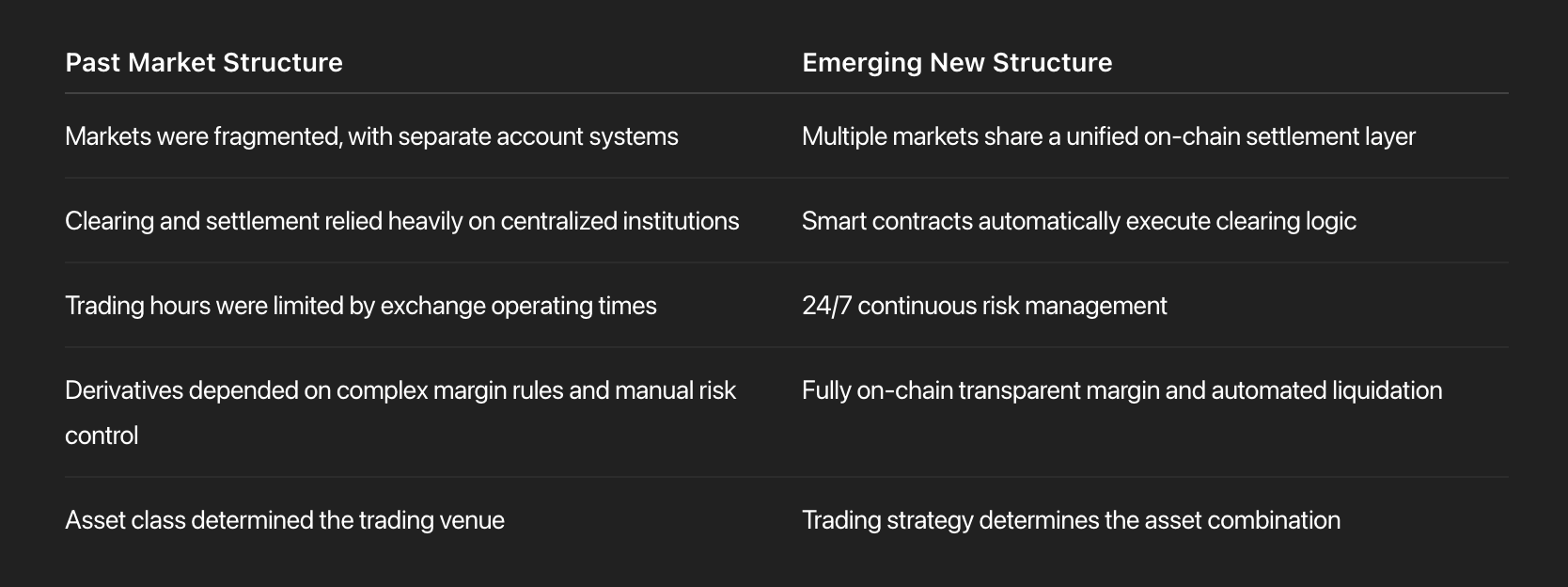
Potential paths include:
- More TradFi derivatives directly existing in on-chain form
- Stablecoins becoming universal margin across markets
- Market makers and arbitrageurs becoming key connectors between traditional and emerging markets
- The boundary between exchanges and on-chain protocols gradually blurring
- The concept of accounts weakening as addresses and contracts become the primary modes of interaction
Amid the integration of traditional and emerging finance, the biggest change is not in assets or technology but in the cognitive upgrade of traders themselves. The core ability of the future will no longer be deep understanding of a single market, but insight into structural differences between financial systems—and the ability to translate that insight into trading strategies. When market boundaries disappear, true opportunities arise where those boundaries once existed.