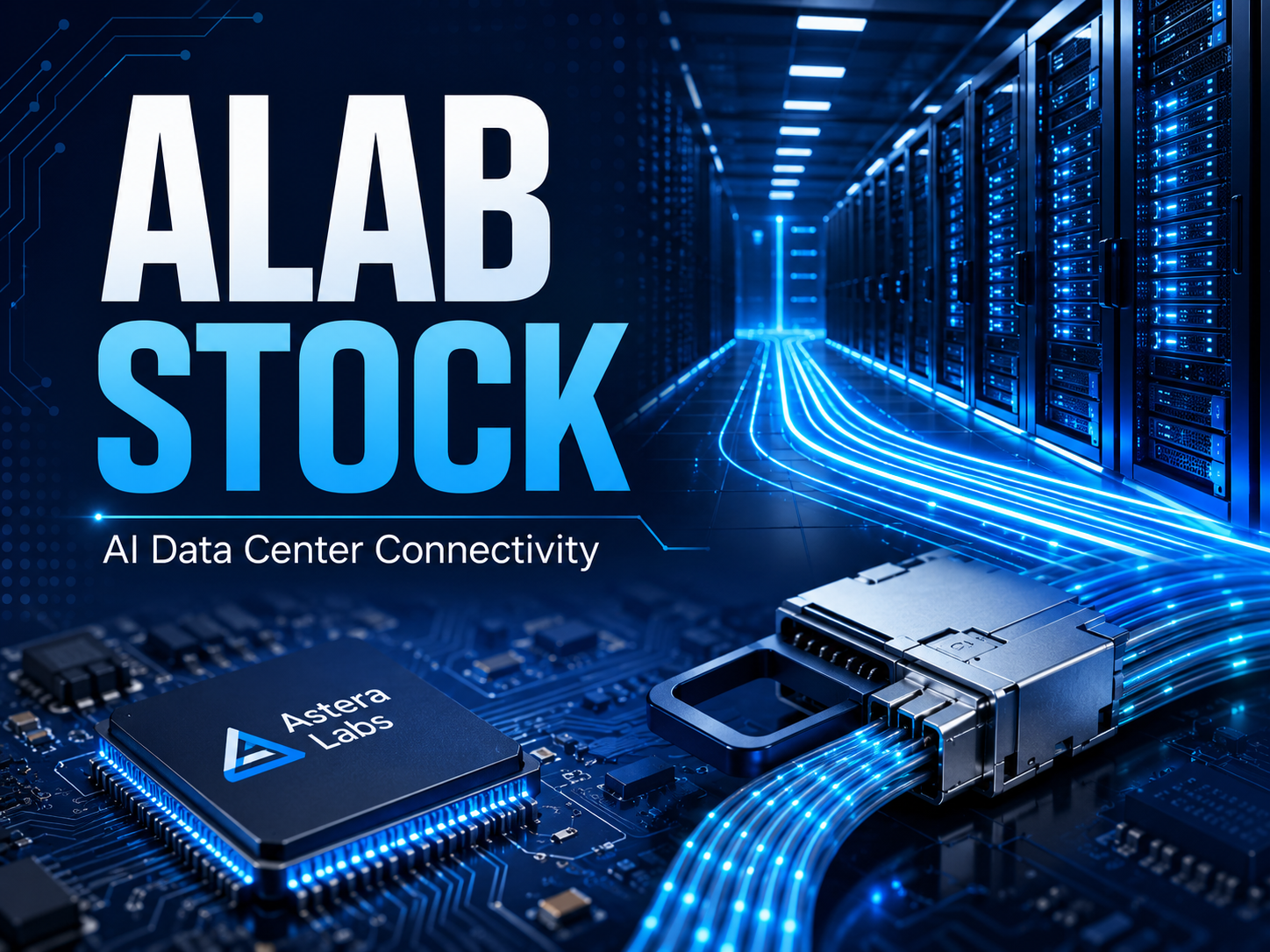
Astera Labs identifies itself in its 2025 financial report as a semiconductor connectivity solutions provider for rack-scale AI infrastructure, trading under the ticker ALAB.
Unlike manufacturers of GPUs, CPUs, or memory chips, Astera Labs specializes in solving the challenge of connecting compute, memory, storage, and network resources within AI data centers at high speed, with stability, and low latency. As AI model training and inference scale from single servers to multi-GPU, multi-rack, and large clusters, connectivity chips have become a critical factor influencing overall system efficiency.
To evaluate ALAB stock, it's essential to position it within the broader AI semiconductor value chain. ALAB is neither a traditional consumer electronics chip stock nor a pure-play data center network equipment stock. Instead, it's best understood as an AI infrastructure connectivity company, with revenue closely tied to AI server upgrades, cloud provider capital expenditures, PCIe/CXL generational transitions, and new product adoption cycles.
What Is Astera Labs (ALAB) Stock
The key narrative for Astera Labs (ALAB) stock is whether the company can continue to capitalize on the growing complexity of AI data center connectivity. AI servers require not just more GPUs, but also higher bandwidth, lower latency, and more reliable connections—otherwise, these costly accelerators may be underutilized due to data transmission bottlenecks.
Astera Labs’ core offering is its Intelligent Connectivity Platform, which the company describes as a suite of high-speed connectivity ICs, modules, boards, and COSMOS connectivity system management and optimization software. This platform is designed for hyperscale customers, supporting high-performance AI infrastructure deployment, monitoring, and long-term stability.
From an investment perspective, ALAB is a growth-oriented semiconductor stock. Its revenue growth is generally linked to AI infrastructure buildout cycles, rather than consumer electronics trends. Market perceptions of its revenue and profit potential depend on the platform’s penetration into new AI systems, customer diversification, and sustained volume growth in areas like PCIe 6, CXL, and fabric switches.
Astera Labs’ Business Structure
Astera Labs’ business is built around its intelligent connectivity platform, with core products spanning PCI Express, CXL, and Ethernet connectivity protocols. According to the company’s product page, PCIe solutions include Scorpio Smart Fabric Switches, Aries PCIe/CXL Smart DSP Retimers, Aries Smart Cable Modules, and Aries PCIe Smart Gearbox; CXL offerings feature the Leo CXL Smart Memory Controller and related Aries products; Ethernet solutions are led by Taurus Ethernet Smart Cable Modules.
This diversified structure means Astera Labs isn’t reliant on a single chip product line, but instead addresses multiple aspects of AI data center connectivity. Aries focuses on high-speed signal transmission and reliability, Leo enables CXL memory expansion and pooling, Taurus delivers Ethernet connectivity, and Scorpio targets AI fabric switching and large-scale rack-level connections.
| Business Module |
Core Product |
Main Function |
AI Data Center Use Case |
| PCIe Connectivity |
Aries Retimer, Smart Cable, Gearbox |
Enhances high-speed signal integrity and connection distance |
GPU, CPU, accelerator, storage links |
| CXL Connectivity |
Leo CXL Memory Controller |
Supports memory expansion and pooling |
AI inference, memory-intensive workloads |
| Ethernet Connectivity |
Taurus Smart Cable Module |
Enables high-speed Ethernet connectivity and diagnostics |
Data center network and server links |
| Fabric Switch |
Scorpio Smart Fabric Switch |
Scales AI cluster connectivity |
GPU clusters, rack-level AI architectures |
| Software Platform |
COSMOS |
Monitors, diagnoses, and manages connectivity |
Large-scale infrastructure operations |
This table highlights a core trait of ALAB stock: the company’s value is driven by the completeness of its AI data center connectivity platform, not just individual chips. The broader the product line’s coverage, the greater the opportunity to evolve from a single-point chip supplier to a platform-based connectivity solutions provider.
How Astera Labs’ Core Products Enable AI Data Centers
Astera Labs’ product lines help AI data centers by making high-speed data paths between compute, memory, storage, and network more stable and manageable. As signal speeds increase and system designs become more complex, connectivity chips play a crucial role in maintaining signal integrity, device interoperability, and system reliability.
Aries PCIe/CXL Smart DSP Retimers address high-speed PCIe and CXL signal transmission challenges. According to the company, Aries Retimers solve signal integrity issues and provide reliable reach extension, while Aries Smart Cable Modules support the COSMOS suite for fleet management, security, and advanced diagnostics.
The Leo CXL Smart Memory Controller is designed for memory expansion and pooling. It’s a purpose-built solution for overcoming performance bottlenecks and capacity limits in cloud servers. In AI inference, recommendation systems, and large-scale memory access, CXL connectivity is a key driver of system efficiency.
Why Do AI Servers Need High-Speed Connectivity Chips?
The bottleneck for AI workloads isn’t just compute power—it’s also the ability to move data efficiently. If bandwidth is insufficient, latency is high, or signals are unstable between GPUs, CPUs, memory, SSDs, and network cards, overall system utilization suffers.
Astera Labs emphasizes that AI workloads at scale are driving rack-scale computing requirements, and purpose-built connectivity solutions are essential to unlock full infrastructure potential. The Intelligent Connectivity Platform prioritizes high bandwidth, low latency, reliability, real-time link monitoring, and fleet health management—all critical for large-scale AI cluster operations.
Connectivity complexity also increases with protocol upgrades. Transitions to PCIe 5, PCIe 6, CXL, and high-speed Ethernet mean higher speeds, denser wiring, and stricter reliability standards. Astera Labs’ product strategy is closely aligned with these protocol transitions, making ALAB a key beneficiary of the AI data center connectivity trend.
Astera Labs’ Revenue Sources and Profit Model
Astera Labs’ revenue is primarily derived from selling semiconductor connectivity products and solutions to cloud providers, AI server platforms, and data center infrastructure customers. Since these products are integral to AI infrastructure, revenue growth is closely linked to AI server deployment, customer adoption, product ramp-up, and new protocol cycles.
For fiscal year 2025, Astera Labs reported $852.5 million in annual revenue, up 115% year-over-year; Q4 revenue reached $270.6 million, up 92% year-over-year and 17% sequentially. The company also posted a GAAP gross margin of 75.7% and GAAP net income of $219.1 million, underscoring its high-margin business model.
| Financial Metric |
2025 Result |
Meaning |
| Annual Revenue |
$852.5 million |
Indicates scale-up of AI connectivity sales |
| YoY Revenue Growth |
115% |
Reflects high-growth business phase |
| GAAP Gross Margin |
75.70% |
Demonstrates high value-added product mix |
| GAAP Net Income |
$219.1 million |
Confirms annual profitability |
| Q4 Revenue |
$270.6 million |
Shows ongoing quarterly demand expansion |
This financial performance is central to understanding ALAB. Rapid growth and high margins support premium valuations, but also raise expectations for sustained revenue acceleration, customer expansion, and product ramp-up. Any slowdown can lead to negative valuation adjustments.
Astera Labs’ Position in the AI Semiconductor Value Chain
Astera Labs operates at the connectivity layer of the AI semiconductor value chain—not the core compute layer. GPUs, CPUs, and AI accelerators handle computation; HBM and memory systems manage data storage and access; Astera Labs’ products enable efficient connections among these components in servers and rack-scale architectures.
This positioning relates ALAB to companies like NVIDIA, AMD, Intel, Broadcom, and Marvell, but with distinct business boundaries. Astera Labs’ value is tied to rising connectivity complexity, not direct sales of GPUs or large switching chips. As AI infrastructure expands from single machines to rack-scale and clusters, the importance of the connectivity layer increases.
In this context, Astera Labs acts as an “efficiency amplifier” for AI infrastructure. When GPU costs are high, cloud providers focus on accelerator utilization, system stability, and operational efficiency—areas where connectivity chips, fabric switches, and COSMOS software add value.
What Drives ALAB Stock Price?
ALAB stock price is influenced by AI server demand, cloud provider capital expenditures, customer adoption rates, new product ramp-up, and overall financial performance. Since revenue is closely tied to AI infrastructure buildout, investors watch for continued AI server investment by large cloud providers and platform wins for Astera Labs’ products.
Product cycles are also critical: Aries targets mature PCIe/CXL connectivity, Leo addresses CXL memory expansion, and Scorpio opens up AI fabric switch and rack-scale opportunities. In its 2025 earnings report, Astera Labs announced the expansion of the Scorpio X-Series smart fabric roadmap for scale-up opportunities and ramp-up for lead platforms.
Key factors affecting ALAB stock include:
- Expansion pace of AI server and GPU cluster deployments
- Smooth ramp-up of Aries, Leo, Taurus, and Scorpio product lines
- Stability of demand from cloud providers and AI platform customers
- New demand from PCIe, CXL, Ethernet, and other protocol upgrades
- Financial growth, gross margin, and customer concentration meeting expectations
Together, these shape ALAB’s growth stock valuation logic—investors look beyond current revenue to future product portfolio, customer expansion, and generational AI infrastructure upgrades.
How Is Astera Labs Stock Different from Traditional Chip Stocks?
Astera Labs differs from traditional chip stocks by focusing on the AI data center connectivity layer. Its business cycle is not directly tied to consumer electronics, automotive, or general-purpose analog chips. Traditional chip stocks are often influenced by consumer cycles, inventory swings, and broad industry demand, while ALAB is concentrated on cloud data center and AI infrastructure investment.
Astera Labs’ advantage over traditional semiconductor firms is its focus on the fast-growing AI connectivity segment, leveraging hardware ICs, modules, boards, and COSMOS software for a platform approach. The company highlights features like distributed microcontrollers, sensors, diagnostics, telemetry, reliability, QoS, and software management—delivering both chips and system-level connectivity solutions.
| Comparison |
Astera Labs (ALAB) Stock |
Traditional Chip Stocks |
| Core Application |
AI data center connectivity |
Consumer electronics, industrial, auto, communications |
| Revenue Drivers |
AI servers, cloud capex, protocol upgrades |
End demand, inventory cycles, industry health |
| Product Features |
PCIe, CXL, Ethernet, Fabric Switch, software |
Compute, storage, analog, control, communications chips |
| Growth Elasticity |
Highly correlated with AI infrastructure expansion |
Dependent on industry/product cycles |
| Main Challenges |
Customer concentration, rapid tech iteration, AI investment sensitivity |
Cyclical swings, price competition, inventory adjustments |
| Valuation Logic |
High-growth AI infrastructure focus |
Mix of growth, cyclical, defensive factors |
This focus brings both opportunity and risk. ALAB stock is more sensitive to shifts in AI infrastructure demand; slower cloud capex, delayed platform adoption, or increased competition in connectivity chips could impact growth expectations. Understanding ALAB requires more than just the “AI story”—it demands attention to product adoption, customer mix, protocol upgrades, and profit quality.
How to Trade Astera Labs (ALAB) Stock with USDT on Gate
To trade Astera Labs (ALAB) stock on Gate, users can search for ALAB on the Gate stock page and use USDT in their account to buy or sell. Unlike traditional brokers that require USD or local fiat deposits, Gate’s stock trading is tailored for users who already hold USDT and want access to US equities on the same platform.
Before trading, confirm you’re on the ALAB stock trading page, not the ALAB_USDT perpetual futures or other derivatives page. Each product has different rules, risk structures, and settlement methods—verify the product type, available balance, order price, execution method, and platform notices before placing an order.
After buying ALAB stock with USDT, you can view filled quantity, fill price, current valuation, and sellable quantity in your holdings or order history. After selling, proceeds are settled in USDT per platform rules and reflected in your account. Specific details and fees are as shown on the Gate page.
Summary
Astera Labs (ALAB) stock represents a US-listed company focused on high-speed connectivity chips for AI data centers, with its core value coming from the Intelligent Connectivity Platform—encompassing PCIe, CXL, Ethernet, fabric switch, and COSMOS software. The company doesn’t manufacture GPUs, but instead enables efficient data connectivity among GPUs, CPUs, memory, storage, and network components.
Key factors for ALAB include AI server demand, cloud provider capex, performance of mature products like Aries, ramp-up of new products like Leo and Scorpio, and the company’s ability to sustain high growth and margins. Compared to traditional chip stocks, ALAB is more concentrated on the AI infrastructure connectivity layer, offering greater growth potential but also higher sensitivity to customer demand and technology cycles.
FAQ
What is Astera Labs (ALAB) stock?
Astera Labs (ALAB) stock is the common stock of Astera Labs listed on Nasdaq, representing a semiconductor company specializing in high-speed connectivity chips, CXL, PCIe, and intelligent connectivity platforms for AI data centers.
What does Astera Labs do?
Astera Labs provides connectivity chips and system solutions for AI data centers, including Aries Retimer, Leo CXL Memory Controller, Taurus Ethernet Module, Scorpio Fabric Switch, and COSMOS software.
Why is ALAB stock related to AI data centers?
ALAB stock is tied to AI data centers because AI servers require high-speed, low-latency, and reliable connections—needs addressed by Astera Labs’ PCIe, CXL, and fabric switch products.
Where does Astera Labs’ revenue come from?
Astera Labs’ revenue primarily comes from data center customers purchasing high-speed connectivity chips, modules, boards, and related solutions. Revenue growth is linked to AI server deployment, cloud provider demand, and new product ramp-up.
What factors affect ALAB stock price?
ALAB stock price is influenced by AI server demand, cloud provider capex, customer adoption rates, product ramp-up, revenue growth, gross margin, and the competitive semiconductor landscape.
How is Astera Labs different from traditional chip stocks?
Astera Labs differs from traditional chip stocks by focusing on the AI data center connectivity layer, rather than consumer electronics, automotive, or general-purpose chips, making it more sensitive to AI infrastructure cycles.