When buying USDT, the same exchange often offers Quick Buy (Quick Trade) and P2P side by side. Both deliver USDT balance but differ in counterparty, price formation, and confirmation actions. Treating them as "the same button with two skins" is a common cause of fee miscalculation and timeout errors.
How to Buy USDT covers four total paths. Quick Buy and P2P are the two most common fiat routes and deserve a direct fee, speed, and risk comparison. Gate click order follows the live Buy Crypto page and Gate Help Center.
What Are Quick Buy and P2P?
Quick Buy means selecting USDT and a payment method on the buy page, then paying per the displayed quote or channel flow, with the platform and payment provider handling fiat-to-crypto ledger credit. Users mainly verify amount, fees, and payment outcome, with little interaction with individual sellers.
P2P means browsing seller ads, filtering by price, payment method, and limits, then placing an order. The platform typically locks seller USDT; the buyer pays fiat within the window and confirms; the seller releases after confirming receipt. Users must verify merchant reputation, payee account, and payment proof.
| Dimension |
Quick Buy |
P2P |
| Counterparty |
Channel / platform quote flow |
Merchant or individual seller |
| Price formation |
Page quote or channel rate |
Ad price + filters |
| Key user action |
Select payment and complete channel pay |
Off-platform pay + in-platform "I have paid" |
| Common failure |
Channel decline, limits |
Timeout, payee mismatch, dispute |
The table shows different confirmation targets: Quick Buy confirms channel and order status; P2P confirms fiat arrival at the seller and platform release of USDT.
How Do Fees and Settlement Speed Usually Differ?
Quick Buy often bundles channel fees, spread, or service charges into the received amount or displayed rate—total cost is visible but may run higher. P2P platform buyer fees may look lower or show as zero, but ad price may include a premium and banks may still charge transfers. Compare "fiat paid ÷ USDT received," not "0% fee" labels alone.
Quick Buy usually credits faster after successful payment. P2P adds seller confirmation—help docs often cite roughly 10–30+ minutes. Slow channel clearing or slow seller response can delay both paths. Available payment methods also vary by region and market.
| Comparison |
Quick Buy tendency |
P2P tendency |
| Fee readability |
Shown on confirmation page |
Merge ad price and bank fees |
| Fee level |
May be higher in channel scenarios |
Ad premium + transfer fees |
| Settlement pace |
Faster after channel callback |
Depends on seller confirm |
| Negotiability |
Low |
Filter ads by price and completion rate |
Figures are a comparison framework; live order pages govern actual numbers by region and payment method.
How Do Complexity and Risk Profiles Compare?
Quick Buy has fewer steps; risks concentrate on official site access, payment data exposure, and duplicate channel charges. Users face less direct seller fraud, but phishing sites and fake support remain threats.
P2P has more steps; risks concentrate on fake payment proof, off-platform chat, payment memos that trigger bank controls, and disputes after timeout. Escrow lowers the classic "paid and seller ran with unlocked crypto" risk, but not all disputes—appeals depend on complete proof. Checking ratings, completion history, and merchant verification reduces counterparty risk, yet every order still needs careful review of payee details.
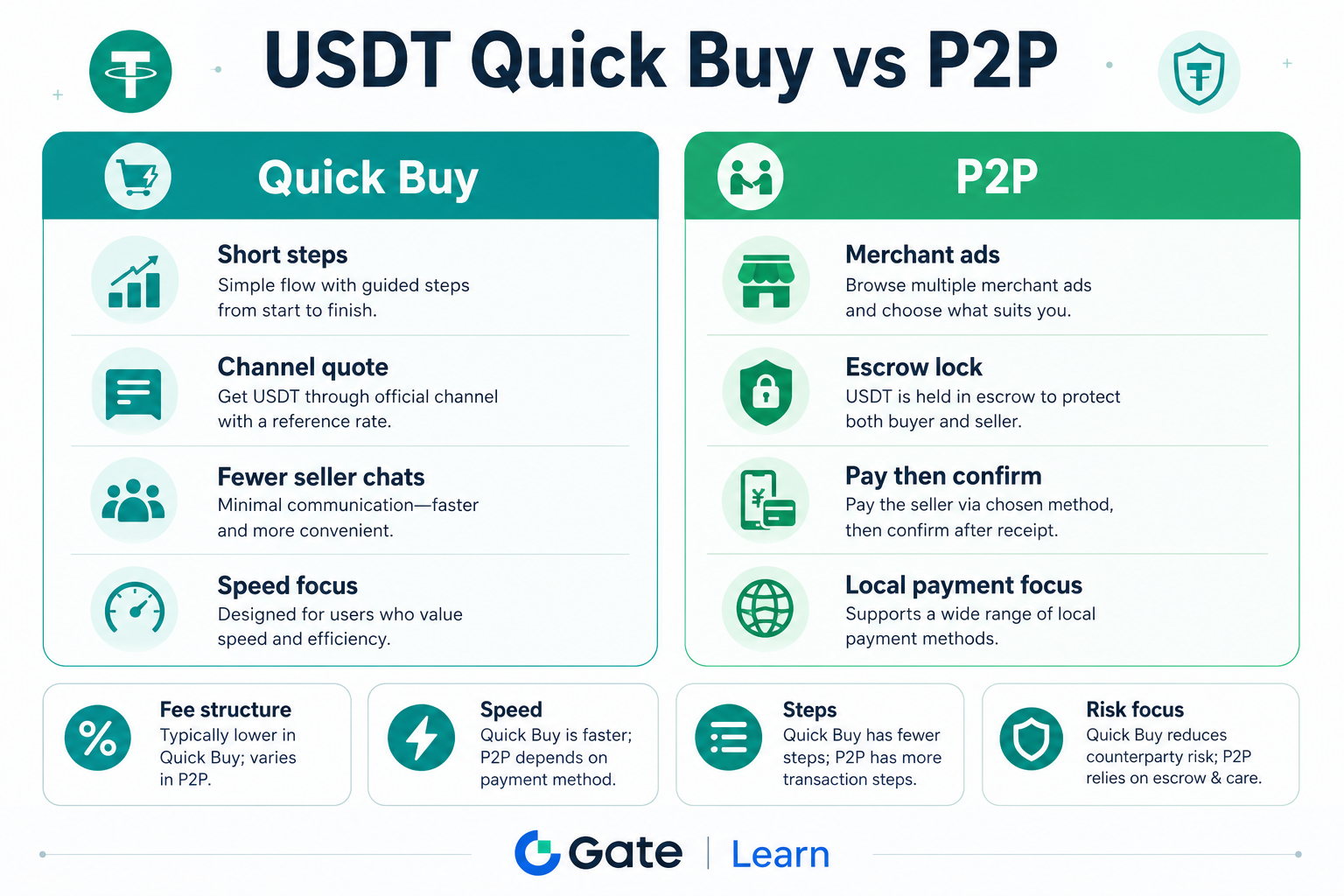
Figure 1. Quick Buy vs P2P across fees, speed, steps, and risk focus.
When Is Quick Buy a Better Fit? When Is P2P?
Quick Buy fits better for: first small test purchase, less seller interaction, local channel available with acceptable channel fees, need USDT in account quickly. P2P fits better for: local bank or e-wallet reliance, optimizing received price via ad filters, amount within merchant limits, strict time-limit and proof discipline.
If a payment method is unavailable on Quick Buy but common in P2P ads, P2P is often the practical entry. Users unfamiliar with bank transfer proof and appeals may complete a small Quick Buy loop first, then learn P2P to limit operational errors.
| Scenario |
Common choice |
Reason |
| First $10–50 test |
Quick Buy |
Shorter steps; failures more contained |
| Local payment primary |
P2P |
Ads cover local methods |
| Fastest account credit |
Quick Buy |
Fewer seller confirm steps |
| Price comparison & filters |
P2P |
Completion rate and price filters |
The scenario table is heuristic, not a rule. The same user might use Quick Buy for small amounts and P2P for familiar payment methods.
How Do You Make an Executable Choice Between the Two Paths?
Use four questions: Which path supports my payment method? Do I accept channel fees or ad premium plus manual tracking? Can I pay within the window and keep proof? Do I only need in-account balance, or immediate on-chain withdraw?
After all four are clear, complete one small purchase on the chosen path, then scale. If withdraw is planned, network choice remains a separate step—USDT TRC-20 vs ERC-20 Networks covers chain checks for USDT transfers. Path choice solves "fiat to account USDT," not "which chain to withdraw to."
Summary
Quick Buy and P2P are both mainstream fiat entries for USDT: one prioritizes a short flow, the other uses ads for local payment and price flexibility. Compare received amount for fees, confirmation steps for speed, phishing and P2P disputes for risk. When both exist on Gate, use the four-question framework to pick a path, then follow that path's order fields.
FAQ
Is P2P Always Cheaper Than Quick Buy?
Not necessarily. P2P platform fees may be lower, but ad price may include premium and banks may charge fees. Use "fiat paid ÷ USDT received" for true cost.
Quick Buy Failed but the Bank Charged—What Now?
Check Gate order status and order ID first, then the payment channel for charge outcome. Keep statements and screenshots; use official tickets or support—never transfer to "unfreeze" addresses from unknown chat apps.
No. Off-order trading loses platform escrow on seller USDT and standard appeal paths—fraud risk rises sharply.
Can One Payment Fund Both Quick Buy and P2P Orders at Once?
Multiple open orders may conflict on funds and limits and raise timeout or double-pay risk. One active unfinished order at a time is safer.
Does USDT Differ After Quick Buy vs P2P?
USDT credited to the same exchange account is usually the same ledger balance—purchase path affects process fees and risk, not the token contract itself.