Juttmunda

vip
Age 0.6 Yıl
Peak Tier 0
No content yet
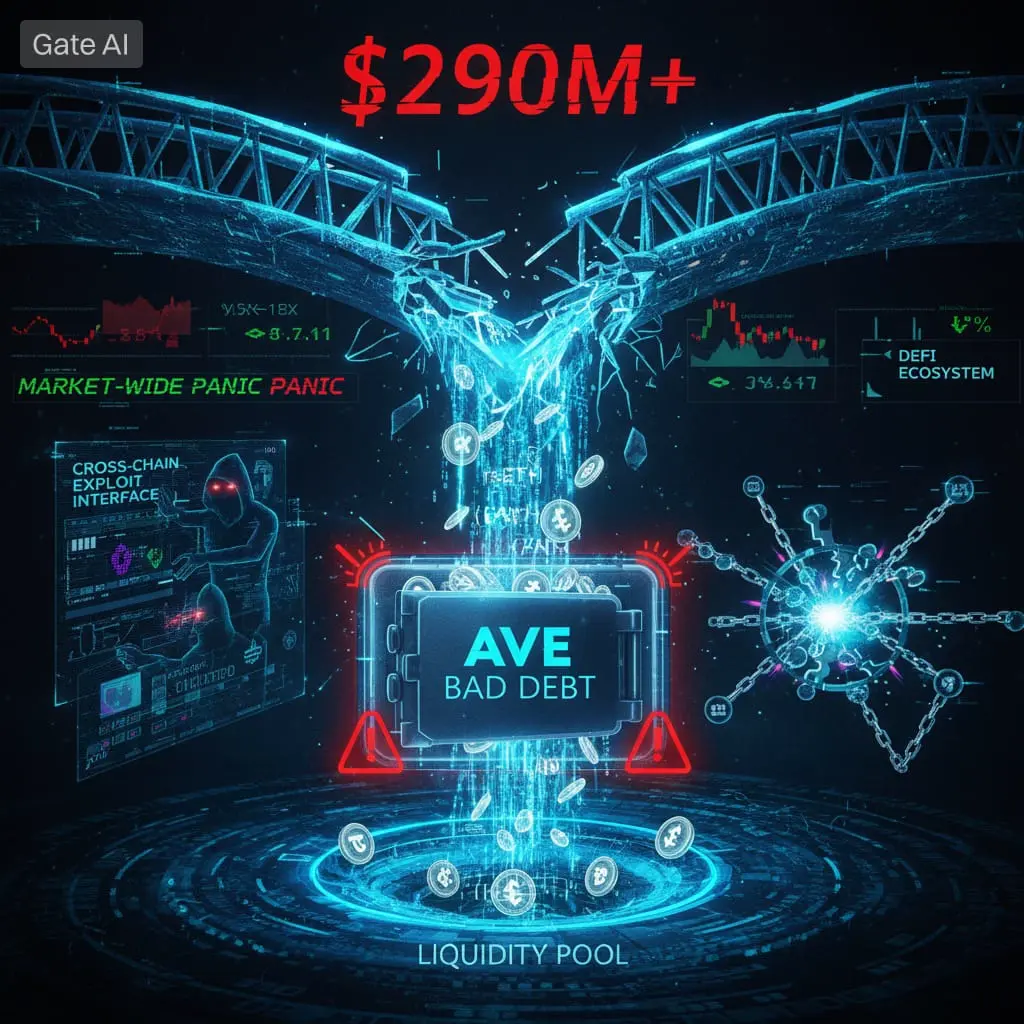
#KelpDAOBridgeHacked
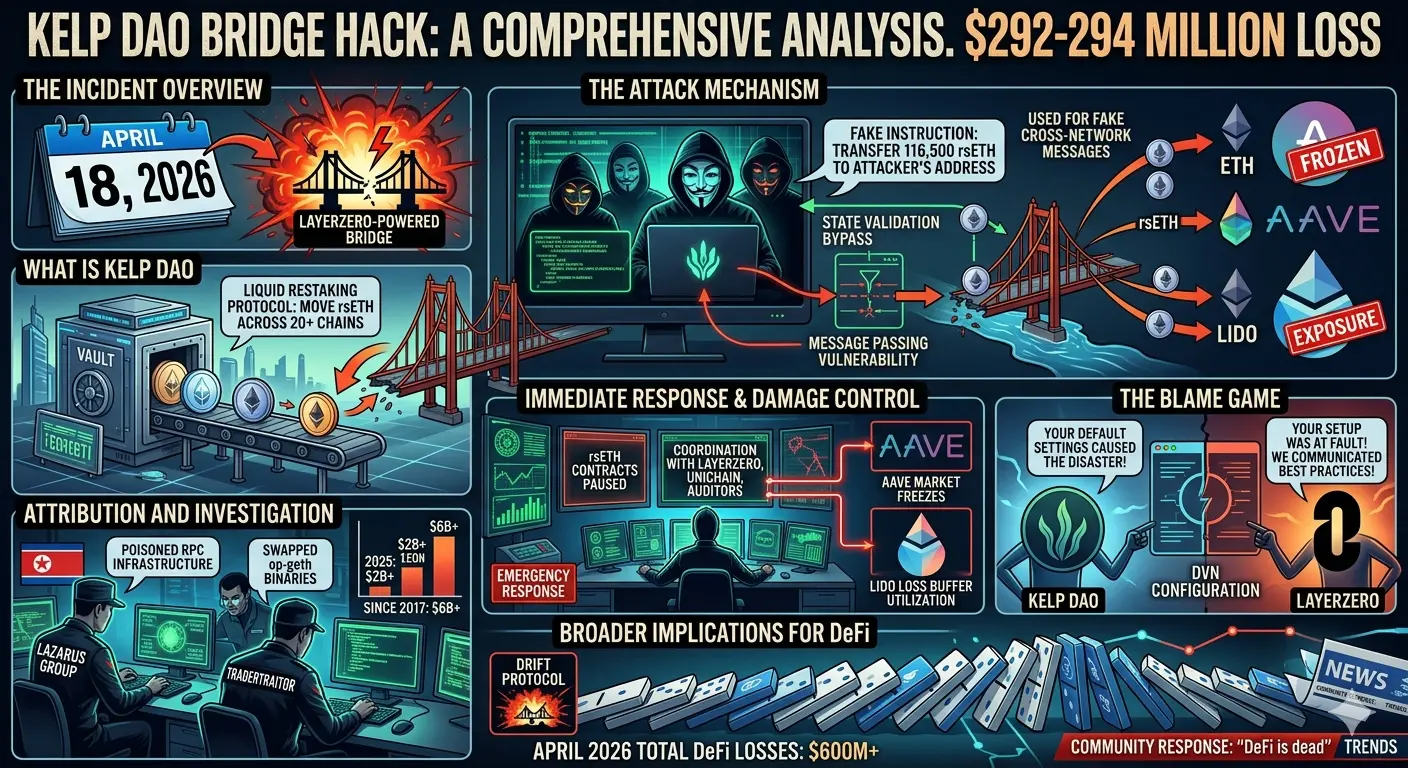
On April 18, 2026, Kelp DAO became the victim of the largest cryptocurrency exploit of the year when hackers drained approximately $292-294 million from its cross-chain bridge infrastructure. The attack targeted the protocol's LayerZero-powered bridge, which enables the transfer of rsETH (restaked Ether) tokens across multiple blockchain networks. This incident represents a significant breach in the decentralized finance ecosystem and has sent shockwaves throughout the crypto community.
What is Kelp DAO
Kelp DAO operates as a liquid restaking protocol that allows users to
HighAmbition
#KelpDAOBridgeHacked
On April 18, 2026, Kelp DAO became the victim of the largest cryptocurrency exploit of the year when hackers drained approximately $292-294 million from its cross-chain bridge infrastructure. The attack targeted the protocol's LayerZero-powered bridge, which enables the transfer of rsETH (restaked Ether) tokens across multiple blockchain networks. This incident represents a significant breach in the decentralized finance ecosystem and has sent shockwaves throughout the crypto community.
What is Kelp DAO
Kelp DAO operates as a liquid restaking protocol that allows users to deposit popular staking tokens such as stETH or cbETH in exchange for rsETH tokens. These rsETH tokens represent "restaked" Ether, enabling users to earn yields on their idle cryptocurrency investments while maintaining liquidity. The protocol's bridge infrastructure, built using LayerZero technology, facilitates the movement of these tokens across more than 20 different blockchain networks including Base, Arbitrum, Linea, Blast, Mantle, and Scroll.
The Attack Mechanism
The exploit occurred through a sophisticated manipulation of the cross-chain messaging system. Attackers managed to send fake cross-network messages that appeared to be valid instructions, triggering the system to transfer 116,500 rsETH tokens to the attacker's address. This amount represented approximately 18% of the total circulating supply of rsETH at the time of the attack.
Security experts from Cyvers explained that the attacker exploited state validation and message passing vulnerabilities to bypass security measures and extract collateral. The technique allowed the creation of unbacked rsETH tokens, which were then used to borrow real assets like ETH. This mechanism demonstrates how cross-chain bridge exploits can escalate rapidly, creating not just a single protocol breach but a cross-protocol contagion event affecting multiple platforms simultaneously.
Immediate Response and Damage Control
Upon detecting suspicious cross-chain activity involving rsETH, Kelp DAO immediately paused all rsETH contracts across Ethereum mainnet and several layer-2 networks. The protocol coordinated with LayerZero, Unichain, auditors, and security experts to conduct a root cause analysis. This emergency response helped contain further damage but could not reverse the already stolen assets.
The attack triggered emergency freezes across multiple DeFi platforms. Aave, the largest DeFi lending protocol, froze its rsETH markets on both Ethereum and Arbitrum to prevent additional bad debt exposure. Industry estimates suggest Aave could face potential losses ranging from $123 million to $230 million due to this incident. Lido reported approximately $21.6 million in exposure through leveraged positions and indicated it might utilize a $3 million loss buffer to mitigate damages.
Attribution and Investigation
Multiple sources have attributed the attack to North Korean hackers, specifically the Lazarus Group, also known as TraderTraitor. LayerZero identified that on April 18, the attackers targeted its DVN (Decentralized Validator Network) by poisoning downstream RPC infrastructure. The attackers gained access to the list of RPCs used by the DVN, compromised two independent nodes running on separate clusters, and swapped out binaries running the op-geth nodes.
This attribution aligns with North Korea's established pattern of targeting cryptocurrency platforms. According to available data, North Korean hackers stole more than $2 billion in cryptocurrency during 2025, bringing their total haul since 2017 to approximately $6 billion. Security experts note that this attack demonstrates the familiar North Korean approach of patient intrusion, manipulation of trust, and detection suppression.
The Blame Game: Kelp DAO vs LayerZero
Following the incident, a dispute emerged between Kelp DAO and LayerZero regarding responsibility for the security breach. Kelp DAO claimed that LayerZero's default settings were the actual cause of the massive disaster, suggesting that the infrastructure provider's configuration choices created the vulnerability. LayerZero countered by stating that Kelp DAO's specific setup was at fault and emphasized that they had previously communicated best practices around DVN diversification to Kelp DAO.
This disagreement highlights the complex nature of accountability in decentralized finance, where multiple parties contribute to the security infrastructure of interconnected protocols. The incident raises important questions about responsibility allocation between protocol developers and infrastructure providers in the DeFi ecosystem.
Broader Implications for DeFi
The Kelp DAO hack has pushed total DeFi exploit losses for April 2026 beyond $600 million, making it one of the most damaging months in cryptocurrency history. This incident follows closely on the heels of the Drift Protocol exploit on April 1, 2026, which resulted in approximately $285 million in losses, also attributed to North Korean hackers.
The attack has reignited discussions about the security of cross-chain bridges, which have historically been among the most vulnerable components of the DeFi infrastructure. Despite numerous audits and security measures, bridges continue to present attractive targets for sophisticated attackers due to their complexity and the large amounts of value they secure.
The incident also exposed the interconnected nature of modern DeFi protocols. What began as an attack on Kelp DAO's bridge quickly cascaded into liquidity crises and bad debt situations across multiple platforms, demonstrating how vulnerabilities in one protocol can create systemic risks throughout the ecosystem.
Community Response and Market Impact
The crypto community has reacted with concern and introspection following the hack. The phrase "DeFi is dead" circulated on social media platforms as users grappled with the implications of yet another major exploit. Ethereum's price dipped to $2,300 on April 17, 2026, with prediction markets pricing in continued volatility.
The exploit has prompted calls for enhanced security measures, improved bridge designs, and greater transparency in DeFi protocols. Industry participants are increasingly recognizing that the current approach to cross-chain interoperability may require fundamental rethinking to achieve the security standards necessary for mainstream adoption.
Lessons and Future Considerations
The Kelp DAO bridge hack serves as a stark reminder of the risks inherent in cross-chain DeFi protocols. Several key lessons emerge from this incident:
First, the complexity of cross-chain bridges creates multiple attack vectors that sophisticated actors can exploit. Despite audits and security reviews, the interaction between different blockchain networks and messaging protocols introduces vulnerabilities that may not be apparent during standard security assessments.
Second, the interconnected nature of DeFi protocols means that exploits can rapidly cascade across multiple platforms, amplifying the damage beyond the initial breach. This systemic risk requires coordinated response mechanisms and improved isolation between protocols.
Third, the attribution to state-sponsored hackers highlights the evolving threat landscape in cryptocurrency security. Nation-state actors with substantial resources and patience pose a fundamentally different challenge than individual hackers or criminal groups.
Fourth, the dispute between Kelp DAO and LayerZero underscores the need for clearer accountability frameworks in DeFi infrastructure. When multiple parties contribute to a protocol's security, determining responsibility for failures becomes complex and can delay effective response and recovery efforts.
Conclusion
The Kelp DAO bridge hack represents a watershed moment for the DeFi industry in 2026. With nearly $300 million stolen and cascading effects across multiple protocols, the incident has exposed critical vulnerabilities in cross-chain infrastructure and highlighted the sophisticated capabilities of state-sponsored threat actors. As the industry continues to grapple with the aftermath, the attack serves as a powerful reminder that security must remain the paramount concern in the development of decentralized financial systems. The path forward will require not just technical improvements but also fundamental changes in how the industry approaches risk management, accountability, and cross-protocol coordination. Bhai is per picture banaa do la ke na aap puri post ko uthakar tasvir mein Dal dete ho Thoda Thoda sa mavad uthakar jabardast ek VIP tasvir banaa do meherbani Hogi
repost-content-media
  • Reward
  • Comment
  • Repost
  • Share
#USIranTensionsShakeMarkets
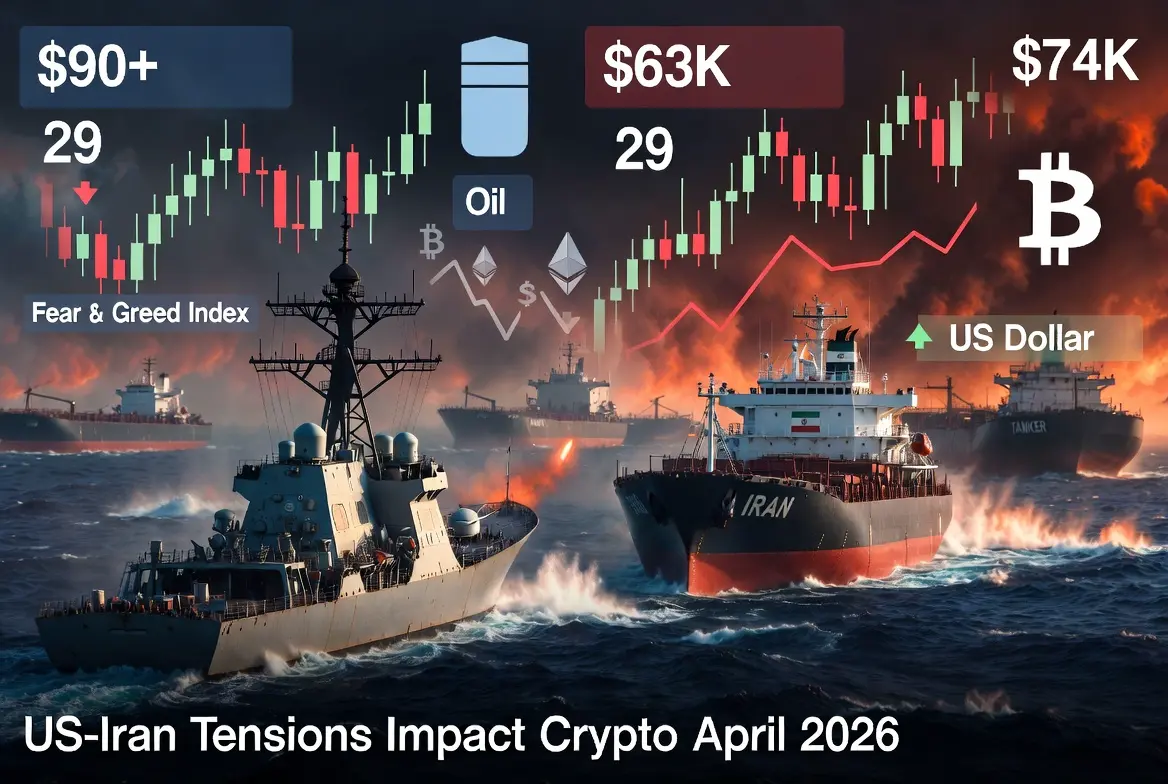
The escalating geopolitical tensions between the United States and Iran have sent shockwaves through global financial markets, creating significant volatility across traditional and digital asset classes. This article provides a detailed examination of how these tensions have impacted Bitcoin (BTC), Ethereum (ETH), Tether Gold (XAUT), and oil markets, analyzing the magnitude of market movements and the underlying factors driving these shifts.
Understanding the US-Iran Conflict Context
The current wave of tensions began in late February 2026, when military confronta
HighAmbition
#USIranTensionsShakeMarkets
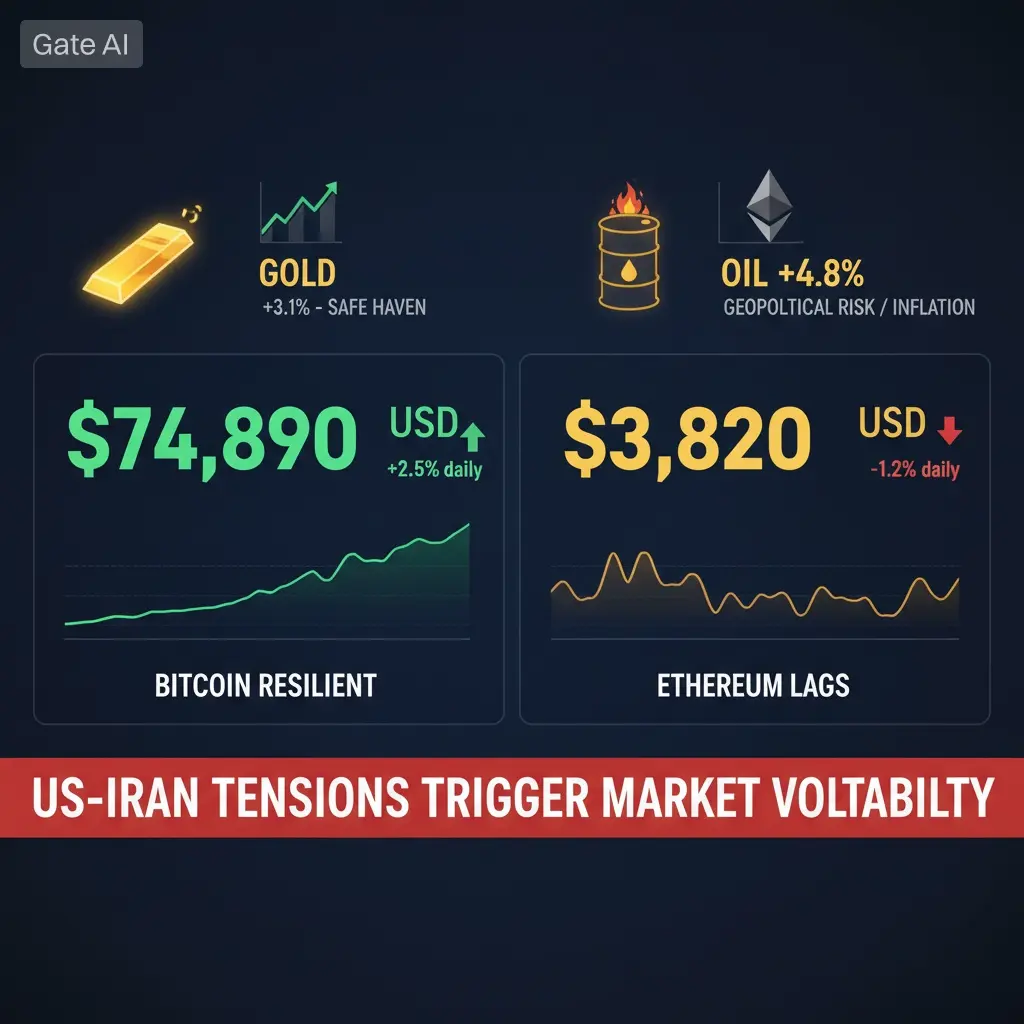
The escalating geopolitical tensions between the United States and Iran have sent shockwaves through global financial markets, creating significant volatility across traditional and digital asset classes. This article provides a detailed examination of how these tensions have impacted Bitcoin (BTC), Ethereum (ETH), Tether Gold (XAUT), and oil markets, analyzing the magnitude of market movements and the underlying factors driving these shifts.
Understanding the US-Iran Conflict Context
The current wave of tensions began in late February 2026, when military confrontations between the United States and Iran intensified. The conflict reached a critical point when Iran imposed controls on the Strait of Hormuz, one of the world's most strategically important oil transit chokepoints. This move triggered immediate reactions across global markets, as traders and investors scrambled to assess the implications for energy supplies, inflation expectations, and overall risk sentiment.
The situation escalated further over the weekend of April 18-19, 2026, when the US military seized an Iranian cargo ship, putting pressure on the fragile ceasefire between the two nations. This development caused renewed anxiety in markets that had begun to price in a de-escalation following earlier diplomatic overtures.
Bitcoin's Resilient Performance
Bitcoin has demonstrated remarkable resilience in the face of geopolitical turbulence. Currently trading at approximately $75,790, BTC has maintained its position above the critical $74,000 support level despite multiple waves of negative news. The cryptocurrency experienced a modest pullback of only 1.6% following the weekend's escalation, a relatively muted response compared to traditional markets.
What makes Bitcoin's performance particularly noteworthy is its divergence from conventional risk assets. While European equity futures dropped 1.2% and oil prices surged over 5%, Bitcoin's decline was contained within a narrow range. This suggests that cryptocurrency markets may have already priced in much of the geopolitical tail risk associated with the Iran conflict.
Several factors support Bitcoin's relative stability. First, institutional adoption continues to provide underlying support. Strategy (formerly MicroStrategy) recently announced the acquisition of 34,164 additional Bitcoin, bringing their total holdings to 815,061 BTC with an average cost basis of approximately $75,527. This corporate buying has created a floor of demand that absorbs selling pressure during risk-off episodes.
Second, the spot Bitcoin ETF market has evolved into a more reliable source of price support than the futures-driven weekend gaps that characterized earlier market cycles. The consistent inflows into these products have altered the market structure, making Bitcoin less susceptible to the sharp drawdowns that previously accompanied geopolitical shocks.
From a technical perspective, Bitcoin is displaying constructive signals. The 15-minute charts show CCI and WR indicators in oversold territory, suggesting potential for short-term recovery. The 4-hour timeframe reveals a MACD bullish divergence, where prices made lower lows while momentum indicators improved. However, the daily timeframe shows Bitcoin trading below its 20-period moving average, indicating that the broader trend requires monitoring.
Ethereum's Mixed Response
Ethereum has experienced more pronounced volatility compared to Bitcoin, currently trading around $2,313. The second-largest cryptocurrency by market capitalization has faced additional headwinds beyond geopolitical tensions, including a significant security incident involving KelpDAO's rsETH cross-chain bridge, which suffered an exploit resulting in approximately $290 million in losses.
This security breach triggered cascading effects across decentralized finance protocols, with Aave and other platforms freezing related markets as a precautionary measure. The incident highlighted the ongoing risks within the DeFi ecosystem and contributed to Ethereum's underperformance relative to Bitcoin.
Despite these challenges, Ethereum maintains several positive catalysts. Bitmine, a major institutional player, has been aggressively accumulating ETH, with holdings now exceeding 4.98 million tokens representing approximately 4.12% of the total supply. This institutional demand provides substantial support for Ethereum's price.
Technical analysis of Ethereum shows similar oversold conditions on shorter timeframes, with CCI and WR indicators suggesting potential for bounce plays. The 4-hour chart displays a MACD bullish divergence, indicating that selling pressure may be exhausting. However, Ethereum's performance relative to Bitcoin has been weaker, with the ETH/BTC ratio under pressure.
Tether Gold's Safe Haven Appeal
Tether Gold (XAUT), a digital asset backed by physical gold, has emerged as a beneficiary of the flight-to-safety dynamic. Trading at approximately $4,785 per token, XAUT has maintained stability while traditional markets experienced turbulence. The asset's 24-hour trading volume has been robust at over $9.3 million, indicating active interest from investors seeking exposure to gold through digital means.
Gold's traditional role as a safe haven during geopolitical crises has translated well to its tokenized form. As tensions escalated, investors rotated capital into gold-backed digital assets, viewing them as a hedge against both geopolitical risk and potential inflationary pressures from higher oil prices.
The technical picture for XAUT shows the asset trading in a relatively tight range, with bandwidth compression indicating that a significant directional move may be imminent. The asset has outperformed many risk assets during the crisis period, validating its utility as a portfolio diversifier.
Oil Market Dynamics
The oil market has been the most dramatically affected by US-Iran tensions. Brent crude prices surged over 5% to approximately $95 per barrel following the weekend escalation, reversing sharp losses from Friday when prices had slumped on news that Iran declared the Strait of Hormuz "completely open."
The volatility in oil markets reflects the critical importance of the Strait of Hormuz, through which approximately one-fifth of global oil shipments pass. Any threat to this vital transit route has immediate implications for global energy security and inflation expectations.
The oil price surge has created a complex dynamic for risk assets. Higher energy costs typically translate to increased inflationary pressure, which could prompt central banks to maintain higher interest rates for longer. This environment generally weighs on risk assets, including cryptocurrencies, though Bitcoin's inflation-resistant narrative has provided some insulation.
Cross-Asset Correlations and Market Structure
The current crisis has revealed interesting shifts in cross-asset correlations. Traditional safe havens like the US dollar and gold have strengthened, while risk assets have experienced selective pressure. Bitcoin's correlation with traditional risk assets appears to be decreasing, potentially marking an evolution in its market characteristics.
The divergence between Bitcoin and oil price movements is particularly significant. In previous geopolitical crises, cryptocurrencies often sold off sharply alongside other risk assets. The fact that Bitcoin has maintained relative stability while oil surged suggests that market participants are increasingly viewing digital assets through a distinct lens.
Institutional Flows and Market Depth
Institutional activity has played a crucial role in stabilizing cryptocurrency markets during this period. US spot crypto ETFs have seen continued inflows across Bitcoin, Ethereum, and other major assets. This institutional bid has provided a cushion against retail panic selling and has helped maintain orderly market conditions despite elevated uncertainty.
The presence of sophisticated market makers and institutional participants has improved market depth, reducing the severity of price dislocations during periods of stress. This evolution in market structure represents a maturation of the cryptocurrency ecosystem.
Macroeconomic Implications
The US-Iran conflict carries significant macroeconomic implications that extend beyond immediate market movements. Higher oil prices threaten to reignite inflationary pressures that had been showing signs of moderation. This complicates the outlook for monetary policy, with traders now pricing in reduced expectations for Federal Reserve rate cuts.
The probability of a US rate cut this year has declined from expectations of two cuts to approximately 28% probability of a single cut. This shift in rate expectations has supported the US dollar while creating headwinds for risk assets.
For cryptocurrency markets, the inflationary implications of higher oil prices present a mixed picture. While rising inflation typically supports Bitcoin's narrative as an inflation hedge, the accompanying tightening of financial conditions and potential for higher interest rates can pressure valuations in the short term.
Risk Management Considerations
For investors navigating this environment, several risk management considerations emerge. The persistence of geopolitical tensions suggests that volatility will remain elevated, requiring careful position sizing and risk management. Diversification across asset classes, including exposure to safe havens like gold, can help mitigate portfolio volatility.
The evolving nature of cryptocurrency market structure means that historical patterns may not perfectly predict future behavior. Bitcoin's reduced sensitivity to geopolitical shocks represents a potential shift in its risk characteristics, though this thesis will be tested if tensions escalate further.
Conclusion
The US-Iran tensions have created a complex market environment where traditional relationships between asset classes are being tested. Bitcoin has demonstrated surprising resilience, suggesting a potential evolution in its market characteristics. Ethereum faces additional challenges from security incidents but maintains institutional support. Tether Gold has fulfilled its role as a digital safe haven, while oil markets have borne the brunt of supply concerns.
As diplomatic efforts continue and military tensions fluctuate, markets will remain sensitive to developments. The key question for investors is whether the current pricing adequately reflects tail risks or if further escalation could trigger more significant repricing. For now, the market appears to be balancing geopolitical concerns against improving institutional adoption and evolving market structure in the cryptocurrency space.
repost-content-media
  • Reward
  • Comment
  • Repost
  • Share
#FirstTradeOfTheWeek .
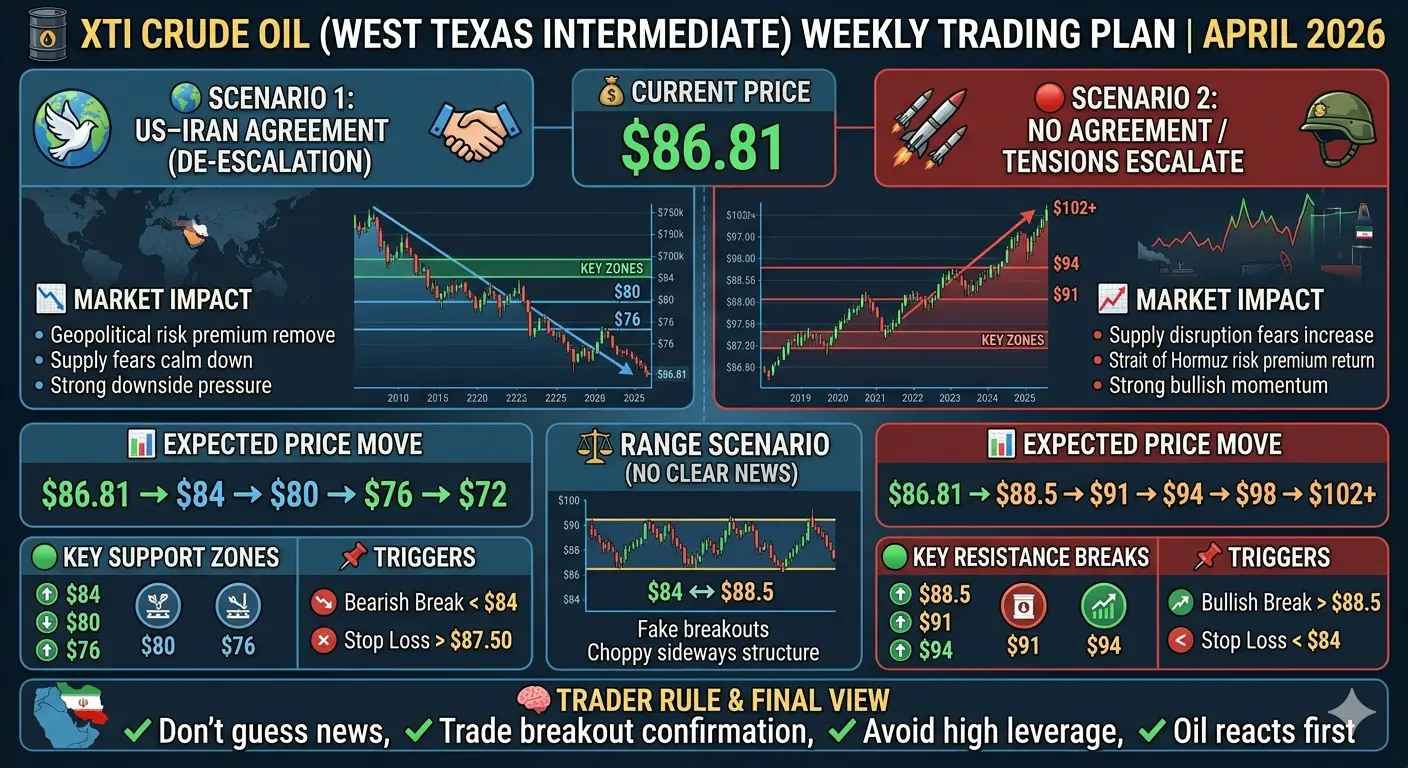
🛢️ XTI (Crude Oil) Weekly Trading Plan | April 2026
💰 Current Price: $86.81
🌍 SCENARIO 1: US–IRAN AGREEMENT (De-escalation)
📉 Market Impact:
Geopolitical risk premium remove
Supply fears calm down
Strong downside pressure on oil
📊 Expected Price Move: 👉 $86.8 → $84 → $80 → $76 → $72
🟢 Key Support Zones:
$84 (first reaction zone)
$80 (major liquidity zone)
$76 (strong demand area)
📌 Bearish Trigger: Break below $84
📌 Stop Loss for shorts: Above $87.50
🧠 Market Behavior:
Sharp dump possible on headline confirmation
Fast retracement candles
High volatility sell pr
HighAmbition
#FirstTradeOfTheWeek .
🛢️ XTI (Crude Oil) Weekly Trading Plan | April 2026
💰 Current Price: $86.81
🌍 SCENARIO 1: US–IRAN AGREEMENT (De-escalation)
📉 Market Impact:
Geopolitical risk premium remove
Supply fears calm down
Strong downside pressure on oil
📊 Expected Price Move: 👉 $86.8 → $84 → $80 → $76 → $72
🟢 Key Support Zones:
$84 (first reaction zone)
$80 (major liquidity zone)
$76 (strong demand area)
📌 Bearish Trigger: Break below $84
📌 Stop Loss for shorts: Above $87.50
🧠 Market Behavior:
Sharp dump possible on headline confirmation
Fast retracement candles
High volatility sell pressure
🔴 SCENARIO 2: NO AGREEMENT / TENSIONS ESCALATE
📈 Market Impact:
Supply disruption fears increase
Strait of Hormuz risk premium return
Strong bullish momentum in oil
📊 Expected Price Move: 👉 $86.8 → $88.5 → $91 → $94 → $98 → $102+
🟢 Key Resistance Breaks:
$88.5 (first breakout level)
$91 (momentum confirmation)
$94 (trend acceleration zone)
📌 Bullish Trigger: Break above $88.5
📌 Stop Loss for longs: Below $84
🧠 Market Behavior:
Sharp bullish spikes
Breakout candles with volume
News-driven impulsive moves
⚖️ RANGE SCENARIO (NO CLEAR NEWS FLOW)
📊 Range Zone: 👉 $84 ↔ $88.5
📌 Market Behavior:
Fake breakouts both sides
Liquidity hunting
Choppy sideways structure
📈 Scalping Flow: $85.5 → $87 → $86 → $84.8 → $88 → $86.2
🔥 FINAL WEEKLY VIEW (XTI)
👉 Oil is in a geopolitical breakout zone
👉 One headline = $3 to $8 move possible
👉 Direction fully depends on US–Iran news flow
👉 $84 = key support, $88.5 = key breakout level
🧠 TRADER RULE
✔ Don’t guess news outcome
✔ Trade breakout confirmation only
✔ Avoid high leverage in range
✔ Oil reacts first, crypto follows later
repost-content-media
  • Reward
  • Comment
  • Repost
  • Share
This afternoon, Gate founder Dr. Han will step into The University of Hong Kong, and have face-to-face exchanges with students and teachers. From data intelligence to entrepreneurial strategy, from emerging technologies to industry waves, looking forward to an in-depth conversation about the future. 🎓
Sincere thanks to The University of Hong Kong and the HKU Blockchain Association for their strong support.
🎓 Special thanks to:
School of Computing and Data Science
HKU Innovation and Technology Center
HKU Core Curriculum
#Gate13周年
HighAmbition
This afternoon, Gate founder Dr. Han will step into The University of Hong Kong, and have face-to-face exchanges with students and teachers. From data intelligence to entrepreneurial strategy, from emerging technologies to industry waves, looking forward to an in-depth conversation about the future. 🎓
Sincere thanks to The University of Hong Kong and the HKU Blockchain Association for their strong support.
🎓 Special thanks to:
School of Computing and Data Science
HKU Innovation and Technology Center
HKU Core Curriculum
#Gate13周年
repost-content-media
  • Reward
  • Comment
  • Repost
  • Share
#BitcoinBouncesBack
Bitcoin Recovery Analysis: Where Can BTC Go From Here?
The cryptocurrency market is currently navigating one of its most complex and sensitive phases, with Bitcoin reclaiming strength above the $76,000 level amid persistent geopolitical tensions between the United States and Iran. This recovery is unfolding at a critical intersection where traditional safe-haven assets and high-risk assets are behaving in unusual correlation patterns. As a result, traders and investors are facing a market environment filled with both opportunity and elevated uncertainty.
Bitcoin’s rebound
BTC0,51%
HighAmbition
#BitcoinBouncesBack
Bitcoin Recovery Analysis: Where Can BTC Go From Here?
The cryptocurrency market is currently navigating one of its most complex and sensitive phases, with Bitcoin reclaiming strength above the $76,000 level amid persistent geopolitical tensions between the United States and Iran. This recovery is unfolding at a critical intersection where traditional safe-haven assets and high-risk assets are behaving in unusual correlation patterns. As a result, traders and investors are facing a market environment filled with both opportunity and elevated uncertainty.
Bitcoin’s rebound is not happening in isolation. It is deeply connected to macroeconomic shifts, geopolitical instability, institutional flows, and technical positioning. This combination makes the current market structure highly reactive and fragile, where even small developments can trigger sharp price movements in either direction.
Current Market Position and Technical Landscape
Bitcoin is currently trading around $76,500 after successfully reclaiming the psychological resistance level of $76,000. Over the past 24 hours, the asset has recorded approximately a 2% gain, with a daily high near $76,900 and a low around $74,700. This recovery marks a strong bounce from recent pullbacks, but the sustainability of this upward move remains uncertain.
From a technical standpoint, lower timeframes are showing bullish momentum. On the 15-minute chart, moving averages are aligned positively, with MA7 above MA30 and MA30 above MA120. This indicates short-term strength and continued buying pressure. The Directional Movement Index also confirms this trend, with buyers clearly dominating sellers and trend strength appearing solid.
However, the picture becomes more cautious on higher timeframes. The 4-hour chart shows overbought signals through indicators like CCI and Williams %R, suggesting that the market may be stretched in the short term. On the daily timeframe, a bearish MACD divergence is forming, where price continues to make higher highs while momentum is weakening. This type of divergence often signals that the current rally could slow down or face a correction.
Geopolitical Context: The US-Iran Factor
The primary macro driver behind Bitcoin’s current movement is the ongoing geopolitical tension between the United States and Iran. The temporary ceasefire agreement is approaching its expiration date, creating a high-stakes environment where uncertainty is dominating market sentiment.
The situation is further complicated by strategic pressure points such as the Strait of Hormuz, a critical global oil supply route. Restrictions in this region have disrupted maritime activity, with reports indicating that a large number of vessels remain stranded. Iran’s proposal to charge significant transit fees, even considering crypto payments like Bitcoin and USDT, highlights the growing intersection between geopolitics and digital assets.
Markets are closely watching whether negotiations will lead to de-escalation or further conflict. This uncertainty is directly influencing Bitcoin’s behavior, as it increasingly acts as both a speculative asset and a hedge against systemic instability.
Recovery Potential: How Far Can BTC Climb?
Bitcoin’s immediate resistance lies in the $77,000 to $78,000 range. This zone previously acted as strong support before the breakdown and is now serving as a key barrier. A successful breakout above $78,000 could open the path toward $80,000, which is both a psychological and technical milestone.
However, reaching higher levels will not be easy. The presence of bearish divergence on higher timeframes and overbought conditions suggests that upward momentum may weaken before a sustained breakout occurs. A period of consolidation or a short-term pullback would be a healthy reset for the market.
On the downside, $74,000 acts as immediate support, while $72,500 remains a critical level. A breakdown below this zone would invalidate the current bullish structure and could push Bitcoin back toward the $70,000 region.
Institutional Flows and Market Structure
Institutional activity continues to provide strong support for Bitcoin. Significant inflows into spot Bitcoin ETFs indicate that large players are still accumulating. This demand creates a structural foundation that helps stabilize price during volatile periods.
Exchange data also shows a consistent decline in Bitcoin reserves, suggesting that investors are moving assets into long-term storage rather than preparing to sell. This supply reduction strengthens the bullish case over the long term.
Major entities continue to accumulate Bitcoin aggressively, reinforcing confidence in its future value. Additionally, increasing participation from traditional financial institutions signals growing mainstream acceptance, which could act as a long-term catalyst for price growth.
Dollar Dynamics and Their Impact
The US Dollar Index has shown signs of weakness recently, which historically supports Bitcoin. The inverse relationship between the dollar and BTC remains a key factor in price movement.
However, the situation is not straightforward. Monetary policy expectations, inflation concerns, and geopolitical risks are creating mixed signals for the dollar. If the dollar strengthens due to prolonged instability or tight monetary policy, Bitcoin’s upside could be limited. Conversely, a weaker dollar could provide the necessary momentum for BTC to break higher resistance levels.
Whale Activity and Market Sentiment
On-chain data reveals that large traders are actively positioning for volatility. Some whales are opening short positions even as price rises, indicating expectations of a potential pullback. This behavior reflects caution among experienced market participants.
At the same time, retail sentiment remains largely bullish. Social data shows a majority of positive outlooks, although engagement levels are slightly declining. This could indicate that while optimism exists, conviction may not be as strong as before.
Risk Factors and Possible Scenarios
Several risks could impact Bitcoin’s current trajectory. The most immediate is the expiration of the ceasefire agreement, which could trigger sharp market reactions. Escalation may increase volatility across all asset classes.
Technical risks include overbought conditions and weakening momentum, both of which suggest that a correction is possible even without negative news. External risks such as security concerns and mining-related selling pressure also add to uncertainty.
Strategic Positioning
Given the current environment, traders should prioritize risk management. Position sizes should be adjusted to account for volatility, and stop-loss levels should be clearly defined.
For bullish traders, partial profit-taking near resistance levels is a sensible approach. For long-term investors, gradual accumulation through dollar-cost averaging remains a strong strategy, especially during periods of volatility.
Conclusion: Where Does the Recovery Stop?
Bitcoin’s recovery above $76,000 is a strong signal of resilience, but it does not guarantee continued upward movement. The market is currently balancing between bullish institutional support and bearish technical signals, all while being heavily influenced by geopolitical developments.
The most likely scenario is continued range-bound movement between $72,500 and $78,000 until greater clarity emerges. A breakout above this range could lead to $80,000 and beyond, while a breakdown could trigger a deeper correction.
Ultimately, the next 48–72 hours will be critical. Market direction will largely depend on geopolitical outcomes and macroeconomic signals. Until then, Bitcoin is likely to remain in a high-volatility phase where disciplined trading and strong risk management are essential.
repost-content-media
  • Reward
  • Comment
  • Repost
  • Share
#USIranTalksProgress
US-Iran Talks Progress:
Current Status of Negotiations
The US-Iran talks are at a critical juncture as of April 21, 2026. Here's where things stand:
Key Developments
Failed Initial Talks in Islamabad (April 11-12, 2026)
US Vice President JD Vance traveled to Islamabad, Pakistan for marathon negotiations lasting over 20 hours
Despite "friendly" talks, no deal was reached
Vance stated Iran refused to accept US terms, calling it their "final and best offer"
Iran countered that they didn't expect a deal at the first meeting
Current Standoff
A 14-day ceasefire between the US,
BTC0,51%
HighAmbition
#USIranTalksProgress
US-Iran Talks Progress:
Current Status of Negotiations
The US-Iran talks are at a critical juncture as of April 21, 2026. Here's where things stand:
Key Developments
Failed Initial Talks in Islamabad (April 11-12, 2026)
US Vice President JD Vance traveled to Islamabad, Pakistan for marathon negotiations lasting over 20 hours
Despite "friendly" talks, no deal was reached
Vance stated Iran refused to accept US terms, calling it their "final and best offer"
Iran countered that they didn't expect a deal at the first meeting
Current Standoff
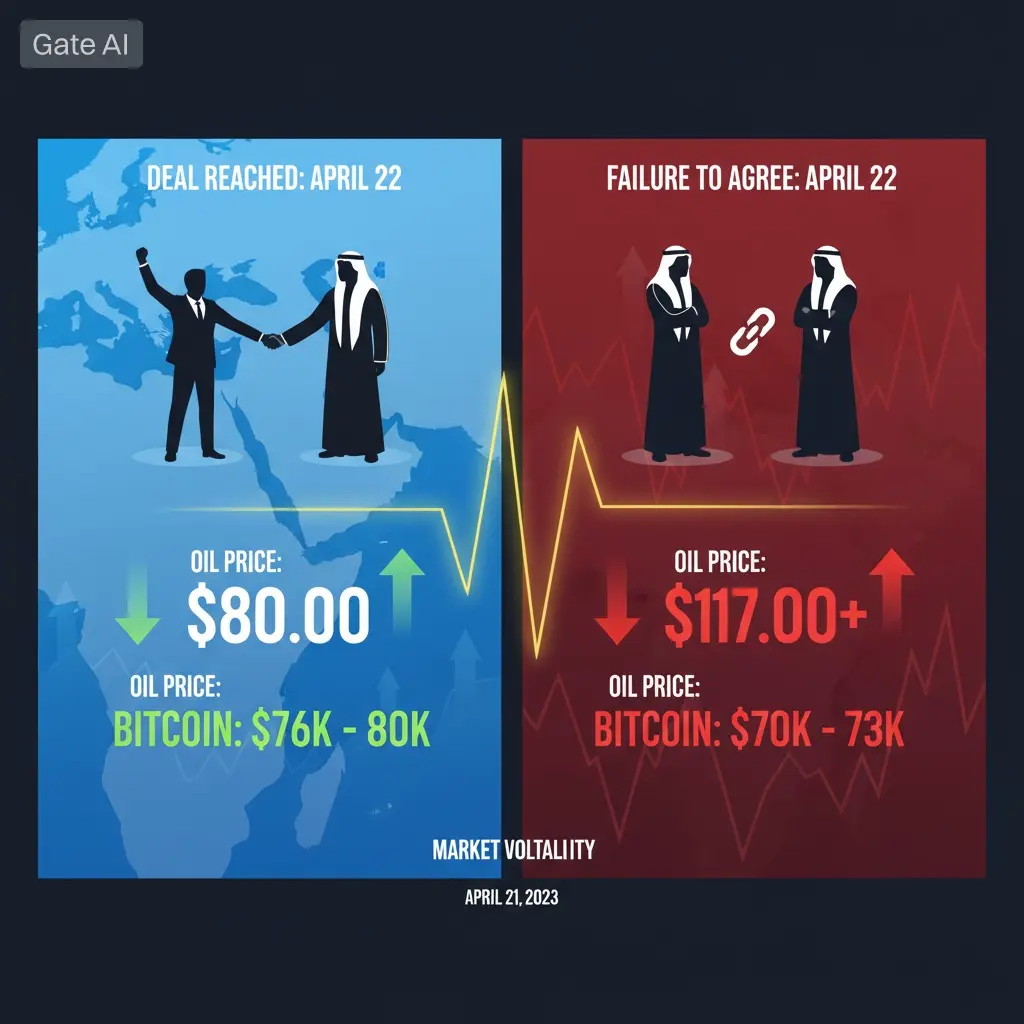
A 14-day ceasefire between the US, Israel, and Iran is set to expire on April 22, 2026
Reports are mixed: some sources indicate failed talks with Trump threatening a Hormuz blockade and potential resumed bombings
However, Pakistani media reports optimism for an agreement by Wednesday, with Iran potentially sending a delegation
The IRGC (Iranian Revolutionary Guard Corps) has reportedly consolidated control over Iran's negotiations policy
Ongoing Tensions
US Navy has been boarding Iranian vessels
Naval blockade of Iranian ports continues
Strait of Hormuz remains a flashpoint
What Happens Next: Two Scenarios
Scenario A: Successful Progress
If a deal is reached:
Oil Market Impact:
Oil prices could fall toward $80/barrel from current elevated levels near $97
Supply fears would ease as Strait of Hormuz blockade lifts
Kuwait has already declared force majeure on some shipments due to security concerns
Crypto Market Impact:
Bitcoin could surge above $76,000, potentially testing $80,000+
Risk-on sentiment would return to markets
Crypto has shown resilience; a deal could trigger significant upside
Institutional flows via ETFs would likely accelerate
Traditional Markets:
Equities would rally
Safe-haven assets (gold, USD) would face pressure
Global risk appetite would improve dramatically
Scenario B: Talks Fail / Escalation
If negotiations collapse:
Oil Market Impact:
Oil could spike to $117+ per barrel
Strait of Hormuz closure would disrupt -20% of global oil supply
Energy crisis risks would escalate globally
Crypto Market Impact:
Bitcoin could test support levels around $70,000-$73,000
Risk-off flows would dominate
Fear & Greed Index is already at 29/100 (Fear territory)
$384M in crypto futures liquidations occurred recently on negative news
Traditional Markets:
Equities would sell off
Flight to safety would benefit USD, gold, and bonds
Global recession fears would intensify
Bitcoin Technical Analysis
Current Price: -$75,720 (up 1.51% in 24h)
Key Levels to Watch:
Resistance: $76,562 (24h high), $80,000 (psychological)
Support: $74,105 (24h low), $73,000, $70,000
Technical Signals:
15-minute SAR shows bullish trend
4-hour MACD forming bullish divergence
Price has broken below MA20 on 15-minute timeframe (short-term weakness)
Volume is elevated, indicating strong participation
Market Structure:
BTC has shown more resilience than oil and equities to Iran-related shocks
Shrinking sell-offs suggest crypto may have largely priced in geopolitical tail risk
Spot ETF bid is providing a floor around $74,000-$75,000
Oil Market Deep Dive
Current Price: -$97/barrel (Brent)
Supply Dynamics:
Strait of Hormuz handles -20% of global oil supply
Blockade has already disrupted shipping; two ships turned around
Kuwait declared force majeure on some shipments
US military extended blockade east to Gulf of Oman and Arabian Sea
Price Scenarios:
Deal reached: $80-85/barrel (relief rally)
Status quo: $90-100/barrel (elevated risk premium)
Escalation: $117+/barrel (supply shock)
Strategic Outlook
For Crypto Traders:
Bullish Case:
A deal removes major macro headwind
Institutional adoption continues (Strategy now holds 815,061 BTC, surpassing BlackRock)
Morgan Stanley and Charles Schwab entering the space
ETF inflows at 5-month highs
Bearish Case:
Failed talks could trigger risk-off cascade
$70,000 is key support; break below could see $65,000
Death cross forming on some timeframes
For Oil Traders:
The next 48 hours are pivotal
Current price reflects significant risk premium
Asymmetric risk: upside limited on deal, downside severe on escalation
Conclusion
The US-Iran talks represent a binary event for markets in the immediate term. The ceasefire deadline of April 22 creates urgency.
Base Case: Expect continued volatility until clarity emerges. Markets are pricing in elevated uncertainty.
Key Watch:
Whether Iran sends a delegation to Islamabad
Any statements from US or Iranian officials
Strait of Hormuz shipping activity
The outcome will likely set the tone for risk assets through Q2 2026. A successful deal could unleash a significant relief rally across crypto and equities, while failure risks a return to March-style volatility with oil spiking and risk assets selling off.
repost-content-media
  • Reward
  • Comment
  • Repost
  • Share
#WCTCTradingChallengeShare8MUSDT
WCTC S8 Global Trading Challenge: Complete Guide to Gate.io's 8 Million USDT Prize Pool
Overview
The World Crypto Trading Competition (WCTC) Season 8 (S8) is Gate.io's flagship global trading competition, launched to celebrate the platform's 13th anniversary. This edition features a massive prize pool of up to 8,000,000 USDT, making it one of the largest trading competitions in the cryptocurrency industry.
Competition Structure
Three Main Competition Modes
1. Team Trading Contest
Prize Pool: Up to $3.6 Million USDT
Team leaders can claim up to 108,000 USDT
Bon
USD10,01%
HighAmbition
#WCTCTradingChallengeShare8MUSDT
WCTC S8 Global Trading Challenge: Complete Guide to Gate.io's 8 Million USDT Prize Pool
Overview
The World Crypto Trading Competition (WCTC) Season 8 (S8) is Gate.io's flagship global trading competition, launched to celebrate the platform's 13th anniversary. This edition features a massive prize pool of up to 8,000,000 USDT, making it one of the largest trading competitions in the cryptocurrency industry.
Competition Structure
Three Main Competition Modes
1. Team Trading Contest
Prize Pool: Up to $3.6 Million USDT
Team leaders can claim up to 108,000 USDT
Bonus: First 30 team leaders whose teams reach 50 members share an additional 3,000 USDT
Larger teams receive bigger reward shares
2. Solo Trading Contest (Individual)
Prize Pool: Up to $2 Million USDT
Rankings-based rewards for individual traders
3. Champions Showdown (1v1 PK Battles)
Prize Pool: Up to $1.6 Million USDT
Head-to-head trading battles between participants
Five Trading Categories
Participants can compete across five different trading tracks:
1. Spot Trading - Traditional cryptocurrency spot markets
2. ETF Trading - Leveraged ETF products
3. Convert/Flash Swap - Instant token swaps with zero fees
4. Futures Trading - Perpetual contracts and derivatives
5. TradFi - Traditional finance trading pairs
Bonus Rewards
Beyond the main prize pools, participants can earn additional rewards:
Early Registration Bonus: Share 800,000 USDT for early registrants
New User Bonus: 20 USDT voucher for new participants
Team Fast Bonus: Additional rewards for top-performing teams
Daily Mystery Boxes: Surprise rewards throughout the competition
Timeline (UTC)
Phase Dates
Pre-registration/Warm-up April 14 - April 23, 2026
Main Competition April 23 - May 20, 2026
Current Status: As of April 21, 2026, registration is open with over 15,000+ traders and 2,000+ teams already registered.
How to Participate: Step-by-Step Guide
Step 1: Create or Log In to Your Gate Account
Visit www.gate.com
Create a new account or log in to your existing account
Step 2: Complete KYC Verification
Identity verification is mandatory before the event ends
Ensure your KYC is approved to be eligible for rewards
Step 3: Register for the Competition
Visit the official competition page: gate.com/competition/wctc-s8
Click [Join Now] to register
Step 4: Choose Your Competition Mode
Select between Team, Solo, or Champions Showdown
For Team mode: Join an existing team or create your own
Step 5: Select Your Trading Track
Pick from Spot, ETF, Convert, Futures, or TradFi
You can participate in multiple tracks
Step 6: Start Trading
Begin trading to accumulate volume and returns
Track your progress on the leaderboard
Eligibility Requirements
Minimum Trading Volume Requirements
Team/Solo Contest: Minimum 20,000 USDT total trading volume to qualify for rewards
Valid Users: Must achieve at least 10,000 USDT trading volume to unlock prize pool tiers
Excluded Account Types
The following accounts are NOT eligible:
API users
VIP 15 and above
Market makers
Enterprise or institutional accounts
Subaccounts (trading volume from subaccounts won't count)
Important Rules
Stablecoin pairs (USDC/USDT, GUSD/USDT, USD1/USDT) do not count toward trading volume
Participants in multiple similar Gate events will only receive rewards from one event
Strict prohibition against wash trading, collusive trading, self-trading, and market manipulation
Prize Distribution
Team and Solo Contest Rewards: Credited within 15 business days after the event ends
Vouchers: Can be viewed and used in the [Vouchers] section
Physical Rewards: Airdropped via Gate Shop; must be claimed within the valid period
Minimum Reward: Rewards under 1 USDT will not be issued
Strategic Tips for Participants
1. Register Early: Secure your spot and claim early registration bonuses
2. Join or Build a Team: Team mode offers the largest prize pool and additional leader bonuses
3. Diversify Across Tracks: Participate in multiple trading categories to maximize earning potential
4. Focus on Volume: Meet the minimum 20,000 USDT threshold to qualify for rewards
5. Trade Responsibly: Avoid prohibited activities to prevent disqualification
Community Engagement
Follow official channels for updates:
Twitter/X: @Gate_io and @Gate__Live
Official Page: gate.com/competition/wctc-s8
Conclusion
The WCTC S8 represents Gate.io's commitment to fostering an active trading community while celebrating its 13-year journey in the cryptocurrency industry. With an unprecedented 8 million USDT prize pool, multiple competition modes, and five trading categories, this event offers something for every type of trader—from beginners to professionals.
Whether you prefer trading solo, leading a team, or competing head-to-head in PK battles, the WCTC S8 provides ample opportunities to showcase your trading skills and win substantial rewards. Registration is currently open, but spots are filling fast, so act quickly to secure your place in this global trading championship.
repost-content-media
  • Reward
  • Comment
  • Repost
  • Share
#BrentOilRises
Brent Oil Surge: Geopolitical Shockwaves Reshape Global Energy Markets
The global oil landscape has undergone a seismic transformation in 2026, with Brent crude experiencing unprecedented volatility driven by escalating geopolitical tensions in the Middle East. Front-month Brent futures delivered a record-breaking 64% monthly gain in March 2026, marking the largest single-month rally since LSEG data collection began in June 1988. This extraordinary price action reflects the most severe supply disruption in oil market history, fundamentally altering energy trade flows and econom
BlackRiderCryptoLord
#BrentOilRises
Brent Oil Surge: Geopolitical Shockwaves Reshape Global Energy Markets
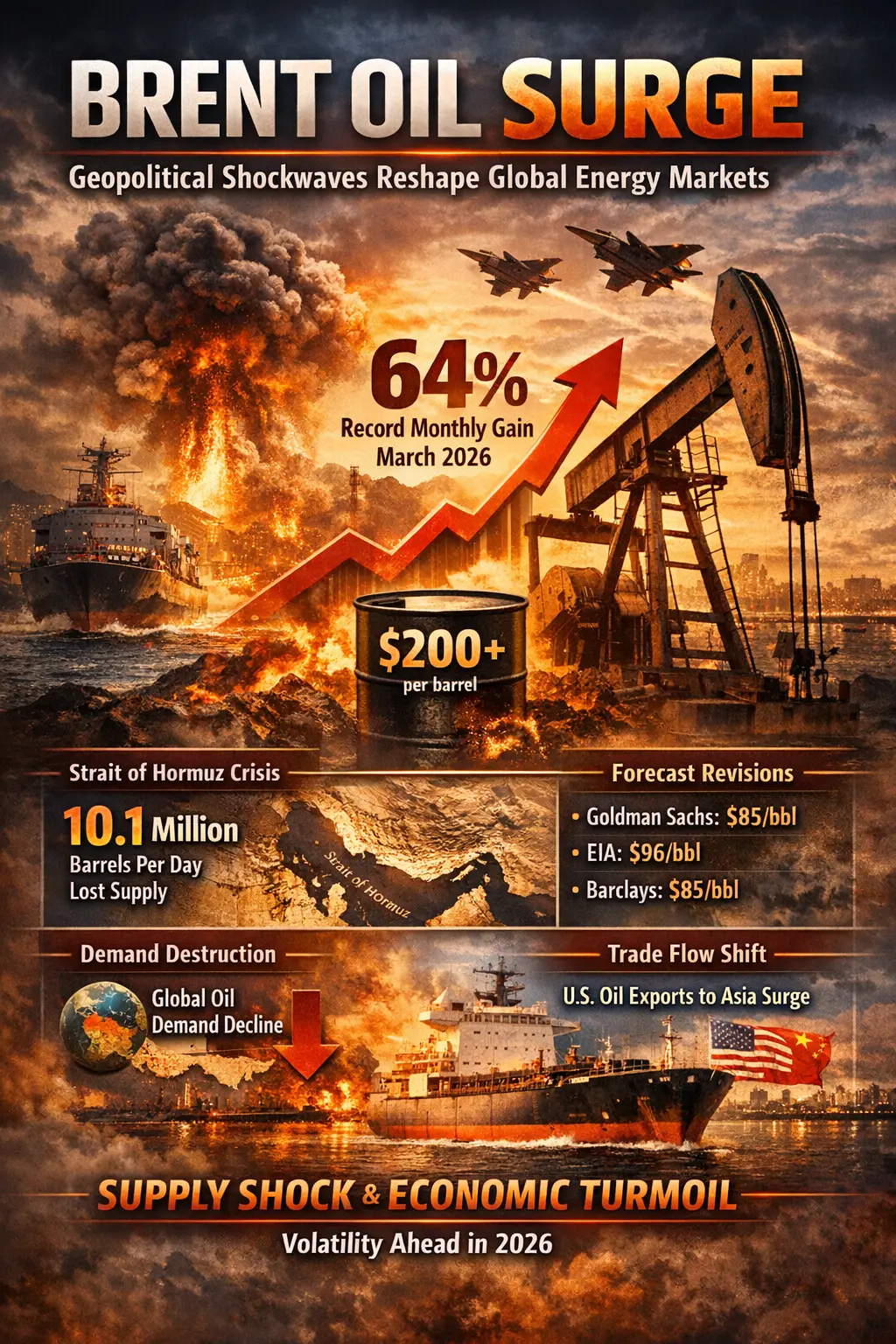
The global oil landscape has undergone a seismic transformation in 2026, with Brent crude experiencing unprecedented volatility driven by escalating geopolitical tensions in the Middle East. Front-month Brent futures delivered a record-breaking 64% monthly gain in March 2026, marking the largest single-month rally since LSEG data collection began in June 1988. This extraordinary price action reflects the most severe supply disruption in oil market history, fundamentally altering energy trade flows and economic projections worldwide.
The Strait of Hormuz Crisis: Supply Disruption of Historic Proportions
The closure of the Strait of Hormuz, through which approximately 20% of global oil and liquefied natural gas supplies transit, has created a supply shock of unparalleled magnitude. According to the International Energy Agency, March witnessed a staggering 10.1 million barrels per day of lost supply, representing the largest disruption ever recorded. The IEA explicitly stated that resuming flows through this critical waterway remains the single most important variable for easing pressure on energy supplies, prices, and the global economy.
The physical market has responded with acute tightness. While crude futures have shown volatility, refined product prices have skyrocketed, with diesel and jet fuel at times exceeding $200 per barrel. This divergence between physical and paper markets signals genuine supply scarcity rather than speculative positioning, with Asian markets bearing the brunt of disruptions as they rely heavily on Middle East crude and LPG shipments.
Institutional Forecast Revisions: Wall Street Adjusts to New Reality
Major financial institutions have dramatically revised their 2026 oil price forecasts upward to reflect the changed supply landscape:
Goldman Sachs raised its 2026 Brent crude average price forecast by $8 to $85 per barrel, citing extended disruptions to crude shipments through the Strait of Hormuz and increased strategic stockpiling by consuming nations. The bank anticipates oil flows gradually normalizing by mid-May, though near-term risks remain elevated.
The U.S. Energy Information Administration has similarly upgraded its price outlook, now projecting Brent to average $96 per barrel as prolonged outages keep markets tight despite weaker demand growth. This represents a substantial upward revision from earlier forecasts of approximately $70 per barrel at the start of 2026.
Barclays has raised its 2026 Brent forecast to $85 per barrel, while HSBC maintains a more conservative $80 per barrel projection. These revisions reflect a consensus that supply constraints will persist through at least the first half of 2026.
Demand Destruction: The Counterbalancing Force
The IEA has sharply cut its global oil demand growth forecast, now projecting a decline of 80,000 barrels per day in 2026 compared to a previous projection of 640,000 bpd growth. This marks the first annual demand contraction since the 2020 pandemic, as price surges triggered by the Middle East conflict erode consumption.
Preliminary estimates suggest global demand losses in early 2026 have exceeded those seen during more dramatic price spikes in 2011 and 2022. High fuel costs are particularly impacting low-income countries in Africa, the Middle East, and Central America, where households spend significant portions of income on energy. The Bloomberg Economics SHOK model projects that oil prices around $110 per barrel would deliver a marked but manageable boost to inflation while delivering a blow to growth.
Trade Flow Realignment: The Western Pivot
The supply disruption has triggered a fundamental reconfiguration of global oil trade flows. U.S. oil exports to Asia are poised to surge in April as refineries seek alternative suppliers to replace Middle East barrels. This shift represents a structural change in energy trade patterns that may persist even after Strait of Hormuz flows resume.
China's aluminum exports are expected to surge as international prices show their biggest premium to the Chinese market since 2022, creating arbitrage opportunities for smelters. Annual sales could match or exceed the record 6.7 million tons exported in 2024 due to war-related demand shifts.
Market Outlook: Balancing Supply Scarcity Against Demand Weakness
The oil market faces a complex balancing act between acute supply constraints and deteriorating demand fundamentals. Goldman Sachs maintains that softer demand and easing supply disruptions have balanced out risks in its outlook, though it kept 2026 average forecasts unchanged at $83 per barrel for Brent and $78 for WTI, assuming gradual normalization of Hormuz flows.
The physical-to-futures price divergence highlights the market's bifurcated condition. While futures prices have retreated from peaks on optimism regarding potential peace negotiations, spot prices for immediate delivery remain elevated, reflecting genuine supply scarcity. President Trump has indicated the conflict could resolve within two to three weeks, though military deployments including a third U.S. aircraft carrier strike group heading to the region suggest potential for further escalation.
Investment Implications
For commodity traders and investors, the current environment demands careful attention to several key variables: the timeline for Strait of Hormuz reopening, the pace of demand destruction in price-sensitive markets, the extent of strategic petroleum reserve releases by consuming nations, and the durability of altered trade flows even after supply normalization.
The energy sector's transformation extends beyond crude oil to encompass refined products, petrochemicals, and alternative energy sources. Market participants should monitor the evolving relationship between physical and futures markets as a real-time indicator of supply-demand balance.
The 2026 oil market represents a textbook case of geopolitical risk premium intersecting with physical supply constraints, creating conditions that will likely persist until a durable resolution to regional tensions emerges. Until then, volatility will remain the defining characteristic of energy markets.
repost-content-media
  • Reward
  • Comment
  • Repost
  • Share
#BrentOilRises
Brent Oil Surge: Geopolitical Shockwaves Reshape Global Energy Markets
The global oil landscape has undergone a seismic transformation in 2026, with Brent crude experiencing unprecedented volatility driven by escalating geopolitical tensions in the Middle East. Front-month Brent futures delivered a record-breaking 64% monthly gain in March 2026, marking the largest single-month rally since LSEG data collection began in June 1988. This extraordinary price action reflects the most severe supply disruption in oil market history, fundamentally altering energy trade flows and econom
BlackRiderCryptoLord
#BrentOilRises
Brent Oil Surge: Geopolitical Shockwaves Reshape Global Energy Markets
The global oil landscape has undergone a seismic transformation in 2026, with Brent crude experiencing unprecedented volatility driven by escalating geopolitical tensions in the Middle East. Front-month Brent futures delivered a record-breaking 64% monthly gain in March 2026, marking the largest single-month rally since LSEG data collection began in June 1988. This extraordinary price action reflects the most severe supply disruption in oil market history, fundamentally altering energy trade flows and economic projections worldwide.
The Strait of Hormuz Crisis: Supply Disruption of Historic Proportions
The closure of the Strait of Hormuz, through which approximately 20% of global oil and liquefied natural gas supplies transit, has created a supply shock of unparalleled magnitude. According to the International Energy Agency, March witnessed a staggering 10.1 million barrels per day of lost supply, representing the largest disruption ever recorded. The IEA explicitly stated that resuming flows through this critical waterway remains the single most important variable for easing pressure on energy supplies, prices, and the global economy.
The physical market has responded with acute tightness. While crude futures have shown volatility, refined product prices have skyrocketed, with diesel and jet fuel at times exceeding $200 per barrel. This divergence between physical and paper markets signals genuine supply scarcity rather than speculative positioning, with Asian markets bearing the brunt of disruptions as they rely heavily on Middle East crude and LPG shipments.
Institutional Forecast Revisions: Wall Street Adjusts to New Reality
Major financial institutions have dramatically revised their 2026 oil price forecasts upward to reflect the changed supply landscape:
Goldman Sachs raised its 2026 Brent crude average price forecast by $8 to $85 per barrel, citing extended disruptions to crude shipments through the Strait of Hormuz and increased strategic stockpiling by consuming nations. The bank anticipates oil flows gradually normalizing by mid-May, though near-term risks remain elevated.
The U.S. Energy Information Administration has similarly upgraded its price outlook, now projecting Brent to average $96 per barrel as prolonged outages keep markets tight despite weaker demand growth. This represents a substantial upward revision from earlier forecasts of approximately $70 per barrel at the start of 2026.
Barclays has raised its 2026 Brent forecast to $85 per barrel, while HSBC maintains a more conservative $80 per barrel projection. These revisions reflect a consensus that supply constraints will persist through at least the first half of 2026.
Demand Destruction: The Counterbalancing Force
The IEA has sharply cut its global oil demand growth forecast, now projecting a decline of 80,000 barrels per day in 2026 compared to a previous projection of 640,000 bpd growth. This marks the first annual demand contraction since the 2020 pandemic, as price surges triggered by the Middle East conflict erode consumption.
Preliminary estimates suggest global demand losses in early 2026 have exceeded those seen during more dramatic price spikes in 2011 and 2022. High fuel costs are particularly impacting low-income countries in Africa, the Middle East, and Central America, where households spend significant portions of income on energy. The Bloomberg Economics SHOK model projects that oil prices around $110 per barrel would deliver a marked but manageable boost to inflation while delivering a blow to growth.
Trade Flow Realignment: The Western Pivot
The supply disruption has triggered a fundamental reconfiguration of global oil trade flows. U.S. oil exports to Asia are poised to surge in April as refineries seek alternative suppliers to replace Middle East barrels. This shift represents a structural change in energy trade patterns that may persist even after Strait of Hormuz flows resume.
China's aluminum exports are expected to surge as international prices show their biggest premium to the Chinese market since 2022, creating arbitrage opportunities for smelters. Annual sales could match or exceed the record 6.7 million tons exported in 2024 due to war-related demand shifts.
Market Outlook: Balancing Supply Scarcity Against Demand Weakness
The oil market faces a complex balancing act between acute supply constraints and deteriorating demand fundamentals. Goldman Sachs maintains that softer demand and easing supply disruptions have balanced out risks in its outlook, though it kept 2026 average forecasts unchanged at $83 per barrel for Brent and $78 for WTI, assuming gradual normalization of Hormuz flows.
The physical-to-futures price divergence highlights the market's bifurcated condition. While futures prices have retreated from peaks on optimism regarding potential peace negotiations, spot prices for immediate delivery remain elevated, reflecting genuine supply scarcity. President Trump has indicated the conflict could resolve within two to three weeks, though military deployments including a third U.S. aircraft carrier strike group heading to the region suggest potential for further escalation.
Investment Implications
For commodity traders and investors, the current environment demands careful attention to several key variables: the timeline for Strait of Hormuz reopening, the pace of demand destruction in price-sensitive markets, the extent of strategic petroleum reserve releases by consuming nations, and the durability of altered trade flows even after supply normalization.
The energy sector's transformation extends beyond crude oil to encompass refined products, petrochemicals, and alternative energy sources. Market participants should monitor the evolving relationship between physical and futures markets as a real-time indicator of supply-demand balance.
The 2026 oil market represents a textbook case of geopolitical risk premium intersecting with physical supply constraints, creating conditions that will likely persist until a durable resolution to regional tensions emerges. Until then, volatility will remain the defining characteristic of energy markets.
repost-content-media
  • Reward
  • Comment
  • Repost
  • Share
#BrentOilRises
Brent Oil Surge: Geopolitical Shockwaves Reshape Global Energy Markets
The global oil landscape has undergone a seismic transformation in 2026, with Brent crude experiencing unprecedented volatility driven by escalating geopolitical tensions in the Middle East. Front-month Brent futures delivered a record-breaking 64% monthly gain in March 2026, marking the largest single-month rally since LSEG data collection began in June 1988. This extraordinary price action reflects the most severe supply disruption in oil market history, fundamentally altering energy trade flows and econom
BlackRiderCryptoLord
#BrentOilRises
Brent Oil Surge: Geopolitical Shockwaves Reshape Global Energy Markets
The global oil landscape has undergone a seismic transformation in 2026, with Brent crude experiencing unprecedented volatility driven by escalating geopolitical tensions in the Middle East. Front-month Brent futures delivered a record-breaking 64% monthly gain in March 2026, marking the largest single-month rally since LSEG data collection began in June 1988. This extraordinary price action reflects the most severe supply disruption in oil market history, fundamentally altering energy trade flows and economic projections worldwide.
The Strait of Hormuz Crisis: Supply Disruption of Historic Proportions
The closure of the Strait of Hormuz, through which approximately 20% of global oil and liquefied natural gas supplies transit, has created a supply shock of unparalleled magnitude. According to the International Energy Agency, March witnessed a staggering 10.1 million barrels per day of lost supply, representing the largest disruption ever recorded. The IEA explicitly stated that resuming flows through this critical waterway remains the single most important variable for easing pressure on energy supplies, prices, and the global economy.
The physical market has responded with acute tightness. While crude futures have shown volatility, refined product prices have skyrocketed, with diesel and jet fuel at times exceeding $200 per barrel. This divergence between physical and paper markets signals genuine supply scarcity rather than speculative positioning, with Asian markets bearing the brunt of disruptions as they rely heavily on Middle East crude and LPG shipments.
Institutional Forecast Revisions: Wall Street Adjusts to New Reality
Major financial institutions have dramatically revised their 2026 oil price forecasts upward to reflect the changed supply landscape:
Goldman Sachs raised its 2026 Brent crude average price forecast by $8 to $85 per barrel, citing extended disruptions to crude shipments through the Strait of Hormuz and increased strategic stockpiling by consuming nations. The bank anticipates oil flows gradually normalizing by mid-May, though near-term risks remain elevated.
The U.S. Energy Information Administration has similarly upgraded its price outlook, now projecting Brent to average $96 per barrel as prolonged outages keep markets tight despite weaker demand growth. This represents a substantial upward revision from earlier forecasts of approximately $70 per barrel at the start of 2026.
Barclays has raised its 2026 Brent forecast to $85 per barrel, while HSBC maintains a more conservative $80 per barrel projection. These revisions reflect a consensus that supply constraints will persist through at least the first half of 2026.
Demand Destruction: The Counterbalancing Force
The IEA has sharply cut its global oil demand growth forecast, now projecting a decline of 80,000 barrels per day in 2026 compared to a previous projection of 640,000 bpd growth. This marks the first annual demand contraction since the 2020 pandemic, as price surges triggered by the Middle East conflict erode consumption.
Preliminary estimates suggest global demand losses in early 2026 have exceeded those seen during more dramatic price spikes in 2011 and 2022. High fuel costs are particularly impacting low-income countries in Africa, the Middle East, and Central America, where households spend significant portions of income on energy. The Bloomberg Economics SHOK model projects that oil prices around $110 per barrel would deliver a marked but manageable boost to inflation while delivering a blow to growth.
Trade Flow Realignment: The Western Pivot
The supply disruption has triggered a fundamental reconfiguration of global oil trade flows. U.S. oil exports to Asia are poised to surge in April as refineries seek alternative suppliers to replace Middle East barrels. This shift represents a structural change in energy trade patterns that may persist even after Strait of Hormuz flows resume.
China's aluminum exports are expected to surge as international prices show their biggest premium to the Chinese market since 2022, creating arbitrage opportunities for smelters. Annual sales could match or exceed the record 6.7 million tons exported in 2024 due to war-related demand shifts.
Market Outlook: Balancing Supply Scarcity Against Demand Weakness
The oil market faces a complex balancing act between acute supply constraints and deteriorating demand fundamentals. Goldman Sachs maintains that softer demand and easing supply disruptions have balanced out risks in its outlook, though it kept 2026 average forecasts unchanged at $83 per barrel for Brent and $78 for WTI, assuming gradual normalization of Hormuz flows.
The physical-to-futures price divergence highlights the market's bifurcated condition. While futures prices have retreated from peaks on optimism regarding potential peace negotiations, spot prices for immediate delivery remain elevated, reflecting genuine supply scarcity. President Trump has indicated the conflict could resolve within two to three weeks, though military deployments including a third U.S. aircraft carrier strike group heading to the region suggest potential for further escalation.
Investment Implications
For commodity traders and investors, the current environment demands careful attention to several key variables: the timeline for Strait of Hormuz reopening, the pace of demand destruction in price-sensitive markets, the extent of strategic petroleum reserve releases by consuming nations, and the durability of altered trade flows even after supply normalization.
The energy sector's transformation extends beyond crude oil to encompass refined products, petrochemicals, and alternative energy sources. Market participants should monitor the evolving relationship between physical and futures markets as a real-time indicator of supply-demand balance.
The 2026 oil market represents a textbook case of geopolitical risk premium intersecting with physical supply constraints, creating conditions that will likely persist until a durable resolution to regional tensions emerges. Until then, volatility will remain the defining characteristic of energy markets.
repost-content-media
  • Reward
  • Comment
  • Repost
  • Share
#BrentOilRises
Brent Oil Surge: Geopolitical Shockwaves Reshape Global Energy Markets
The global oil landscape has undergone a seismic transformation in 2026, with Brent crude experiencing unprecedented volatility driven by escalating geopolitical tensions in the Middle East. Front-month Brent futures delivered a record-breaking 64% monthly gain in March 2026, marking the largest single-month rally since LSEG data collection began in June 1988. This extraordinary price action reflects the most severe supply disruption in oil market history, fundamentally altering energy trade flows and econom
BlackRiderCryptoLord
#BrentOilRises
Brent Oil Surge: Geopolitical Shockwaves Reshape Global Energy Markets
The global oil landscape has undergone a seismic transformation in 2026, with Brent crude experiencing unprecedented volatility driven by escalating geopolitical tensions in the Middle East. Front-month Brent futures delivered a record-breaking 64% monthly gain in March 2026, marking the largest single-month rally since LSEG data collection began in June 1988. This extraordinary price action reflects the most severe supply disruption in oil market history, fundamentally altering energy trade flows and economic projections worldwide.
The Strait of Hormuz Crisis: Supply Disruption of Historic Proportions
The closure of the Strait of Hormuz, through which approximately 20% of global oil and liquefied natural gas supplies transit, has created a supply shock of unparalleled magnitude. According to the International Energy Agency, March witnessed a staggering 10.1 million barrels per day of lost supply, representing the largest disruption ever recorded. The IEA explicitly stated that resuming flows through this critical waterway remains the single most important variable for easing pressure on energy supplies, prices, and the global economy.
The physical market has responded with acute tightness. While crude futures have shown volatility, refined product prices have skyrocketed, with diesel and jet fuel at times exceeding $200 per barrel. This divergence between physical and paper markets signals genuine supply scarcity rather than speculative positioning, with Asian markets bearing the brunt of disruptions as they rely heavily on Middle East crude and LPG shipments.
Institutional Forecast Revisions: Wall Street Adjusts to New Reality
Major financial institutions have dramatically revised their 2026 oil price forecasts upward to reflect the changed supply landscape:
Goldman Sachs raised its 2026 Brent crude average price forecast by $8 to $85 per barrel, citing extended disruptions to crude shipments through the Strait of Hormuz and increased strategic stockpiling by consuming nations. The bank anticipates oil flows gradually normalizing by mid-May, though near-term risks remain elevated.
The U.S. Energy Information Administration has similarly upgraded its price outlook, now projecting Brent to average $96 per barrel as prolonged outages keep markets tight despite weaker demand growth. This represents a substantial upward revision from earlier forecasts of approximately $70 per barrel at the start of 2026.
Barclays has raised its 2026 Brent forecast to $85 per barrel, while HSBC maintains a more conservative $80 per barrel projection. These revisions reflect a consensus that supply constraints will persist through at least the first half of 2026.
Demand Destruction: The Counterbalancing Force
The IEA has sharply cut its global oil demand growth forecast, now projecting a decline of 80,000 barrels per day in 2026 compared to a previous projection of 640,000 bpd growth. This marks the first annual demand contraction since the 2020 pandemic, as price surges triggered by the Middle East conflict erode consumption.
Preliminary estimates suggest global demand losses in early 2026 have exceeded those seen during more dramatic price spikes in 2011 and 2022. High fuel costs are particularly impacting low-income countries in Africa, the Middle East, and Central America, where households spend significant portions of income on energy. The Bloomberg Economics SHOK model projects that oil prices around $110 per barrel would deliver a marked but manageable boost to inflation while delivering a blow to growth.
Trade Flow Realignment: The Western Pivot
The supply disruption has triggered a fundamental reconfiguration of global oil trade flows. U.S. oil exports to Asia are poised to surge in April as refineries seek alternative suppliers to replace Middle East barrels. This shift represents a structural change in energy trade patterns that may persist even after Strait of Hormuz flows resume.
China's aluminum exports are expected to surge as international prices show their biggest premium to the Chinese market since 2022, creating arbitrage opportunities for smelters. Annual sales could match or exceed the record 6.7 million tons exported in 2024 due to war-related demand shifts.
Market Outlook: Balancing Supply Scarcity Against Demand Weakness
The oil market faces a complex balancing act between acute supply constraints and deteriorating demand fundamentals. Goldman Sachs maintains that softer demand and easing supply disruptions have balanced out risks in its outlook, though it kept 2026 average forecasts unchanged at $83 per barrel for Brent and $78 for WTI, assuming gradual normalization of Hormuz flows.
The physical-to-futures price divergence highlights the market's bifurcated condition. While futures prices have retreated from peaks on optimism regarding potential peace negotiations, spot prices for immediate delivery remain elevated, reflecting genuine supply scarcity. President Trump has indicated the conflict could resolve within two to three weeks, though military deployments including a third U.S. aircraft carrier strike group heading to the region suggest potential for further escalation.
Investment Implications
For commodity traders and investors, the current environment demands careful attention to several key variables: the timeline for Strait of Hormuz reopening, the pace of demand destruction in price-sensitive markets, the extent of strategic petroleum reserve releases by consuming nations, and the durability of altered trade flows even after supply normalization.
The energy sector's transformation extends beyond crude oil to encompass refined products, petrochemicals, and alternative energy sources. Market participants should monitor the evolving relationship between physical and futures markets as a real-time indicator of supply-demand balance.
The 2026 oil market represents a textbook case of geopolitical risk premium intersecting with physical supply constraints, creating conditions that will likely persist until a durable resolution to regional tensions emerges. Until then, volatility will remain the defining characteristic of energy markets.
repost-content-media
  • Reward
  • Comment
  • Repost
  • Share
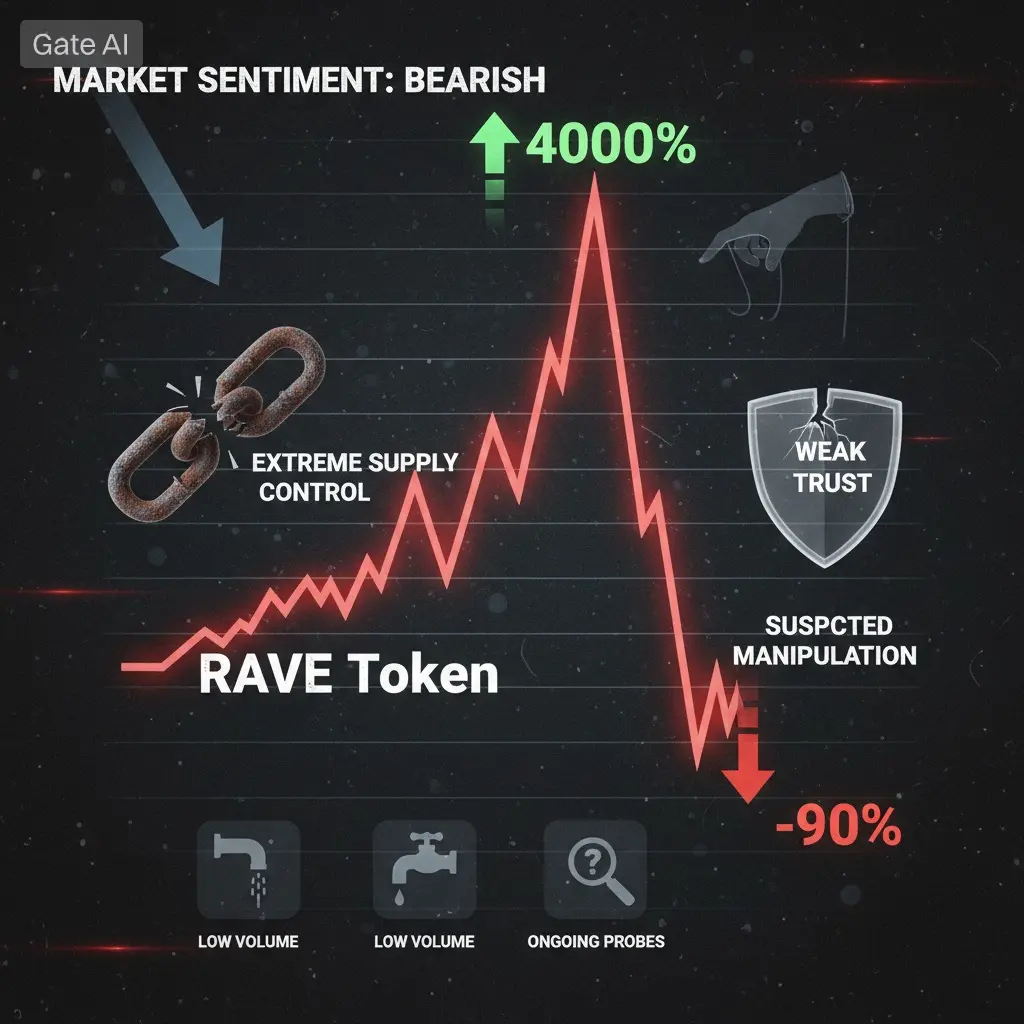
#RAVECrashes90%
RAVECrashes90%
RAVE Token Crash Analysis:
The Full 90%+ Collapse Breakdown
What Happened: Complete Timeline
(The Most Explosive Pump-and-Dump in Recent Crypto History)
Phase 1: The Insane Pump (April 10–18, 2026)
RAVE token moved from almost complete obscurity to becoming one of the most aggressively traded assets in the market within just eight days, creating a perfect example of how hype and speculation can drive prices far beyond their real value without any strong fundamental support.
Starting price: ~$0.68 on April 10
All-time high: $27.94 on April 18
Total surge: Over 4,
RAVE-2,1%
HighAmbition
#RAVECrashes90%
RAVECrashes90%
RAVE Token Crash Analysis:
The Full 90%+ Collapse Breakdown
What Happened: Complete Timeline
(The Most Explosive Pump-and-Dump in Recent Crypto History)
Phase 1: The Insane Pump (April 10–18, 2026)
RAVE token moved from almost complete obscurity to becoming one of the most aggressively traded assets in the market within just eight days, creating a perfect example of how hype and speculation can drive prices far beyond their real value without any strong fundamental support.
Starting price: ~$0.68 on April 10
All-time high: $27.94 on April 18
Total surge: Over 4,000% in under a week
Market cap: Shot into the top-15 cryptocurrencies globally
This type of extremely fast upward movement is usually not sustainable because it is not backed by real adoption, strong utility, or consistent demand, but instead driven by fear of missing out, low circulating supply, and aggressive buying from traders who expect the price to keep rising without understanding the risks involved.
Phase 2: The Brutal Crash (April 18–19, 2026)
The fall happened just as fast as the rise, wiping out billions in value within a very short time and leaving most retail traders stuck at high prices while large holders exited early.
Drop: 92–95% from peak
Price fell from $27.94 to roughly $1.00–$1.50
Market cap loss: $5.7–6 billion erased
Liquidations: Only $52 million
The low liquidation number clearly shows that the biggest players had already started selling before the crash became obvious, while smaller traders entered late and absorbed most of the losses, which strongly suggests that this was not a natural correction but a controlled distribution of tokens by large holders.
Phase 3: Where We Stand Right Now (April 20, 2026 – 10:18 AM PKT)
Current price: $2.418
24-hour change: -14.55%
24-hour high/low: $3.00 / $1.703
7-day performance: -85.42%
Market cap: $558.9 million
Current ranking: #109
24-hour trading volume: $4.38 million
At this stage, the token is trading at a very small percentage of its previous peak value, and more importantly, the market liquidity has dropped significantly, which means even small selling pressure can push the price down quickly because there are not enough buyers to absorb the supply.
Root Causes: Why This Crash Was Almost Inevitable
1. Extreme Supply Concentration (Core Structural Weakness)
The biggest issue was the way the tokens were distributed, because a very large portion of the total supply was controlled by only a few wallets, which made the entire market highly unstable and dependent on the actions of a small group of holders.
95% of supply controlled by just 9 wallets
One wallet alone holding 60%
This kind of structure creates an artificial price environment where the value does not reflect real demand, and once these large holders decide to sell, the market cannot handle the pressure, leading to a sudden collapse.
2. Coordinated Market Behavior Signals
There were several warning signs that the price movement was not completely natural and may have been influenced by coordinated actions.
Large movements of tokens before major price changes
Perfectly timed buying and selling patterns
Sudden spikes in trading activity without consistent follow-through
These patterns are commonly seen in markets where price is driven by strategy rather than organic growth, which increases the risk for late investors.
3. Weak Transparency from Project Side
Even though the team denied any involvement, there are still serious concerns that remain unanswered.
Large wallets continued moving tokens during the crash
No clear information about token lockups or release schedules
No detailed explanation about supply concentration
In crypto markets, transparency builds trust, and when transparency is missing, confidence drops quickly and recovery becomes very difficult.
Technical Structure & Market Behavior
The price chart now shows a clear pattern that is often seen after extreme hype cycles.
A very sharp rise followed by a sudden vertical drop
No strong support levels because price discovery was artificial
Trading volume decreasing, showing reduced interest
Number of holders declining as people exit positions
This is not a normal correction where the market stabilizes gradually, but a structural breakdown where confidence and demand both disappear at the same time.
Sentiment & Trader Psychology
Market sentiment is currently weak and uncertain.
Negative sentiment: 54%
Positive sentiment: 46%
Fear & Greed Index: 29 (Fear)
Most traders are discussing losses, questioning the price movement, and warning others to stay cautious, while even experienced participants are avoiding aggressive positions because the situation remains unclear.
Bull vs Bear Scenario
Bearish Case (Dominant)
The bearish side remains much stronger because the core problems in the project have not been solved.
Supply concentration still exists
Liquidity remains weak
Trust in the project has been damaged
No strong buying demand is visible
Bullish Case
There is still a small possibility of short-term price movement upward due to oversold conditions and high volatility, but these moves are usually temporary and driven by speculation rather than real recovery.
Strategic Outlook
This situation should not be treated as a normal market dip, but as a high-risk environment where protecting capital is more important than chasing quick profits.
Traders should stay patient, avoid emotional decisions, and only consider strong projects with clear fundamentals, while understanding that any short-term bounce in this token is likely temporary unless the overall structure improves significantly.
Final Conclusion
The RAVE collapse clearly shows how hype, low supply circulation, and concentrated ownership can push prices to unrealistic levels and then cause a massive crash within a very short time.
The market has already moved from a growth phase into distribution and now into uncertainty, where risk remains high and confidence is low.
Current Market Stance: Strongly BEARISH
Until there is real transparency, stronger demand, and structural improvement, the downside risk continues to outweigh any potential upside.
repost-content-media
  • Reward
  • Comment
  • Repost
  • Share
#KelpDAOBridgeHacked
On April 18, 2026, KelpDAO suffered one of the most serious security breaches in the crypto space this year when attackers exploited its cross-chain bridge and drained approximately 116,500 rsETH tokens worth nearly $292–294 million in under 46 minutes, making it not only one of the largest hacks of 2026 but also one of the fastest executed exploits in DeFi history.
This was not just a simple theft, but a highly structured attack that triggered a chain reaction across multiple protocols, exposing how deeply connected and fragile the DeFi ecosystem can be under stress.
How
ETH0,35%
BTC0,51%
AAVE0,66%
HighAmbition
#KelpDAOBridgeHacked
On April 18, 2026, KelpDAO suffered one of the most serious security breaches in the crypto space this year when attackers exploited its cross-chain bridge and drained approximately 116,500 rsETH tokens worth nearly $292–294 million in under 46 minutes, making it not only one of the largest hacks of 2026 but also one of the fastest executed exploits in DeFi history.
This was not just a simple theft, but a highly structured attack that triggered a chain reaction across multiple protocols, exposing how deeply connected and fragile the DeFi ecosystem can be under stress.
How the Attack Worked: Step-by-Step Breakdown
The attackers targeted a technical weakness in the bridge system that connects different blockchains and allows assets to move between them
First, they created a forged cross-chain message that looked completely legitimate to the system, which tricked the protocol into accepting a fake transaction as real.
Second, once this fake message was processed, the system automatically released a large amount of rsETH tokens to the attacker’s wallet without proper verification, effectively minting unbacked assets.
Third, the attackers moved very quickly and used these fake tokens as collateral in DeFi lending platforms, where they borrowed real ETH and extracted approximately $230M+ in usable liquidity, turning a smart contract flaw into real financial profit.
Finally, this created massive bad debt in the system because the borrowed funds were backed by fake collateral, leaving protocols exposed and undercollateralized.
Immediate Impact on Crypto Prices
The market reacted quickly because this event directly affected confidence in DeFi infrastructure.
Bitcoin (BTC) dropped from around $76,000 to nearly $74,500, showing a decline of roughly 1.5%–2%
Ethereum (ETH) fell below $2,300, reaching lows near $2,250–$2,280, reflecting stronger pressure due to its DeFi exposure
AAVE token experienced a sharper decline, dropping around 10%–18%, as lending protocol risk became the main concern
These price movements were not extreme crashes, but they clearly showed a risk-off reaction, where traders reduced exposure to avoid further uncertainty.
Liquidity Shock & DeFi Contagion
The biggest damage was not just the hack itself, but how quickly it spread across the ecosystem.
Over $5 billion+ in liquidity was withdrawn from lending platforms within hours
Total Value Locked (TVL) dropped sharply across multiple protocols
Borrowing systems became unstable due to sudden imbalance in supply and demand
This created a situation where even users who were not directly affected by the hack still faced risk due to the interconnected nature of DeFi systems.
Role of Gate.io in Market Reaction
While the exploit itself happened in decentralized systems, trading activity and market reactions were visible on platforms like Gate.io, where traders responded to volatility by adjusting positions, managing risk, and reacting to price fluctuations.
It is important to understand that centralized platforms were not the cause of the issue, but they reflected real-time sentiment and liquidity movements as the situation unfolded.
Why This Hack Is So Important
This event highlights several major risks that still exist in crypto despite years of development.
First, cross-chain bridges remain one of the weakest points in DeFi, because they rely on complex communication systems that can be exploited if even a small flaw exists.
Second, liquid restaking tokens (like rsETH) increase systemic risk because the same asset is used across multiple platforms, which means one failure can spread quickly.
Third, DeFi composability, while powerful, also creates hidden risks because protocols depend on each other in ways that are not always fully understood until something breaks.
Current Market Structure After the Hack
Even though the initial panic has slowed down, the market is still in a cautious state.
Funding rates remain slightly negative, showing bearish sentiment
Traders are reducing leverage and avoiding aggressive positions
Large investors are slowly re-entering, but with controlled risk
This indicates that the market is stabilizing, but confidence has not fully returned yet.
What Happens Next
Moving forward, this event will likely push the crypto industry toward stronger security practices and stricter risk management.
We can expect:
Better bridge security and auditing systems
More conservative collateral rules in DeFi lending
Reduced reliance on complex cross-chain structures
Increased focus on transparency from protocols
Final Conclusion
The KelpDAO hack is a powerful reminder that even advanced DeFi systems can fail quickly when a critical vulnerability is exploited, and that speed and complexity in crypto can amplify both opportunity and risk at the same time.
While the direct financial loss is massive, the bigger impact is on trust, system design, and future regulation, which will shape how DeFi evolves from here.
The market has shown resilience with only moderate price drops, but the deeper effect lies in how investors now view risk across interconnected protocols.
repost-content-media
  • Reward
  • Comment
  • Repost
  • Share
#AIInfraShiftstoApplications
AI Application Era and the Silent Revolution Inside Crypto Markets
From Infrastructure Race to Application-Driven Intelligence Economy
The global artificial intelligence landscape is undergoing a deep structural transition where the focus is shifting away from infrastructure-heavy development and moving decisively toward application-layer systems that directly interact with real-world economic activity. The earlier phase was defined by GPUs, cloud scaling, foundation models, and massive computational investments, but that foundation is now becoming a background ut
HighAmbition
#AIInfraShiftstoApplications
AI Application Era and the Silent Revolution Inside Crypto Markets
From Infrastructure Race to Application-Driven Intelligence Economy
The global artificial intelligence landscape is undergoing a deep structural transition where the focus is shifting away from infrastructure-heavy development and moving decisively toward application-layer systems that directly interact with real-world economic activity. The earlier phase was defined by GPUs, cloud scaling, foundation models, and massive computational investments, but that foundation is now becoming a background utility rather than the main source of competitive advantage. The real power is moving into applications where intelligence is no longer just built but actively deployed to execute, optimize, and transform real systems.
Intelligence Is Moving From Analysis to Execution
Artificial intelligence is no longer limited to generating insights or predictions; it is now evolving into an execution-driven force where autonomous agents, automated workflows, and intelligent systems are making decisions and performing actions in real time. This shift represents a fundamental change in the role of AI, from passive computation to active participation in economic and financial environments. As a result, AI is becoming deeply embedded into operational systems where outcomes matter more than models, and execution matters more than theory.
Direct Spillover Into Crypto Market Structure
This transformation is having a direct and visible impact on crypto markets, which are highly sensitive to technological innovation, liquidity shifts, and narrative-driven capital flows. As AI applications expand, capital is increasingly rotating toward blockchain ecosystems that integrate artificial intelligence into financial systems, particularly in decentralized finance, automated trading infrastructures, and intelligent on-chain analytics platforms. This is creating a new market dynamic where value is not only driven by speculation but also by functional utility and system-level efficiency.
Acceleration of Price Behavior and Market Volatility
Crypto markets are becoming significantly faster and more reactive due to the influence of AI-driven systems and algorithmic trading agents. These systems continuously analyze real-time data, sentiment shifts, and liquidity conditions, resulting in rapid execution of trades and instant market reactions. Price movements that once took extended periods are now compressed into shorter timeframes, creating sharp momentum cycles where trends accelerate quickly and reverse with equal speed. This makes market behavior more intense, more dynamic, and more sensitive to information flow.
Transformation of Trading Volume Into Multi-Agent Activity
Trading volume is no longer a simple reflection of human participation but has evolved into a multi-layered system involving retail traders, institutional capital, algorithmic execution, and autonomous AI agents operating simultaneously. This creates sudden volume expansions during AI-related developments and narrative shifts, followed by rapid stabilization phases once momentum slows. Volume is now a continuously evolving metric that reflects the interaction between human psychology and machine-driven execution.
Liquidity Becomes Dynamic and Algorithmically Controlled
Liquidity in crypto markets is undergoing a structural transformation where capital no longer remains fixed within assets or pools but continuously rotates across ecosystems based on predictive models and real-time signals.
During strong momentum phases, liquidity expands and supports large-scale execution with reduced friction, while during uncertainty it contracts rapidly, leading to sharp volatility and accelerated corrections. This dual behavior makes liquidity both highly efficient and highly unstable depending on market conditions.
Convergence of AI and Decentralized Finance Systems
A major development in this evolution is the integration of artificial intelligence into decentralized finance systems, where AI is being used to optimize yield strategies, manage risk exposure, and dynamically rebalance liquidity in real time. This is transforming DeFi from a static rule-based environment into a continuously adaptive financial ecosystem that responds intelligently to market conditions. The result is a financial layer that is more efficient, more responsive, and significantly more complex in its internal behavior.
Shift in Capital Allocation and Investment Focus
Investment behavior is also changing as capital moves away from infrastructure-heavy AI projects and flows toward application-layer systems that demonstrate real-world adoption and monetization potential. Investors are increasingly prioritizing platforms that integrate directly into workflows, trading systems, and enterprise operations because these applications provide faster feedback cycles, clearer performance metrics, and more immediate economic impact compared to long-term infrastructure plays.
Emergence of Hybrid Machine-Speed Financial Systems
Over time, this transformation is leading toward a hybrid financial environment where human decision-making and machine intelligence coexist, but execution speed and market responsiveness are increasingly dominated by autonomous systems. In this environment, price discovery, liquidity flow, and trading execution become continuous processes shaped by both psychological and algorithmic forces operating simultaneously.
Final Insight: A New Digital Financial Reality
The shift toward AI application-driven systems represents a broader evolution of the digital economy where intelligence is no longer confined to computation or infrastructure but is fully embedded into operational and financial systems. Crypto markets are becoming faster, more algorithmically driven, and more structurally complex as AI systems actively participate in liquidity formation and market execution, ultimately creating a financial ecosystem that operates at machine speed and reacts in real time to both human and artificial intelligence inputs.
repost-content-media
  • Reward
  • Comment
  • Repost
  • Share
#GatePreIPOsLaunchesWithSpaceX
Gate Pre-IPOs x SpaceX: The Next Evolution of Global Investing
The global financial system is undergoing a profound structural transformation, and for the first time in modern history, retail investors are not merely observers of wealth creation but are becoming active participants in opportunities that were once tightly controlled by institutional powerhouses. With the introduction of the Pre-IPOs product by Gate.io and its inaugural offering centered around SpaceX, a new bridge is being constructed between decentralized digital markets and the traditionally ex
HighAmbition
#GatePreIPOsLaunchesWithSpaceX
Gate Pre-IPOs x SpaceX: The Next Evolution of Global Investing
The global financial system is undergoing a profound structural transformation, and for the first time in modern history, retail investors are not merely observers of wealth creation but are becoming active participants in opportunities that were once tightly controlled by institutional powerhouses. With the introduction of the Pre-IPOs product by Gate.io and its inaugural offering centered around SpaceX, a new bridge is being constructed between decentralized digital markets and the traditionally exclusive world of private capital, fundamentally redefining how early-stage investment access is distributed across the globe.
📅 Participation Timeline: A Critical Window of Opportunity
The participation window for this groundbreaking opportunity is strictly limited and strategically designed to reward early conviction and sustained commitment from investors who recognize the significance of timing in wealth creation.
Subscription Opens: April 20, 2026 — 10:00 UTC
Subscription Closes: April 22, 2026 — 10:00 UTC
Distribution: April 22, 2026 — 14:00 UTC
Pre-Market Trading: April 24, 2026 — 10:00 UTC
This 48-hour window is not merely a subscription period but a competitive environment where capital allocation is influenced by participation timing, meaning that those who engage earlier and maintain their positions consistently throughout the duration significantly increase their probability of receiving higher allocations, effectively turning time itself into a strategic asset.
From Exclusivity to Accessibility: The Collapse of Traditional Barriers
For decades, the ability to invest in companies before their public debut has been confined to a narrow circle of venture capital firms, private equity giants, and ultra-high-net-worth individuals who operate within closed networks and privileged financial ecosystems, leaving the broader investing public to enter only after valuations have already expanded significantly. This model has historically concentrated wealth creation at the top tiers of the financial hierarchy, reinforcing inequality in access to high-growth opportunities.
However, with the introduction of Pre-IPOs, Gate.io is actively dismantling these barriers by leveraging blockchain infrastructure to create a system where participation is no longer dictated by status, geography, or institutional connections, but instead by accessibility, transparency, and digital liquidity, allowing a much wider segment of the global population to position themselves earlier in the investment lifecycle.
A New Investment Paradigm: Efficiency, Liquidity, and Transparency Combined
What distinguishes Pre-IPOs from traditional pre-public investment mechanisms is not merely the access it provides, but the efficiency and flexibility embedded within its structure, which transforms historically rigid and illiquid investments into dynamic financial instruments that can adapt to market conditions in real time. Investors are no longer required to navigate complex legal frameworks, endure extended lock-up periods, or rely on opaque valuation processes, as the entire system is designed to operate within a transparent digital environment.
Through tokenized exposure, participants can gain access to the valuation trajectory of high-growth companies without engaging in the cumbersome processes typically associated with equity ownership, while real-time valuation tracking ensures that market sentiment is continuously reflected, providing a level of visibility that was previously unavailable in private markets. Additionally, the elimination of lock-up constraints introduces a degree of liquidity that fundamentally changes the risk profile of pre-IPO investments, making them more adaptable and responsive to individual investment strategies.
🚀 SpaceX (SPCX): A Transformational Asset Backed by Vision and Innovation
The selection of SpaceX as the inaugural project is both strategic and symbolic, as the company represents one of the most ambitious and disruptive forces in modern industry, having consistently pushed the boundaries of what is technologically and economically possible under the leadership of Elon Musk.
SpaceX has fundamentally altered the economics of space exploration through the development of reusable rocket systems such as Falcon 9, significantly reducing launch costs while increasing frequency and reliability, and has simultaneously expanded into global communications through the Starlink satellite network, which is rapidly becoming one of the most extensive and impactful internet infrastructures in the world. Beyond these achievements, the company’s long-term vision of interplanetary expansion and Mars colonization positions it not just as a market participant but as a pioneer shaping entirely new industries.
SPCX Structure: A Synthetic Gateway to Private Market Valuation
The SPCX asset is engineered as a Mirror Note, which means that it is designed to reflect the valuation movements of SpaceX rather than confer direct ownership of equity, thereby creating a synthetic exposure mechanism that bridges the gap between traditional private market investments and the liquidity of digital assets. This structure allows investors to benefit from valuation changes without being subject to the regulatory and logistical complexities associated with holding private shares.
With a total supply of 33,900 tokens priced at $590 each, the offering implies a valuation of approximately $1.4 trillion, positioning SpaceX among the most valuable companies globally even before its public listing. The allocation model, split between USDT and GUSD, ensures stable participation while maintaining alignment with crypto-native liquidity standards.
Time-Weighted Allocation: A Strategic Layer of Participation
One of the most innovative aspects of this offering is its time-weighted allocation mechanism, which introduces a strategic dimension to participation by rewarding early and consistent commitment rather than simply prioritizing speed of execution. Unlike traditional systems where allocation is determined by who acts fastest, this model evaluates the duration and consistency of capital commitment, effectively incentivizing long-term engagement within the subscription window.
This means that investors who allocate funds at the beginning of the subscription period and maintain their position throughout are granted significantly higher allocation weights compared to those who enter later, creating a system where patience and foresight are directly linked to potential rewards, and where timing becomes as critical as capital itself.
Liquidity Revolution: Breaking the Lock-Up Paradigm
Perhaps the most transformative feature of the Pre-IPOs model is its approach to liquidity, which stands in stark contrast to the traditional pre-IPO environment where investors are often locked into positions for extended periods with no access to secondary markets. In this new framework, participants are given multiple exit pathways, allowing them to respond dynamically to market conditions rather than being constrained by rigid contractual limitations.
Investors can choose to exit their positions before the IPO through valuation-based mechanisms, participate in pre-market trading once it becomes available, or hold their positions long-term in anticipation of further valuation growth, effectively transforming what was once a static and restrictive investment into a flexible and adaptive financial instrument.
Strategic Vision: Gate’s Expansion Beyond a Traditional Exchange
Founded by Dr. Han, Gate.io has consistently positioned itself at the forefront of innovation within the digital asset space, and the introduction of Pre-IPOs represents a natural evolution of its broader strategy to become a comprehensive financial ecosystem rather than merely a trading platform.
With a global user base exceeding 50 million and support for thousands of digital assets, Gate is now extending its reach into areas traditionally dominated by legacy financial institutions, including venture investment, tokenized real-world assets, and AI-integrated financial services, thereby creating an infrastructure that is capable of supporting the next generation of global capital markets.
Market Context: Timing Aligned with Macro and Technological Trends
The launch of this product is not occurring in isolation but is instead aligned with broader macroeconomic and technological trends that are reshaping the financial landscape, including the growing demand for access to private markets, the increasing adoption of tokenized real-world assets, and the anticipation surrounding potential mega-IPOs such as that of SpaceX.
As traditional financial systems continue to evolve and integrate with digital technologies, platforms that can bridge these two worlds are likely to play a central role in defining the future of investing, and the success of this initial offering could set a precedent for a new category of hybrid financial products.
Risk Considerations: Understanding the Structure Before Participation
Despite the significant opportunities presented by this model, it is essential for participants to fully understand the associated risks, particularly the distinction between synthetic exposure and direct equity ownership, as SPCX does not grant shareholders’ rights or direct claims on SpaceX assets.
Additionally, the performance of the asset is dependent on Gate’s ability to maintain effective hedging strategies, while the timing and valuation of any future IPO remain uncertain and subject to market conditions, regulatory approvals, and corporate decisions, making it crucial for investors to approach this opportunity with a well-informed perspective and a clear understanding of their risk tolerance.
The Future of Investing: A Structural Transformation, Not a Temporary Trend
What is being introduced through Pre-IPOs is not simply a new product category but a foundational shift in how capital markets operate, where the boundaries between private and public investing are gradually dissolving, and where blockchain technology serves as the infrastructure enabling this transition.
As this model evolves, it has the potential to unlock a wide range of opportunities, from tokenized venture capital ecosystems to fully liquid private equity markets, fundamentally changing how and when investors can participate in the growth of high-impact companies.
Final Perspective: Positioning Before the World Arrives
The launch of Pre-IPOs by Gate.io, combined with the inclusion of SpaceX as its first project, represents a defining moment in the evolution of global finance, where access, liquidity, and innovation converge to create a new paradigm for investment.
In this emerging landscape, the most successful participants will not be those who react after opportunities become widely recognized, but those who position themselves early, understand the underlying mechanisms, and adapt to a system where the future of investing is no longer bound by traditional limitations, but is instead driven by technology, accessibility, and strategic foresight.
repost-content-media
  • Reward
  • Comment
  • Repost
  • Share
#AnthropicvsOpenAIHeatsUp
The Battle for Intelligence Infrastructure, Global AI Control, and the Future Digital Economy
The rivalry between Anthropic and OpenAI in 2026 has evolved far beyond the boundaries of traditional technology competition, because what is unfolding now is not simply a contest between two companies, but rather a foundational struggle over how artificial intelligence will be structured, monetized, regulated, and distributed across the global economy for the next several decades.
What makes this moment historically significant is that both companies are no longer experimen
HighAmbition
#AnthropicvsOpenAIHeatsUp
The Battle for Intelligence Infrastructure, Global AI Control, and the Future Digital Economy
The rivalry between Anthropic and OpenAI in 2026 has evolved far beyond the boundaries of traditional technology competition, because what is unfolding now is not simply a contest between two companies, but rather a foundational struggle over how artificial intelligence will be structured, monetized, regulated, and distributed across the global economy for the next several decades.
What makes this moment historically significant is that both companies are no longer experimenting in a niche innovation phase, but are instead actively building parallel systems of intelligence infrastructure that are becoming deeply embedded into enterprise workflows, consumer ecosystems, and even government-level decision-making systems.
1. The Revenue Acceleration Shock: From Tools to Economic Infrastructure
The most striking transformation in 2026 is the sheer speed at which AI systems have transitioned from being productivity tools into full-scale economic infrastructure, where Anthropic’s rapid enterprise expansion reflects how deeply businesses are integrating AI into mission-critical operations such as finance, legal analysis, software engineering, and risk management, while OpenAI continues to dominate the consumer and developer ecosystems by embedding itself into daily digital behavior at massive global scale.
This divergence has created a clear structural separation where Anthropic is effectively becoming the “backbone intelligence layer” for high-value enterprises that prioritize precision, safety, and reliability, whereas OpenAI is evolving into a “mass intelligence utility platform” that prioritizes accessibility, speed, and ecosystem expansion.
2. Valuation War and Capital Psychology Shift
The valuation dynamics between both companies are no longer purely driven by hype cycles, but are increasingly shaped by investor psychology that now focuses on long-term sustainability, compute efficiency, and enterprise revenue durability, which explains why Anthropic is gaining disproportionate attention from institutional investors despite OpenAI maintaining higher overall valuation and global user dominance.
A deeper interpretation of this trend suggests that capital markets are entering a new phase where AI companies are being evaluated not only on growth velocity, but also on their ability to survive extreme infrastructure costs, regulatory pressure, and long-term profitability challenges that are becoming increasingly unavoidable as AI systems scale.
3. Model Intelligence Competition: Reasoning Depth vs Ecosystem Breadth
At the core of this rivalry lies an accelerating model capability race where Anthropic is heavily optimizing for deep reasoning, structured decision-making, and extended context processing that allows it to outperform in complex enterprise environments requiring high reliability and interpretability, while OpenAI is aggressively expanding multimodal intelligence, agentic automation, and cross-platform integration that enables AI systems to interact directly with software environments, user workflows, and real-time digital ecosystems.
This has resulted in two distinct philosophical approaches to intelligence design, where Anthropic is effectively engineering systems that behave like highly disciplined analytical minds, whereas OpenAI is building systems that behave like autonomous digital operators capable of executing tasks across multiple environments with minimal human intervention.
4. Safety, Alignment, and the Silent Convergence of Ideologies
Although the original split between the two companies was rooted in a fundamental disagreement over AI safety philosophy, the reality in 2026 is that both approaches are gradually converging under the pressure of regulatory scrutiny, enterprise demand, and geopolitical oversight, because neither extreme caution nor unchecked acceleration is viable at global scale.
As a result, safety has evolved from being an ideological principle into a strategic necessity that influences enterprise adoption, government contracts, and public trust, which means both companies are now operating within a tightly controlled innovation corridor where model capability must be balanced with alignment, transparency, and risk mitigation frameworks.
5. The Emergence of Dual AI Economies
One of the most important structural shifts in the AI landscape is the formation of two parallel intelligence economies, where Anthropic is becoming deeply embedded within regulated industries such as banking, insurance, law, and enterprise software systems, while OpenAI is expanding across consumer applications, creative industries, education tools, and developer ecosystems, effectively creating a bifurcated global AI structure where different layers of society interact with different intelligence systems depending on their operational needs and risk tolerance.
This separation is not accidental but rather a natural outcome of product positioning, regulatory alignment, and trust dynamics that are shaping how AI integrates into the global economic architecture.
6. Compute Infrastructure as the Real Battlefield of Power
Behind the visible competition in models and applications lies the far more critical battle over compute infrastructure, where access to GPUs, energy resources, and long-term hardware supply chains is becoming the ultimate constraint that determines how fast each company can scale its intelligence capabilities.
In this environment, AI companies are no longer just software builders but are increasingly functioning as hybrid infrastructure corporations that must secure multi-year chip supply agreements, build massive data center networks, and negotiate energy partnerships at national scale, which means the true competitive advantage is shifting from algorithm design to physical infrastructure control.
7. Talent Concentration and Research Capitalism
Another invisible but decisive dimension of this rivalry is the intense competition for elite AI researchers, where a small number of highly specialized individuals are capable of producing breakthroughs that reshape entire model architectures, meaning that talent concentration is becoming one of the most valuable and strategically sensitive assets in the entire AI ecosystem.
This has created a situation where research teams are effectively functioning like high-impact “intelligence units” within corporate structures, and even small shifts in personnel between Anthropic, OpenAI, and other major labs can lead to significant changes in capability trajectories.
8. Geopolitical Integration of AI Systems
The geopolitical dimension of this rivalry has become increasingly important, as governments are now actively integrating AI systems into national security frameworks, regulatory structures, and economic planning models, which means that both Anthropic and OpenAI are effectively becoming strategic technology partners within broader state-level AI ecosystems.
Export restrictions on advanced chips, data sovereignty laws, and compliance requirements are all shaping how these companies design and deploy their systems, making AI development not just a technological challenge but also a geopolitical balancing act.
9. Market Maturity and the End of Pure Hype Cycles
The AI market in 2026 is undergoing a clear psychological transition from speculative hype cycles toward infrastructure-driven valuation models, where investors are increasingly focused on measurable revenue streams, enterprise retention rates, compute efficiency, and regulatory resilience rather than purely on model capability demonstrations or viral product adoption.
This shift indicates that AI is entering a maturity phase where long-term sustainability is becoming more important than short-term innovation bursts, fundamentally changing how capital flows into the sector.
10. Long-Term Outcome Scenarios: Structural Coexistence is Most Likely
Looking forward, the most realistic long-term outcome is not a single winner dominating the entire AI ecosystem, but rather a structural coexistence where OpenAI establishes itself as the dominant consumer intelligence platform powering global digital interaction, while Anthropic solidifies its position as the enterprise-grade reasoning infrastructure that supports high-stakes decision-making environments across regulated industries.
In this scenario, both companies become foundational layers of the global AI stack, operating in different but complementary domains of intelligence application.
Final Perspective
The #AnthropicvsOpenAIHeatsUp narrative represents far more than a corporate rivalry, because what is unfolding in 2026 is the construction of a new global intelligence architecture where AI is becoming the central operating layer of economic activity, digital communication, and institutional decision-making.
In this environment, competition between Anthropic and OpenAI is not simply about who builds better models, but about who defines the standards, infrastructure, and trust systems that will govern how intelligence itself is deployed across the world
And as the race continues, one truth is becoming increasingly clear — this is not a temporary competition, but the beginning of a permanent structural transformation of the global economy driven by artificial intelligence. 🚀
repost-content-media
  • Reward
  • Comment
  • Repost
  • Share
#KalshiFacesNevadaRegulatoryClash
Kalshi vs Nevada Regulatory Clash
The ongoing conflict between Kalshi and Nevada regulators in 2026 has become one of the most important regulatory-financial confrontations in the United States, because it directly challenges the boundary between federally regulated financial derivatives and state-level gambling authority, while also exposing how modern prediction markets are reshaping the relationship between law, liquidity, and real-time probability pricing systems.
At its core, this dispute is not just about whether one platform can operate in one state,
HighAmbition
#KalshiFacesNevadaRegulatoryClash
Kalshi vs Nevada Regulatory Clash
The ongoing conflict between Kalshi and Nevada regulators in 2026 has become one of the most important regulatory-financial confrontations in the United States, because it directly challenges the boundary between federally regulated financial derivatives and state-level gambling authority, while also exposing how modern prediction markets are reshaping the relationship between law, liquidity, and real-time probability pricing systems.
At its core, this dispute is not just about whether one platform can operate in one state, but about whether financial instruments that represent real-world outcomes can be uniformly regulated at the federal level, or whether individual states retain the power to reclassify and restrict them based on functional similarity to gambling.
1. Market Structure – How Kalshi Pricing and Probability Systems Work
Kalshi operates event-based contracts that function as binary financial instruments where pricing directly reflects implied probability, creating a real-time market for forecasting future outcomes.
These contracts typically trade within a range of $0.01 to $0.99, where the price represents the collective market probability of an event occurring, meaning a $0.70 contract implies roughly a 70 percent probability of that outcome.
During normal conditions, price movement remains relatively stable, but during high-impact events such as elections, legal rulings, or macroeconomic announcements, prices can shift extremely rapidly, often moving between 10 percent and 40 percent intraday as new information is absorbed by the market.
This makes Kalshi markets behave more like live probability engines than traditional gambling systems, because pricing continuously adapts to new information in real time.
2. Liquidity and Volume Dynamics – Event-Driven Market Behavior
Unlike traditional financial markets that maintain continuous liquidity, Kalshi operates in a highly event-sensitive liquidity environment where capital flow is concentrated around specific informational catalysts.
Liquidity tends to increase significantly during major events such as elections, federal policy decisions, central bank announcements, major sports outcomes, and legal rulings, while it declines sharply during low-information periods when there are no major catalysts influencing market expectations.
In active conditions, trading volume can increase between 3 times and 10 times compared to baseline levels, while in low-activity phases, liquidity depth becomes thin and sensitive, meaning even small trades can materially shift pricing.
This structure results in a market that is highly efficient in pricing information but structurally fragile under uncertainty shocks or regulatory disruptions.
3. Nevada Regulatory Position – State Authority and Gambling Classification
Nevada regulators argue that Kalshi’s event contracts are functionally equivalent to traditional sports betting because users are still placing money on uncertain outcomes such as games, elections, or public events.
From this perspective, the legal structure of the product does not change its economic function, and therefore it falls under Nevada’s gambling laws, which require strict licensing, taxation, and regulatory oversight.
Nevada also emphasizes that gambling regulation is a matter of state sovereignty, meaning each state has the authority to define and control gambling activity within its jurisdiction to protect consumers and preserve the integrity of its licensed gaming industry.
The state further argues that allowing federally regulated prediction markets to operate without local licensing would create a regulatory loophole that could undermine established casino and sportsbook ecosystems by reclassifying gambling activity as financial trading.
4. Kalshi’s Position – Federal Law, Financial Innovation, and Market Structure
Kalshi’s defense is built on the argument that its platform operates under the Commodity Futures Trading Commission as a Designated Contract Market, meaning it is legally classified as a financial exchange rather than a gambling operator.
The central legal argument is based on federal preemption, which states that when an instrument is regulated under federal commodities law, conflicting state-level restrictions cannot override its operation.
Kalshi also argues that its markets serve legitimate financial functions, including risk hedging, probability forecasting, and price discovery, which are essential components of modern financial infrastructure.
From this perspective, prediction markets are not gambling systems, but rather information pricing systems that allow participants to trade expectations about future events in a structured financial environment.
5. Judicial Landscape – Conflicting Legal Interpretations Across Jurisdictions
The legal system has produced inconsistent outcomes, which has significantly increased uncertainty around the final resolution of the case.
Nevada state courts have generally supported regulatory enforcement, agreeing that the contracts resemble gambling under state law.
Federal courts have been divided, with some early decisions favoring Kalshi under federal preemption arguments, while appellate courts such as the Ninth Circuit have expressed skepticism, suggesting that economic function may override legal classification when the activity resembles betting in practice.
At the same time, other federal circuits have ruled more favorably toward similar prediction market structures, creating a clear jurisdictional conflict that increases the likelihood of Supreme Court review to establish a unified national standard.
6. Market Impact – Liquidity Fragmentation and Structural Inefficiency
The Nevada enforcement action has already produced measurable effects on market structure and liquidity distribution.
Restricted access has led to an estimated 10 percent to 25 percent decline in liquidity within affected regions, while market maker participation has decreased due to increased regulatory uncertainty.
This has resulted in wider bid-ask spreads, reduced arbitrage efficiency between jurisdictions, and volume redistribution toward unrestricted markets.
These effects demonstrate that regulatory actions do not only affect legal compliance, but also directly influence price efficiency, liquidity depth, and overall market stability.
7. Crypto Market Parallel – Structural Implications for Digital Prediction Systems
When mapped to crypto-based prediction markets and decentralized finance systems, the implications of this case become significantly broader and more critical.
Crypto prediction markets operate using the same fundamental structure, where prices reflect probability between zero and one, and liquidity is driven by user participation, incentives, and market maker algorithms.
However, crypto systems add an additional layer of complexity due to decentralization, cross-border accessibility, and the absence of a single controlling entity.
If state-level enforcement against Kalshi is upheld, centralized crypto platforms offering similar products may face comparable regulatory pressure, including geofencing requirements, restricted access, and compliance obligations tied to jurisdictional boundaries.
At the same time, fully decentralized prediction markets may gain a structural advantage, since they are harder to restrict at the protocol level, although they remain vulnerable through centralized interfaces, liquidity gateways, and fiat on-ramps.
This creates a clear divergence in the crypto ecosystem between centralized compliance-driven platforms and decentralized permissionless systems operating globally.
8. Broader System Transformation – Convergence of Finance, Gambling, and Data Markets
This case reflects a deeper structural transformation in global financial systems, where three previously separate domains are increasingly merging into a single interconnected structure:
financial derivatives markets, gambling systems, and real-world predictive data markets.
Kalshi sits directly at this intersection, where financial pricing is no longer limited to assets or commodities, but extends to the probabilistic valuation of future events themselves.
This evolution represents a shift toward probability-based financial systems, where information is continuously priced, traded, and redistributed through market mechanisms.
Final Conclusion
The Kalshi versus Nevada regulatory conflict represents a foundational moment in the evolution of modern financial systems, where legal classification, market structure, and liquidity behavior are all being tested simultaneously under real-world conditions.
The dispute involves probability-based pricing systems ranging from $0.01 to $0.99, intraday volatility shifts of 10 to 40 percent, event-driven liquidity spikes of 3 to 10 times normal volume, and regional liquidity fragmentation estimated between 10 and 25 percent in affected zones.
Ultimately, this case will determine whether prediction markets operate under a unified federal financial framework or become fragmented across state-level regulatory systems, and its outcome will have long-term implications for financial derivatives innovation, market liquidity efficiency, and the future development of crypto-based prediction ecosystems worldwide.
repost-content-media
  • Reward
  • Comment
  • Repost
  • Share
#USStocksHitRecordHighs
US equity markets are powering through one of the most resilient and broad-based risk-on rallies in modern market history. As of April 18, 2026, the S&P 500 has not only shattered the historic 7,000 psychological barrier but closed at a record 7,126.06, marking its first-ever close above 7,100 and representing a solid +1.20% gain on the day with an intraday high of 7,147.52. Simultaneously, the Nasdaq Composite has delivered an extraordinary 13-day consecutive winning streak, surging to approximately 24,468.48 (up +1.52% or +365.78 points) and setting fresh all-time hi
HighAmbition
#USStocksHitRecordHighs
US equity markets are powering through one of the most resilient and broad-based risk-on rallies in modern market history. As of April 18, 2026, the S&P 500 has not only shattered the historic 7,000 psychological barrier but closed at a record 7,126.06, marking its first-ever close above 7,100 and representing a solid +1.20% gain on the day with an intraday high of 7,147.52. Simultaneously, the Nasdaq Composite has delivered an extraordinary 13-day consecutive winning streak, surging to approximately 24,468.48 (up +1.52% or +365.78 points) and setting fresh all-time highs. Even the Russell 2000 small-cap index has joined the party with its own new all-time high territory around the 2,776–2,793 level, confirming that this rally is no longer confined to a handful of mega-cap tech names.
What makes this move truly remarkable is the stark contradiction at its core: markets are hitting records amid unresolved geopolitical tensions between the US and Iran. Traditional risk-off triggers—headline shocks, oil volatility, and uncertainty over maritime blockades—are being completely overpowered by a powerful combination of surging corporate earnings, abundant liquidity, compressed volatility, and unshakable investor optimism. This is not blind euphoria; it reflects a structural shift where institutional capital is aggressively pricing in a “controlled escalation” narrative rather than worst-case scenarios. The result is a rare convergence of technical momentum, fundamental strength, and behavioral resilience that has few historical parallels.
Current Market Status
As of the close on April 18, 2026, the S&P 500 stands at 7,126.06, achieving its first-ever close above the 7,100 level and registering a new all-time high with a daily gain of +84.78 points (+1.20%). The Nasdaq Composite has extended its impressive run with a 13-day consecutive winning streak, closing at 24,468.48, also at an all-time high after posting a strong +365.78 points (+1.52%) gain. The Russell 2000 small-cap index has broken into new all-time high territory near the 2,776–2,793 range, signaling strong participation from smaller companies and confirming a broad-based rally across the market. Meanwhile, the VIX, often called the fear gauge, remains compressed in the 17–18 range (closing near 17.48), indicating low volatility expectations and a market that is currently pricing in continued stability despite ongoing geopolitical uncertainties.
Market Interpretation
This rally has evolved far beyond the narrow “Magnificent Seven” tech leadership that defined 2024–2025. Liquidity is now fanning out across the entire market capitalization spectrum. Small-cap outperformance, with the Russell 2000 pushing fresh highs, is the clearest signal yet that investors have growing confidence in macro stability, credit availability, and a soft-landing economic scenario. Financials and industrials are rotating higher alongside semiconductors and software, creating genuine market breadth that historically precedes longer and healthier bull phases.
The subdued VIX near 17.48, combined with small-cap participation, paints a picture of a market that has successfully decoupled short-term geopolitical noise from long-term structural tailwinds. Even if headlines remain noisy, the pricing mechanism has shifted: equities are now trading on expected outcomes rather than immediate events.
US-Iran Ceasefire: Current Situation
Key Timeline
February 28, 2026: Initial US-Israel strikes on Iranian-linked targets triggered a sharp but short-lived volatility spike.
Early April 2026: Back-channel diplomacy produced the first temporary ceasefire framework, easing immediate energy-market panic.
April 15–16, 2026: Senior US officials publicly signaled “cautious optimism” on de-escalation, boosting risk appetite.
April 18, 2026: Markets aggressively began pricing in a high-probability diplomatic resolution.
April 21, 2026: Critical ceasefire deadline—widely viewed as a binary catalyst.
Investors are not assuming permanent peace; they are betting on “managed tension.” Both sides appear economically incentivized to avoid full-scale disruption, particularly given oil’s central role in global inflation. However, the ongoing blockade of strategic maritime routes keeps a live tail-risk alive. This creates a classic dual-speed market: equities discounting resolution and growth, while energy and commodity markets continue to embed physical disruption premiums.
Why Stocks Are Rallying Despite Geopolitical Tension (Deep Breakdown)
Geopolitical Relief Compression
Markets have internalized the “TACO” (Temporary And Contained Outbreaks) framework. Institutional investors now treat geopolitical shocks as short-lived volatility events rather than trend-reversing crises. Hedge funds and pension funds have rotated from defensive cash holdings back into equities at an accelerated pace, confident that policymakers will prioritize financial stability.
Earnings Engine Strength (Most Critical Pillar)
Corporate America’s upward earnings revision cycle remains the rally’s primary fuel. AI-related capital expenditure is accelerating faster than expected, driving semiconductor demand to record levels. Banking profitability has improved markedly due to a normalizing yield curve, while enterprise software margins have stabilized after earlier compression. Consensus now projects 13–16% earnings growth for 2026 across the S&P 500—more than enough fundamental support for current elevated valuations, especially in growth indices.
Oil Price Repricing & Inflation Relief
WTI crude has shown volatility but recently stabilized in a higher range (recent closes fluctuating between the mid-$80s to low-$90s per barrel amid ceasefire developments), removing one of the biggest macro headwinds. Earlier fears of sustained energy-driven inflation have eased, freeing the Federal Reserve from immediate tightening pressure. This oil relief has allowed risk assets to reprice higher without the usual inflation-trade drag.
Market Breadth Expansion
Leadership is broadening dramatically: small caps are breaking all-time highs near the 2,776–2,793 zone, financials are gaining momentum on higher net-interest margins, industrials are benefiting from AI infrastructure build-out, and consumer discretionary is showing resilience on wage growth. This rotation signals the rally is maturing from speculative to structurally supported.
Trader Sentiment Analysis
Bullish psychology dominates. The mantra on trading floors is “buy the dip until proven otherwise.” Momentum strategies are fully engaged, and the fear-of-missing-out (FOMO) around continued AI upside has kept short interest suppressed even in traditionally defensive environments.
Yet risk awareness has not vanished. Traders quietly acknowledge three realities: the April 21 deadline remains a binary event that could swing sentiment instantly, volatility suppression at these levels (VIX ~17.48) is rarely sustainable long-term, and oil markets still hold structural sensitivity to any escalation.
The result is a high-conviction but fragile bullish positioning—bullish enough to drive records, yet adaptive enough to react quickly if the narrative shifts.
Trading Strategy Framework
Short-Term Positioning Logic
Trend-extension rules apply: momentum continuation strategies such as breakout buying and moving-average crossovers are favored over mean-reversion trades. However, with a binary geopolitical catalyst only days away, all positions must carry tight stops and be sized conservatively.
Medium-Term Structural View
The bigger picture remains constructive: AI-driven capex cycle is still in early innings, real monetary policy is no longer restrictive, and global liquidity conditions remain accommodative. Pullbacks are therefore likely to be shallow and quickly bought unless macro conditions deteriorate materially.
Crypto Market Relationship Insight
A notable divergence has emerged. While equities hit records, Bitcoin trades around $75,726–$77,136 (showing mixed daily moves near the $76,000 level), Ethereum follows suit with softer performance, and the Crypto Fear & Greed Index remains in Fear territory.
This lag suggests crypto may either be waiting to catch up once geopolitical clarity arrives, or quietly pricing in risks that equities are currently ignoring. Historical precedent shows such divergences often resolve through heightened volatility rather than smooth convergence.
Forecast Scenarios
Bull Case (60% Probability): If the ceasefire holds or extends and earnings momentum continues, markets may enter a liquidity-fueled expansion phase, pushing indices well beyond current levels (S&P potentially targeting 7,300+ and Nasdaq 25,000+) with minimal consolidation. The key trigger would be a positive outcome on April 21 combined with sustained small-cap strength.
Base Case (30% Probability): Diplomatic progress remains partial. Markets stay elevated but trade in a higher range while participants digest outcomes and reassess valuations. Expect normal healthy pullbacks of 3–5%.
Bear Case (10% Probability): A breakdown in diplomacy reignites energy-market panic. This could trigger a rapid oil spike, leading to an equity drawdown and VIX expansion. The main trigger would be a clear failure of the April 21 deadline.
Final Strategic Conclusion
The current US equity rally is a masterclass in the power of earnings acceleration, volatility compression, and geopolitical risk discounting working in unison. Price action is strongly bullish—with the S&P 500 at 7,126.06 and Nasdaq at 24,468.48—yet the underlying structure retains fragility because markets are now pricing expected outcomes in advance.
The April 21 ceasefire deadline is therefore not merely another news event—it is a structural stress test for the entire bullish positioning. In this environment, disciplined risk management, adaptive sizing, and rapid reaction capability matter far more than static directional conviction.
For investors and traders alike, the message is clear: participate in the upside with confidence, but keep one eye on the exit ramps. Speed of adaptation will separate winners from those caught flat-footed when the next narrative shift inevitably arrives. The rally is real, the momentum is powerful, and the structural tailwinds are still intact—but in markets, nothing is ever truly risk-free.
repost-content-media
  • Reward
  • Comment
  • Repost
  • Share
#CryptoMarketsDipSlightly
Market at a Turning Point
The cryptocurrency market in April 2026 is currently undergoing a healthy and controlled consolidation phase following a strong institutional-driven rally earlier in the year. Bitcoin is trading around $74,000–$75,000, while Ethereum remains near $2,250–$2,300, reflecting a mild pullback rather than a structural reversal.
This slight dip is not random—it is the result of profit-taking near key resistance levels, leverage cooling in derivatives markets, and short-term risk sentiment adjustments linked to global macro uncertainty, particularly
BTC0,51%
ETH0,35%
HighAmbition
#CryptoMarketsDipSlightly
Market at a Turning Point
The cryptocurrency market in April 2026 is currently undergoing a healthy and controlled consolidation phase following a strong institutional-driven rally earlier in the year. Bitcoin is trading around $74,000–$75,000, while Ethereum remains near $2,250–$2,300, reflecting a mild pullback rather than a structural reversal.
This slight dip is not random—it is the result of profit-taking near key resistance levels, leverage cooling in derivatives markets, and short-term risk sentiment adjustments linked to global macro uncertainty, particularly geopolitical tensions and liquidity pauses after strong upside momentum.
Despite this short-term correction, underlying fundamentals remain strong. ETF inflows continue to support Bitcoin, institutional participation remains active, and on-chain activity across major networks is still elevated. The Fear & Greed Index around 29 (Fear zone) suggests the market is still in an accumulation-friendly environment rather than a distribution phase.
Overall, this is a consolidation within a broader bullish cycle, not the end of it.
Why the Crypto Market Slightly Dipped
The recent pullback in crypto prices is driven by a combination of interconnected factors rather than any single bearish trigger.
First, the market experienced profit-taking near major resistance zones, particularly around $75,000–$76,000 for Bitcoin and $2,300–$2,350 for Ethereum, where early buyers and short-term traders locked in gains after a strong rally phase. This created temporary selling pressure, which is normal after extended upward moves.
Second, derivatives markets showed signs of excessive leverage, with funding rates becoming slightly overheated during the previous upward leg. When leverage builds up too aggressively, even small price movements can trigger liquidations or forced deleveraging, which amplifies short-term downside pressure without changing the long-term trend.
Third, there was a temporary shift in global risk sentiment, influenced by ongoing geopolitical uncertainty and broader macro caution. While equities remained relatively stable, crypto markets tend to react faster and more sharply to changes in liquidity expectations and risk appetite.
Fourth, the market entered a liquidity pause phase, where institutional traders and market makers reduced aggressive positioning as prices entered a consolidation range. This creates sideways or slightly corrective movement while the market waits for the next catalyst.
Finally, from a technical perspective, this dip represents a healthy reset of momentum indicators such as RSI and MACD, which had previously entered extended zones during the rally. Such corrections are often necessary before the next upward expansion phase begins.
Bitcoin (BTC): Institutional Accumulation Phase
Bitcoin is currently trading in a tight consolidation range around $74,000–$75,000, reflecting equilibrium between buyers and sellers after strong upward momentum. Price action shows repeated defense of the $73,500–$74,000 zone, indicating ongoing accumulation by institutional participants rather than distribution.
Market Structure
Support remains strong at $73,500–$74,000
Key psychological level at $70,000
Resistance remains at $75,500–$76,000
Breakout zone above $78,000–$80,000
Technical Outlook
Momentum indicators are neutral to slightly bearish in the short term, but overall structure remains bullish. The current formation suggests consolidation inside a larger uptrend, where volatility compression often precedes the next major move.
Bitcoin Outlook
Bullish breakout above $76K → $78K–$84K
Bearish breakdown below $73K → $70K–$65K
Base case → sideways accumulation between $70K–$76K
Ethereum (ETH): Network Strength Amid Consolidation
Ethereum is trading around $2,250–$2,300, showing slightly weaker performance compared to Bitcoin but maintaining strong underlying fundamentals. Network activity remains high, and DeFi participation continues despite short-term volatility.
Key Levels
Support: $2,200 → $2,100
Resistance: $2,300 → $2,500
Breakout zone: $2,800+
Fundamental Strength
Ethereum continues to dominate DeFi activity and stablecoin infrastructure, holding a major share of total network value locked. Even during price corrections, on-chain activity remains strong, indicating that usage is not declining.
ETH Outlook
Short-term consolidation likely
Breakout above $2,500 signals renewed bullish momentum
Long-term structure remains strongly bullish
Market Behavior: What Is Really Happening
The current market phase is defined by liquidity-driven consolidation inside a long-term bullish cycle. Institutional investors are not exiting; they are rotating positions, managing leverage, and accumulating during dips.
This environment is characterized by:
Controlled volatility rather than panic selling
Strong ETF-driven inflows supporting Bitcoin
Selective participation in altcoins
Macro uncertainty creating short-term hesitation
Importantly, this is not a fear-driven crash—it is a positioning reset phase before the next directional move.
Crypto Market Sentiment
The Fear & Greed Index at around 29 (Fear) indicates that sentiment is cautious, which historically aligns with accumulation phases rather than distribution tops.
Retail traders are hesitant, while institutional participants continue to build positions quietly. This divergence between sentiment and capital flow is a key signal of a maturing bull cycle.
Forecast Scenarios
Bullish Scenario (High Probability – 50–60%)
If Bitcoin breaks above $76,000 with strong volume, the market could rapidly move toward $78,000–$84,000, driven by ETF inflows, macro liquidity support, and continued institutional demand.
Neutral Scenario (30–35%)
Market remains in a sideways range between $70,000–$76,000 for several weeks, allowing accumulation before the next major move.
Bearish Scenario (10–15%)
Breakdown below $70,000 triggers deeper correction toward $65,000, driven by macro tightening or sudden risk-off shock.
Trading Strategy Framework
1. Accumulation Strategy (Long-Term)
Best approach during this phase:
Buy gradually in dips between $70K–$74K BTC
Accumulate ETH between $2,100–$2,300
Hold stablecoins for deeper corrections
2. Range Trading Strategy
Buy support zones
Sell resistance zones
Target small, consistent profits within consolidation range
3. Breakout Strategy
Entry above $76,500 BTC or $2,400 ETH
Target continuation toward $80K+ BTC and $2,700+ ETH
Use tight stop-loss due to volatility expansion risk
4. Risk Management
Avoid over-leverage during consolidation
Keep 20–30% capital in stablecoins
Protect positions with strict stop-loss levels
Key Catalysts to Watch
Bullish Drivers
Continued ETF inflows into Bitcoin
Institutional adoption of crypto assets
Fed liquidity stability or easing expectations
Expansion of AI and blockchain integration
Risk Factors
Macro tightening or inflation resurgence
Geopolitical escalation affecting global liquidity
DeFi protocol vulnerabilities
Regulatory uncertainty in major markets
Final Conclusion
The current crypto market is not in a downtrend—it is in a strategic consolidation phase within a broader bullish cycle. The slight dip observed in Bitcoin and Ethereum is primarily driven by profit-taking, leverage normalization, and temporary risk-off sentiment, not structural weakness.
Institutional demand remains strong, ETF inflows continue to support Bitcoin, and Ethereum’s ecosystem remains fundamentally solid. This phase is best described as “calm accumulation before the next expansion wave.”
For traders and investors, this is a period where patience, discipline, and structured positioning matter more than aggressive speculation. The market is preparing for its next major move, and historically, such phases reward those who accumulate during uncertainty rather than chase during euphoria.
repost-content-media
  • Reward
  • Comment
  • Repost
  • Share
#USIranTensionsShakeMarkets
Comprehensive Analysis: US-Iran Tensions and Crypto Market Impact
The Geopolitical Flashpoint: Understanding US-Iran Tensions
Current Situation (April 2026)
The Middle East is experiencing one of its most volatile periods in recent years. A fragile ceasefire between the United States and Iran remains in place, but tensions have escalated dramatically following several critical developments:
Naval Blockade and Seizures
The US Navy has implemented a naval blockade in the Strait of Hormuz, one of the world's most critical oil shipping chokepoints
On April 19, 2026, a
HighAmbition
#USIranTensionsShakeMarkets
Comprehensive Analysis: US-Iran Tensions and Crypto Market Impact
The Geopolitical Flashpoint: Understanding US-Iran Tensions
Current Situation (April 2026)
The Middle East is experiencing one of its most volatile periods in recent years. A fragile ceasefire between the United States and Iran remains in place, but tensions have escalated dramatically following several critical developments:
Naval Blockade and Seizures
The US Navy has implemented a naval blockade in the Strait of Hormuz, one of the world's most critical oil shipping chokepoints
On April 19, 2026, a US Navy guided missile destroyer fired on and disabled an Iranian-flagged cargo ship in the Gulf of Oman
US Marines subsequently boarded and seized the vessel, marking a significant escalation
This represents the tenth Iranian vessel intercepted amid the ongoing blockade
Failed Peace Negotiations
Peace talks between the United States and Iran failed to reach a meaningful resolution
President Trump has warned that the ceasefire could be in jeopardy
Pakistan's army chief visited Tehran attempting to broker renewed talks between the US and Iran
Chinese Foreign Minister Wang Yi indicated the "window of peace was opening," but developments remain uncertain
Iran's Retaliatory Actions
Iran fired upon commercial vessels attempting to transit the Strait of Hormuz
Iran conducted counter-strikes on Arab Gulf states
Reports indicate Iran secretly acquired a Chinese spy satellite, giving it enhanced monitoring capabilities of US military bases
The Strategic Importance of the Strait of Hormuz The Strait of Hormuz handles approximately 20% of global oil shipments. Any disruption to this critical passage sends immediate shockwaves through global energy markets and, by extension, financial markets worldwide.
Market Impact Analysis: Step-by-Step Breakdown
Phase 1: Immediate Energy Market Reaction
Oil Price Surge
West Texas Intermediate (WTI) crude oil futures surged 8.11% to $90.65 per barrel
Brent crude jumped over 5% to approximately $95 per barrel
Oil prices had briefly fallen on Friday when Iran declared the Strait "completely open," but weekend developments reversed this relief
Why Oil Spikes Matter for Crypto
Higher oil prices increase inflation expectations
Rising energy costs affect mining operations profitability
Inflation concerns typically strengthen the US dollar, creating headwinds for risk assets including cryptocurrencies
Phase 2: Traditional Financial Markets Response
Equity Markets
S&P 500 futures declined 0.8%
Nasdaq-100 futures fell 0.65%
Asian markets opened mixed, with Hong Kong Hang Seng index futures showing some resilience at 26,502 (above previous close of 26,160)
Safe Haven Flows
The US dollar strengthened as the "haven of choice" during conflict
Treasuries fell across the curve as concerns about oil-driven inflation mounted
Traditional safe havens attracted capital while risk assets faced selling pressure
Phase 3: Cryptocurrency Market Reaction
Bitcoin's Price Action Bitcoin experienced notable volatility in response to these developments:
Session Low: Bitcoin dropped to approximately $70,617 as investors reacted to the failed peace talks and naval blockade announcement
Support Level: BTC briefly approached the $63,000 level, triggering fear across the market
Current Trading: As of April 20, 2026, Bitcoin trades around $74,542, down 1.4% over 24 hours
24-Hour Range: High of $76,243 / Low of $73,716
Ethereum and Altcoins
Ethereum declined 2.57% to $2,282
24-hour range: High of $2,350 / Low of $2,252
The broader crypto market experienced significant volatility, with total market cap dropping by approximately $36 billion at one point
Market Sentiment Indicators
Crypto Fear & Greed Index stands at 29 (Fear territory)
Bitcoin sentiment shows 82 bullish authors vs 41 bearish authors
Ethereum sentiment shows 91 bullish authors vs 69 bearish authors
Why Did Bitcoin Dip? Understanding the Mechanisms
1. Risk-Off Sentiment
Geopolitical tensions trigger a classic "flight to safety" response:
Investors reduce exposure to volatile assets
Capital flows toward traditional safe havens (USD, gold, Treasuries)
Cryptocurrencies, despite their "digital gold" narrative, remain risk assets in institutional portfolios
2. Dollar Strength Headwind
The US dollar strengthened as geopolitical uncertainty increased
A stronger dollar typically creates downward pressure on Bitcoin and other cryptocurrencies
Dollar-denominated assets become more expensive for foreign investors
3. Inflation Expectations
Rising oil prices stoke inflation concerns
Higher inflation expectations can lead to expectations of tighter monetary policy
This creates a challenging environment for risk assets
4. Institutional Position Adjustments
Institutional investors often reduce leverage and risk exposure during geopolitical crises
Algorithmic trading systems may trigger sell orders based on volatility spikes
Margin calls and forced liquidations can accelerate price declines
5. Correlation with Traditional Markets
Bitcoin's correlation with equities increases during stress periods
As stock futures declined, crypto followed suit
The "decoupling" narrative breaks down during risk-off events
Why the Recovery from $63K to $74K?
Supportive Factors
1. Institutional Accumulation
Spot Bitcoin ETFs saw nearly $1 billion in weekly inflows (March high)
Michael Saylor and institutional leaders continue accumulating
Strategy (MicroStrategy) maintains aggressive Bitcoin accumulation strategy
2. Long-Term Holder Strength
On-chain data shows long-term holders have concentrated positions
Retail investors have largely been "washed out"
HODL ratio reached the third-highest level in history, suggesting a potential bottom formation
3. Technical Support Levels
The $63,000-$68,000 range has been tested multiple times
Each approach to this level has seen buying interest emerge
Technical traders view this as a strong support zone
4. Geopolitical Relief Hopes
Markets partially recovered on hopes for de-escalation
The ceasefire, though fragile, remains technically in place
Diplomatic efforts continue behind the scenes
5. Structural Market Changes
Coinbase and Schwab expanding crypto services
Growing institutional acceptance
Bitcoin's narrative as "digital gold" gaining traction among some investors
The Current Market Structure
Bitcoin Technical Analysis
Trading Range: $72,000 - $78,000 consolidation zone
Key Support: $73,800 (tested multiple times)
Resistance: $76,000 - $78,000 range
Pattern: Double top structure forming on higher timeframes
Ethereum Developments
Despite price decline, Ethereum shows fundamental strength
Q1 on-chain transactions exceeded 200 million
Stablecoin supply reached $180 billion
Layer 2 ecosystem continues expanding
DeFi Sector Challenges
KelpDAO bridge exploit ($292 million stolen) caused temporary stress
$5.4 billion emergency withdrawal from Aave
Lending rates spiked to double digits
However, the ecosystem showed resilience with quick responses
Forward-Looking Considerations
Bullish Factors
1. Institutional Adoption: Continued ETF inflows and corporate treasury allocations
2. Halving Aftermath: Post-halving supply dynamics remain supportive
3. Long-Term Holder Conviction: Strong on-chain metrics suggest limited selling pressure
4. Regulatory Clarity: Potential for more favorable regulatory developments
Bearish Risks
1. Geopolitical Escalation: Further US-Iran conflict could trigger deeper corrections
2. Macro Environment: Persistent inflation may force continued tight monetary policy
3. Technical Breakdown: Failure to hold $73,800 support could lead to deeper declines
4. DeFi Systemic Risk: Additional protocol exploits could shake confidence
Key Levels to Watch
Bitcoin: $73,800 support / $78,000 resistance
Ethereum: $2,250 support / $2,350 resistance
Oil Prices: $90-95 range (inflation implications)
Fear & Greed Index: Currently at 29 (Fear) - watch for extreme fear signals
Conclusion
The US-Iran tensions have created a complex environment for cryptocurrency markets. While the immediate reaction was negative due to risk-off sentiment and dollar strength, the underlying market structure remains relatively robust. Institutional accumulation, strong long-term holder conviction, and technical support levels have prevented a deeper correction.
The market is currently in a consolidation phase, digesting both geopolitical risks and the positive structural developments in the crypto space. Traders and investors should monitor the $73,800 level for Bitcoin as a critical support zone, while keeping an eye on developments in the Middle East for potential volatility triggers.
The recovery from $63,000 to $74,000+ demonstrates the market's resilience, but the situation remains fluid. As with all geopolitical events, the crypto market's reaction is a combination of immediate sentiment-driven moves and longer-term structural factors that ultimately determine price direction.
Disclaimer: This analysis is for informational purposes only and does not constitute investment advice. Cryptocurrency markets are highly volatile and subject to rapid changes based on geopolitical developments, regulatory changes, and market sentiment.
repost-content-media
  • Reward
  • Comment
  • Repost
  • Share
  • Pin