GateUser-c7ab0120

vip
Age 0.2 Yıl
Peak Tier 0
No content yet
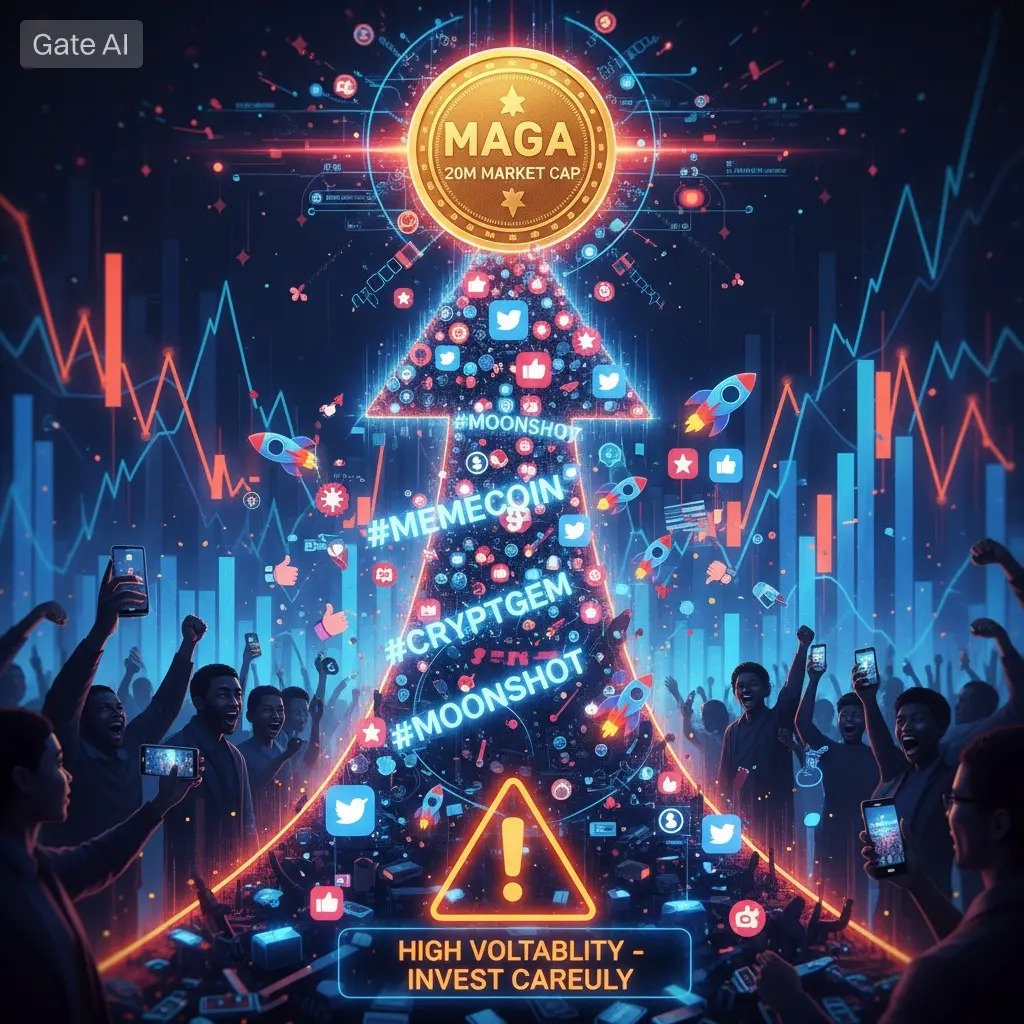
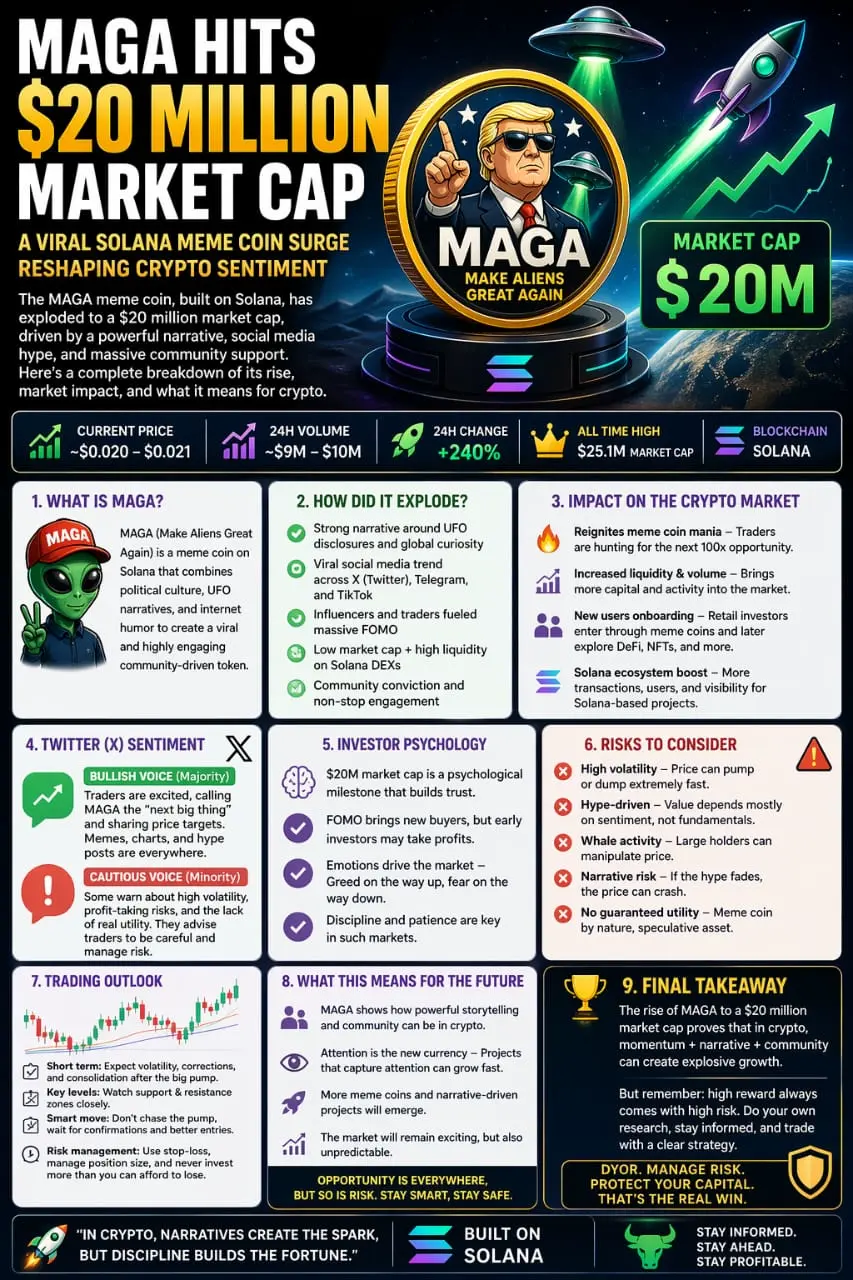
#MAGAHits$20MMarketCap
MAGA Hits $20 Million Market Cap: A Viral Meme Coin Surge Reshaping Crypto Sentiment
The rapid rise of the MAGA meme coin to a $20 million market capitalization marks one of the most striking short-term breakouts in the current crypto cycle. Market capitalization, calculated by multiplying a coin’s price by its circulating supply, reflects the total value of a project. For a meme coin, reaching this level is not just growth—it’s a signal of powerful momentum, intense speculation, and expanding market attention.
What Makes MAGA Unique in a Crowded Market
MAGA, meaning “M
SOL2,67%
HighAmbition
#MAGAHits$20MMarketCap
MAGA Hits $20 Million Market Cap: A Viral Meme Coin Surge Reshaping Crypto Sentiment
The rapid rise of the MAGA meme coin to a $20 million market capitalization marks one of the most striking short-term breakouts in the current crypto cycle. Market capitalization, calculated by multiplying a coin’s price by its circulating supply, reflects the total value of a project. For a meme coin, reaching this level is not just growth—it’s a signal of powerful momentum, intense speculation, and expanding market attention.
What Makes MAGA Unique in a Crowded Market
MAGA, meaning “Make Aliens Great Again,” is a meme coin built on the Solana blockchain. Its uniqueness lies in combining political symbolism linked to Donald Trump with trending global curiosity around UFO disclosures. This blend of culture, controversy, and humor creates a compelling narrative that spreads quickly across digital platforms.
Unlike traditional crypto projects that rely on utility, MAGA thrives on storytelling. In today’s market, attention is often more valuable than fundamentals—and MAGA captured that attention at the perfect time.
Why This Rally Happened So Fast
The speed of MAGA’s growth can be traced to three powerful forces: narrative, timing, and distribution. The UFO discussion created a trending topic, social media amplified it, and crypto traders quickly capitalized on the momentum. Within days, the coin moved from near obscurity to a multi-million-dollar valuation.
This type of movement highlights a key truth about modern crypto markets: capital flows where attention goes. Once a coin starts trending, it enters a feedback loop where hype attracts buyers, and buyers create more hype.
Impact on the Crypto Market
The effect of MAGA’s surge extends beyond just one token. It has reignited activity across the meme coin sector, encouraging traders to search for the next breakout opportunity. This increases liquidity, boosts trading volumes, and brings fresh participants into the market.
At the same time, the Solana blockchain ecosystem benefits significantly. Higher transaction activity, increased user engagement, and renewed developer interest all contribute to strengthening the network. Meme coins often act as gateways, bringing new users who later explore other areas of crypto such as DeFi and NFTs.
However, there is also a cautionary side. Rapid inflows into speculative assets can create unstable conditions. When attention shifts, liquidity can disappear just as quickly, leading to sharp corrections across similar tokens.
Twitter and Social Media Sentiment
On platforms like X (Twitter), sentiment around MAGA has been largely bullish, especially among retail traders and meme coin enthusiasts. Many users are celebrating the rapid gains and promoting the coin as the next big opportunity. Influencers and smaller accounts are actively sharing price targets, memes, and hype-driven content.
At the same time, more experienced traders are expressing caution. Some are pointing out that such rapid growth often leads to profit-taking phases. There is also discussion about sustainability, with questions around how long the narrative can hold attention.
This split in sentiment—excitement vs caution—is typical in meme coin rallies. It reflects a market driven by both opportunity and risk.
Investor Behavior and Market Psychology
Reaching a $20 million market cap creates a psychological shift. New investors see it as validation, while early investors begin evaluating exit opportunities. This dynamic often leads to increased volatility, as buying pressure and profit-taking collide.
FOMO plays a major role during this phase. Many traders enter late, driven by the fear of missing gains, which can push prices higher temporarily but also increases the risk of sharp reversals.
Risks Behind the Hype
Despite the excitement, meme coins like MAGA carry significant risks. Their value is largely dependent on social momentum rather than fundamental utility. If the narrative weakens or attention moves elsewhere, prices can drop rapidly.
Large holders, often referred to as whales, can also influence price movements. A single large sell-off can trigger panic and accelerate a downward trend. This makes risk management essential for anyone participating in such assets.
What This Means for the Future of Crypto
MAGA’s rise highlights a broader evolution in the crypto industry—where attention, culture, and community are becoming central to value creation. It shows that markets are no longer driven purely by technology, but also by narratives and collective behavior.
This trend is likely to continue, especially as social media becomes even more integrated with financial markets. Meme coins will remain a key part of this ecosystem, acting as both entry points for new users and high-risk opportunities for traders.
Final Takeaway: Opportunity with Awareness
The journey of MAGA to a $20 million market cap is a powerful example of how quickly fortunes can change in crypto. It demonstrates the strength of narrative-driven growth, the influence of social media, and the importance of timing.
At the same time, it serves as a reminder that high rewards come with high risks. Success in this space requires not just spotting trends, but understanding them, managing risk, and staying disciplined in the face of market hype.
repost-content-media
  • Reward
  • Comment
  • Repost
  • Share
#BitcoinBouncesBack
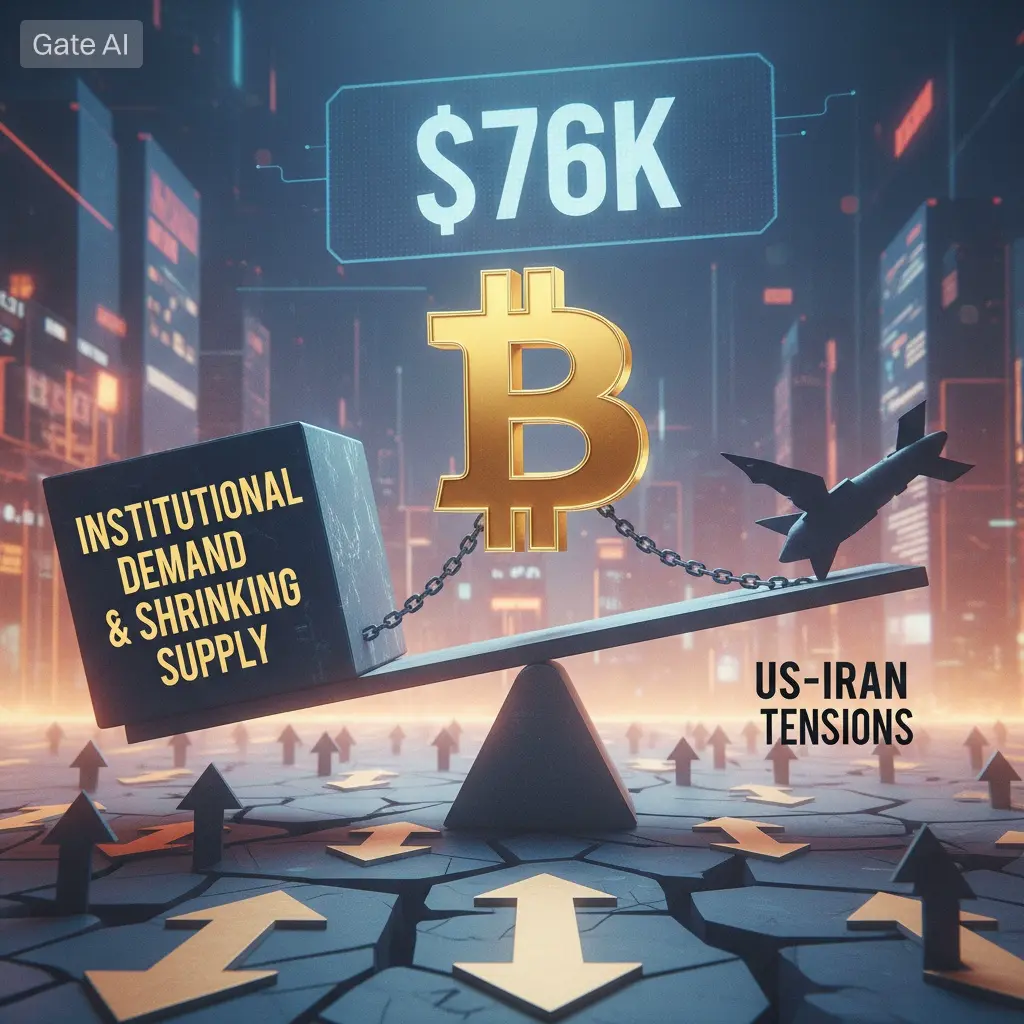
Bitcoin's Tense Standoff: Navigating the $76K Rebound Amidst Geopolitical Uncertainty
The cryptocurrency market finds itself at a critical juncture as Bitcoin has staged an impressive recovery, reclaiming the $76,000 level after a volatile weekend triggered by escalating tensions between the United States and Iran. This rebound comes at a time when geopolitical uncertainty remains the dominant narrative, with President Trump signaling that an extension of the ceasefire is unlikely while simultaneously suggesting he would broker peace if given the opportunity. The juxtaposi
HighAmbition
#BitcoinBouncesBack
Bitcoin's Tense Standoff: Navigating the $76K Rebound Amidst Geopolitical Uncertainty
The cryptocurrency market finds itself at a critical juncture as Bitcoin has staged an impressive recovery, reclaiming the $76,000 level after a volatile weekend triggered by escalating tensions between the United States and Iran. This rebound comes at a time when geopolitical uncertainty remains the dominant narrative, with President Trump signaling that an extension of the ceasefire is unlikely while simultaneously suggesting he would broker peace if given the opportunity. The juxtaposition of these conflicting signals has created a complex trading environment where traditional safe-haven dynamics are being tested against Bitcoin's evolving role as a macro hedge.
The recent price action tells a compelling story of market resilience. Bitcoin had surged to approximately $78,300 late Friday, marking its highest level since early February, before the weekend brought renewed volatility. The catalyst for this turbulence was the US military's seizure of an Iranian cargo ship, which immediately put pressure on the fragile ceasefire agreement between the two nations. This development caused Bitcoin to retreat below $74,000 on Sunday, erasing the weekend gains and testing investor conviction. However, the subsequent rebound to $76,387 demonstrates the underlying strength in the market, with the price currently trading in a defined range between $74,800 and $76,900 over the past 24 hours.
Several fundamental factors are supporting this recovery and warrant careful consideration when assessing where this rebound might ultimately top out. Institutional accumulation continues at an unprecedented pace, with Strategy alone deploying $2.54 billion in a single week to acquire 34,164 additional Bitcoin. This follows a broader trend where BlackRock, Morgan Stanley, and other major financial institutions have been systematically positioning Bitcoin as a geopolitical and inflation hedge. The technical development of Bitcoin Core v31.0, which has optimized mempool logic and enhanced privacy broadcast features, represents ongoing protocol improvements that strengthen the network's fundamentals.
Perhaps most significantly, on-chain data reveals a sustained pattern of supply tightening. Exchange reserves have declined for seven consecutive weeks, now sitting at approximately 2.681 million Bitcoin. This indicates that coins are migrating from short-term traders to long-term holders, a classic accumulation signal that typically precedes significant price movements. The Coinbase Bitcoin premium index has remained positive for twelve consecutive days, reflecting persistent buying pressure from US-based investors. These structural factors suggest that even in the face of geopolitical headwinds, the underlying demand dynamics remain robust.
Where This Rebound Could Top Out
Determining the potential ceiling for this rebound requires a multi-layered analysis of technical levels, macro catalysts, and sentiment indicators. From a technical perspective, the immediate resistance zone sits between $77,000 and $78,500, which represents the recent high from Friday's surge. A decisive break above $78,500 would open the path toward the psychologically significant $80,000 level, which has historically acted as both a magnet for price action and a formidable barrier.
Should bullish momentum persist and geopolitical tensions ease, the next major resistance cluster emerges around $82,000 to $85,000. This range aligns with the previous all-time high vicinity and would likely trigger significant profit-taking from long-term holders who accumulated during the 2022-2023 bear market. The Fear and Greed Index currently reads 33, indicating a state of fear that typically precedes sustained rallies rather than marking tops. This suggests there remains room for sentiment improvement before reaching euphoric levels that historically coincide with major peaks.
However, the path forward is not without obstacles. The ongoing negotiations between the US and Iran represent a binary risk event that could dramatically alter market trajectory. If the ceasefire collapses completely and military escalation follows, risk assets including Bitcoin could face sharp corrections regardless of underlying fundamentals. Conversely, a breakthrough in negotiations that produces a durable peace agreement could catalyze a risk-on rally across all markets, potentially pushing Bitcoin toward new all-time highs above $85,000.
The timing of these developments is particularly critical as the ceasefire deadline approaches. Market participants are likely to position defensively ahead of this inflection point, which could create choppy, range-bound price action until clarity emerges. The current trading range of $72,000 to $78,000 appears to be a consolidation phase where liquidity is being redistributed between different market participants, with long-term holders and institutions absorbing supply from shorter-term traders.
Positioning Strategy Ahead of the Ceasefire Deadline
Given the uncertainty surrounding the US-Iran situation, a prudent positioning strategy should balance opportunity capture with risk management. For those looking to participate in potential upside while protecting against downside scenarios, several approaches merit consideration.
Dollar-cost averaging remains a time-tested strategy in volatile environments. Rather than deploying capital all at once, splitting intended purchases across multiple entry points over the coming days can reduce the impact of timing risk. This approach is particularly suitable given the binary nature of the upcoming geopolitical events, where outcomes are genuinely uncertain and price reactions could be extreme in either direction.
For more active traders, maintaining a core long-term position while trading around shorter-term fluctuations may be appropriate. The current range between $74,000 and $78,000 offers clear levels for tactical entries and exits. Accumulating on dips toward the lower end of this range, particularly near $74,800 where recent support held, while taking partial profits on rallies toward $77,000 to $78,000 resistance, allows for participation in range-bound volatility.
Risk management takes on heightened importance in this environment. Position sizing should reflect the genuine possibility of sharp moves in either direction. Setting stop-losses below recent support levels around $74,000 provides downside protection while allowing for normal market fluctuations. Conversely, taking partial profits on rallies prevents giving back gains if the market reverses suddenly on geopolitical developments.
Diversification beyond Bitcoin should also be considered. While Bitcoin has demonstrated its resilience, maintaining exposure to other asset classes including traditional safe havens like gold or stablecoins can provide balance. The TradFi markets available through platforms like Gate offer access to traditional assets that may behave differently than crypto during geopolitical stress, providing useful portfolio diversification.
For those with existing Bitcoin positions, the decision to hold, add, or reduce exposure depends on individual risk tolerance and investment horizon. Long-term holders with conviction in Bitcoin's macro thesis may view any dips as accumulation opportunities, while those with shorter time horizons may prefer to reduce exposure until geopolitical clarity emerges. The key is making intentional decisions rather than reactive ones based on headline-driven volatility.
The options market provides additional tools for navigating this uncertainty. Protective puts can insure existing long positions against severe downside, albeit at a cost. For those expecting continued volatility but uncertain about direction, volatility strategies may be appropriate. More sophisticated traders might consider structured products that offer defined risk-reward profiles suited to their specific market views.
Looking beyond the immediate ceasefire deadline, the structural case for Bitcoin remains compelling regardless of short-term geopolitical outcomes. The continued institutional adoption, supply dynamics of decreasing exchange reserves, and Bitcoin's evolving narrative as a hedge against both inflation and geopolitical instability suggest that any corrections may prove temporary. However, the path between current prices and higher levels is likely to remain volatile, requiring patience and disciplined risk management.
In conclusion, Bitcoin's rebound to $76,000 represents a significant technical recovery that is supported by strong underlying fundamentals. The potential for this rally to extend toward $80,000 or beyond exists, particularly if geopolitical tensions resolve favorably. However, the binary risk of the US-Iran situation demands respect, and positioning should reflect this uncertainty. A balanced approach that maintains core exposure while managing risk through appropriate position sizing, diversification, and tactical trading around key levels offers the best probability of navigating the days ahead successfully. The market is sending clear signals about Bitcoin's resilience, but prudent investors will remain vigilant and adaptable as the geopolitical situation unfolds.
repost-content-media
  • Reward
  • Comment
  • Repost
  • Share
#GatePreIPOsLaunchesWithSpaceX
Gate Pre-IPOs Launches With SpaceX:
Gate.io has taken a major step in connecting crypto markets with traditional finance by launching its first Pre-IPO product featuring SpaceX (SPCX). This move is seen as an important development in tokenized equities, allowing crypto users to gain exposure to private company valuation before an actual IPO.
The SpaceX Pre-IPO Launch: Overview and Structure
Gate officially introduced its Pre-IPO product on April 15, 2026, with SpaceX as the underlying asset. This marks the platform’s entry into the tokenized equity sector, wher
HighAmbition
#GatePreIPOsLaunchesWithSpaceX
Gate Pre-IPOs Launches With SpaceX:
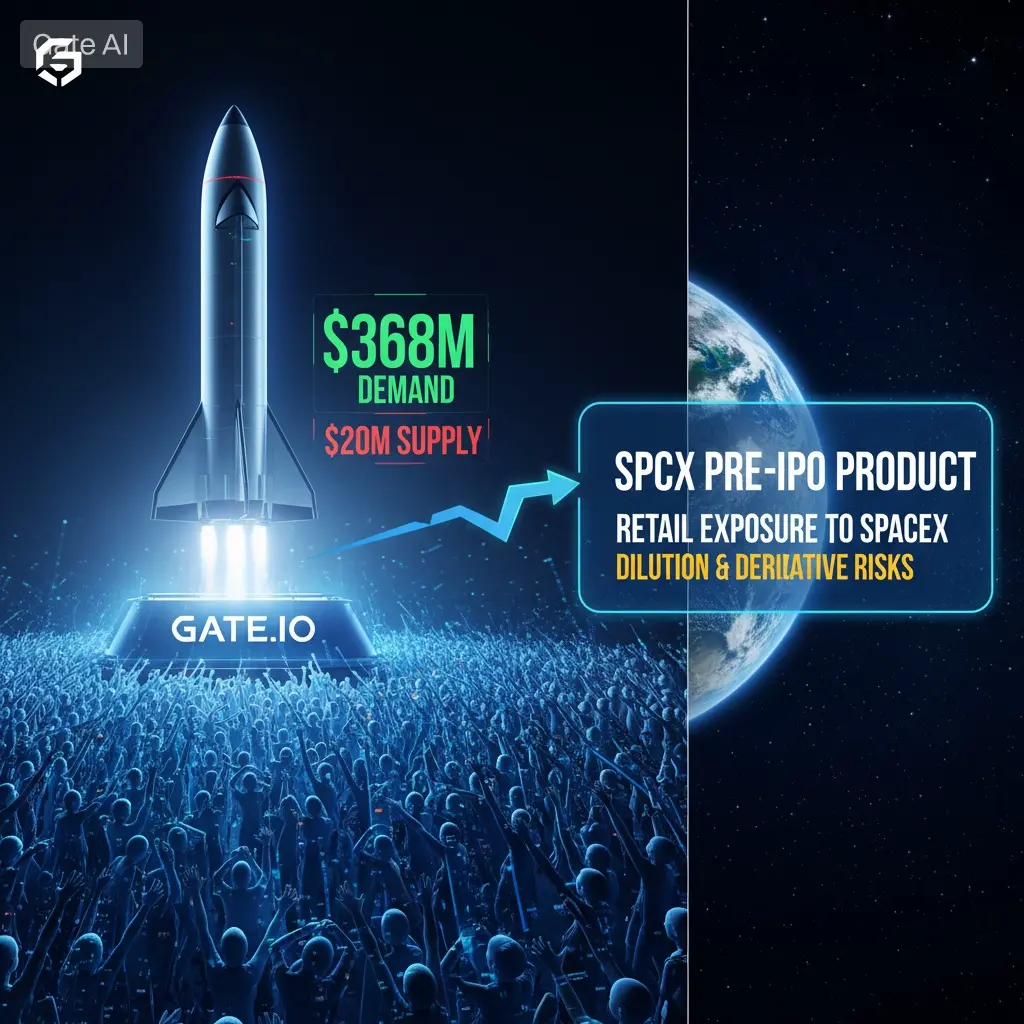
Gate.io has taken a major step in connecting crypto markets with traditional finance by launching its first Pre-IPO product featuring SpaceX (SPCX). This move is seen as an important development in tokenized equities, allowing crypto users to gain exposure to private company valuation before an actual IPO.
The SpaceX Pre-IPO Launch: Overview and Structure
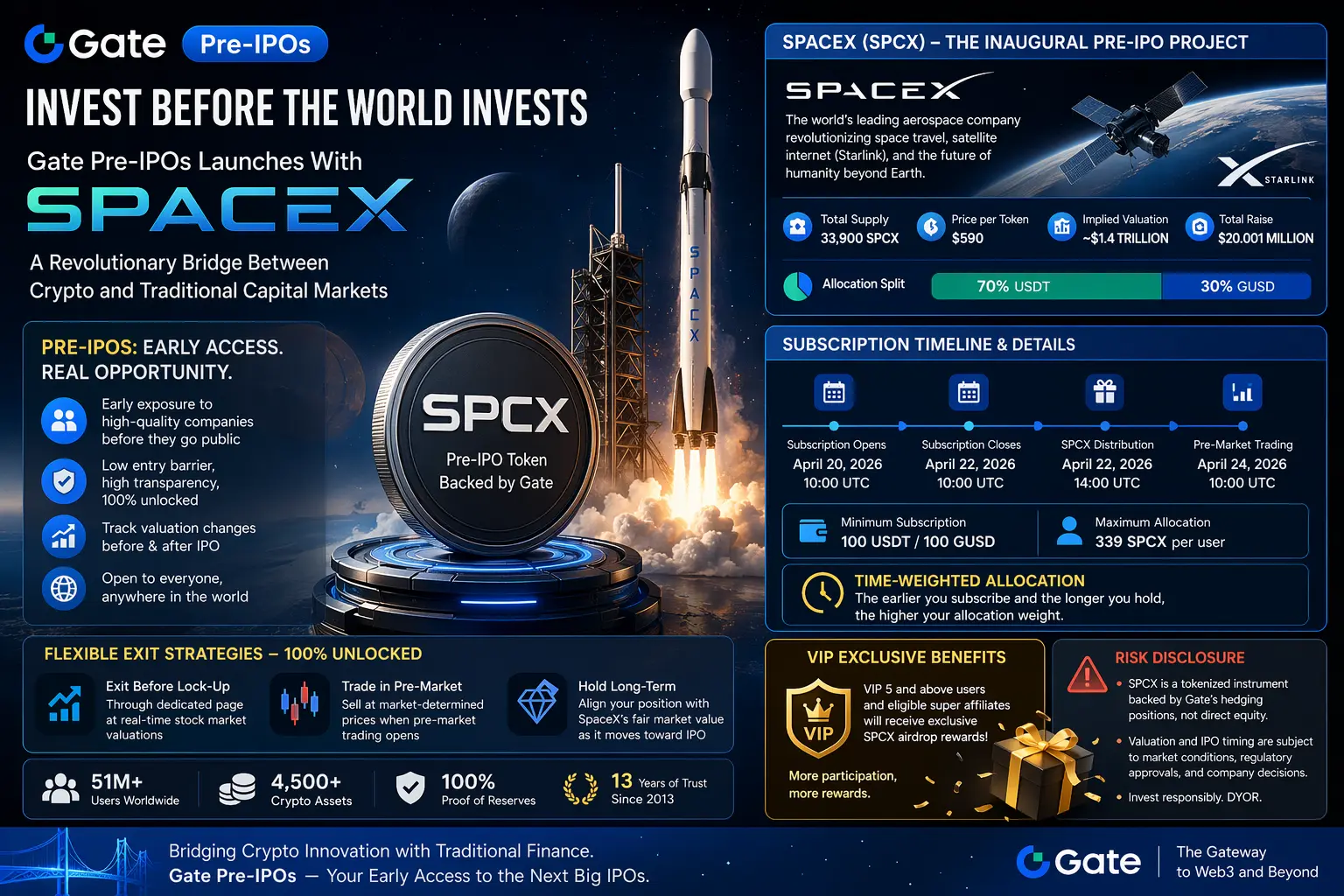
Gate officially introduced its Pre-IPO product on April 15, 2026, with SpaceX as the underlying asset. This marks the platform’s entry into the tokenized equity sector, where it competes with private market platforms while offering retail users access to early-stage investment opportunities.
The SPCX token works as a mirror-based instrument that tracks the estimated valuation of SpaceX, which is around $1.4 trillion. It does not represent direct ownership but provides price exposure through a crypto-based derivative structure.
Subscription Details and Allocation Structure
The subscription period ran for 48 hours from April 20 to April 22, 2026. During this time, users could commit funds to participate in the allocation process.
The total supply was very limited, with only 33,900 SPCX tokens available at a fixed price of $590 each, making the total pool around $20 million USDT equivalent. Allocation followed a pro-rata system, meaning larger or earlier commitments had better weight in distribution.
Subscription Performance: Massive Demand
The demand for SPCX exceeded expectations significantly. Total subscriptions reached around $368 million, which is nearly 17 times higher than the available supply.
This shows strong retail interest in gaining early exposure to SpaceX before its expected IPO. However, this also means most participants will receive reduced allocations due to oversubscription pressure.
Timeline and Key Milestones
After the subscription phase ended, certificate distribution was scheduled shortly after. These certificates then move into pre-market trading, allowing users to trade positions before the official IPO.
The expected SpaceX IPO is targeted for June 2026, with a projected valuation of $1.75 trillion and a possible large-scale public offering. This timeline creates multiple phases of potential liquidity for SPCX holders.
SpaceX Valuation Context
SpaceX is currently valued at around $1.4 trillion, making it one of the most valuable private companies in the world. Its business includes rocket launches, satellite internet through Starlink, and expansion into artificial intelligence through xAI integration.
The company’s strong revenue model and dominance in space technology are key factors behind its high valuation and investor interest.
Governance Structure and Control
A major aspect of SpaceX is its dual-class share structure. Elon Musk maintains majority voting control even while holding a lower percentage of total equity.
This structure means that while investors can benefit from price exposure, they have limited influence over company decisions, which is an important factor for risk evaluation.
Investor Interest and Market Sentiment
The oversubscription of $368 million shows strong demand from retail investors who want early exposure to high-growth private companies.
Positive sentiment is driven by SpaceX’s market dominance, Starlink’s subscription growth, and Elon Musk’s track record with previous companies. However, some concerns remain regarding valuation and governance structure.
Product Mechanics and Exit Options
SPCX holders have multiple exit options depending on market conditions. Before IPO completion, trading can happen through pre-market systems. After IPO and lock-up periods, users may exit through token conversion or USDT settlement.
In extreme cases like delays or restructuring, positions may be settled based on fair valuation mechanisms set by the platform.
Risk Considerations
Despite strong interest, SPCX carries several risks. It is not direct equity ownership but a derivative product issued by the platform.
Key risks include valuation uncertainty, liquidity limitations, oversubscription dilution, and dependency on SpaceX successfully completing its IPO process.
Competitive Landscape
Gate is now competing in a growing tokenized equity market alongside traditional private equity platforms and other crypto exchanges exploring similar products.
Its short subscription window and crypto-native structure make it different from traditional investment platforms, offering faster access but higher risk exposure.
Bonus Incentives and Participation Benefits
Gate has also added extra incentives such as airdrops, staking rewards, and yield programs to encourage participation. These benefits are designed to attract both new and experienced users into the ecosystem.
Conclusion
The Gate SpaceX Pre-IPO launch is a major step toward merging traditional equity markets with crypto-based investment systems. With high demand, limited supply, and strong retail interest, it highlights growing demand for early-stage exposure to major private companies.
However, investors must understand that SPCX is a derivative product with risks such as dilution, valuation uncertainty, and limited control rights. Overall, it represents both a high-interest opportunity and a high-risk financial instrument in the evolving crypto ecosystem.
repost-content-media
  • Reward
  • Comment
  • Repost
  • Share
#USIranTalksProgress
US-Iran Nuclear Talks: Current Status and Crypto Market Impact Analysis
The US-Iran nuclear negotiations have reached a critical juncture with significant uncertainty hanging over the crypto markets. Here is a comprehensive analysis of the current situation:
Current Status of Talks (As of April 22, 2026)
The second phase of high-level US-Iran negotiations was scheduled to take place in Islamabad, Pakistan on April 21, 2026. However, Iran has shown reluctance to participate. According to Iranian state media and sources close to the negotiating team, Iran currently has no p
BTC2,49%
HighAmbition
#USIranTalksProgress
US-Iran Nuclear Talks: Current Status and Crypto Market Impact Analysis
The US-Iran nuclear negotiations have reached a critical juncture with significant uncertainty hanging over the crypto markets. Here is a comprehensive analysis of the current situation:
Current Status of Talks (As of April 22, 2026)
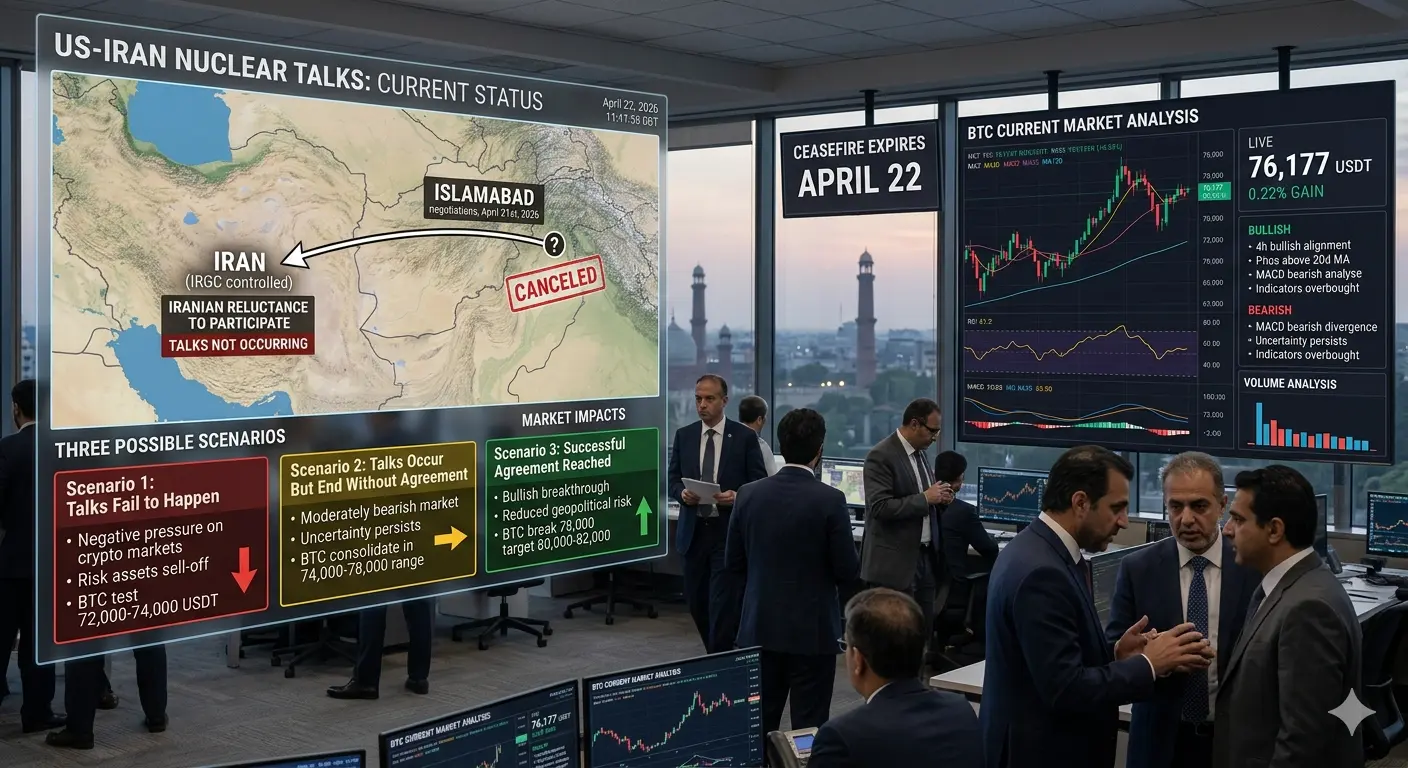
The second phase of high-level US-Iran negotiations was scheduled to take place in Islamabad, Pakistan on April 21, 2026. However, Iran has shown reluctance to participate. According to Iranian state media and sources close to the negotiating team, Iran currently has no plans to attend these talks. The Islamic Revolutionary Guard Corps (IRGC) has reportedly consolidated control over Iran's negotiation policy, creating additional complications.
The 14-day ceasefire between the US, Israel, and Iran is set to expire on April 22, 2026, adding pressure to the diplomatic timeline. Mediators are pushing for a compromise on three main sticking points: Iran's nuclear program, the Strait of Hormuz, and compensation for wartime damages.
Three Possible Scenarios and Market Impacts
Scenario 1: Talks Fail to Happen
If negotiations collapse before they begin, the crypto market would likely face immediate negative pressure. Risk assets including Bitcoin typically sell off during geopolitical escalations. BTC could test support levels around 72,000-74,000 USDT as investors flee to safer assets. The market is already showing signs of stress, and this scenario would amplify volatility.
Scenario 2: Talks Occur But End Without Agreement
Even if talks proceed but fail to produce a deal, the market reaction would be moderately bearish. The uncertainty would persist, keeping institutional investors cautious. BTC might consolidate in the 74,000-78,000 range with elevated volatility. The key concern here is that failed negotiations often lead to renewed tensions, which could trigger gradual risk-off sentiment.
Scenario 3: Successful Agreement Reached
A breakthrough deal would be bullish for crypto markets. Reduced geopolitical risk typically benefits risk assets. BTC could break above the 78,000 resistance and target 80,000-82,000 in the short term. However, this scenario appears less likely given Iran's current stance and the IRGC's hardline position.
BTC Current Market Analysis
Bitcoin is currently trading at approximately 76,177 USDT, showing a modest 0.22% gain over 24 hours. The technical picture presents mixed signals:
Bullish Factors:
4-hour timeframe shows a bullish alignment with MA7 > MA30 > MA120
Price remains above the 20-day moving average at 75,849
Daily RSI at 61.5 indicates healthy momentum without extreme overbought conditions
Market sentiment shows 72% positive social sentiment versus 13% negative
Bearish/Cautionary Signals:
15-minute timeframe shows MACD bearish divergence (price making higher highs while MACD momentum weakens)
Both 15-minute and 4-hour CCI indicators are in overbought territory
WR (Williams %R) indicators showing overbought conditions on multiple timeframes
The 90-day performance remains negative at -15%, indicating the broader downtrend since the February highs
Volume Analysis:
24-hour trading volume stands at approximately 413 million USDT, which is below the 7-day average. This suggests that the current price level lacks strong conviction from buyers, making BTC vulnerable to sudden moves on geopolitical headlines.
Strategic Outlook
The crypto market is indeed under stress as you noted. The combination of geopolitical uncertainty, upcoming ceasefire expiration, and Iran's apparent reluctance to engage creates a fragile environment. Traders should monitor:
1. Any confirmation of Iran's participation in Pakistan talks
2. Statements from US officials regarding the blockade and Hormuz Strait
3. Technical support at 74,000-75,000 range
Given the high uncertainty, risk management remains paramount. The market could see sharp moves in either direction depending on how the diplomatic situation unfolds in the coming 24-48 hours.
repost-content-media
  • Reward
  • Comment
  • Repost
  • Share
#GateSquareAprilPostingChallenge
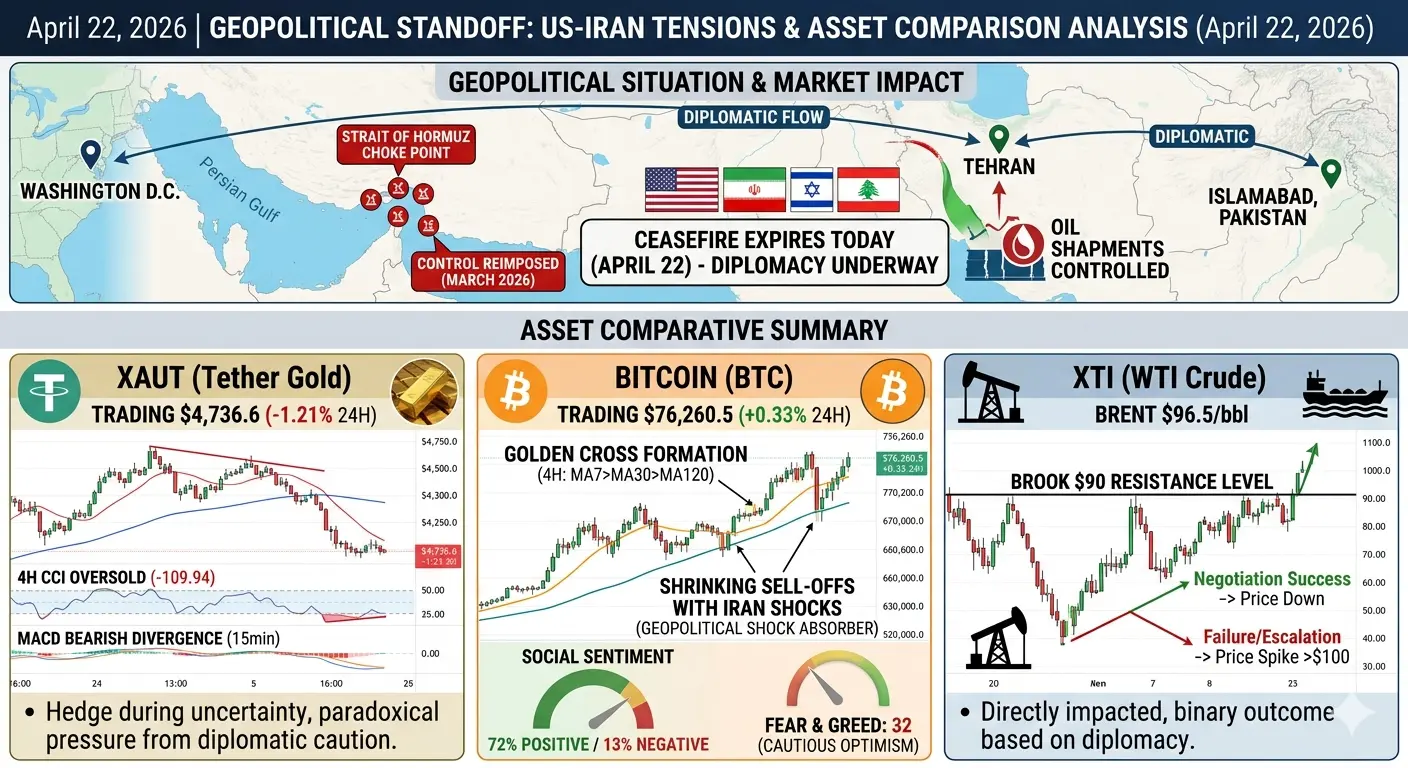
Geopolitical Tensions Between US and Iran: Market Impact and Asset Comparison
The ongoing geopolitical standoff between the United States and Iran has emerged as one of the most significant market-moving events of2026. The conflict, which intensified in early March2026 with the closure of the Strait of Hormuz, has created ripple effects across global financial markets, particularly impacting safe-haven assets like gold and cryptocurrencies, as well as energy commodities. Understanding how these tensions affect different asset classes is crucial for traders nav
HighAmbition
#GateSquareAprilPostingChallenge
Geopolitical Tensions Between US and Iran: Market Impact and Asset Comparison
The ongoing geopolitical standoff between the United States and Iran has emerged as one of the most significant market-moving events of2026. The conflict, which intensified in early March2026 with the closure of the Strait of Hormuz, has created ripple effects across global financial markets, particularly impacting safe-haven assets like gold and cryptocurrencies, as well as energy commodities. Understanding how these tensions affect different asset classes is crucial for traders navigating the current volatile environment.
Current Geopolitical Situation
The US-Iran conflict has entered a critical phase as a fragile two-week ceasefire is set to expire, with diplomatic efforts underway to prevent further escalation. Iranian officials have been engaging with Pakistan's military leadership to discuss messages exchanged between Iran and the US, while Israel and Lebanon are also holding historic talks for the first time in decades. The Strait of Hormuz, which handles more than half of the world's oil shipments, remains a focal point of tension. Iran has reimposed controls on this crucial waterway, preventing tankers from using the passage and creating significant supply concerns for global energy markets.
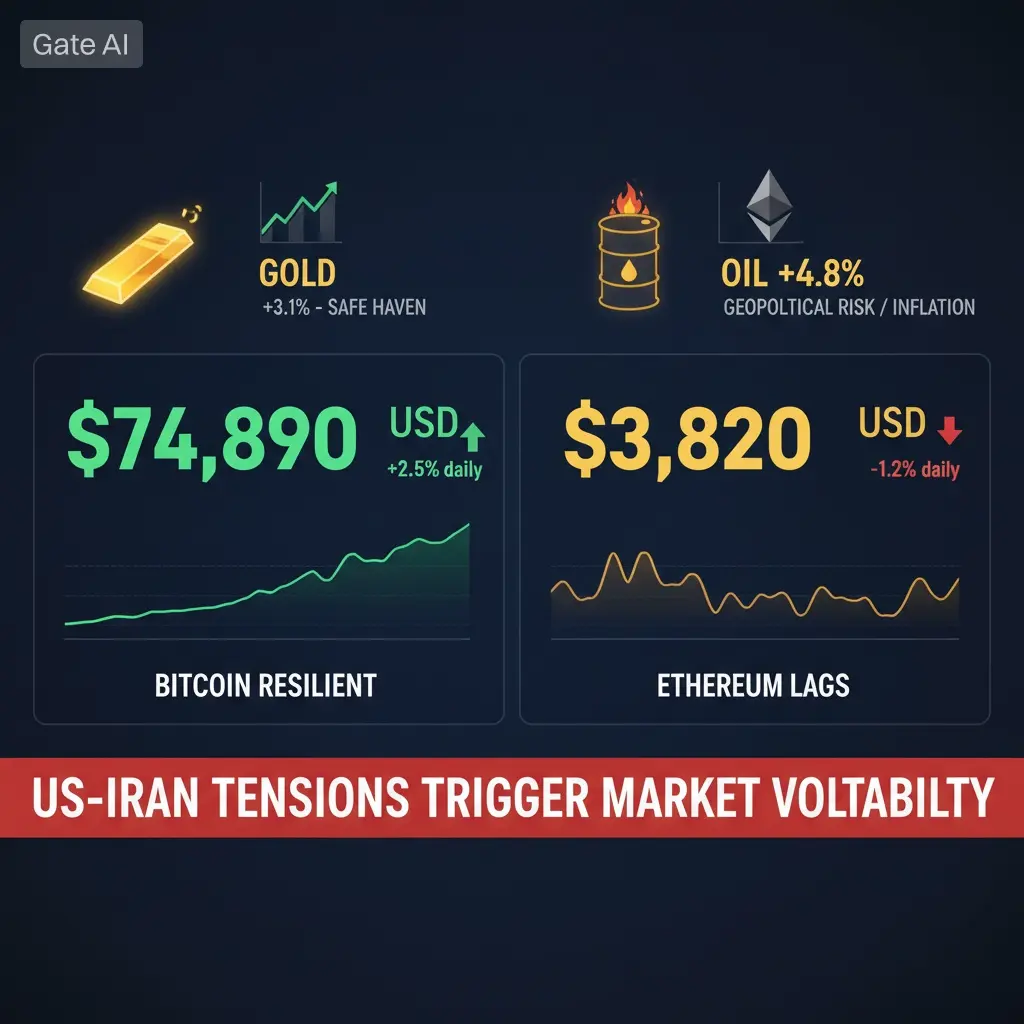
The market reaction has been immediate and pronounced. When Iran reimposed controls over the weekend, Brent crude jumped5.7% while Bitcoin experienced only a modest1.6% pullback to $74,335. This divergence suggests that different asset classes are pricing geopolitical risk differently, with traditional markets still reacting to Middle East uncertainty while cryptocurrency markets appear to have largely absorbed the geopolitical tail risk.
XAUT (Tether Gold) Analysis
XAUT, a gold-backed stablecoin, is currently trading at $4,736.6, reflecting a24-hour decline of1.21%. Over the past30 days, XAUT has gained4.31%, demonstrating its role as a safe-haven asset during periods of uncertainty. However, the90-day performance shows a decline of5.19%, indicating that gold has faced headwinds despite geopolitical tensions.
Technical analysis reveals mixed signals for XAUT. The4-hour chart shows CCI in the oversold territory at -109.94, suggesting potential buying opportunities. The daily SAR indicator remains below recent average lows, indicating a bullish trend with support around $4,658. However, the15-minute chart shows MACD bearish divergence with prices making new highs while momentum wanes, suggesting short-term correction risks.
The fundamental outlook for gold remains supported by central bank demand and ongoing geopolitical risk, which should establish a price floor above recent correction lows. However, gold prices have actually extended declines recently as investors remain cautious over the negotiations to end the near-two-month war. This creates a paradox where gold should theoretically benefit from safe-haven demand, but the uncertainty around diplomatic outcomes is causing hesitation among investors.
Trading Strategy for XAUT
Traders should watch the support level at $4,658 closely. A break below this level could see XAUT test lower support around $4,600. On the upside, resistance exists at $4,795. Given the current geopolitical uncertainty, XAUT serves as a portfolio hedge rather than a speculative position. Conservative traders might accumulate on dips toward $4,650-$4,700, while risk-tolerant traders could wait for clearer directional signals from the diplomatic negotiations.
Bitcoin (BTC) Analysis
Bitcoin is currently trading at $76,260.5, showing remarkable resilience with only a0.33% gain over24 hours but an impressive8.08% surge over the past30 days. The7-day performance shows a modest1.48% gain, indicating consolidation after the recent rally.
Technical indicators paint a bullish picture for Bitcoin. The4-hour chart shows a golden cross formation with MA7 above MA30 above MA120, indicating a strong upward trend. The15-minute SAR is positioned above recent average highs, suggesting short-term bearish pressure, but the4-hour SAR remains below average lows, confirming the broader bullish structure. Volume analysis shows significant participation with24-hour trading volume at $413.6 million, and the price is currently holding above the20-day moving average at $75,874.
What is particularly noteworthy is Bitcoin's behavior during the latest Iran-related flare-up. While traditional markets repriced Middle East risk with oil jumping and equities falling, Bitcoin slipped only modestly. This shrinking of sell-offs with each Iran shock suggests that cryptocurrency may have largely priced in geopolitical tail risk. Either holders who were going to sell on Iran headlines have already sold, or the spot ETF bid has become a more reliable floor than the futures-driven weekend gaps that characterized earlier cycles.
Social sentiment data shows bullish dominance with72% positive content versus13% negative, and the fear and greed index reading of32 indicates cautious optimism. The discussion heat remains steady with751 social posts over the past three days.
Trading Strategy for BTC
Bitcoin appears to be acting as a geopolitical shock absorber, with strong support established around $74,000-$73,000. Traders should monitor whether Bitcoin can maintain its role as a diversifier during traditional market stress. The current technical structure supports continued upside, with resistance targets at $76,891 (24-hour high) and potentially $78,000 if momentum continues. Risk management is crucial, with stop-losses recommended below $74,000. The ETF bid provides a structural floor, but traders should remain alert to any breakdown in diplomatic talks that could trigger broader risk-off sentiment.
XTI (Oil/WTI Crude) Analysis
West Texas Intermediate (WTI) crude oil, represented by XTI, has been the most directly impacted asset by the US-Iran tensions. Current Brent crude prices are around $96.5 per barrel, with analysts forecasting that both crude benchmarks are expected to average above $60 per barrel this year, representing an increase of about $1.50 per barrel compared to forecasts from just a month ago.
The oil market is experiencing a complex dynamic where supply disruptions from the Strait of Hormuz closure are competing with hopes for diplomatic resolution. The price consolidation shows that the energy market remains highly volatile, with WTI trading in a range between $80 to $120. The technical structure shows Brent crude has broken above the $90 resistance level, which was previously the ceiling of a descending broadening wedge pattern, suggesting bullish momentum if geopolitical tensions persist.
However, the oil market faces a binary outcome scenario. If diplomatic talks succeed and the Strait of Hormuz reopens, oil prices could see significant downward pressure as supply concerns ease. Conversely, if negotiations fail and military escalation occurs, prices could spike well above $100 per barrel. Analysts note that even if a lasting deal emerges, it could take months for oil shipments to return to normal levels.
**Trading Strategy for XTI**: Oil traders are currently caught between supply shocks and macroeconomic changes. The short-term outlook favors volatility within the $80-$120 range. Traders might consider range-bound strategies, buying dips toward $85-$90 support and taking profits near $100-$105 resistance. However, given the binary nature of the diplomatic outcome, position sizing should be conservative. A breakthrough above $100 would signal potential for a run toward $120, while a breakdown below $80 could see prices retreat toward $70 if supply concerns resolve.
Comparative Analysis and Portfolio Considerations
The three assets present distinct risk-return profiles in the current geopolitical environment. XAUT offers traditional safe-haven characteristics but has shown recent weakness as investors weigh diplomatic outcomes. Bitcoin demonstrates emerging safe-haven properties with reduced volatility during geopolitical shocks, potentially benefiting from its decentralized nature and ETF institutional support. XTI remains the most sensitive to headline risk, offering the highest potential returns but also the greatest downside risk if tensions de-escalate.
For traders considering allocation across these assets, a balanced approach might involve using XAUT as a portfolio stabilizer during extreme volatility, Bitcoin as a growth component with improving risk-adjusted returns, and XTI as a tactical play on geopolitical developments. The correlation dynamics are shifting, with Bitcoin showing decreasing correlation to traditional risk assets during geopolitical stress, while gold's safe-haven status is being tested by the unusual combination of inflation concerns and potential diplomatic resolution.
What Traders Are Thinking
Market participants are currently focused on several key factors. For XAUT, traders are weighing whether the traditional safe-haven bid will return if diplomatic talks falter, or whether gold will continue to face pressure from a potential resolution. The technical setup suggests accumulation opportunities on weakness, but conviction remains low until geopolitical clarity emerges.
Bitcoin traders are increasingly viewing the cryptocurrency as a mature asset class that has absorbed geopolitical risks. The spot ETF flows provide a structural bid that did not exist in previous cycles, potentially explaining the reduced volatility during Iran-related headlines. However, traders remain cautious about a potential breakdown below $74,000, which could trigger stop-loss selling and test the $70,000-$72,000 support zone.
Oil traders are positioned for continued volatility, with many maintaining long positions as a hedge against supply disruption while remaining alert to any diplomatic breakthrough that could trigger sharp reversals. The consensus view appears to be that oil prices will remain elevated until there is concrete evidence of Strait of Hormuz reopening, with $90-$100 serving as the near-term trading range.
Outlook and Key Levels to Watch
The coming weeks will be critical as diplomatic efforts intensify. For XAUT, support at $4,658 and resistance at $4,795 will determine near-term direction. A diplomatic breakthrough could pressure gold toward $4,600, while escalation might drive it back toward $4,800-$4,850.
Bitcoin's key support zone remains $74,000-$73,000, with resistance at $76,891 and $78,000. The ability to hold gains during traditional market stress will be crucial for cementing its status as a portfolio diversifier.
For XTI, the $90 level has become critical support, with $100 serving as psychological resistance. A sustained break above $100 could open the path to $110-$120, while a failure to hold $90 might signal a retreat toward $85-$80.
Traders should remain nimble, as headline risk remains elevated. Position sizing should reflect the binary nature of the diplomatic outcome, with wider stops to account for potential gap moves on breaking news. The interaction between these three assets will provide valuable insights into how markets are pricing geopolitical risk and whether traditional correlations are shifting in the current environment.
repost-content-media
  • Reward
  • Comment
  • Repost
  • Share
#HKUnveilsNewCryptoRules
Hong Kong significantly tightened cryptocurrency regulations in 2025–2026 as part of its strategy to become a leading digital asset hub in Asia. Below is a step-by-step explanation of the complete framework.
Hong Kong New Crypto Rules: Complete Analysis
1. Regulatory Framework Overview
Hong Kong has adopted the principle of “same activity, same risks, same regulation,” meaning activities regulated in traditional finance are now also applied to virtual assets.
Key Regulatory Bodies:
Securities and Futures Commission (SFC): Regulates Virtual Asset Trading Platforms (VAT
BTC2,49%
ETH3,07%
HighAmbition
#HKUnveilsNewCryptoRules
Hong Kong significantly tightened cryptocurrency regulations in 2025–2026 as part of its strategy to become a leading digital asset hub in Asia. Below is a step-by-step explanation of the complete framework.
Hong Kong New Crypto Rules: Complete Analysis
1. Regulatory Framework Overview
Hong Kong has adopted the principle of “same activity, same risks, same regulation,” meaning activities regulated in traditional finance are now also applied to virtual assets.
Key Regulatory Bodies:
Securities and Futures Commission (SFC): Regulates Virtual Asset Trading Platforms (VATPs) and securities-related crypto activities
Hong Kong Monetary Authority (HKMA): Supervises stablecoins and banking-related crypto operations
2. Major Regulatory Changes Step by Step
Step 1: VASP Licensing Regime (2022–2023)
In December 2022, Hong Kong passed the Anti-Money Laundering and Counter-Terrorist Financing (Amendment) Bill 2022. Under this, all Virtual Asset Service Providers (VASPs) must obtain a license from the SFC.
Step 2: Travel Rule Implementation
Hong Kong implemented the FATF Travel Rule. For transactions above HKD 8,000 (approximately USD 1,000), VASPs must share sender and receiver information for AML/CFT compliance.
Step 3: Enhanced Custody Standards (2025)
In 2025, the SFC introduced stricter custody requirements for licensed crypto exchanges due to weaknesses found in cybersecurity systems. Strong asset protection and cybersecurity measures became mandatory.
Step 4: ASPIRe Strategy (February 2025)
The SFC launched the ASPIRe roadmap at Consensus 2025. It stands for:
Access
Safeguards
Products
Infrastructure
Relationships
This framework addresses liquidity fragmentation, regulatory arbitrage, and market volatility.
Step 5: Tokenized Investment Products Framework (April 2026)
On April 20, 2026, the SFC launched a pilot framework for secondary market trading of tokenized products. It includes 13 publicly available products with approximately USD 10.7 billion AUM.
Step 6: Stablecoin Ordinance (August 2025 – April 2026)
The Stablecoin Ordinance became effective in August 2025. On April 10, 2026, the HKMA issued the first stablecoin licenses to:
HSBC (The Hongkong and Shanghai Banking Corporation Limited)
Anchorpoint Financial Limited (a joint venture of Standard Chartered, HKT Limited, and Animoca Brands Limited)
Only 2 approvals were granted out of 36 applicants, showing very high compliance standards.
3. Current Market Impact Analysis
Institutional Adoption Boost:
Clear regulations have increased institutional confidence. Major banks like HSBC and Standard Chartered can now issue stablecoins, bridging traditional finance and crypto.
Licensed Exchange Growth:
Currently, 11 licensed VATPs operate in Hong Kong, with expectations of further growth due to regulatory clarity.
Tokenized Assets Market:
SFC-authorized tokenized products have around USD 10.7 billion in AUM, boosting Real World Asset (RWA) tokenization.
4. Current Crypto Market Prices
Bitcoin (BTC):
Current Price: USD 76,298.50
24h Change: +0.72%
7-day Change: +1.53%
30-day Change: +8.13%
Market Cap: USD 1.52 trillion
Rank: #1
Technical Analysis:
4-hour trend remains bullish (MA7 > MA30 > MA120)
Slight overbought conditions in short term
Volume expansion indicates institutional participation
Ethereum (ETH):
Current Price: USD 2,322.12
24h Change: +0.59%
7-day Change: -1.10%
30-day Change: +7.69%
Market Cap: USD 279.8 billion
Rank: #2
Technical Analysis:
Short-term uptrend remains intact
Underperforming compared to BTC
Some negative sentiment due to recent DeFi exploits
5. Market Sentiment Analysis
Fear and Greed Index:
32 (Fear zone), but showing gradual recovery.
Social Sentiment:
BTC: 70% positive, 14% negative
ETH: 56% positive, 34% negative
Institutional interest has increased after Hong Kong’s regulatory announcements.
6. Impact on Global Crypto Market
Positive Impacts:
Regulatory clarity reduces uncertainty globally
Institutional adoption increases via major banks
Hong Kong strengthens its position as Asia’s compliance-first crypto hub
RWA tokenization gains strong momentum
Challenges:
Very high licensing barriers (only 2 of 36 approved)
Limited retail investor access (mostly professional investors)
Innovation may slow due to strict compliance, though risks reduce significantly
7. Future Outlook
The HKMA expects regulated stablecoins to launch in mid to late 2026, further integrating digital assets into financial systems.
The SFC’s ASPIRe strategy will continue expanding regulated products, strengthening Hong Kong’s position in the global digital asset ecosystem.
Conclusion
Hong Kong’s crypto regulations represent a balanced approach that supports innovation while ensuring investor protection and financial stability. Strict licensing improves legitimacy, but only strong and compliant players are likely to survive in the long term.
Current data shows BTC around USD 76,300 with positive momentum, while ETH trades near USD 2,322. Institutional participation is rising following regulatory clarity, and this trend is expected to continue.
repost-content-media
  • Reward
  • Comment
  • Repost
  • Share
#HKUnveilsNewCryptoRules
🇭🇰 Hong Kong Unveils New Crypto Rules: A Deep Regulatory Transformation (2025–2026)
🌍 1. Overview: Building the Future of Regulated Digital Finance
Hong Kong has launched one of the most advanced crypto regulatory systems in the world, aiming to position itself as a global hub for compliant digital assets. The new framework is designed to bring cryptocurrency fully under financial regulation while still supporting innovation, institutional adoption, and blockchain-based financial evolution. This marks a shift from an experimental crypto environment to a structured
HighAmbition
#HKUnveilsNewCryptoRules
🇭🇰 Hong Kong Unveils New Crypto Rules: A Deep Regulatory Transformation (2025–2026)
🌍 1. Overview: Building the Future of Regulated Digital Finance
Hong Kong has launched one of the most advanced crypto regulatory systems in the world, aiming to position itself as a global hub for compliant digital assets. The new framework is designed to bring cryptocurrency fully under financial regulation while still supporting innovation, institutional adoption, and blockchain-based financial evolution. This marks a shift from an experimental crypto environment to a structured, bank-integrated digital economy.
💱 2. Stablecoin Licensing Regime (Effective August 2025)
🏛️ Strict Licensing System
Under the Hong Kong Monetary Authority (HKMA), all stablecoin issuers must obtain official approval before operating. This ensures only highly regulated and financially strong entities can issue digital currencies.
💰 Full Reserve Backing Requirement
Every stablecoin must be backed 100% by high-quality liquid assets, ensuring stability and preventing collapse risks seen in unregulated markets.
⚡ Investor Protection Mechanism
Users are guaranteed the right to redeem stablecoins at full value within one business day, creating strong trust and financial security.
🏦 Institutional Entry
Major global banks such as HSBC and Standard Chartered are among the first approved issuers, signaling full integration of traditional banking into crypto infrastructure.
🪙 3. Tokenized Investment Products (April 2026)
📊 Bridging Traditional Finance and Blockchain
Hong Kong now allows tokenized bonds, funds, and regulated investment products to be traded on licensed crypto platforms, expanding access beyond institutional investors.
👥 Retail Investor Expansion
Products that were previously limited to large financial institutions are now accessible to retail investors under strict regulatory oversight.
📈 Market Modernization
This shift transforms traditional financial instruments into blockchain-based assets, improving transparency, efficiency, and accessibility.
🔗 4. Project Ensemble: Digital Settlement Revolution
⚙️ Tokenized Banking Infrastructure
Project Ensemble introduces tokenized deposits to enable faster and more efficient settlement systems between banks and financial institutions.
🏦 Strong Banking Collaboration
Leading institutions including HSBC, Bank of China, and Standard Chartered are actively participating, showing deep integration between blockchain systems and traditional finance.
🚀 Future Financial System Model
This initiative lays the foundation for a hybrid financial ecosystem where blockchain technology powers real-world banking operations.
📜 5. Upcoming Dealer & Custodian Regulations (2026)
🛡️ Complete Market Oversight
New laws will regulate crypto exchanges, custodians, and dealers, ensuring full control over trading platforms and asset storage services.
🔐 Stronger Security Standards
Only licensed and compliant institutions will be allowed to handle digital assets, significantly reducing fraud and market manipulation risks.
📊 6. Market Structure Transformation
🏛️ Shift Toward Centralized Compliance
Hong Kong’s model replaces decentralized, unregulated systems with verified wallets, KYC/AML compliance, and licensed intermediaries.
🧱 Closed Financial Ecosystem
Only approved entities can issue and distribute stablecoins, creating a controlled but stable crypto environment.
🌐 Global Benchmark Setting
The strict reserve and redemption rules are likely to influence global regulatory frameworks, pushing other countries toward similar standards.
🌏 7. Global Competitive Position
🇨🇳 vs China
Unlike mainland China’s strict crypto restrictions, Hong Kong offers a regulated but open ecosystem for digital assets.
🇸🇬 vs Singapore
Singapore remains diversified, but Hong Kong’s bank-led approach gives it stronger institutional integration.
🇺🇸 vs United States
Compared to US regulatory uncertainty, Hong Kong provides clear and structured rules, attracting global crypto firms.
🏦 8. Institutional Adoption Surge
📈 Banks Become Crypto Gateways
Traditional banks are now becoming the main entry point for crypto adoption, replacing unregulated exchanges.
💼 Capital Inflow Growth
Clear regulations are encouraging hedge funds, asset managers, and global institutions to enter Hong Kong’s crypto ecosystem.
🔒 Increased Investor Confidence
Strong compliance rules reduce risks and increase long-term trust in digital assets.
🔄 9. Market Impact & Industry Shift
🧭 From DeFi to Regulated Finance
Hong Kong is shifting the industry from decentralized experimentation to regulated financial integration.
💡 Innovation Within Regulation
Despite strict rules, blockchain innovation continues through tokenization, settlement systems, and institutional crypto products.
📊 Market Stability Improvement
Stronger oversight reduces volatility caused by scams, collapses, and unregulated stablecoin failures.
🚀 10. Industry Positioning (Gate.io Example)
🏢 Compliance-Driven Growth
Exchanges like Gate.io that focus on security, licensing, and global compliance are well-positioned to benefit from this new environment.
🌐 Institutional Readiness
Platforms with strong infrastructure will serve banks, funds, and institutional investors entering the regulated crypto market.
⚡ Liquidity & Global Reach Advantage
Deep liquidity and international presence make compliant exchanges key players in Hong Kong’s crypto ecosystem.
📉 11. Market Sentiment & Outlook
😐 Short-Term Caution
Market sentiment remains cautious due to global uncertainty, but regulatory clarity is improving long-term confidence.
📈 Long-Term Bullish Structure
Institutional inflows and regulatory stability are expected to support sustained growth in digital assets.
🌍 Asia Becoming Crypto Hub
Hong Kong’s framework strengthens Asia’s position in the global digital finance race.
🧾 12. Final Conclusion: A New Financial Era Begins
Hong Kong’s crypto regulations represent a major turning point in global digital finance. By combining strict compliance, banking integration, and blockchain innovation, the city is creating a fully regulated crypto ecosystem. This system not only protects investors but also attracts institutional capital and sets a global benchmark for future regulation. The result is a new financial model where traditional banking and blockchain technology operate together under one structured and transparent system.
repost-content-media
  • Reward
  • Comment
  • Repost
  • Share
#USIranTalksProgress
US-Iran Talks Progress:
Current Status of Negotiations
The US-Iran talks are at a critical juncture as of April 21, 2026. Here's where things stand:
Key Developments
Failed Initial Talks in Islamabad (April 11-12, 2026)
US Vice President JD Vance traveled to Islamabad, Pakistan for marathon negotiations lasting over 20 hours
Despite "friendly" talks, no deal was reached
Vance stated Iran refused to accept US terms, calling it their "final and best offer"
Iran countered that they didn't expect a deal at the first meeting
Current Standoff
A 14-day ceasefire between the US,
BTC2,49%
HighAmbition
#USIranTalksProgress
US-Iran Talks Progress:
Current Status of Negotiations
The US-Iran talks are at a critical juncture as of April 21, 2026. Here's where things stand:
Key Developments
Failed Initial Talks in Islamabad (April 11-12, 2026)
US Vice President JD Vance traveled to Islamabad, Pakistan for marathon negotiations lasting over 20 hours
Despite "friendly" talks, no deal was reached
Vance stated Iran refused to accept US terms, calling it their "final and best offer"
Iran countered that they didn't expect a deal at the first meeting
Current Standoff
A 14-day ceasefire between the US, Israel, and Iran is set to expire on April 22, 2026
Reports are mixed: some sources indicate failed talks with Trump threatening a Hormuz blockade and potential resumed bombings
However, Pakistani media reports optimism for an agreement by Wednesday, with Iran potentially sending a delegation
The IRGC (Iranian Revolutionary Guard Corps) has reportedly consolidated control over Iran's negotiations policy
Ongoing Tensions
US Navy has been boarding Iranian vessels
Naval blockade of Iranian ports continues
Strait of Hormuz remains a flashpoint
What Happens Next: Two Scenarios
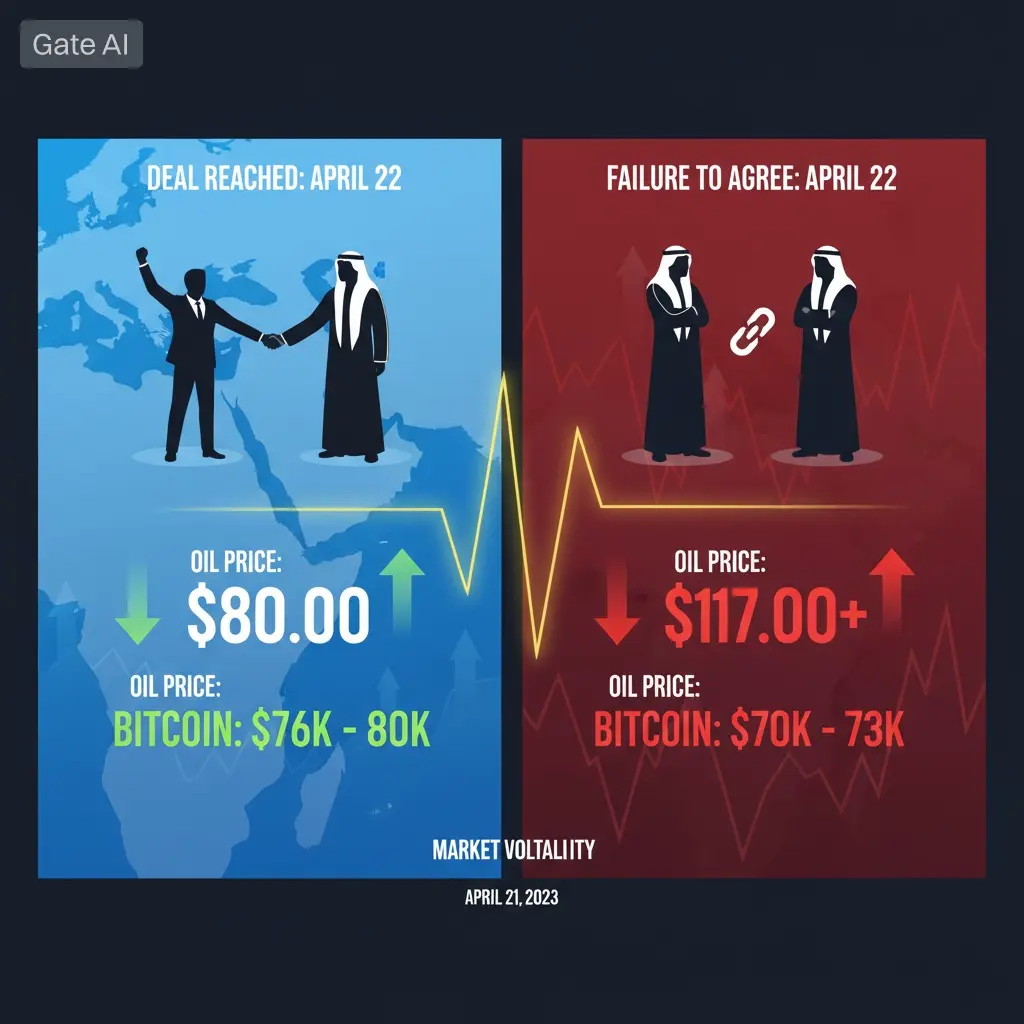
Scenario A: Successful Progress
If a deal is reached:
Oil Market Impact:
Oil prices could fall toward $80/barrel from current elevated levels near $97
Supply fears would ease as Strait of Hormuz blockade lifts
Kuwait has already declared force majeure on some shipments due to security concerns
Crypto Market Impact:
Bitcoin could surge above $76,000, potentially testing $80,000+
Risk-on sentiment would return to markets
Crypto has shown resilience; a deal could trigger significant upside
Institutional flows via ETFs would likely accelerate
Traditional Markets:
Equities would rally
Safe-haven assets (gold, USD) would face pressure
Global risk appetite would improve dramatically
Scenario B: Talks Fail / Escalation
If negotiations collapse:
Oil Market Impact:
Oil could spike to $117+ per barrel
Strait of Hormuz closure would disrupt -20% of global oil supply
Energy crisis risks would escalate globally
Crypto Market Impact:
Bitcoin could test support levels around $70,000-$73,000
Risk-off flows would dominate
Fear & Greed Index is already at 29/100 (Fear territory)
$384M in crypto futures liquidations occurred recently on negative news
Traditional Markets:
Equities would sell off
Flight to safety would benefit USD, gold, and bonds
Global recession fears would intensify
Bitcoin Technical Analysis
Current Price: -$75,720 (up 1.51% in 24h)
Key Levels to Watch:
Resistance: $76,562 (24h high), $80,000 (psychological)
Support: $74,105 (24h low), $73,000, $70,000
Technical Signals:
15-minute SAR shows bullish trend
4-hour MACD forming bullish divergence
Price has broken below MA20 on 15-minute timeframe (short-term weakness)
Volume is elevated, indicating strong participation
Market Structure:
BTC has shown more resilience than oil and equities to Iran-related shocks
Shrinking sell-offs suggest crypto may have largely priced in geopolitical tail risk
Spot ETF bid is providing a floor around $74,000-$75,000
Oil Market Deep Dive
Current Price: -$97/barrel (Brent)
Supply Dynamics:
Strait of Hormuz handles -20% of global oil supply
Blockade has already disrupted shipping; two ships turned around
Kuwait declared force majeure on some shipments
US military extended blockade east to Gulf of Oman and Arabian Sea
Price Scenarios:
Deal reached: $80-85/barrel (relief rally)
Status quo: $90-100/barrel (elevated risk premium)
Escalation: $117+/barrel (supply shock)
Strategic Outlook
For Crypto Traders:
Bullish Case:
A deal removes major macro headwind
Institutional adoption continues (Strategy now holds 815,061 BTC, surpassing BlackRock)
Morgan Stanley and Charles Schwab entering the space
ETF inflows at 5-month highs
Bearish Case:
Failed talks could trigger risk-off cascade
$70,000 is key support; break below could see $65,000
Death cross forming on some timeframes
For Oil Traders:
The next 48 hours are pivotal
Current price reflects significant risk premium
Asymmetric risk: upside limited on deal, downside severe on escalation
Conclusion
The US-Iran talks represent a binary event for markets in the immediate term. The ceasefire deadline of April 22 creates urgency.
Base Case: Expect continued volatility until clarity emerges. Markets are pricing in elevated uncertainty.
Key Watch:
Whether Iran sends a delegation to Islamabad
Any statements from US or Iranian officials
Strait of Hormuz shipping activity
The outcome will likely set the tone for risk assets through Q2 2026. A successful deal could unleash a significant relief rally across crypto and equities, while failure risks a return to March-style volatility with oil spiking and risk assets selling off.
repost-content-media
  • Reward
  • Comment
  • Repost
  • Share
#RAVECrashes90%
RAVECrashes90%
RAVE Token Crash Analysis:
The Full 90%+ Collapse Breakdown
What Happened: Complete Timeline
(The Most Explosive Pump-and-Dump in Recent Crypto History)
Phase 1: The Insane Pump (April 10–18, 2026)
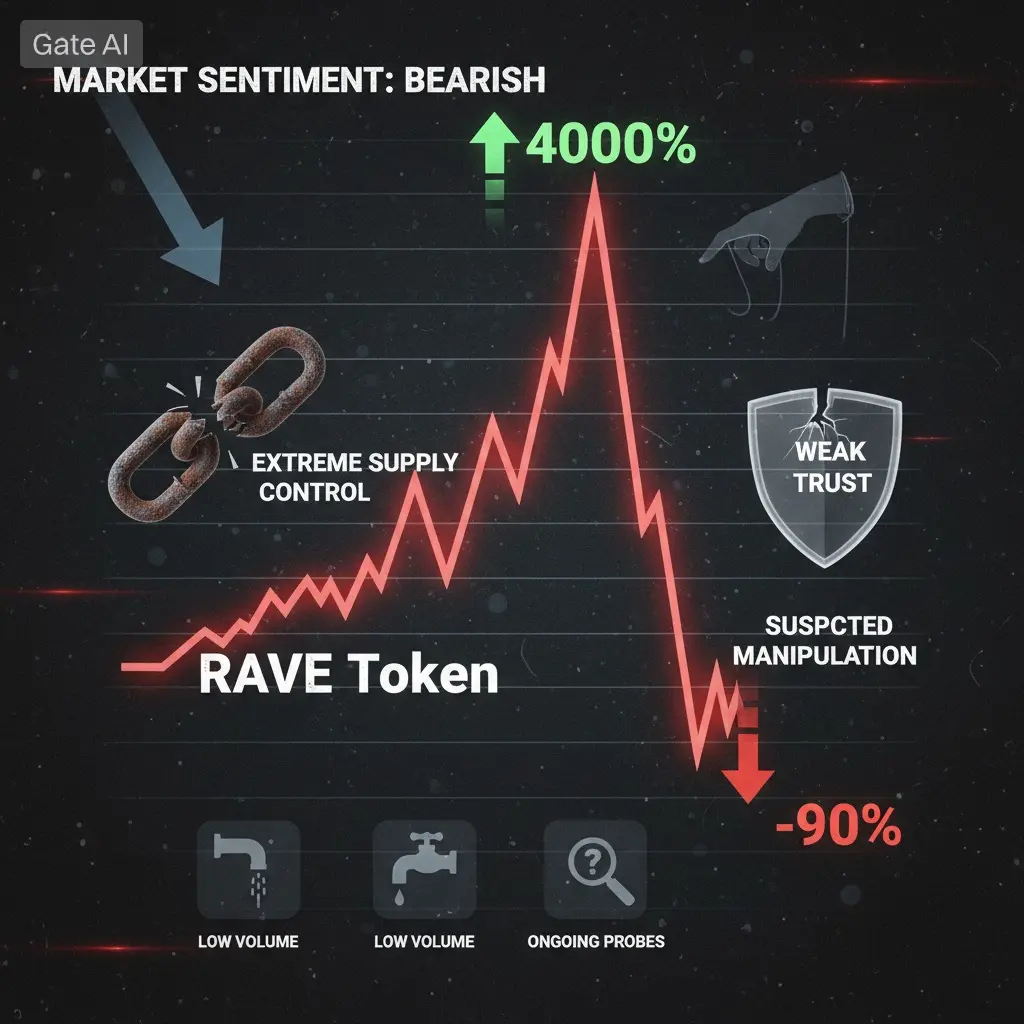
RAVE token moved from almost complete obscurity to becoming one of the most aggressively traded assets in the market within just eight days, creating a perfect example of how hype and speculation can drive prices far beyond their real value without any strong fundamental support.
Starting price: ~$0.68 on April 10
All-time high: $27.94 on April 18
Total surge: Over 4,
RAVE-16,48%
HighAmbition
#RAVECrashes90%
RAVECrashes90%
RAVE Token Crash Analysis:
The Full 90%+ Collapse Breakdown
What Happened: Complete Timeline
(The Most Explosive Pump-and-Dump in Recent Crypto History)
Phase 1: The Insane Pump (April 10–18, 2026)
RAVE token moved from almost complete obscurity to becoming one of the most aggressively traded assets in the market within just eight days, creating a perfect example of how hype and speculation can drive prices far beyond their real value without any strong fundamental support.
Starting price: ~$0.68 on April 10
All-time high: $27.94 on April 18
Total surge: Over 4,000% in under a week
Market cap: Shot into the top-15 cryptocurrencies globally
This type of extremely fast upward movement is usually not sustainable because it is not backed by real adoption, strong utility, or consistent demand, but instead driven by fear of missing out, low circulating supply, and aggressive buying from traders who expect the price to keep rising without understanding the risks involved.
Phase 2: The Brutal Crash (April 18–19, 2026)
The fall happened just as fast as the rise, wiping out billions in value within a very short time and leaving most retail traders stuck at high prices while large holders exited early.
Drop: 92–95% from peak
Price fell from $27.94 to roughly $1.00–$1.50
Market cap loss: $5.7–6 billion erased
Liquidations: Only $52 million
The low liquidation number clearly shows that the biggest players had already started selling before the crash became obvious, while smaller traders entered late and absorbed most of the losses, which strongly suggests that this was not a natural correction but a controlled distribution of tokens by large holders.
Phase 3: Where We Stand Right Now (April 20, 2026 – 10:18 AM PKT)
Current price: $2.418
24-hour change: -14.55%
24-hour high/low: $3.00 / $1.703
7-day performance: -85.42%
Market cap: $558.9 million
Current ranking: #109
24-hour trading volume: $4.38 million
At this stage, the token is trading at a very small percentage of its previous peak value, and more importantly, the market liquidity has dropped significantly, which means even small selling pressure can push the price down quickly because there are not enough buyers to absorb the supply.
Root Causes: Why This Crash Was Almost Inevitable
1. Extreme Supply Concentration (Core Structural Weakness)
The biggest issue was the way the tokens were distributed, because a very large portion of the total supply was controlled by only a few wallets, which made the entire market highly unstable and dependent on the actions of a small group of holders.
95% of supply controlled by just 9 wallets
One wallet alone holding 60%
This kind of structure creates an artificial price environment where the value does not reflect real demand, and once these large holders decide to sell, the market cannot handle the pressure, leading to a sudden collapse.
2. Coordinated Market Behavior Signals
There were several warning signs that the price movement was not completely natural and may have been influenced by coordinated actions.
Large movements of tokens before major price changes
Perfectly timed buying and selling patterns
Sudden spikes in trading activity without consistent follow-through
These patterns are commonly seen in markets where price is driven by strategy rather than organic growth, which increases the risk for late investors.
3. Weak Transparency from Project Side
Even though the team denied any involvement, there are still serious concerns that remain unanswered.
Large wallets continued moving tokens during the crash
No clear information about token lockups or release schedules
No detailed explanation about supply concentration
In crypto markets, transparency builds trust, and when transparency is missing, confidence drops quickly and recovery becomes very difficult.
Technical Structure & Market Behavior
The price chart now shows a clear pattern that is often seen after extreme hype cycles.
A very sharp rise followed by a sudden vertical drop
No strong support levels because price discovery was artificial
Trading volume decreasing, showing reduced interest
Number of holders declining as people exit positions
This is not a normal correction where the market stabilizes gradually, but a structural breakdown where confidence and demand both disappear at the same time.
Sentiment & Trader Psychology
Market sentiment is currently weak and uncertain.
Negative sentiment: 54%
Positive sentiment: 46%
Fear & Greed Index: 29 (Fear)
Most traders are discussing losses, questioning the price movement, and warning others to stay cautious, while even experienced participants are avoiding aggressive positions because the situation remains unclear.
Bull vs Bear Scenario
Bearish Case (Dominant)
The bearish side remains much stronger because the core problems in the project have not been solved.
Supply concentration still exists
Liquidity remains weak
Trust in the project has been damaged
No strong buying demand is visible
Bullish Case
There is still a small possibility of short-term price movement upward due to oversold conditions and high volatility, but these moves are usually temporary and driven by speculation rather than real recovery.
Strategic Outlook
This situation should not be treated as a normal market dip, but as a high-risk environment where protecting capital is more important than chasing quick profits.
Traders should stay patient, avoid emotional decisions, and only consider strong projects with clear fundamentals, while understanding that any short-term bounce in this token is likely temporary unless the overall structure improves significantly.
Final Conclusion
The RAVE collapse clearly shows how hype, low supply circulation, and concentrated ownership can push prices to unrealistic levels and then cause a massive crash within a very short time.
The market has already moved from a growth phase into distribution and now into uncertainty, where risk remains high and confidence is low.
Current Market Stance: Strongly BEARISH
Until there is real transparency, stronger demand, and structural improvement, the downside risk continues to outweigh any potential upside.
repost-content-media
  • Reward
  • 1
  • Repost
  • Share
ShainingMoon:
To The Moon 🌕
#GatePreIPOsLaunchesWithSpaceX :
GatePreIPOsLaunchesWithSpaceX
Gate Pre-IPOs Launches with SpaceX (SPCX):
Gate.io, a major global cryptocurrency exchange, has officially introduced its innovative Pre-IPOs platform, and the very first project featured on this groundbreaking system is SpaceX (SPCX), which is widely recognized as one of the most ambitious and transformative aerospace companies in the modern era, founded by Elon Musk, whose vision has continuously pushed the boundaries of space exploration, satellite technology, and global connectivity.
This launch represents a major structural sh
HighAmbition
#GatePreIPOsLaunchesWithSpaceX :
GatePreIPOsLaunchesWithSpaceX
Gate Pre-IPOs Launches with SpaceX (SPCX):
Gate.io, a major global cryptocurrency exchange, has officially introduced its innovative Pre-IPOs platform, and the very first project featured on this groundbreaking system is SpaceX (SPCX), which is widely recognized as one of the most ambitious and transformative aerospace companies in the modern era, founded by Elon Musk, whose vision has continuously pushed the boundaries of space exploration, satellite technology, and global connectivity.
This launch represents a major structural shift in how financial markets are accessed, because it effectively bridges the gap between traditional private equity markets and the rapidly expanding world of cryptocurrency, allowing ordinary retail investors to gain early exposure to one of the most valuable and highly anticipated private companies in the world without needing exclusive venture capital connections or extremely large capital commitments that were historically required to access such opportunities.
By tokenizing pre-IPO exposure through a carefully structured financial product, Gate.io is opening the door for a much wider audience to participate in premium assets, and this move has the potential to reshape investment accessibility while also setting a precedent for future offerings involving other high-profile unicorn companies across multiple industries.
What is Gate Pre-IPOs?
Gate Pre-IPOs is a sophisticated digital subscription mechanism created by Gate.io that is specifically designed to provide users with early access to high-quality companies before they complete their Initial Public Offering (IPO), which traditionally has been a stage reserved only for institutional investors and elite financial entities.
Through this platform, investors are able to position themselves early in the lifecycle of major companies, monitor valuation trends in a more dynamic and real-time environment, and gain exposure to global assets that were previously inaccessible to the general public, thereby transforming the investment landscape into a more inclusive and decentralized system.
The product is deeply integrated into Gate.io’s ecosystem, ensuring that the entire process remains simple, transparent, and efficient, while eliminating the need for complex brokerage structures or excessively high minimum investment requirements, which ultimately makes participation far more approachable for a broader range of users.
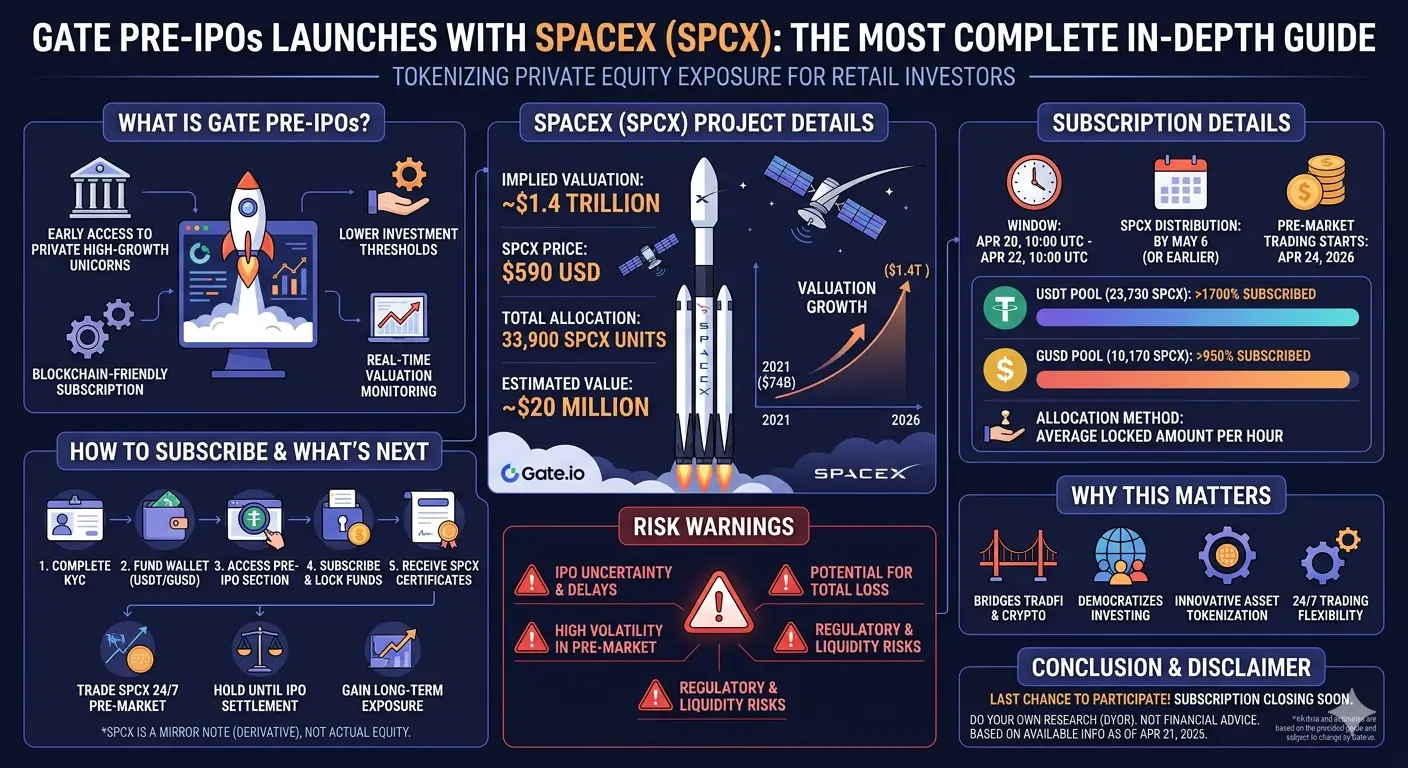
SpaceX (SPCX) Project Details
SpaceX, officially known as Space Exploration Technologies Corp., was founded in 2002 by Elon Musk and has since evolved into the world’s leading commercial aerospace company, gaining global recognition for its reusable rocket systems, the rapidly expanding Starlink satellite internet network, strategic partnerships with NASA, and its long-term ambition to enable human life on Mars.
As of the current offering within this Pre-IPOs structure, the implied valuation for SpaceX stands at approximately $1.4 trillion, while each SPCX unit is priced at $590, and the total allocation available in this round is 33,900 SPCX units, representing an overall offering value of roughly $20 million, which highlights both the exclusivity and the scale of this opportunity.
The valuation growth of SpaceX over the years has been exceptionally strong, rising from around $74 billion in 2021 to $125 billion in 2022, increasing further to $150 billion in 2023, then accelerating sharply to $350 billion in 2024, followed by a major leap to $800 billion in 2025, and reaching approximately $1.25 trillion in 2026, while the $1.4 trillion implied valuation in this product reflects continued market confidence and strong private-sector demand.
There are also ongoing discussions and reports suggesting a potential IPO timeline, with expectations of a possible roadshow in mid-2026 and a projected valuation that could range between $1.75 trillion and $2 trillion, although these developments remain subject to change depending on market conditions and company strategy.
Subscription Details
The subscription window for SpaceX (SPCX) runs from April 20, 2026, 10:00 UTC to April 22, 2026, 10:00 UTC, creating a limited and highly competitive timeframe for participation, while the distribution of SPCX asset certificates is expected to be completed before May 6, 2026, with some indications suggesting earlier distribution timelines depending on allocation processing.
Pre-market trading is scheduled to begin on April 24, 2026, which introduces an additional layer of flexibility by allowing participants to trade their positions even before any official IPO event takes place.
The platform offers two separate subscription pools using stablecoins, where the USDT pool is priced at 590 USDT per SPCX with a total allocation of 23,730 units, and the GUSD pool is priced at 590 GUSD per SPCX with a total allocation of 10,170 units, while the minimum subscription requirement in both cases is set at 100 units, making entry accessible while still maintaining a structured participation model.
Both pools have experienced extremely high demand, with subscription levels exceeding 1,700% in the USDT pool and 950% in the GUSD pool, reflecting strong market interest and intense competition among participants.
The allocation mechanism is based on the average locked amount per hour, meaning that users who commit funds earlier and maintain their positions for longer durations are rewarded with a higher weighted allocation, which introduces a strategic element to participation and encourages early engagement.
Once distributed, SPCX certificates are 100% unlocked immediately, with no vesting periods or lock-up restrictions, allowing users full control over their assets.
How to Subscribe – Step-by-Step Guide
The participation process is designed to be straightforward while still requiring proper preparation, as users must first complete full KYC verification on Gate.io, ensuring compliance with platform requirements, while also noting that institutional accounts and sub-accounts are not eligible for this product.
Users must then ensure that they have sufficient USDT or GUSD available in their spot wallets before accessing the Pre-IPOs section through the platform interface, where they can locate the active SpaceX (SPCX) project and select their preferred subscription pool.
After entering the desired subscription amount, with a minimum requirement of 100 units, users confirm and lock their funds, after which the allocation is calculated based on the time-weighted average balance, and SPCX asset certificates are distributed accordingly.
What Happens After Subscription?
Once users receive their SPCX asset certificates, they gain access to multiple strategic options that provide both flexibility and control over their investment approach, including the ability to participate in 24/7 pre-market trading, which allows them to capitalize on price movements and adjust their positions dynamically before any official IPO event.
Alternatively, users may choose to hold their position until SpaceX eventually goes public, at which point the product is structured to settle based on fair market value, or they may opt for long-term exposure as a way to track the company’s valuation trajectory over time.
It is important to understand that SPCX is not an actual equity share but rather a Mirror Note structured as a Contingent Payout Note (CPN), which provides synthetic exposure to SpaceX’s valuation through derivative-based mechanisms without granting direct ownership rights.
VIP and Community Benefits
Gate.io has also introduced additional incentives for its loyal user base, where VIP 5 and higher members, along with Affiliate Ultra participants, can receive extra airdrops and exclusive rewards, while occasional promotional campaigns may offer enhanced earning opportunities through integrated features such as Simple Earn products
Important Risk Warnings
While the opportunity presents significant potential, it also carries notable risks that must be carefully considered, including the uncertainty surrounding the IPO timeline, the possibility of valuation fluctuations due to market or operational factors, and the inherent volatility associated with pre-market trading environments.
There is also the potential for partial or total capital loss in extreme scenarios, along with regulatory and liquidity risks that may arise due to the nature of tokenized derivative products, and therefore users are strongly advised to conduct thorough research and only invest funds they can afford to risk.
Why This Launch Matters
This launch represents a meaningful evolution in financial markets, as it creates a functional bridge between traditional finance and cryptocurrency, democratizes access to pre-IPO opportunities, introduces innovative asset tokenization models, and provides unprecedented flexibility through 24/7 trading and full asset unlock features.
The overwhelming demand observed during the subscription phase highlights the strong global interest in SpaceX’s growth narrative and reinforces the significance of this new investment model.
Conclusion
Gate.io’s launch of Pre-IPOs with SpaceX (SPCX) stands as a landmark development in the convergence of crypto and traditional financial systems, offering retail investors a rare and early window into one of the most transformative companies of the modern era, backed by the visionary leadership of Elon Musk.
With the subscription window closing soon and demand already exceeding expectations, this initiative not only represents a unique opportunity for participants but also signals the beginning of a broader shift toward more accessible, tokenized investment ecosystems that could redefine how global markets operate in the future
#CreatorCarnival
#ContentMining
repost-content-media
  • Reward
  • Comment
  • Repost
  • Share
#CryptoMarketsDipSlightly
Comprehensive Crypto Market Analysis: Iran Ceasefire Impact and Market Dip
1. US-Iran Ceasefire Escalation and Crypto Market Trend
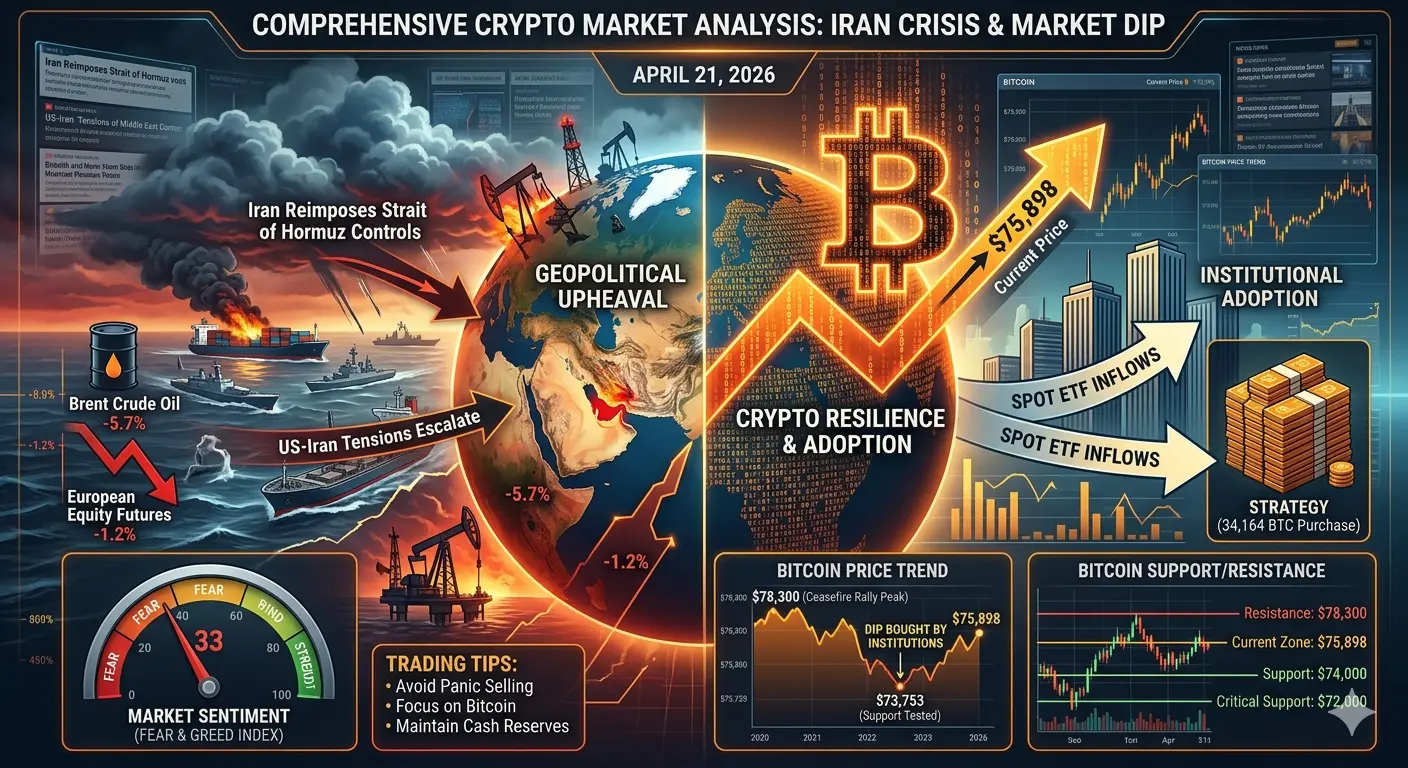
The recent crypto market volatility is directly tied to the escalating tensions between the United States and Iran. Initially, hopes of a ceasefire triggered a brief rally in risk assets including cryptocurrencies. Bitcoin surged to approximately $78,300 on Friday, marking its highest price since early February 2026. However, the situation deteriorated rapidly over the weekend when Iran rejected a second round of US-led peace talks and re
HighAmbition
#CryptoMarketsDipSlightly
Comprehensive Crypto Market Analysis: Iran Ceasefire Impact and Market Dip
1. US-Iran Ceasefire Escalation and Crypto Market Trend
The recent crypto market volatility is directly tied to the escalating tensions between the United States and Iran. Initially, hopes of a ceasefire triggered a brief rally in risk assets including cryptocurrencies. Bitcoin surged to approximately $78,300 on Friday, marking its highest price since early February 2026. However, the situation deteriorated rapidly over the weekend when Iran rejected a second round of US-led peace talks and reimposed controls on the Strait of Hormuz, a critical chokepoint for global oil shipments.
The US military's seizure of an Iranian cargo ship attempting to run the blockade further escalated tensions, with Iran vowing retaliation. This geopolitical uncertainty caused immediate market reactions. Traditional markets experienced significant volatility with Brent crude oil jumping 5.7% and European equity futures dropping 1.2%. Interestingly, Bitcoin proved more resilient than oil and equities, slipping only modestly by 1.6% compared to the severe reactions in traditional markets.
The crypto market has shown signs of pricing in geopolitical tail risk. With each Iran-related shock, Bitcoin sell-offs have become progressively smaller, suggesting that holders who intended to sell on such headlines have largely already done so. The spot ETF bid has emerged as a more reliable floor than the futures-driven weekend gaps that characterized earlier market cycles.
2. Why the Crypto Market Dipped and Price Analysis
Causes of the Dip:
The crypto market dip occurred due to multiple converging factors. The primary trigger was renewed geopolitical uncertainty surrounding the US-Iran ceasefire negotiations. When diplomatic hopes faded and Iran reimposed Strait of Hormuz controls, risk sentiment across all markets deteriorated. Bitcoin dropped from its weekend high of $78,300 to approximately $73,753 on April 19, representing roughly a 2% decline in 24 hours. This wiped an estimated $83 billion from total crypto market capitalization.
Additional contributing factors include profit-taking after Bitcoin's strong run to two-month highs, concerns about persistent inflation despite softer CPI data, and technical resistance levels triggering automated selling. The market had become overheated with excessive leverage, making it vulnerable to any negative catalyst.
Price Movement Analysis:
Bitcoin demonstrated notable resilience compared to previous geopolitical shocks. After dipping to approximately $73,753, it quickly found support and stabilized. Currently trading around $75,898, Bitcoin has recovered significantly from the weekend lows. The price action shows Bitcoin holding above the critical $74,000 support level, with the 24-hour trading range between $74,105 and $76,562.
Ethereum experienced more pronounced volatility, declining from around $2,350 to test support near $2,263 before recovering to current levels around $2,315. The 24-hour range for Ethereum spans from $2,263 to $2,347, showing a tighter consolidation pattern compared to Bitcoin.
The Fear and Greed Index currently reads 33, indicating Fear sentiment in the market. This represents a shift from the greed-driven euphoria seen during the rally phase, creating a more cautious trading environment.
---
3. Current Price Forecast and Trading Strategy
Technical Outlook:
Bitcoin is currently trading in a consolidation phase between $72,000 and $78,000. The immediate resistance sits at $76,500-$77,000, with stronger resistance at the $78,300 recent high. Support levels are established at $74,000, with critical support at $73,000-$72,000. A break below $72,000 could trigger a deeper correction toward $68,000-$70,000.
Ethereum faces resistance at $2,350-$2,400, with support established at $2,250-$2,300. The relative underperformance of Ethereum compared to Bitcoin suggests continued caution for ETH traders.
Trading Strategy Recommendations:
For conservative traders, a dollar-cost averaging approach makes sense in the current environment. Accumulating small positions on dips toward the $74,000-$75,000 range for Bitcoin and $2,250-$2,300 for Ethereum provides favorable risk-reward. Setting stop losses below $72,000 for Bitcoin and $2,200 for Ethereum helps manage downside risk.
For active traders, range-bound strategies work well given the current consolidation. Buying near support levels and taking profits near resistance while maintaining core positions for potential breakouts captures short-term volatility while preserving upside exposure.
The institutional accumulation narrative remains strong. Strategy alone purchased 34,164 Bitcoin worth $25.4 billion in a single week, while spot ETFs saw nearly $1 billion in weekly inflows. This institutional demand provides a structural floor that makes aggressive shorting risky despite short-term bearish sentiment.
4. What Traders Are Thinking and Tips
Current Trader Sentiment:
Trader sentiment on social media platforms shows a mixed but leaning bullish outlook. Approximately 50-60% of trader discussions frame this dip as a healthy correction and prime buying opportunity. The dominant narrative encourages dollar-cost averaging into Bitcoin, with many viewing sub-$100,000 prices as the dip before higher targets like $80,000-$84,000.
However, bearish voices comprise roughly 30-40% of discussions, questioning whether this represents a dead cat bounce or deeper correction. These traders point to Ethereum's momentum reversal and retail futures liquidations as warning signs. Some anticipate one more leg down if Bitcoin fails to hold its 100-day moving average.
Practical Trading Tips:
First, avoid panic selling into weakness. The institutional bid remains strong, and geopolitical shocks have shown diminishing impact on crypto prices with each occurrence. Second, focus on Bitcoin over altcoins during uncertain periods, as BTC has demonstrated superior resilience and institutional support. Third, maintain adequate cash reserves to capitalize on deeper dips toward $70,000-$72,000 if they materialize.
Risk management remains paramount. Position sizing should reflect the elevated volatility environment, with smaller position sizes and wider stop losses than during calm market conditions. Avoid excessive leverage, as geopolitical headlines can trigger sudden moves that liquidate overleveraged positions.
5. Understanding the Crypto Market Dip Step by Step
Step One: Initial Rally Phase
The market began with optimism surrounding potential US-Iran ceasefire developments. Bitcoin broke above $78,000, reaching levels not seen since February. This rally was fueled by institutional buying, ETF inflows, and improving macro sentiment.
Step Two: Geopolitical Reversal
Diplomatic hopes faded when Iran rejected peace talks and reimposed Strait of Hormuz controls. The US cargo ship seizure escalated tensions further. Risk assets globally sold off, with crypto following though showing relative strength compared to traditional markets.
Step Three: Technical Correction
The market had become technically overextended after the strong rally. Profit-taking combined with leveraged long liquidations amplified the downward move. Bitcoin shed approximately $4,500 from its peak while Ethereum dropped more sharply.
Step Four: Support Testing and Stabilization
Bitcoin found buyers near $73,750, demonstrating the strength of institutional demand. The recovery toward $76,000 shows that dip buyers remain active. Ethereum stabilized near $2,260 support, though showing less conviction than Bitcoin.
Step Five: Current Consolidation
The market now trades in a range-bound environment, digesting geopolitical developments and awaiting clearer directional catalysts. Volume has normalized, and volatility has decreased from panic levels. This consolidation phase typically precedes the next significant move.
---
6. Current Market Conditions and Future Direction
Present State:
The cryptocurrency market sits at a critical juncture. Bitcoin trades around $75,898, up 1.63% over 24 hours, showing resilience despite ongoing geopolitical uncertainty. Ethereum trades at $2,315, up 1.08%, though underperforming Bitcoin. The total crypto market capitalization stands at approximately $2.51 trillion.
Institutional flows remain robust with $1.4 billion in weekly inflows to crypto investment products, marking the second-strongest week since January. Bitcoin funds captured $1.12 billion of these inflows, while Ethereum products saw $328 million. This institutional accumulation provides underlying support that limits downside.
The Fear and Greed Index at 33 indicates cautious sentiment, which from a contrarian perspective often marks favorable entry points. Extreme fear readings typically coincide with market bottoms, while current levels suggest healthy skepticism rather than panic.
Future Direction:
The near-term trajectory depends heavily on geopolitical developments. A genuine de-escalation between the US and Iran could trigger a rapid rally toward $80,000-$85,000 for Bitcoin as risk sentiment improves. Conversely, further escalation with Strait of Hormuz disruptions could test support at $70,000-$72,000.
Medium-term fundamentals remain constructive. Institutional adoption continues accelerating with Coinbase launching crypto-backed lending in the UK and Strategy maintaining aggressive accumulation. The Bitcoin halving supply dynamics combined with ETF demand create a supply squeeze that favors higher prices over time.
Technical analysts eye $80,000 as the next major resistance level. A decisive break above this level could trigger momentum buying toward $100,000. Support at $72,000-$74,000 must hold to maintain the bullish structure. Failure to hold this zone would shift focus to $68,000-$70,000 support.
The market appears to be in a accumulation phase where smart money is building positions while retail sentiment remains cautious. This dynamic typically resolves with an upward move once catalysts align. Traders should prepare for continued volatility while maintaining exposure to capture the next leg higher.
#CreatorCarnival
#ContentMining
repost-content-media
  • Reward
  • Comment
  • Repost
  • Share
#FirstTradeOfTheWeek
🐶 Dogecoin (DOGE) Weekly Trading Plan | April 2026
💰 Current Price: $0.094
🌍 SCENARIO 1: RISK-ON / MARKET IMPROVEMENT (Crypto Bullish Flow)
📈 Market Impact:
Improved global sentiment boosts altcoins
Liquidity rotates from BTC into meme coins
Strong volatility expansion in DOGE
📊 Expected Price Move:
👉 $0.094 → $0.100 → $0.110 → $0.125 → $0.140
🟢 Key Support Zones:
$0.090 (first defense level)
$0.085 (strong accumulation zone)
$0.080 (major demand zone)
📌 Bullish Trigger: Break above $0.100
📌 Stop Loss for longs: Below $0.088
🧠 Market Behavio
DOGE2,21%
BTC2,49%
HighAmbition
#FirstTradeOfTheWeek
🐶 Dogecoin (DOGE) Weekly Trading Plan | April 2026
💰 Current Price: $0.094
🌍 SCENARIO 1: RISK-ON / MARKET IMPROVEMENT (Crypto Bullish Flow)
📈 Market Impact:
Improved global sentiment boosts altcoins
Liquidity rotates from BTC into meme coins
Strong volatility expansion in DOGE
📊 Expected Price Move:
👉 $0.094 → $0.100 → $0.110 → $0.125 → $0.140
🟢 Key Support Zones:
$0.090 (first defense level)
$0.085 (strong accumulation zone)
$0.080 (major demand zone)
📌 Bullish Trigger: Break above $0.100
📌 Stop Loss for longs: Below $0.088
🧠 Market Behavior:
Fast impulsive pumps
Retail-driven momentum spikes
High volatility breakouts
🔴 SCENARIO 2: RISK-OFF / MARKET WEAKNESS
📉 Market Impact:
Liquidity shifts back to BTC/stable assets
Altcoins under pressure
Weak meme coin performance
📊 Expected Price Move:
👉 $0.094 → $0.090 → $0.085 → $0.080 → $0.075
🟢 Key Levels:
$0.090 (first support test)
$0.085 (trend defense zone)
$0.080 (strong support base)
📌 Bearish Trigger: Break below $0.090
📌 Stop Loss for shorts: Above $0.098
🧠 Market Behavior:
Slow bleed or sharp dumps
Weak volume recovery
Meme coins underperforming
⚖️ RANGE SCENARIO (SIDEWAYS MARKET)
📊 Range Zone:
👉 $0.090 ↔ $0.100
📌 Market Behavior:
Fake breakouts both sides
Liquidity hunting moves
Choppy price action
📈 Scalping Flow: $0.092 → $0.096 → $0.094 → $0.090 → $0.098 → $0.095
🔥 FINAL WEEKLY VIEW (DOGE)
👉 DOGE is in a tight accumulation zone near $0.094
👉 Breakout above $0.10 can trigger strong momentum
👉 Loss of $0.09 support may lead to weakness
👉 High volatility expected due to altcoin sensitivity
🧠 TRADER RULE
✔ Don’t chase pumps in DOGE
✔ Wait for $0.10 breakout confirmation
✔ Avoid over-leverage in range
✔ Follow BTC direction for confirmation
repost-content-media
  • Reward
  • Comment
  • Repost
  • Share
#USIranTensionsShakeMarkets
The escalating geopolitical tensions between the United States and Iran have sent shockwaves through global financial markets, creating significant volatility across traditional and digital asset classes. This article provides a detailed examination of how these tensions have impacted Bitcoin (BTC), Ethereum (ETH), Tether Gold (XAUT), and oil markets, analyzing the magnitude of market movements and the underlying factors driving these shifts.
Understanding the US-Iran Conflict Context
The current wave of tensions began in late February 2026, when military confronta
HighAmbition
#USIranTensionsShakeMarkets
The escalating geopolitical tensions between the United States and Iran have sent shockwaves through global financial markets, creating significant volatility across traditional and digital asset classes. This article provides a detailed examination of how these tensions have impacted Bitcoin (BTC), Ethereum (ETH), Tether Gold (XAUT), and oil markets, analyzing the magnitude of market movements and the underlying factors driving these shifts.
Understanding the US-Iran Conflict Context
The current wave of tensions began in late February 2026, when military confrontations between the United States and Iran intensified. The conflict reached a critical point when Iran imposed controls on the Strait of Hormuz, one of the world's most strategically important oil transit chokepoints. This move triggered immediate reactions across global markets, as traders and investors scrambled to assess the implications for energy supplies, inflation expectations, and overall risk sentiment.
The situation escalated further over the weekend of April 18-19, 2026, when the US military seized an Iranian cargo ship, putting pressure on the fragile ceasefire between the two nations. This development caused renewed anxiety in markets that had begun to price in a de-escalation following earlier diplomatic overtures.
Bitcoin's Resilient Performance
Bitcoin has demonstrated remarkable resilience in the face of geopolitical turbulence. Currently trading at approximately $75,790, BTC has maintained its position above the critical $74,000 support level despite multiple waves of negative news. The cryptocurrency experienced a modest pullback of only 1.6% following the weekend's escalation, a relatively muted response compared to traditional markets.
What makes Bitcoin's performance particularly noteworthy is its divergence from conventional risk assets. While European equity futures dropped 1.2% and oil prices surged over 5%, Bitcoin's decline was contained within a narrow range. This suggests that cryptocurrency markets may have already priced in much of the geopolitical tail risk associated with the Iran conflict.
Several factors support Bitcoin's relative stability. First, institutional adoption continues to provide underlying support. Strategy (formerly MicroStrategy) recently announced the acquisition of 34,164 additional Bitcoin, bringing their total holdings to 815,061 BTC with an average cost basis of approximately $75,527. This corporate buying has created a floor of demand that absorbs selling pressure during risk-off episodes.
Second, the spot Bitcoin ETF market has evolved into a more reliable source of price support than the futures-driven weekend gaps that characterized earlier market cycles. The consistent inflows into these products have altered the market structure, making Bitcoin less susceptible to the sharp drawdowns that previously accompanied geopolitical shocks.
From a technical perspective, Bitcoin is displaying constructive signals. The 15-minute charts show CCI and WR indicators in oversold territory, suggesting potential for short-term recovery. The 4-hour timeframe reveals a MACD bullish divergence, where prices made lower lows while momentum indicators improved. However, the daily timeframe shows Bitcoin trading below its 20-period moving average, indicating that the broader trend requires monitoring.
Ethereum's Mixed Response
Ethereum has experienced more pronounced volatility compared to Bitcoin, currently trading around $2,313. The second-largest cryptocurrency by market capitalization has faced additional headwinds beyond geopolitical tensions, including a significant security incident involving KelpDAO's rsETH cross-chain bridge, which suffered an exploit resulting in approximately $290 million in losses.
This security breach triggered cascading effects across decentralized finance protocols, with Aave and other platforms freezing related markets as a precautionary measure. The incident highlighted the ongoing risks within the DeFi ecosystem and contributed to Ethereum's underperformance relative to Bitcoin.
Despite these challenges, Ethereum maintains several positive catalysts. Bitmine, a major institutional player, has been aggressively accumulating ETH, with holdings now exceeding 4.98 million tokens representing approximately 4.12% of the total supply. This institutional demand provides substantial support for Ethereum's price.
Technical analysis of Ethereum shows similar oversold conditions on shorter timeframes, with CCI and WR indicators suggesting potential for bounce plays. The 4-hour chart displays a MACD bullish divergence, indicating that selling pressure may be exhausting. However, Ethereum's performance relative to Bitcoin has been weaker, with the ETH/BTC ratio under pressure.
Tether Gold's Safe Haven Appeal
Tether Gold (XAUT), a digital asset backed by physical gold, has emerged as a beneficiary of the flight-to-safety dynamic. Trading at approximately $4,785 per token, XAUT has maintained stability while traditional markets experienced turbulence. The asset's 24-hour trading volume has been robust at over $9.3 million, indicating active interest from investors seeking exposure to gold through digital means.
Gold's traditional role as a safe haven during geopolitical crises has translated well to its tokenized form. As tensions escalated, investors rotated capital into gold-backed digital assets, viewing them as a hedge against both geopolitical risk and potential inflationary pressures from higher oil prices.
The technical picture for XAUT shows the asset trading in a relatively tight range, with bandwidth compression indicating that a significant directional move may be imminent. The asset has outperformed many risk assets during the crisis period, validating its utility as a portfolio diversifier.
Oil Market Dynamics
The oil market has been the most dramatically affected by US-Iran tensions. Brent crude prices surged over 5% to approximately $95 per barrel following the weekend escalation, reversing sharp losses from Friday when prices had slumped on news that Iran declared the Strait of Hormuz "completely open."
The volatility in oil markets reflects the critical importance of the Strait of Hormuz, through which approximately one-fifth of global oil shipments pass. Any threat to this vital transit route has immediate implications for global energy security and inflation expectations.
The oil price surge has created a complex dynamic for risk assets. Higher energy costs typically translate to increased inflationary pressure, which could prompt central banks to maintain higher interest rates for longer. This environment generally weighs on risk assets, including cryptocurrencies, though Bitcoin's inflation-resistant narrative has provided some insulation.
Cross-Asset Correlations and Market Structure
The current crisis has revealed interesting shifts in cross-asset correlations. Traditional safe havens like the US dollar and gold have strengthened, while risk assets have experienced selective pressure. Bitcoin's correlation with traditional risk assets appears to be decreasing, potentially marking an evolution in its market characteristics.
The divergence between Bitcoin and oil price movements is particularly significant. In previous geopolitical crises, cryptocurrencies often sold off sharply alongside other risk assets. The fact that Bitcoin has maintained relative stability while oil surged suggests that market participants are increasingly viewing digital assets through a distinct lens.
Institutional Flows and Market Depth
Institutional activity has played a crucial role in stabilizing cryptocurrency markets during this period. US spot crypto ETFs have seen continued inflows across Bitcoin, Ethereum, and other major assets. This institutional bid has provided a cushion against retail panic selling and has helped maintain orderly market conditions despite elevated uncertainty.
The presence of sophisticated market makers and institutional participants has improved market depth, reducing the severity of price dislocations during periods of stress. This evolution in market structure represents a maturation of the cryptocurrency ecosystem.
Macroeconomic Implications
The US-Iran conflict carries significant macroeconomic implications that extend beyond immediate market movements. Higher oil prices threaten to reignite inflationary pressures that had been showing signs of moderation. This complicates the outlook for monetary policy, with traders now pricing in reduced expectations for Federal Reserve rate cuts.
The probability of a US rate cut this year has declined from expectations of two cuts to approximately 28% probability of a single cut. This shift in rate expectations has supported the US dollar while creating headwinds for risk assets.
For cryptocurrency markets, the inflationary implications of higher oil prices present a mixed picture. While rising inflation typically supports Bitcoin's narrative as an inflation hedge, the accompanying tightening of financial conditions and potential for higher interest rates can pressure valuations in the short term.
Risk Management Considerations
For investors navigating this environment, several risk management considerations emerge. The persistence of geopolitical tensions suggests that volatility will remain elevated, requiring careful position sizing and risk management. Diversification across asset classes, including exposure to safe havens like gold, can help mitigate portfolio volatility.
The evolving nature of cryptocurrency market structure means that historical patterns may not perfectly predict future behavior. Bitcoin's reduced sensitivity to geopolitical shocks represents a potential shift in its risk characteristics, though this thesis will be tested if tensions escalate further.
Conclusion
The US-Iran tensions have created a complex market environment where traditional relationships between asset classes are being tested. Bitcoin has demonstrated surprising resilience, suggesting a potential evolution in its market characteristics. Ethereum faces additional challenges from security incidents but maintains institutional support. Tether Gold has fulfilled its role as a digital safe haven, while oil markets have borne the brunt of supply concerns.
As diplomatic efforts continue and military tensions fluctuate, markets will remain sensitive to developments. The key question for investors is whether the current pricing adequately reflects tail risks or if further escalation could trigger more significant repricing. For now, the market appears to be balancing geopolitical concerns against improving institutional adoption and evolving market structure in the cryptocurrency space.
repost-content-media
  • Reward
  • Comment
  • Repost
  • Share
#GatePreIPOsLaunchesWithSpaceX
Gate Pre-IPOs x SpaceX: The Next Evolution of Global Investing
The global financial system is undergoing a profound structural transformation, and for the first time in modern history, retail investors are not merely observers of wealth creation but are becoming active participants in opportunities that were once tightly controlled by institutional powerhouses. With the introduction of the Pre-IPOs product by Gate.io and its inaugural offering centered around SpaceX, a new bridge is being constructed between decentralized digital markets and the traditionally ex
HighAmbition
#GatePreIPOsLaunchesWithSpaceX
Gate Pre-IPOs x SpaceX: The Next Evolution of Global Investing
The global financial system is undergoing a profound structural transformation, and for the first time in modern history, retail investors are not merely observers of wealth creation but are becoming active participants in opportunities that were once tightly controlled by institutional powerhouses. With the introduction of the Pre-IPOs product by Gate.io and its inaugural offering centered around SpaceX, a new bridge is being constructed between decentralized digital markets and the traditionally exclusive world of private capital, fundamentally redefining how early-stage investment access is distributed across the globe.
📅 Participation Timeline: A Critical Window of Opportunity
The participation window for this groundbreaking opportunity is strictly limited and strategically designed to reward early conviction and sustained commitment from investors who recognize the significance of timing in wealth creation.
Subscription Opens: April 20, 2026 — 10:00 UTC
Subscription Closes: April 22, 2026 — 10:00 UTC
Distribution: April 22, 2026 — 14:00 UTC
Pre-Market Trading: April 24, 2026 — 10:00 UTC
This 48-hour window is not merely a subscription period but a competitive environment where capital allocation is influenced by participation timing, meaning that those who engage earlier and maintain their positions consistently throughout the duration significantly increase their probability of receiving higher allocations, effectively turning time itself into a strategic asset.
From Exclusivity to Accessibility: The Collapse of Traditional Barriers
For decades, the ability to invest in companies before their public debut has been confined to a narrow circle of venture capital firms, private equity giants, and ultra-high-net-worth individuals who operate within closed networks and privileged financial ecosystems, leaving the broader investing public to enter only after valuations have already expanded significantly. This model has historically concentrated wealth creation at the top tiers of the financial hierarchy, reinforcing inequality in access to high-growth opportunities.
However, with the introduction of Pre-IPOs, Gate.io is actively dismantling these barriers by leveraging blockchain infrastructure to create a system where participation is no longer dictated by status, geography, or institutional connections, but instead by accessibility, transparency, and digital liquidity, allowing a much wider segment of the global population to position themselves earlier in the investment lifecycle.
A New Investment Paradigm: Efficiency, Liquidity, and Transparency Combined
What distinguishes Pre-IPOs from traditional pre-public investment mechanisms is not merely the access it provides, but the efficiency and flexibility embedded within its structure, which transforms historically rigid and illiquid investments into dynamic financial instruments that can adapt to market conditions in real time. Investors are no longer required to navigate complex legal frameworks, endure extended lock-up periods, or rely on opaque valuation processes, as the entire system is designed to operate within a transparent digital environment.
Through tokenized exposure, participants can gain access to the valuation trajectory of high-growth companies without engaging in the cumbersome processes typically associated with equity ownership, while real-time valuation tracking ensures that market sentiment is continuously reflected, providing a level of visibility that was previously unavailable in private markets. Additionally, the elimination of lock-up constraints introduces a degree of liquidity that fundamentally changes the risk profile of pre-IPO investments, making them more adaptable and responsive to individual investment strategies.
🚀 SpaceX (SPCX): A Transformational Asset Backed by Vision and Innovation
The selection of SpaceX as the inaugural project is both strategic and symbolic, as the company represents one of the most ambitious and disruptive forces in modern industry, having consistently pushed the boundaries of what is technologically and economically possible under the leadership of Elon Musk.
SpaceX has fundamentally altered the economics of space exploration through the development of reusable rocket systems such as Falcon 9, significantly reducing launch costs while increasing frequency and reliability, and has simultaneously expanded into global communications through the Starlink satellite network, which is rapidly becoming one of the most extensive and impactful internet infrastructures in the world. Beyond these achievements, the company’s long-term vision of interplanetary expansion and Mars colonization positions it not just as a market participant but as a pioneer shaping entirely new industries.
SPCX Structure: A Synthetic Gateway to Private Market Valuation
The SPCX asset is engineered as a Mirror Note, which means that it is designed to reflect the valuation movements of SpaceX rather than confer direct ownership of equity, thereby creating a synthetic exposure mechanism that bridges the gap between traditional private market investments and the liquidity of digital assets. This structure allows investors to benefit from valuation changes without being subject to the regulatory and logistical complexities associated with holding private shares.
With a total supply of 33,900 tokens priced at $590 each, the offering implies a valuation of approximately $1.4 trillion, positioning SpaceX among the most valuable companies globally even before its public listing. The allocation model, split between USDT and GUSD, ensures stable participation while maintaining alignment with crypto-native liquidity standards.
Time-Weighted Allocation: A Strategic Layer of Participation
One of the most innovative aspects of this offering is its time-weighted allocation mechanism, which introduces a strategic dimension to participation by rewarding early and consistent commitment rather than simply prioritizing speed of execution. Unlike traditional systems where allocation is determined by who acts fastest, this model evaluates the duration and consistency of capital commitment, effectively incentivizing long-term engagement within the subscription window.
This means that investors who allocate funds at the beginning of the subscription period and maintain their position throughout are granted significantly higher allocation weights compared to those who enter later, creating a system where patience and foresight are directly linked to potential rewards, and where timing becomes as critical as capital itself.
Liquidity Revolution: Breaking the Lock-Up Paradigm
Perhaps the most transformative feature of the Pre-IPOs model is its approach to liquidity, which stands in stark contrast to the traditional pre-IPO environment where investors are often locked into positions for extended periods with no access to secondary markets. In this new framework, participants are given multiple exit pathways, allowing them to respond dynamically to market conditions rather than being constrained by rigid contractual limitations.
Investors can choose to exit their positions before the IPO through valuation-based mechanisms, participate in pre-market trading once it becomes available, or hold their positions long-term in anticipation of further valuation growth, effectively transforming what was once a static and restrictive investment into a flexible and adaptive financial instrument.
Strategic Vision: Gate’s Expansion Beyond a Traditional Exchange
Founded by Dr. Han, Gate.io has consistently positioned itself at the forefront of innovation within the digital asset space, and the introduction of Pre-IPOs represents a natural evolution of its broader strategy to become a comprehensive financial ecosystem rather than merely a trading platform.
With a global user base exceeding 50 million and support for thousands of digital assets, Gate is now extending its reach into areas traditionally dominated by legacy financial institutions, including venture investment, tokenized real-world assets, and AI-integrated financial services, thereby creating an infrastructure that is capable of supporting the next generation of global capital markets.
Market Context: Timing Aligned with Macro and Technological Trends
The launch of this product is not occurring in isolation but is instead aligned with broader macroeconomic and technological trends that are reshaping the financial landscape, including the growing demand for access to private markets, the increasing adoption of tokenized real-world assets, and the anticipation surrounding potential mega-IPOs such as that of SpaceX.
As traditional financial systems continue to evolve and integrate with digital technologies, platforms that can bridge these two worlds are likely to play a central role in defining the future of investing, and the success of this initial offering could set a precedent for a new category of hybrid financial products.
Risk Considerations: Understanding the Structure Before Participation
Despite the significant opportunities presented by this model, it is essential for participants to fully understand the associated risks, particularly the distinction between synthetic exposure and direct equity ownership, as SPCX does not grant shareholders’ rights or direct claims on SpaceX assets.
Additionally, the performance of the asset is dependent on Gate’s ability to maintain effective hedging strategies, while the timing and valuation of any future IPO remain uncertain and subject to market conditions, regulatory approvals, and corporate decisions, making it crucial for investors to approach this opportunity with a well-informed perspective and a clear understanding of their risk tolerance.
The Future of Investing: A Structural Transformation, Not a Temporary Trend
What is being introduced through Pre-IPOs is not simply a new product category but a foundational shift in how capital markets operate, where the boundaries between private and public investing are gradually dissolving, and where blockchain technology serves as the infrastructure enabling this transition.
As this model evolves, it has the potential to unlock a wide range of opportunities, from tokenized venture capital ecosystems to fully liquid private equity markets, fundamentally changing how and when investors can participate in the growth of high-impact companies.
Final Perspective: Positioning Before the World Arrives
The launch of Pre-IPOs by Gate.io, combined with the inclusion of SpaceX as its first project, represents a defining moment in the evolution of global finance, where access, liquidity, and innovation converge to create a new paradigm for investment.
In this emerging landscape, the most successful participants will not be those who react after opportunities become widely recognized, but those who position themselves early, understand the underlying mechanisms, and adapt to a system where the future of investing is no longer bound by traditional limitations, but is instead driven by technology, accessibility, and strategic foresight.
repost-content-media
  • Reward
  • Comment
  • Repost
  • Share
  • Pin