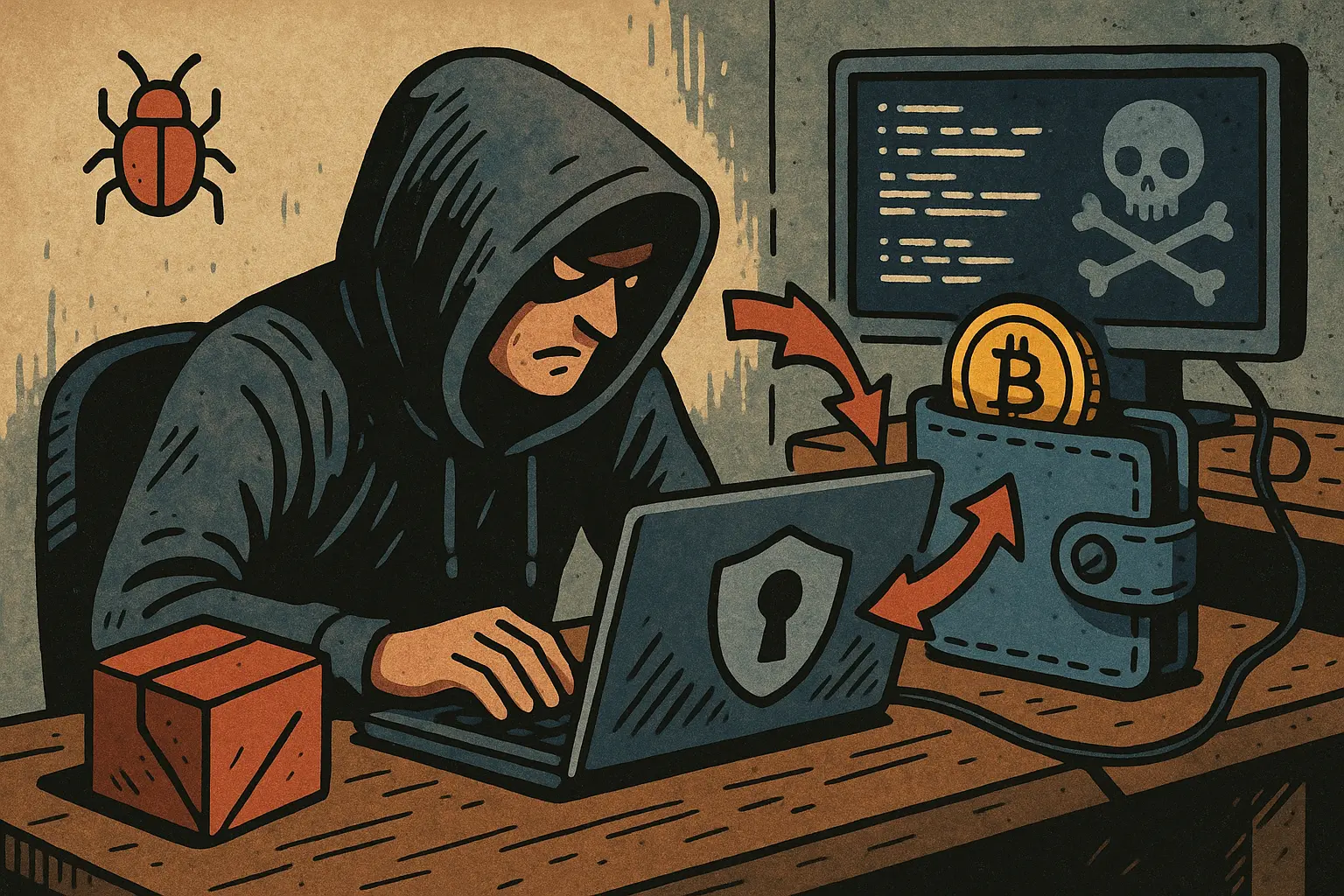
Misty’s Chief Information Security Officer 23pds forwards a Bitwarden security team warning. The Bitwarden CLI version 2026.4.0 that had been distributing malicious packages via npm within a 1.5-hour window from 5:57 to 7:30 p.m. Eastern Time on April 22 has been withdrawn. Bitwarden has officially confirmed that the password vault data and production systems were not affected.
Attack Details: Targeted Theft via bw1.js Malicious Payload
The malicious payload runs silently during npm package installation and collects the following types of data:
· GitHub and npm tokens
· SSH keys
· Environment variables
· Shell history
· Cloud credentials
· Encrypted wallet files (including MetaMask, Phantom, and Solana wallets)
The stolen data is exfiltrated to attacker-controlled domains and submitted to GitHub repositories via a persistence mechanism. Many cryptocurrency teams use the Bitwarden CLI in CI/CD automation workflows for key injection and deployment. Any workflow that ran an infiltrated version could leak high-value wallet private keys and exchange API credentials.
Emergency Response Steps for Affected Users
Only users who installed the 2026.4.0 version via npm within the April 22, 5:57 to 7:30 p.m. Eastern Time window need to take the following actions: immediately uninstall the 2026.4.0 version; clear the npm cache; rotate all sensitive credentials such as API tokens and SSH keys; check for abnormal activity in GitHub and CI/CD workflows; upgrade to the fixed 2026.4.1 version (or downgrade to 2026.3.0, or download the officially signed binary from the Bitwarden official website).
Attack Background: npm Trusted Publish Mechanism First Exploited
Security researcher Adnan Khan points out that this attack is a known first case of the npm trusted publish mechanism being used to compromise software packages. This attack is related to TeamPCP’s supply-chain attack activities. Since March 2026, TeamPCP has launched similar attacks against security tools Trivy, the code security platform Checkmarx, and the AI tool LiteLLM, aiming to embed developer tools within CI/CD build processes.
Frequently Asked Questions
How can I check whether I installed the affected 2026.4.0 version?
Run npm list -g @bitwarden/cli to see the installed version. If it shows 2026.4.0 and the installation time falls between 5:57 and 7:30 p.m. Eastern Time on April 22, you need to take immediate action. Even if you’re unsure of the installation time, it’s recommended to proactively rotate all related credentials.
Was Bitwarden vault data leaked?
No. Bitwarden has officially confirmed that user password vault data and production systems were not compromised. This attack only affected the CLI build process. The attack targets developer credentials and encrypted wallet files, not the Bitwarden platform’s user password database.
What is the broader context of TeamPCP supply-chain attack activities?
Since March 2026, TeamPCP has launched a series of supply-chain attacks targeting developer tools. Affected targets include Trivy, Checkmarx, and LiteLLM. The attack on the Bitwarden CLI is part of the same series of activities, aiming to steal high-value credentials in automated pipelines by embedding developer tools within CI/CD build processes.
Disclaimer: The information on this page may come from third parties and does not represent the views or opinions of Gate. The content displayed on this page is for reference only and does not constitute any financial, investment, or legal advice. Gate does not guarantee the accuracy or completeness of the information and shall not be liable for any losses arising from the use of this information. Virtual asset investments carry high risks and are subject to significant price volatility. You may lose all of your invested principal. Please fully understand the relevant risks and make prudent decisions based on your own financial situation and risk tolerance. For details, please refer to
Disclaimer.
Related Articles
Litecoin Suffers Deep Chain Reorganization After MWEB Zero-Day Exploit, Erasing Three Hours of History
Gate News message, April 26 — Litecoin experienced a deep chain reorganization (reorg) on Saturday after attackers exploited a zero-day vulnerability in its MimbleWimble Extension Block (MWEB) privacy layer, according to the Litecoin Foundation. The bug allowed mining nodes running older software to
GateNews4h ago
Apecoin Insider Turns $174K Into $2.45M in One Day With 14x Trade on Both Sides of 80% Surge
An anonymous wallet with no prior trading history turned $174,000 worth of ether into $2.45 million by trading Apecoin on both sides of an 80% price surge in a single day.
Key Takeaways:
Wallet 0x0b8a converted $174,000 in ETH into a leveraged Apecoin long, exiting near the top for a $1.79M
Coinpedia4h ago
Hong Kong Police Dismantle Cross-Border Fraud Ring Targeting Overseas Students, Seizing HK$5M in Assets
Gate News message, April 26 — Hong Kong police have dismantled a cross-border fraud ring that targeted overseas Chinese students studying abroad, according to local media. The syndicate impersonated law enforcement officials and coerced victims into traveling to Hong Kong to purchase gold bars as "c
GateNews4h ago
Litecoin Reorg Undoes MWEB Privacy Layer Exploit
Litecoin underwent a deep chain reorganization on Saturday after attackers exploited a zero-day vulnerability in its MimbleWimble Extension Block (MWEB) privacy layer, according to the Litecoin Foundation. The incident resulted in a three-hour reorg that erased invalid transactions from the
CryptoFrontier10h ago
North Korean IT Workers Laptop Farm Scam: US Co-Conspirator Sentenced to 7–9 Years, Netting $2.8 Billion Over Two Years
Fortune reported that North Korea used laptop farms inside the United States, generating about $2.8 billion in revenue over two years to support nuclear weapons; annual tribute is $250–600 million. The U.S. citizen suspects Kejia Wang and Zhenxing Wang were each sentenced to 7.5 years and 9 years, respectively, for involvement exceeding 100 companies and 80 cases of identity theft. North Korea operated in the U.S. using U.S. identities and fixed devices, with funds mostly being converted via cryptocurrencies. Experts warn that an accomplice network still exists inside the country, and companies must strengthen identity verification, address tracking, and time zone/IP analysis.
ChainNewsAbmedia13h ago
Hong Kong Police Warn of Surge in Crypto Scams; Two Women Lose $1.24M in Recent Weeks
Gate News message, April 25 — Two Hong Kong women lost a combined HK$9.7 million (US$1.24 million) to crypto scammers over recent weeks, prompting local police to issue a public warning. Hong Kong police reported more than 80 fraud cases in a single week, with total losses exceeding HK$80 million (U
GateNews14h ago


