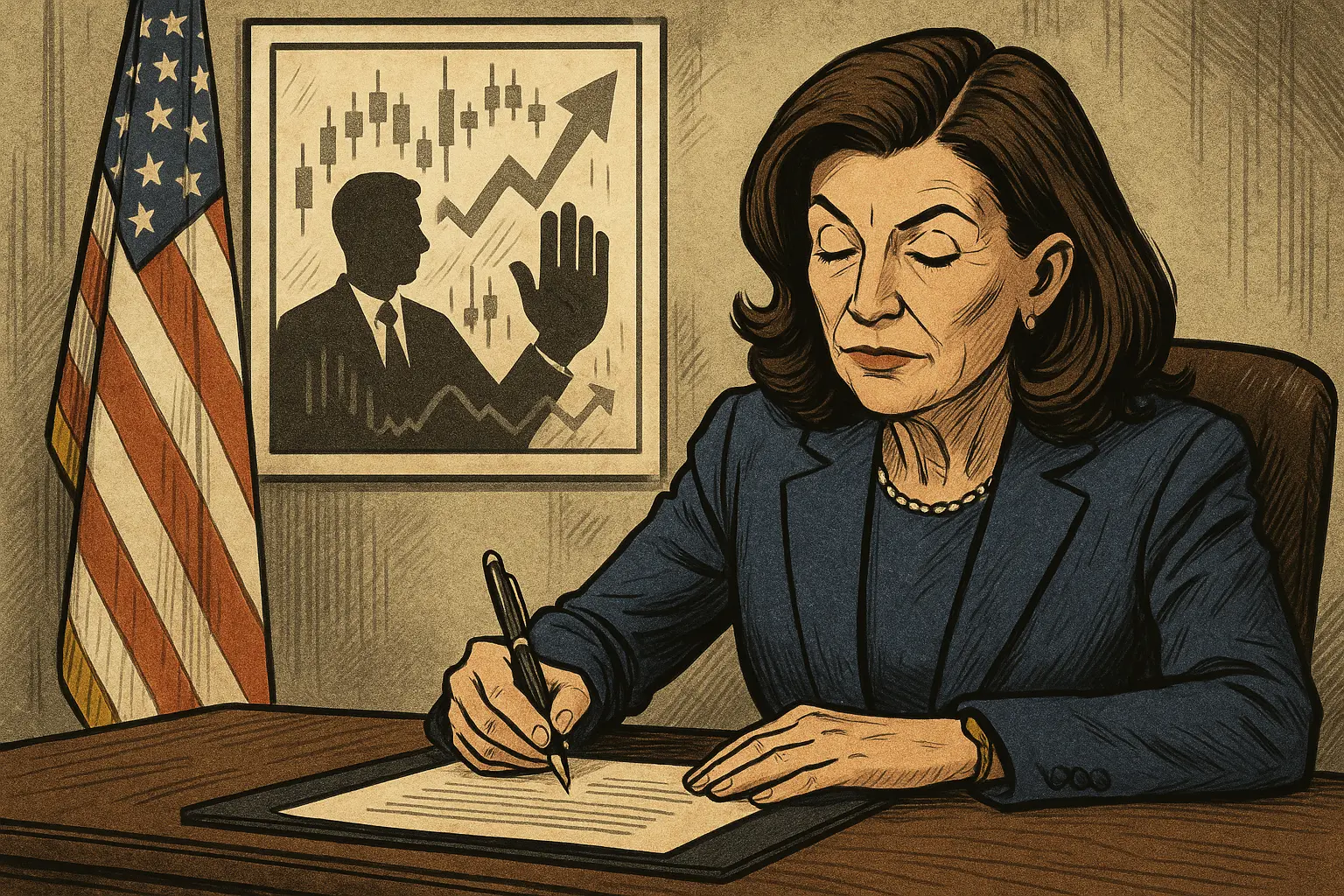
New York Governor Kathy Hochul signed an executive order on Wednesday, April 22, banning state officials and employees from placing bets on prediction markets using nonpublic information obtained through their positions, or assisting any third party in doing so. On the same day, prediction market platform Kalshi announced that it had completed an internal investigation into three political candidates who placed bets in their own campaign activities, and fined and suspended them.
Details of executive orders in New York and Illinois
Under an executive order signed by Governor Hochul on April 22, the prohibited parties include “any state agency officials or employees appointed by the governor or by any agency appointed by the governor, and any members of public bodies appointed by the governor.” The order bans the above individuals from profiting, avoiding losses, or assisting anyone else in doing so in prediction markets or similar services using nonpublic information obtained in the course of performing public duties.
On Tuesday, April 21, Illinois Governor JB Pritzker also issued a similar executive order barring state employees from using nonpublic information to place bets on prediction markets.
Kalshi’s internal investigation into three candidates
According to a statement released by the Kalshi platform on April 22, the company completed internal trading investigations into the following three political candidates, and fined and suspended them based on the fact that they placed bets in prediction market contracts related to their own campaign activities:
Matt Klein: the current state senator from Minnesota, running for a seat in the U.S. House of Representatives
Ezekiel Enriquez: previously ran for a seat in the Texas House of Representatives
Mark Moran: a Democratic candidate participating in the primary for a U.S. Senate seat in Virginia
In its statement, Kalshi said: “No matter the size of the trade, any political candidate who can affect the market by whether they are running violates our rules. Any trade found to have violated the exchange’s rules will be punished, no matter how small.”
On April 22, Moran publicly stated on the X platform that he placed a $100 bet in his own campaign contract, with the goal of drawing public attention to Kalshi’s platform rules, and cited it as saying: “I just want to get caught.”
Federal and state regulatory conflicts and legislative developments
According to a public statement from the chairman of the U.S. Commodity Futures Trading Commission (CFTC), Michael Selig, the CFTC has “exclusive jurisdiction” over prediction markets, and earlier this month filed lawsuits against Illinois, Arizona, and Connecticut, alleging that the three states closed “federally regulated designated contract markets.”
On Tuesday, April 21, New York State Attorney General Letitia James filed a lawsuit against Coinbase and Gemini over their prediction market operations, accusing the two companies of illegally offering betting services to users on events including sports games and election results, and characterizing the related services as “illegal gambling activities.”
In January of this year, a Polymarket account profited $400k from a contract related to the downfall of Venezuelan President Nicolás Maduro, triggering formal congressional attention to the use of insider information in prediction markets. After that, Democratic U.S. Representative Richie Torres introduced a draft bill proposing to ban federal elected officials, political appointees, and employees of the executive branch from placing bets in prediction market contracts involving “government policy, government actions, or political outcomes.”
Frequently Asked Questions
What is the scope of the ban under New York Governor’s executive order?
Under the executive order signed by Governor Hochul on April 22, the banned parties include state agency officials and employees appointed by the governor or by agencies appointed by the governor, as well as members of public bodies appointed by the governor. The order prohibits them from using nonpublic information obtained through their positions to profit in prediction markets or to assist others in profiting.
Which three candidates did Kalshi investigate in this case, and what were the reasons for the violations?
According to Kalshi’s April 22 statement, the three candidates investigated and punished were Matt Klein, Ezekiel Enriquez, and Mark Moran. The reason for the violations was that they placed bets in prediction market contracts related to their own campaign activities, violating Kalshi’s exchange rules.
Why are there legal conflicts between the CFTC and the states regarding regulation of prediction markets?
According to a public statement by CFTC Chairman Michael Selig, the CFTC argues that it has exclusive federal jurisdiction over prediction markets. It filed lawsuits in early April 2026 against Illinois, Arizona, and Connecticut, accusing the three states of illegally shutting down federally regulated designated contract markets.
Disclaimer: The information on this page may come from third parties and does not represent the views or opinions of Gate. The content displayed on this page is for reference only and does not constitute any financial, investment, or legal advice. Gate does not guarantee the accuracy or completeness of the information and shall not be liable for any losses arising from the use of this information. Virtual asset investments carry high risks and are subject to significant price volatility. You may lose all of your invested principal. Please fully understand the relevant risks and make prudent decisions based on your own financial situation and risk tolerance. For details, please refer to
Disclaimer.
Related Articles
SSRN Research Paper: Polymarket’s Pricing Accuracy Comes From 3.14% Informed Traders
According to academic paper published on SSRN on April 20, a research team from London Business School and Yale University analyzed Polymarket’s complete trading records and concluded that the platform’s pricing accuracy is mainly driven by 3.14% of informed traders, rather than the collective intelligence of all accounts. The study covers 98,906 events, 210,322 markets, involves 1.72 million accounts, and total trading volume reaches $13.76 billion.
MarketWhisper55m ago
Research reveals: Polymarket players take home 30% of profits by winning 3% of the positions—more than 70% of players absorb all losses
A new study analyzes Polymarket’s trading records from 2023–2025 and shows that only 3.14% of experienced winners control more than 30% of the profits. Crowd participation alone is not enough to explain overall accuracy; at the same time, it tracks 1,950 highly suspicious insider trading accounts that, while not driving predictions, amplified price volatility. The case shows that large bets were placed and profits were made before the U.S. announced developments regarding Venezuela. The research questions “wisdom of crowds” and emphasizes the need for increasingly strict regulation.
ChainNewsAbmedia2h ago
Polymarket Analysis: Crypto Events Account for 40% of Top 10 Most Volatile Markets
Gate News message, April 27 — Polysights, a third-party prediction market data platform, analyzed over 20,000 Polymarket markets from the past six months and released a volatility ranking. The analysis revealed that cryptocurrency-related markets account for four of the top ten most volatile markets
GateNews3h ago
Polymarket Announces April 28 Upgrade: Collateral Assets Migrated to pUSD, Trading Paused for About 1 Hour
According to an official announcement posted on X on April 27 by Polymarket developers, Polymarket will roll out a full platform infrastructure upgrade at 11:00 UTC on April 28, with trading paused for about 1 hour. This upgrade includes new generation trading contracts, a rebuilt order book, and the introduction of a new collateral token, pUSD. The platform’s existing collateral assets will be migrated from USDC.e to pUSD.
MarketWhisper3h ago
Polymarket Non-Sports Volume Reaches $7.5B vs. Kalshi's $1.6B, Says Blockchain Capital Partner
Gate News message, April 27 — According to Spencer Bogart, a partner at Blockchain Capital, Kalshi and Polymarket have nearly identical total trading volumes of approximately $12.2 billion each (Kalshi at $12.29 billion, Polymarket at $12.22 billion). However, when sports-related trades are
GateNews4h ago


