
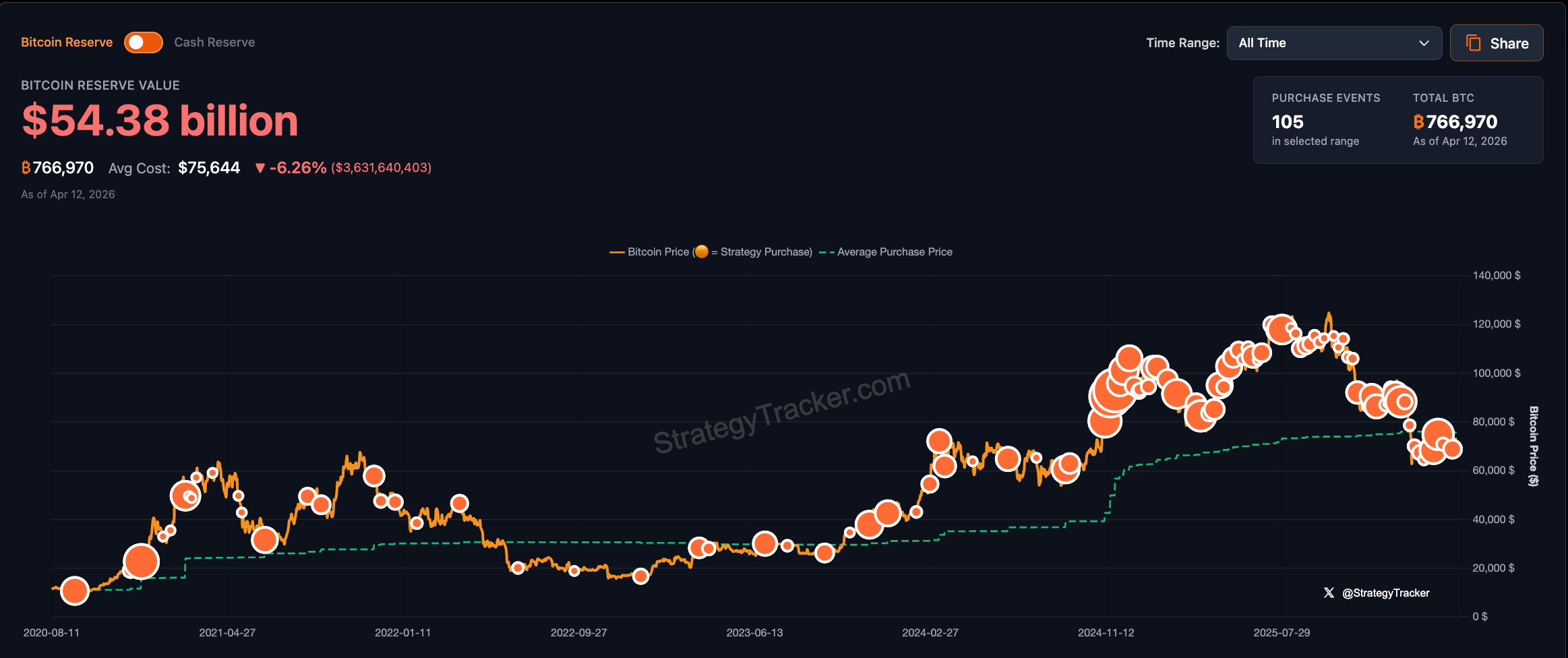
Bitcoin treasury management firm Strategy co-founder Michael Saylor shared on Sunday on the X platform the company’s chart showing its Bitcoin purchase history, captioning it, “Look to the future.” This move has repeatedly become an industry signal that Strategy is about to buy more Bitcoin. Strategy’s Q1 2026 report shows the company’s Bitcoin holdings are showing an unrealized book loss of nearly $14.5 billion.
Chart signal: the buy-more pattern in Sunday’s post
 (Source: StrategyTracker)
In the crypto market, when Saylor publishes a cumulative chart of Bitcoin purchases on Sundays, it has often appeared ahead of the subsequent week’s SEC 8-K filings disclosing another round of large-scale Bitcoin buying, forming the industry-wide, recognized “chart signal.” This chart post was released right after Bitcoin began to pull back from this week’s local highs above $73,000, closely aligning with Strategy’s consistent “add on dips” approach.
Snapshot of Strategy’s Bitcoin holdings
Based on the latest public data, Strategy’s Bitcoin holdings are as follows:
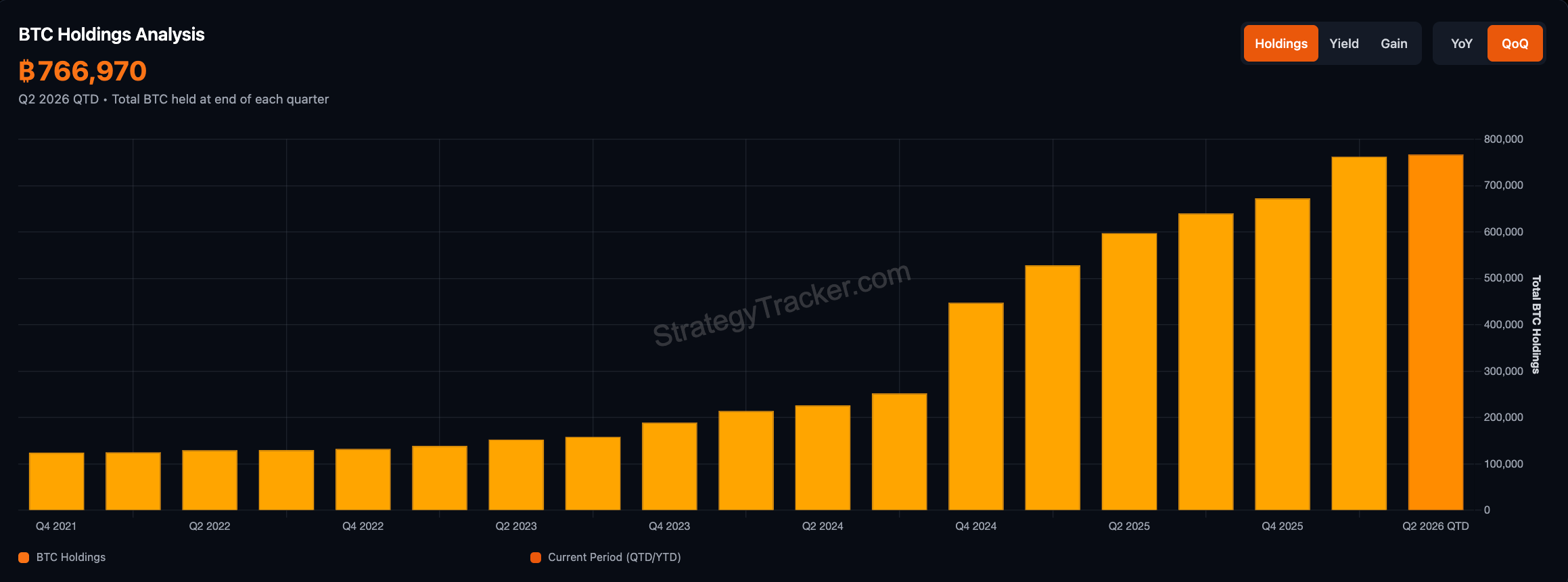
Total holdings: 766,970 BTC, worth approximately $54.5 billion based on the current market price, the #1 corporate Bitcoin holding globally
Average holding cost: $75,644 per coin (the current market price is about $5,000 lower than that)
Q1 2026 book loss: Bitcoin holding losses reported to the SEC of nearly $14.5 billion
Cumulative transaction record: completed 105 Bitcoin transactions since 2020
Industry ranking: with 766,970 BTC, Strategy remains #1 globally for corporate Bitcoin holdings, far exceeding Twenty One Capital (43,514 BTC), which ranks second
The core logic behind adding more despite book losses
 (Source: StrategyTracker)
With a book loss of nearly $14.5 billion yet still continuing to add, Strategy’s strategy has remained controversial in the market. In April of this year, Saylor clearly said: “The global consensus is that Bitcoin is digital capital. The four-year cycle is over. The current price is driven by capital flows. Banks and digital credit will determine Bitcoin’s growth trajectory.”
The essence of this claim is that Bitcoin has evolved from a retail, cyclical speculative asset into a digital reserve for long-term allocation by institutional capital. In the short term, unrealized book losses are simply the holding cost of a long-term positioning. The data also supports this strategy’s scale effects—In March 2026, miners produced about 16,200 new Bitcoins, while Strategy accumulated 46,233 BTC in the same period. The rate of accumulating coins is almost three times the amount of newly mined supply. Some analysts predict this could create structural tension on Bitcoin’s supply side.
Industry comparison: MARA sells vs. Strategy continues to add
While Strategy continues to add, MARA Holdings—another Bitcoin reserve company—chose the opposite action in March 2026: it sold 15,133 BTC, raised about $1.1 billion in cash, and repurchased $1.0 billion worth of zero-coupon convertible bonds at a discount, aiming to enhance financial flexibility and expand into digital energy and AI high-performance computing operations.
MARA’s sell-off and Strategy’s increase highlight the divergence of corporate-level paths for Bitcoin strategies: some companies choose to retain liquidity during pullbacks, while others continue to bet on long-term appreciation.
Frequently asked questions
Why is Michael Saylor’s Sunday chart post seen as a Bitcoin-buy signal?
Based on historical patterns, whenever Saylor shares a post containing Strategy’s cumulative Bitcoin purchase chart on Sunday, a new round of Bitcoin-buying disclosures in SEC 8-K filings typically appears the following week. This pattern has been repeated many times, leading the industry to view it as a precursor signal that he is about to increase his Bitcoin holdings.
Why does Strategy keep buying Bitcoin despite a book loss of $14.5 billion?
Saylor’s core logic is that Bitcoin has become a digital reserve asset for long-term institutional capital allocation. Its price is no longer dominated by four-year cycles; instead, it is determined by capital flows. Under this framework, short-term unrealized book losses are viewed as the holding cost of a long-term strategy rather than a signal of investment failure.
How much Bitcoin does Strategy currently hold, and what is its average cost?
As of the latest data, Strategy holds 766,970 BTC, with an average holding cost of $75,644 per coin. It is the corporate Bitcoin reserve institution with the largest holdings globally, far exceeding the 43,514 BTC held by the #2 ranked Twenty One Capital.
Disclaimer: The information on this page may come from third parties and does not represent the views or opinions of Gate. The content displayed on this page is for reference only and does not constitute any financial, investment, or legal advice. Gate does not guarantee the accuracy or completeness of the information and shall not be liable for any losses arising from the use of this information. Virtual asset investments carry high risks and are subject to significant price volatility. You may lose all of your invested principal. Please fully understand the relevant risks and make prudent decisions based on your own financial situation and risk tolerance. For details, please refer to
Disclaimer.


