
MicroStrategy (Strategy) Chairman Michael Saylor recently disclosed a key financial metric on social media: the company’s Bitcoin (BTC) reserves only need to achieve about 2.05% annualized growth to pay all preferred stock dividends indefinitely, without issuing any new common shares. This threshold is far lower than Bitcoin’s historical annualized return, drawing widespread attention from cryptocurrency investors.
BTC Break-Even Point: What Does 2.05% Mean?
MicroStrategy’s “Bitcoin break-even annualized return” measures the minimum annualized appreciation rate that the company’s existing BTC reserves would need to reach so that, without relying on any additional financing, it can permanently cover all preferred stock dividend obligations. In his post, Saylor directly explained: “Our Bitcoin profit and loss break-even annualized return is about 2.05%. If Bitcoin’s growth rate exceeds this level over time, we can pay dividends indefinitely without issuing new $MSTR shares.”
This 2.05% threshold is far below Bitcoin’s long-term annualized return over the past decade, and is the core basis MicroStrategy is using to signal financial sustainability to the market.
The Real Math Behind 766,970 BTC
 (Source: StrategyTracker)
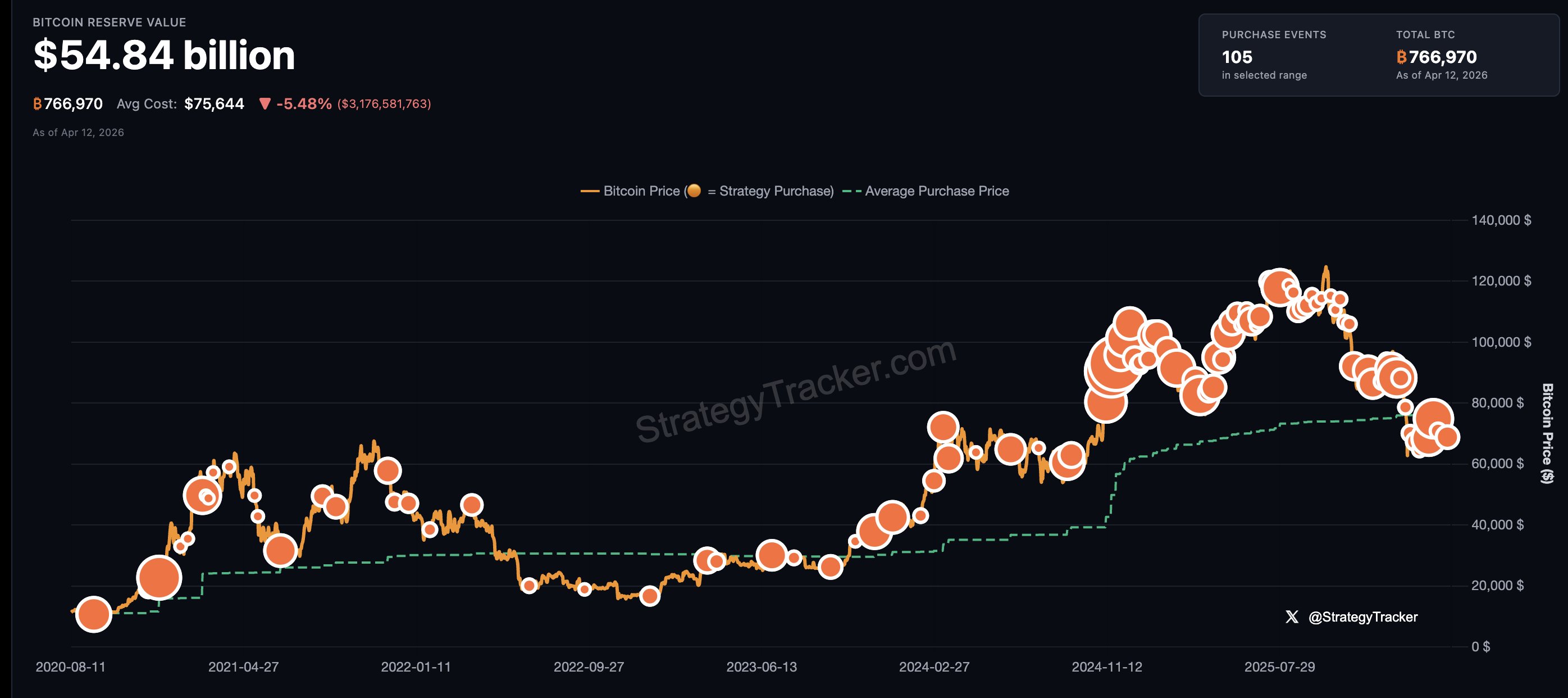
Based on the latest publicly available data from MicroStrategy’s dashboard, the current holdings are as follows:
Total holdings: 766,970 Bitcoins
Average purchase cost: about $75,648 per coin
Total holdings market value: close to $54.58 to $58 billion
Current dividend coverage ratio: about 48.7 years based on current reserve levels
Even if Bitcoin only achieves modest growth over the coming decades, MicroStrategy’s existing position appreciation would be enough to cover preferred stock dividends, and it can continue accumulating Bitcoin without relying on additional equity financing to dilute existing shareholders.
STRC Preferred Stock Mechanism: How Dividends Work
 (Source: Michael Saylor X)
STRC is a variable-rate Series A perpetual preferred stock issued by MicroStrategy. Its current annual yield is 11.5%, and it trades around a par value of $100, paying cash dividends every month. The key point is this: the proceeds from STRC issuance are directly used to buy more Bitcoin, creating a self-reinforcing capital cycle—by expanding Bitcoin holdings through preferred stock financing, Bitcoin appreciation in turn covers preferred stock dividends, and the entire process does not dilute common stock.
A lower break-even point indicates that even if Bitcoin maintains modest long-term growth, MicroStrategy’s reserve funds can generate sufficient appreciation to continue supporting ongoing accumulation while paying high-yield preferred stock dividends.
Frequently Asked Questions
How is MicroStrategy’s Bitcoin break-even annualized return calculated?
This metric measures the minimum annualized appreciation that the company’s existing Bitcoin reserves would need in order to sufficiently cover the dividend obligations of all preferred stocks (including the STRC series), without issuing any new common shares. A 2.05% threshold means Bitcoin only needs to maintain very conservative annualized growth to permanently support MicroStrategy’s dividend plan.
Why did the “Think ₿igger” post from Saylor on Sunday draw market attention?
According to historical patterns, posts Michael Saylor publishes on Sundays are typically submitted to the SEC as an 8-K filing on Monday first, and that filing discloses MicroStrategy’s next round of large Bitcoin purchases. Therefore, the “Think ₿igger” post is widely interpreted by the market as a precursor to Monday’s Bitcoin-buy announcement.
What is MicroStrategy’s STRC preferred stock?
STRC is a variable-rate Series A perpetual preferred stock issued by MicroStrategy. Its current annual yield is 11.5%, and it trades around a par value of $100, paying cash dividends every month. The proceeds from STRC issuance are directly used to buy more Bitcoin—this is the core tool of MicroStrategy’s strategy to drive Bitcoin accumulation through preferred stock financing.
Disclaimer: The information on this page may come from third parties and does not represent the views or opinions of Gate. The content displayed on this page is for reference only and does not constitute any financial, investment, or legal advice. Gate does not guarantee the accuracy or completeness of the information and shall not be liable for any losses arising from the use of this information. Virtual asset investments carry high risks and are subject to significant price volatility. You may lose all of your invested principal. Please fully understand the relevant risks and make prudent decisions based on your own financial situation and risk tolerance. For details, please refer to
Disclaimer.
Related Articles
U.S. stock market opens with broad declines in the crypto sector, Strategy down 2.01%
On April 13, U.S. stocks opened lower: the Dow Jones fell 0.5%, the S&P 500 fell 0.22%, and the Nasdaq fell 0.26%. Crypto-related stocks were broadly down, with one CEX down 1.66% and Robinhood down 1.65%. msx.com is a decentralized RWA trading platform that has already launched multiple U.S. stock and ETF tokens.
GateNews12m ago
Exodus, the Nasdaq-listed Bitcoin treasury company, sues the W3C to demand enforcement of the acquisition agreement
U.S.-listed Bitcoin custody company Exodus Movement filed a lawsuit in Delaware state court on April 13, seeking W3C Corp and its CEO to carry out the 2025 share acquisition agreement and to speed up the completion of the transaction. Exodus has received approval from the UK’s financial regulator and plans to drive the acquisition forward through litigation and the enforcement of security interests.
GateNews41m ago
Bitcoin retreats to $71k, spot ETF net inflows of nearly $1 billion last week
Bitcoin and Ethereum prices were holding steady around April 13, and the overall crypto market weakened. Oil prices rebounded, influenced by the situation in the Middle East. Bitcoin ETF funds worth nearly $1 billion flowed in, but addresses still in unrealized losses remain in the majority, and open interest in futures contracts fell significantly.
GateNews44m ago
TradFi Rise Alert: CLS (Celestica Inc) Rises Over 6%
Gate News: According to the latest Gate TradFi data, CLS (Celestica Inc) has surged by 6% in a short period. Current volatility is significantly higher than recent averages, indicating increased market
GateNews44m ago
Empery Digital reduced its holding by 55 BTC last week, bringing its total Bitcoin holdings down to 2,934 BTC
Empery Digital disclosed that it sold 55 Bitcoins at an average price of $70,560, generating approximately $3.9 million in proceeds, bringing its holdings down to 2,934 Bitcoins. The company has repurchased about $147 million worth of shares and plans to continue selling Bitcoins to fund future repurchases and repay part of its debt.
GateNews1h ago
Can bypassing Financial Supervisory Commission regulations for buying crypto with credit cards be possible? OdenDing pushes a Wallet Pro crypto-purchase service with U.S. debit cards
OdinTing launches OwlPay and Wallet Pro services, focusing on B2B cross-border payments. By combining stablecoin technology with international financial systems, it showcases its fintech transformation. Through a partnership with MoneyGram, Wallet Pro enables cross-border transfers of stablecoins purchased with cash and operates in the U.S. market. The company’s offshore model bypasses Taiwan’s strict regulation and challenges the competitive landscape under the new draft law, which will in the future affect local players’ compliance strategies.
CryptoCity1h ago


