Source: Axis
Axis Robotics is reconstructing embodied intelligence data diversity and scalable production methods with a Simulation-First strategy.
By 2025, multiple technological paths in the robotics industry are rapidly converging: the commercialization upgrade of embodied hardware supply chains makes large-scale deployment of previously expensive prototypes possible; vision-language-action (VLA) models give robots a “brain” for understanding semantics, reasoning, and planning; and a multi-layer data pyramid—from video priors to simulation synthesis—is continuously fueling the evolution of embodied intelligence.
However, the industry still faces a core bottleneck: data. Compared to large language models and autonomous driving, embodied intelligence still has a significant data gap during pretraining. To address this, the industry is advancing along multiple routes: large-scale operation data from UMI, natural interaction data from first-person (Ego-Centric) videos, and rapidly developing simulation synthesis data systems. Against this backdrop of evolving data sources, academia and industry are forming a new technical consensus: Pretraining with high-quality, large-scale simulation data, followed by fine-tuning with a small amount of real-world data, is one of the most feasible approaches today.
But this consensus also raises higher requirements—simulation data must be high quality, low cost, and scalable; otherwise, the dual challenge of high real-world data costs and insufficient simulation quality will continue to slow model training iterations.
So, is the “GPT moment” for embodied intelligence already approaching?
Axis’s answer is yes—provided that we thoroughly reshape the scalable production of robot data and redefine deployment paradigms in the physical world.
Axis Robotics Enables Ordinary People to Participate in Embodied Intelligence Data Collection
Traditional robot data collection relies on small expert teams or local remote operation, which are hard to scale and lack sufficient diversity. To break this bottleneck, Axis adopts a Simulation-First strategy, building an end-to-end embodied intelligence data infrastructure, and significantly enhancing data production through distributed human collaboration. Robots serve humans and are continuously built and evolved through large-scale human participation.
From its inception, Axis recognized that providing data alone is not enough. To truly solve the embodied intelligence data dilemma, a comprehensive end-to-end technical pipeline covering key stages must be built. The three most critical stages are: task generation, data collection, and data evaluation & processing:
- Task Generation: An infinitely scalable dynamic task engine
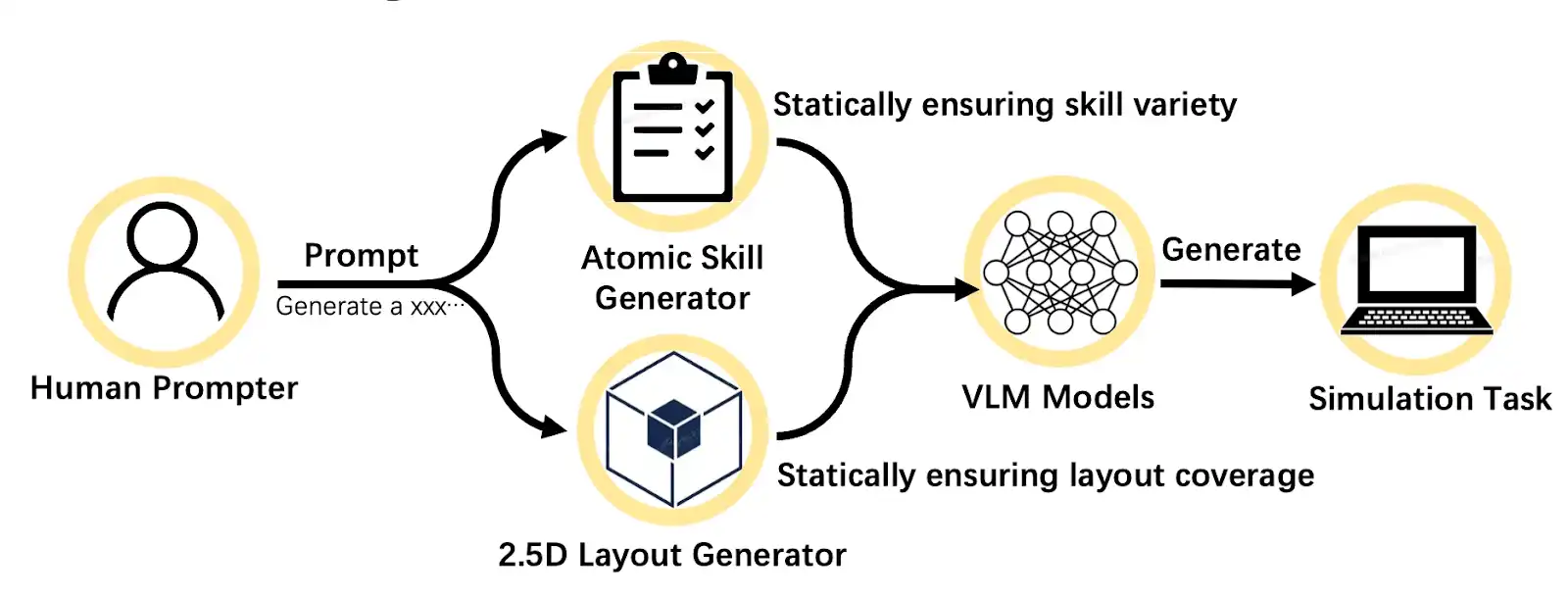
The boundary of data defines the boundary of robot capability. Axis has developed a new generation of 3D dynamic task generation engine, which decomposes essential robot skills into atomic skills and can generate vast amounts of high-quality simulation tasks via prompts. From single scenes to complex chained tasks, robots can continuously evolve within an infinitely rich task space.
- Data Collection: A zero-threshold platform accessible to everyone
Axis brings complex simulation environments, once only operable in professional labs, to browsers and mobile devices. Users can control robots and robotic arms in real-time, generating valuable data trajectories as easily as playing a game. No hardware burden, no technical barriers—data production is now truly “open anytime, anywhere, for everyone.”
- Data Evaluation and Processing: Making each data point “usable, trainable, and scalable”
Every data trajectory undergoes automated evaluation by Axis’s proprietary system, assessing completeness, stability, validity, and smoothness across multiple dimensions. The system filters and processes data to produce assets ready for model training. High quality no longer depends on manual screening but is achieved through systematic, scalable production.
Behind this comprehensive product capability, Axis has built a robust foundational platform. MetaSim, our unified core designed specifically for embodied intelligence, handles simulation decoupling, data validation, and augmentation, serving as the central engine for the entire data pipeline. Leveraging MetaSim, large volumes of human demonstration trajectories generated in lightweight web simulators can be seamlessly reproduced in NVIDIA Isaac Sim for high-precision validation. Simultaneously, Axis deeply utilizes Isaac Sim’s powerful physics and graphics engines for high-fidelity rendering and large-scale domain randomization. This key enhancement amplifies the value of data in Sim-to-Real transfer and robust model training, enabling each data point to significantly improve generalization and practical utility in the real world.
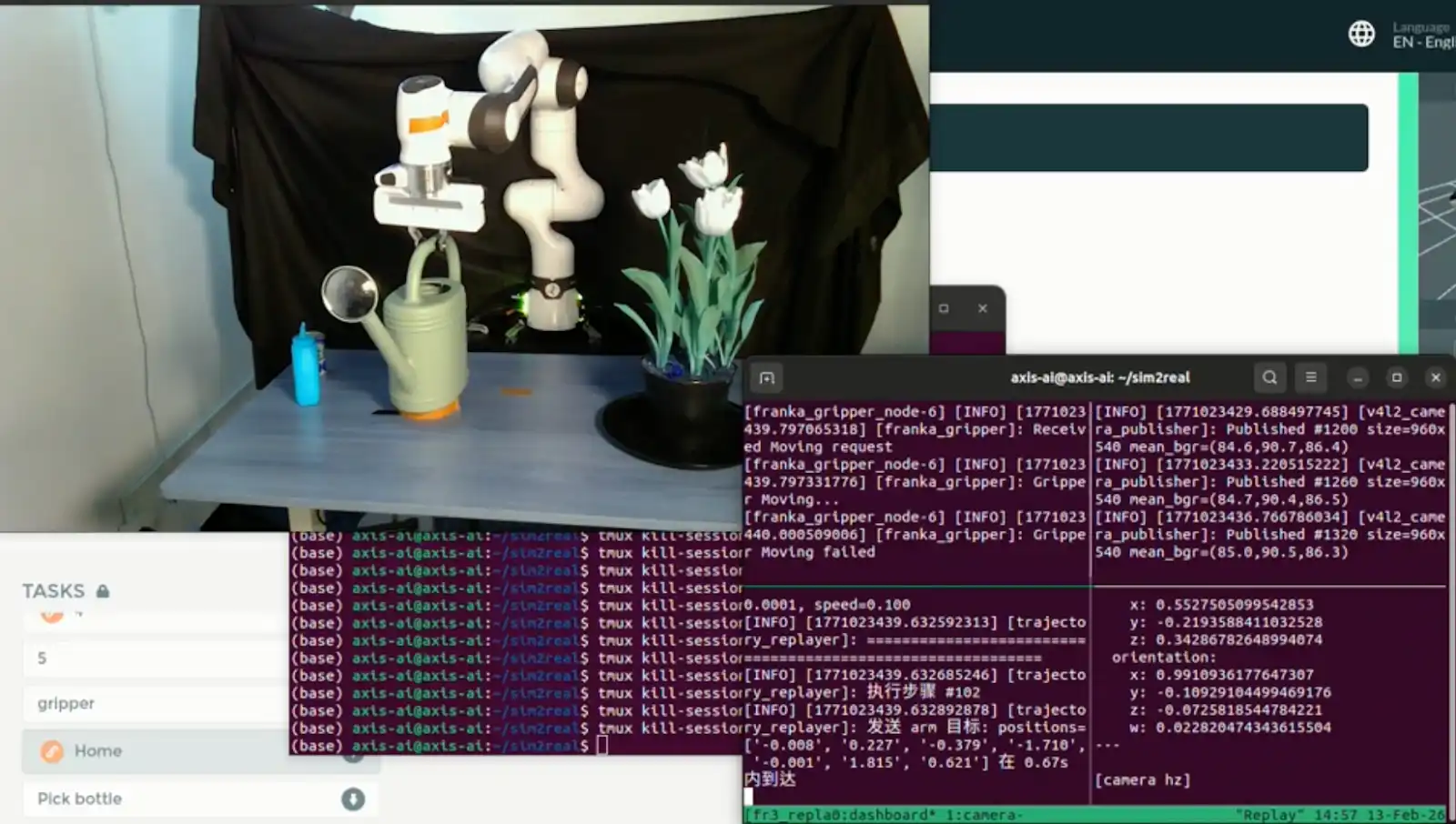 (Raw data collected via web, enhanced, and successfully used for training and real-world deployment)
Meanwhile, only with effective incentive and diffusion mechanisms can this comprehensive infrastructure and product system truly take root and benefit a broader community. This is the unique value of crypto. Axis aims to build a decentralized incentive and distribution network based on crypto, enabling ordinary users worldwide to participate in the construction of embodied intelligence in a distributed manner.
Through this network, contributions of data, task execution, and incentive feedback will be fully transparent, traceable, and verifiable; more importantly, it opens new possibilities for assetizing data collection tasks and trajectory data—each participation can be transformed into part of the value flow within the embodied intelligence ecosystem.
Axis has validated the real effectiveness of its data collection trajectories in model training through a complete end-to-end data pipeline
In the “Little Prince’s Rose” event, the team collected over 10,000 high-quality trajectories from the community in just three days. After replay validation and data smoothing enhancements, all trajectories were directly used for policy training and successfully deployed on Franka robotic arms to autonomously water plants.
This milestone demonstrates Axis’s zero-shot Sim-to-Real transfer capability and first proves that: Web-based large-scale crowdsourced remote simulation operation can generate high-value data suitable for training embodied intelligence models.
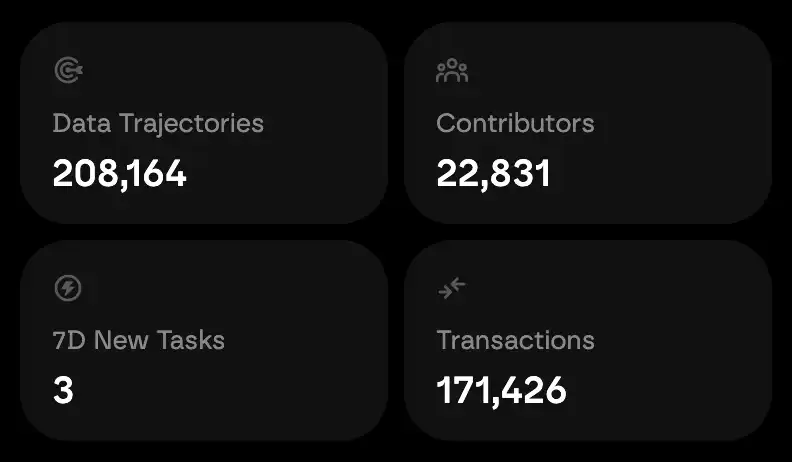
The community shows high enthusiasm for Axis’s “playable + challenging” product experience. Over two testing rounds totaling 15 days, more than 20,000 users participated, generating over 170,000 data trajectories, all publicly viewable on the product’s real-time data dashboard.
Axis Robotics’ Mission: Promoting the True Democratization of Embodied Intelligence
Axis believes that just as robots will serve everyone’s daily life in the future, ordinary people should also have the right to participate in building the next generation of robots. The core value Axis delivers to the market is built on two pillars:
- High-Quality Robot Simulation Datasets for Pretraining
Axis is providing meaningful data inputs for general robot foundational models. “High quality” means not just scale, but also high diversity of task types, rich scene layouts, and multimodal data structures. Axis’s goal is not merely to generate large amounts of data but to redefine industry standards—what kind of data can be directly used for pretraining and truly push forward academic and industrial frontiers in robotics.
- Scalable Infrastructure Stack
Beyond data, Axis is building a low-threshold, flexible, and long-term scalable technical infrastructure, rethinking its openness with an ecosystem approach. Our vision is to make this infrastructure not just for Axis’s own use but open to more participants, jointly building the embodied intelligence ecosystem.
In the future, we will gradually open core interfaces such as task construction, data collection, data processing, and model training, allowing developers, research institutions, and enterprises to participate in a plug-and-play, composable manner. Without sacrificing technical rigor, this open ecosystem will support large-scale inclusive participation and high-quality model output, transforming embodied intelligence development from a closed process to genuine open collaboration.
Axis is establishing broad ecosystem collaborations with manufacturing, robot hardware manufacturers, and model companies, including Lotus Auto, Booster Robotics, Qunhe Technology, YuanDian Intelligence, among others, to advance data production, model training, and deployment.
For example, for embodied robot companies urgently needing scalable teleoperation data, Axis will convert their physical robots into high-fidelity digital twins, and build sim-ready scene layouts and task assets through dynamic task generation pipelines. Then, via Axis’s distributed task dispatch system, users worldwide can directly operate these digital twins in browsers, contributing diverse, high-quality trajectories, enabling data production and business collaboration in a standardized, low-cost manner.
As robot hardware supply chains mature and manufacturing costs drop significantly, the value focus of the embodied intelligence industry is shifting from hardware shells to underlying AI models and data infrastructure. In the future trillion-dollar embodied intelligence market, data and AI algorithms are expected to account for about 10% of core industry value. In this emerging data economy, with improved physics engine accuracy and widespread domain randomization, simulation data is shifting from auxiliary tools to core production factors, growing into a potential hundred-billion-dollar infrastructure track.
Faced with this imminent market explosion, Axis Robotics is transforming traditional “expensive, centralized, asset-heavy” simulation remote operation modes into an exponentially scalable global data network through lightweight web access and distributed task mechanisms.
By drastically reducing marginal data production costs and increasing high-concurrency trajectory collection capacity, Axis not only provides efficient, scalable data solutions for industry partners but also forms a business model with strong growth potential, broad revenue space, and replicability in the rapidly expanding embodied intelligence data market.
Looking Ahead: Toward the “GPT Moment” of Embodied Intelligence
The “GPT moment” for embodied intelligence requires a core engine capable of capturing human intelligence and reliably converting it into verifiable machine-executable capabilities. With the official launch of Base Chain, Axis is deploying such a future-oriented distributed infrastructure—a resilient, scalable open network capable of supporting global collaboration.
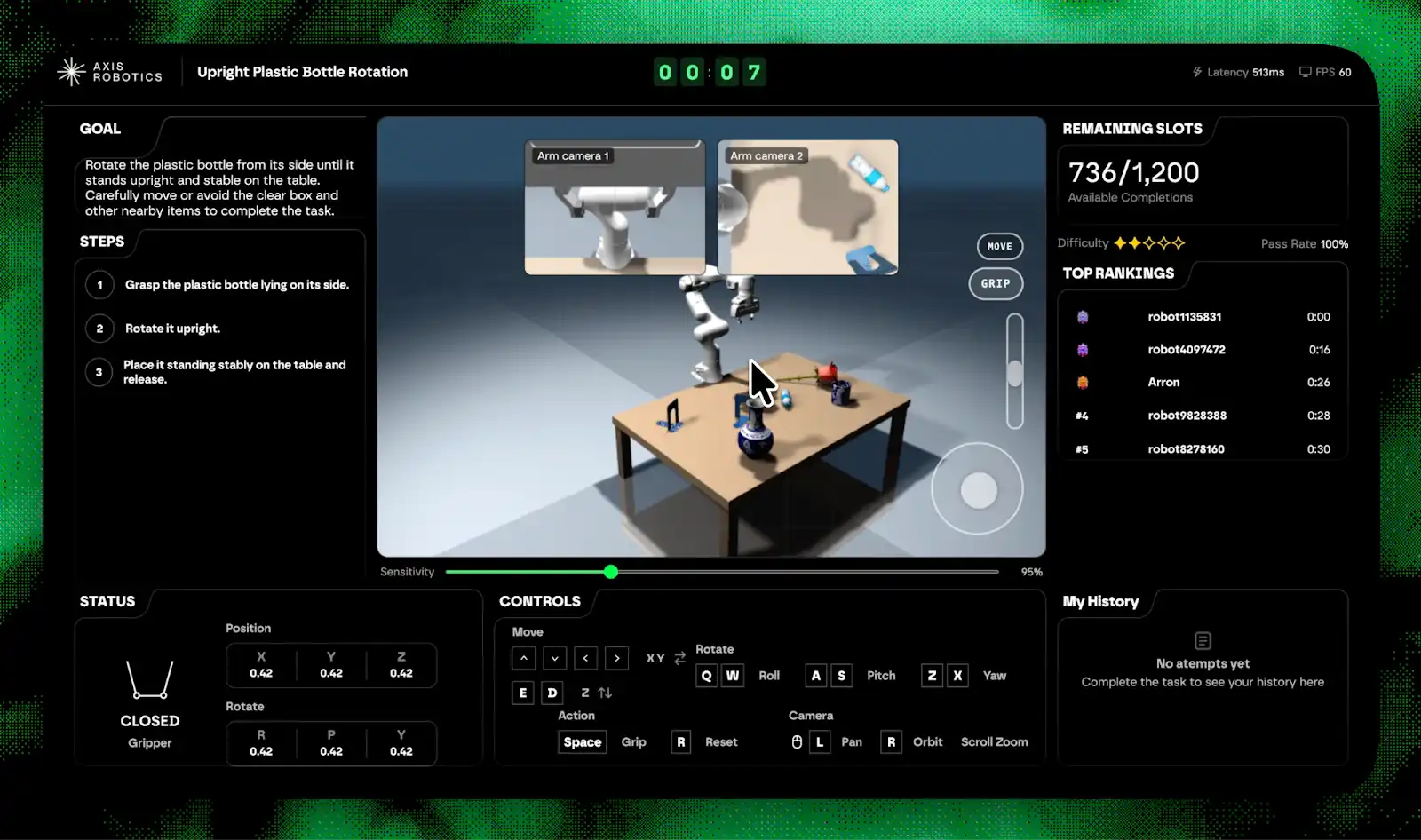
On March 25, Axis’s main product was officially launched and opened to everyone: ordinary users, researchers, developers, and AI labs worldwide can join this ecosystem to collaboratively build the largest and most diverse robot training dataset in history.
Embodied intelligence will not be monopolized by a few; it will be created by everyone.
This article is from submissions and does not represent BlockBeats’ views.
Click to learn about job openings at Rhythm BlockBeats
Join the official Rhythm BlockBeats community:
Telegram Subscription Group: https://t.me/theblockbeats
Telegram Community: https://t.me/BlockBeats_App
Twitter Official Account: https://twitter.com/BlockBeatsAsia


