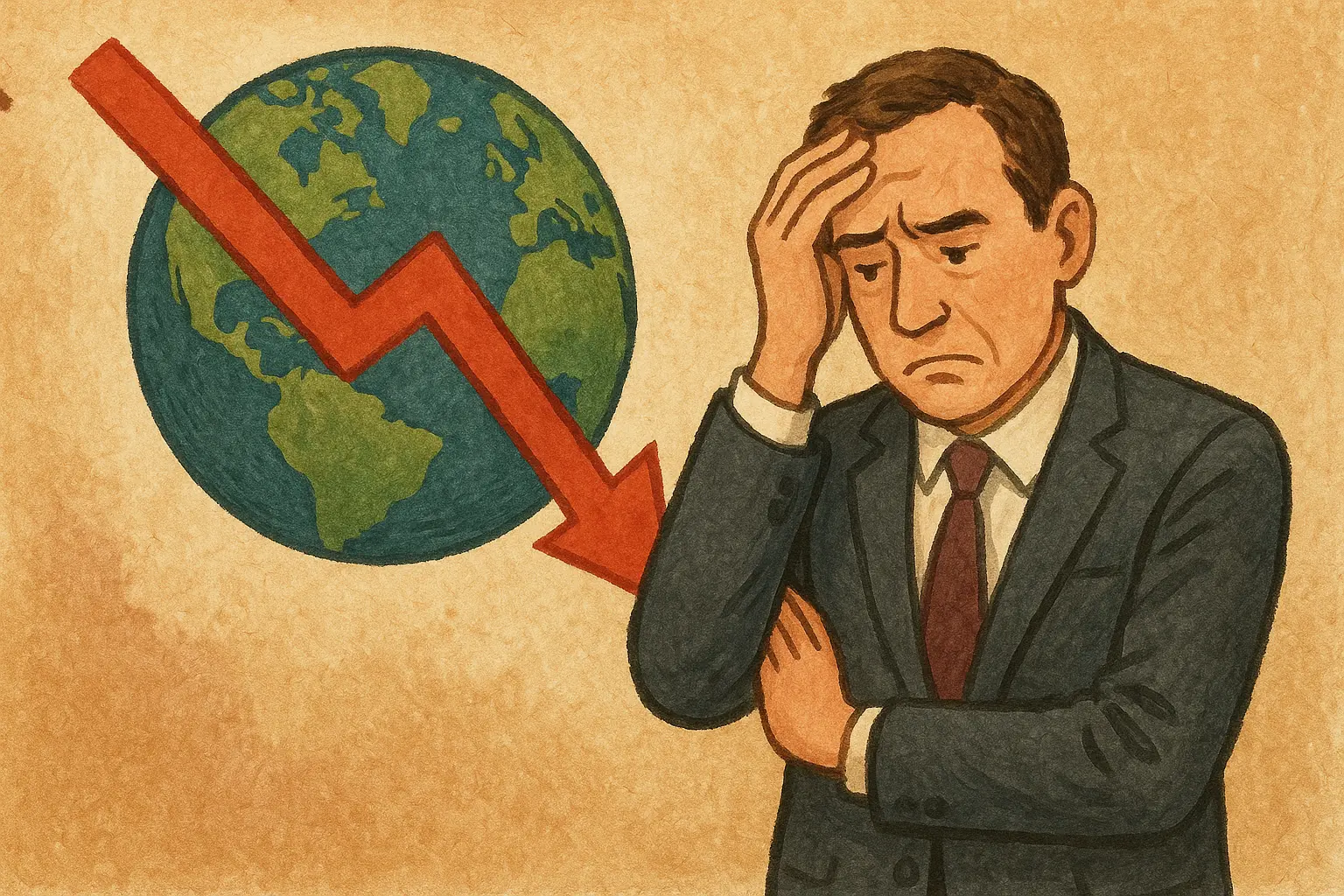
In the World Economic Outlook released by the International Monetary Fund (IMF) in April 2026, the IMF lowered its forecast for global economic growth in 2026 to 3.1%, which is 0.2 percentage points lower than the forecast for 2026 made in January 2026, and raised its forecast for global overall inflation in 2026 to 4.4%. The IMF said in its report that this downward revision mainly reflects economic instability caused by the ongoing conflict in the Middle East.
Data on Revisions to Growth and Inflation Forecasts
According to the IMF’s April 2026 World Economic Outlook, the key forecast revisions are as follows:
Global economic growth in 2026: 3.1%, down 0.2 percentage points from the January 2026 forecast
Global overall inflation in 2026: 4.4% (slight upward adjustment)
Global overall inflation in 2027: 3.7% (continuing the downward trend)
Global economic growth in 2027: The IMF said it is consistent with the updated forecast from the January 2026 World Economic Outlook
The IMF explained that this World Economic Outlook uses a “reference forecast” rather than the traditional “baseline forecast,” reflecting the difficulty of building stable assumptions in an environment of ongoing uncertainty.
Differentiated Impacts on Emerging Markets and Advanced Economies
According to the IMF report, the growth forecast for emerging markets in 2026 was revised downward by 0.3 percentage points, exceeding the adjustment magnitude for the global average (0.2 percentage points); the forecast for advanced economies remained basically unchanged.
The IMF report quotes directly as follows: “What is crucial is that the reference forecast shows a high degree of cross-country variation. While the magnitude of growth and inflation revisions at the global level appears relatively small, the impact on conflict-affected regions and other more vulnerable economies—especially those emerging markets and developing economies that already have vulnerabilities in their imports of major commodities—will be far more pronounced.”
Downside Risk Scenarios Listed by the IMF
According to the IMF report, if energy prices rise by a larger amount and persist for a longer period, global growth in 2026 could slow to 2.5% and inflation could climb to 5.4%. If the Middle East conflict further worsens (especially if energy infrastructure is damaged), global growth in 2027 could slow to about 2% and inflation could exceed 6%; under the above scenario, the impact on emerging markets and developing economies is expected to reach about twice that on advanced economies.
Frequently Asked Questions
How much did the IMF adjust its global growth forecast in April 2026 to?
According to the IMF’s April 2026 World Economic Outlook, the 2026 global economic growth forecast is 3.1%, down 0.2 percentage points from the forecast for January 2026; the IMF said the main reason is economic instability caused by the ongoing conflict in the Middle East.
What is the IMF’s latest forecast for global inflation in 2026?
According to the IMF’s World Economic Outlook in April, the 2026 forecast for global overall inflation is 4.4% (slight upward adjustment), and the 2027 forecast is 3.7% (continuing the downward trend).
Does the revision downward to the growth forecast for emerging markets exceed the global average?
According to the IMF report, the growth forecast for emerging markets in 2026 was revised downward by 0.3 percentage points, exceeding the adjustment magnitude for the global average (0.2 percentage points); the forecast for advanced economies remained basically unchanged.
Disclaimer: The information on this page may come from third parties and does not represent the views or opinions of Gate. The content displayed on this page is for reference only and does not constitute any financial, investment, or legal advice. Gate does not guarantee the accuracy or completeness of the information and shall not be liable for any losses arising from the use of this information. Virtual asset investments carry high risks and are subject to significant price volatility. You may lose all of your invested principal. Please fully understand the relevant risks and make prudent decisions based on your own financial situation and risk tolerance. For details, please refer to
Disclaimer.
Related Articles
Cross-Asset Hedging Emerges as Mainstream Strategy, Q1 Report Shows
A report by Block Scholes reveals rising correlations between crypto assets and traditional markets, noting increased demand for unified trading platforms as traders manage diverse assets. Trading volumes have surged, reflecting a shift towards multi-asset strategies.
GateNews40m ago
Hong Kong Stocks Open Mixed: Hang Seng Index Up 0.17%, Tech Index Rises 0.34%
Hong Kong stocks rose on April 20, with the Hang Seng Index up 0.17%. Oriental Securities jumped 13.53% after announcing plans to acquire Shanghai Securities. Other notable gainers included Cambridge Technology and Blue Focus Technology, while Long-light Semiconductor and Sige New Energy saw declines.
GateNews9h ago
TradFi Rise Alert: VIX (VIX) Rises Over 1.5%
Gate News: According to the latest Gate TradFi data, VIX (VIX) has surged by 1.5% in a short period. Current volatility is significantly higher than recent averages, indicating increased market activity.
GateNews9h ago
The Big Seven is leading U.S. stocks to new highs again—after the valuation reset, has the P/E ratio already fallen back to a reasonable level?
U.S. stocks hit another record high as large technology shares rebounded strongly, and the S&P 500 index showed resilience despite geopolitical and inflationary pressures. The market capitalization of the “Magnificent Seven” tech giants rose again, bringing their price-to-earnings ratios back down to reasonable levels. Profit growth expectations look favorable for the future. However, for the AI sector’s high capital expenditures, the market is still taking a wait-and-see approach, focusing on investment returns.
ChainNewsAbmedia12h ago
Iran War Stagflation Risks Tested by Global PMI Data
Seven weeks of Middle East conflict are expected to reveal their economic impact through a second round of purchasing manager indexes and inflation data from multiple countries in the week of April 20–24, 2024. The International Monetary Fund warned of potential near-recession risks, with IMF
CryptoFrontier19h ago
China Q1 2026 GDP up 5% year-over-year: Held the policy targets amid the impact of the Iran war; high-end manufacturing grew 12.5% year-over-year to carry the growth rate
China’s GDP grew 5% year over year in the first quarter of 2026, showing that it is still holding steady and making progress toward its policy goals under external pressure. High-tech and equipment manufacturing industries became the main drivers of growth, with year-over-year increases of 12.5% and 8.9%, respectively. Total imports and exports rose 15% year over year, demonstrating resilience. This data is also a bargaining chip for the upcoming Trump-Xi summit negotiations, which could affect the crypto market and Taiwan’s supply chain.
ChainNewsAbmedia04-19 09:55


