
According to the latest data from CryptoQuant, Ethereum’s staking rate in March has exceeded 31.1%, reaching a new all-time high. Meanwhile, ETH reserves on centralized exchanges have fallen to a historic low. This dual structural compression—“high staking rate plus low exchange reserves”—is creating a rare tightening of circulating supply in the crypto market. Institutions such as BlackRock and Grayscale are accelerating ETH locking through various methods.
Overview of Major Institutional Ethereum Staking
(Source: Arkham)
Several institutions have recently demonstrated significant and sustained staking activity:
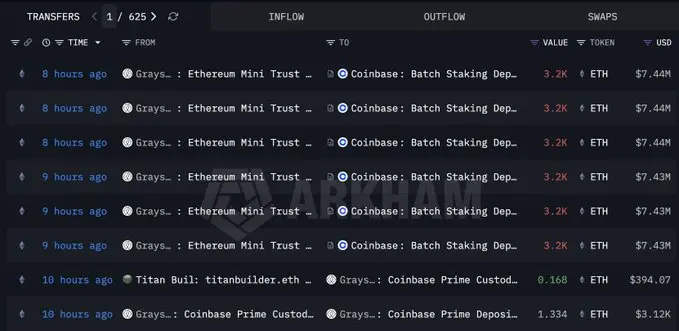
Grayscale: Has staked an additional 19,200 ETH (approximately $44.6 million) through its Ethereum Trust; previously, it had staked a total of 57,600 ETH (about $121.6 million). Recently, it has been transferring 3,200 ETH (roughly $7.4 million) per batch from its accounts to Coinbase’s bulk staking address, indicating a long-term accumulation and fund locking strategy.
BitMine: As of March 15, 2026, has staked 3,040,515 ETH, accounting for about 66% of its total holdings of 4,595,562 ETH. Its staking strategy is expected to generate approximately $180 million in weekly revenue. Currently collaborating with three staking service providers, with a CESR staking rate of 2.79% and a 7-day BMNR yield of 2.81%. It is also advancing the commercialization of the “Made in USA Validator Network” (MAVAN).
SharpLink: Has earned a total of 15,464 ETH (about $36 million) through staking rewards. Its current total holdings amount to 868,699 ETH.
BlackRock: Launched the iShares Staked Ethereum ETF (ticker: ETHB), the first Ethereum ETF product allowing staking, creating a new channel for institutional participation in ETH staking through a compliant route.
Dual Mechanisms Driving Supply Tightening
This wave of institutional ETH staking is driven by two mutually reinforcing supply contraction mechanisms:
Layer 1 (Staking Lockup of Circulating Supply): Ethereum’s staking mechanism requires participants to lock ETH as validators. Before unstaking and completing withdrawal, these ETH are effectively out of circulation. When the network’s staking rate exceeds 31.1%, it indicates that over 30% of the total circulating ETH has temporarily exited secondary market trading.
Layer 2 (Exchange Reserves at a Low Point): According to CryptoQuant data, ETH reserves on centralized exchanges have fallen to historic lows. A decline in exchange reserves is often interpreted as holders transferring ETH to cold wallets or staking contracts, signaling reduced immediate selling pressure.
The combined effect of these two factors is a simultaneous contraction of tradable ETH in circulation. If market demand remains stable or increases, this structural supply tightening can help support ETH’s market price.
Frequently Asked Questions
Why are institutions accelerating ETH staking now?
The reasons are multifaceted. From a yield perspective, staking ETH at around 2-3% annualized return is attractive in the current low-yield environment, and rewards are paid in ETH, naturally hedging some holding costs. Strategically, large-scale ETH accumulation by institutions signals confidence in Ethereum’s long-term ecosystem development. The launch of BlackRock’s ETHB ETF further lowers the barrier for other institutions to participate in staking via a compliant channel.
Will the ETH staking rate continue to rise beyond 31.1%?
It depends on multiple factors, including the pace of new ETH being staked versus withdrawals, the attractiveness of staking yields, and whether more institutions follow the strategies of BitMine and SharpLink. Currently, there are no signs of weakening staking momentum at the institutional level, but the trend remains subject to macroeconomic and regulatory influences.
Does supply tightening necessarily mean ETH prices will rise?
Supply tightening is a favorable structural factor for prices but not a sufficient condition. ETH’s price is ultimately determined by both supply and demand. Even if circulating supply contracts, demand could weaken (e.g., macroeconomic risks persist, or DeFi activity declines), which may not lead to immediate price increases. Analysts believe that the current supply tightening provides ETH with a more resilient, downside-resistant structure relative to the broader crypto market, rather than a guaranteed short-term rally catalyst.
Disclaimer: The information on this page may come from third parties and does not represent the views or opinions of Gate. The content displayed on this page is for reference only and does not constitute any financial, investment, or legal advice. Gate does not guarantee the accuracy or completeness of the information and shall not be liable for any losses arising from the use of this information. Virtual asset investments carry high risks and are subject to significant price volatility. You may lose all of your invested principal. Please fully understand the relevant risks and make prudent decisions based on your own financial situation and risk tolerance. For details, please refer to
Disclaimer.


