
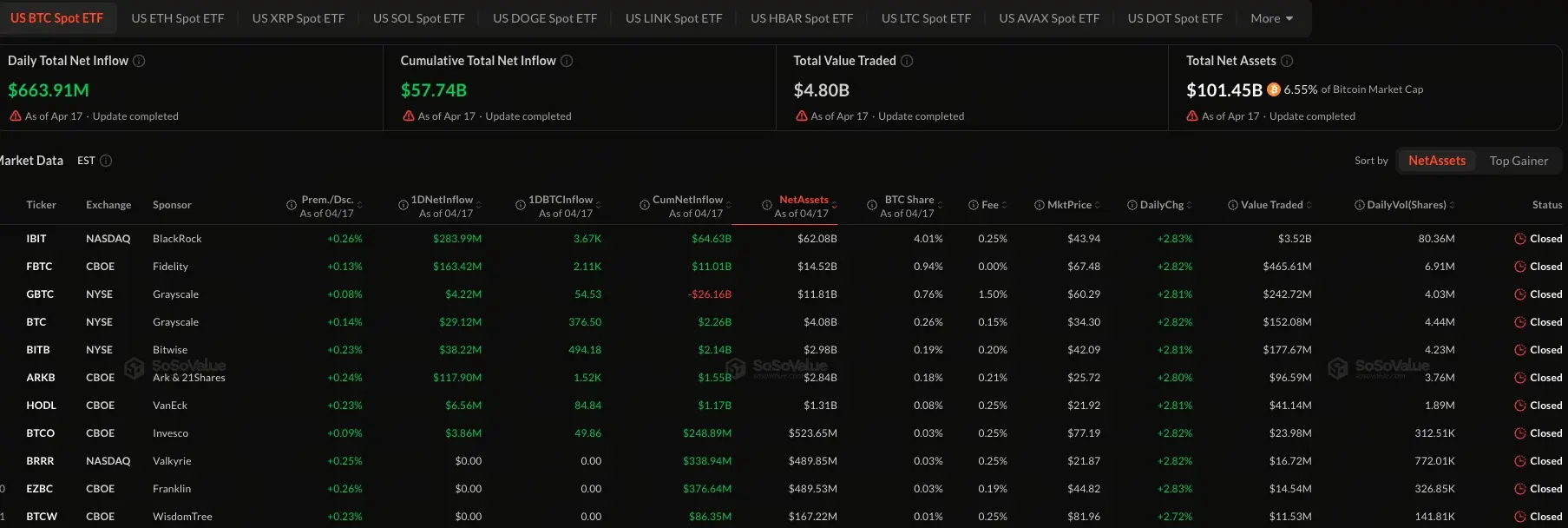
According to SoSoValue data, over the prior week’s trading days (from April 13 to 17 in U.S. Eastern Time), Bitcoin spot ETFs recorded weekly net inflows of $996 million, the highest weekly inflow level since mid-January 2026, and also marked the third consecutive week of net inflows. This surge in capital inflows coincided with the timing of a shift in market sentiment toward risk assets after the U.S.-Iran situation temporarily eased.
Bitcoin Spot ETF Weekly Data: IBIT Leads the One-Week $906 Million Inflow
 (Source: SoSoValue)
Weekly net inflow ranking:
BlackRock IBIT: weekly net inflow of $906 million (historical total net inflows: $64.63 billion)
Ark & 21 Shares ARKB: weekly net inflow of $98.50 million (historical total net inflows: $1.55 billion)
Weekly net outflows:
Fidelity FBTC: weekly net outflow of $104 million (historical total net inflows: $11.01 billion)
As of now, the total net asset value of Bitcoin spot ETFs is $101.45 billion, and the ETF net asset ratio is 6.55% (ETF market cap share of Bitcoin’s total market cap). Cumulative historical net inflows have already reached $57.74 billion.
Ethereum Spot ETF Weekly Data: FETH Leads with a $126 Million Inflow
Weekly net inflow ranking:
Fidelity FETH: weekly net inflow of $126 million (historical total net inflows: $2.36 billion)
BlackRock ETHA: weekly net inflow of $99.23 million (historical total net inflows: $11.83 billion)
Weekly net outflows:
Grayscale ETHE: weekly net outflow of $16.68 million (historical cumulative net outflows: $5.20 billion)
The total net asset value of Ethereum spot ETFs is $14.26 billion, the ETF net asset ratio is 4.87%, and cumulative historical net inflows have reached $11.94 billion.
Macroeconomic Backdrop: Risk-Asset Inflows Driven by Easing U.S.-Iran Tensions
This surge in ETF capital inflows matches the timeline of a temporary easing of U.S.-Iran tensions—after Iran briefly reopened the Strait of Hormuz, it eased global energy supply tension expectations. Traders took the opportunity to rotate into risk assets, including Bitcoin. Polymarket contracts show the probability that Bitcoin will set a new all-time high before December 31 has risen to 17.5%, up from 14% one week earlier.
Analysts note that two key risk factors should be closely watched going forward: if the U.S.-Iran ceasefire agreement breaks down again, it could rekindle risk-off sentiment; the direction of Federal Reserve rate-cut signals could also have a major impact on the Bitcoin and crypto derivatives markets.
FAQ
Why can IBIT continue to dominate the net inflows to Bitcoin spot ETFs?
BlackRock’s IBIT, backed by the brand of the world’s largest asset manager, its large institutional distribution network, and relatively low fees, continues to attract capital allocations from institutional investors. Historical total net inflows amount to $64.63 billion—far ahead of all Bitcoin spot ETFs—reflecting institutional investors’ clear preference for BlackRock’s products through compliant channels.
What does the 6.55% ETF net asset ratio for Bitcoin mean?
A 6.55% ETF net asset ratio means that the value of the Bitcoin market held through spot ETFs currently accounts for 6.55% of Bitcoin’s total market cap—i.e., roughly 1 out of every 15 Bitcoins worldwide is held via the ETF channel. A continued rise in this ratio is typically viewed as an important indicator of accelerating institutional adoption.
What factors could influence the direction of future ETF capital inflows?
Key risk factors include whether the U.S.-Iran ceasefire agreement remains in place (directly affecting risk-asset sentiment), the timing of Federal Reserve rate cuts (directly impacting investors’ risk appetite via the interest-rate environment), and Bitcoin’s own price trend. If Bitcoin can break through key technical resistance levels, it typically attracts more institutional follow-on buying capital.
Disclaimer: The information on this page may come from third parties and does not represent the views or opinions of Gate. The content displayed on this page is for reference only and does not constitute any financial, investment, or legal advice. Gate does not guarantee the accuracy or completeness of the information and shall not be liable for any losses arising from the use of this information. Virtual asset investments carry high risks and are subject to significant price volatility. You may lose all of your invested principal. Please fully understand the relevant risks and make prudent decisions based on your own financial situation and risk tolerance. For details, please refer to
Disclaimer.
Related Articles
Crypto Investment Funds See Strong Weekly Inflows, Second-Best Performance Since January
Global crypto investment funds experienced significant inflows this week, driven by Bitcoin ETFs and improved investor sentiment amid stabilized markets. Factors influencing this trend include greater institutional participation, risk appetite, and macroeconomic signals.
GateNews38m ago
Shiba Inu Sees 82.5B Token Outflow as Market Structure Shifts
Key Insights
Shiba Inu saw 82.5 billion tokens exit exchanges within 24 hours, signaling reduced supply pressure and increasing accumulation behavior among larger holders.
Exchange net flows remain positive as inflows persist, yet rising outflows suggest a gradual balance forming between
CryptoNewsLand50m ago
XRP Price Near $1.45 as ETF Inflows Build Pressure
Key Insights
Institutional XRP ETF inflows reached $41.6 million over four days, lifting assets under management above $1.08 billion and strengthening market confidence.
XRP faces strong resistance near $1.45, where CoinGlass data highlights a short max
CryptoNewsLand58m ago
Strategy Acquires 34,164 BTC Worth $2.54B as Stablecoin Inflows Reach $1.88B
Gate News message, according to Lookonchain Weekly Report (Apr 13–Apr 19, 2026), the market witnessed $1.88B in new stablecoin inflows. CEX spot trading volume increased while perpetual contract volume decreased during the period.
Institutional demand surged, with Strategy purchasing 34,164 BTC val
GateNews1h ago
SUI Volume Surges 37% as Price Stabilizes Near Key Base
Key Insights
SUI trading volume surged by 37%, signaling renewed participation as the price stabilizes near 0.97, reflecting a transition from prolonged downtrend conditions
Futures inflows and bullish long-short ratios indicate rising speculative interest, while liquidation trends show
CryptoNewsLand1h ago
Solana Holds $87 Support as ETF Inflows Top $22M
Key Insights
Solana ETF inflows reached $22.14 million this week, signaling sustained institutional accumulation and reinforcing short-term support above the 50-day EMA level.
Futures open interest climbed to $5.53 billion, highlighting increased retail participation and growing
CryptoNewsLand1h ago


