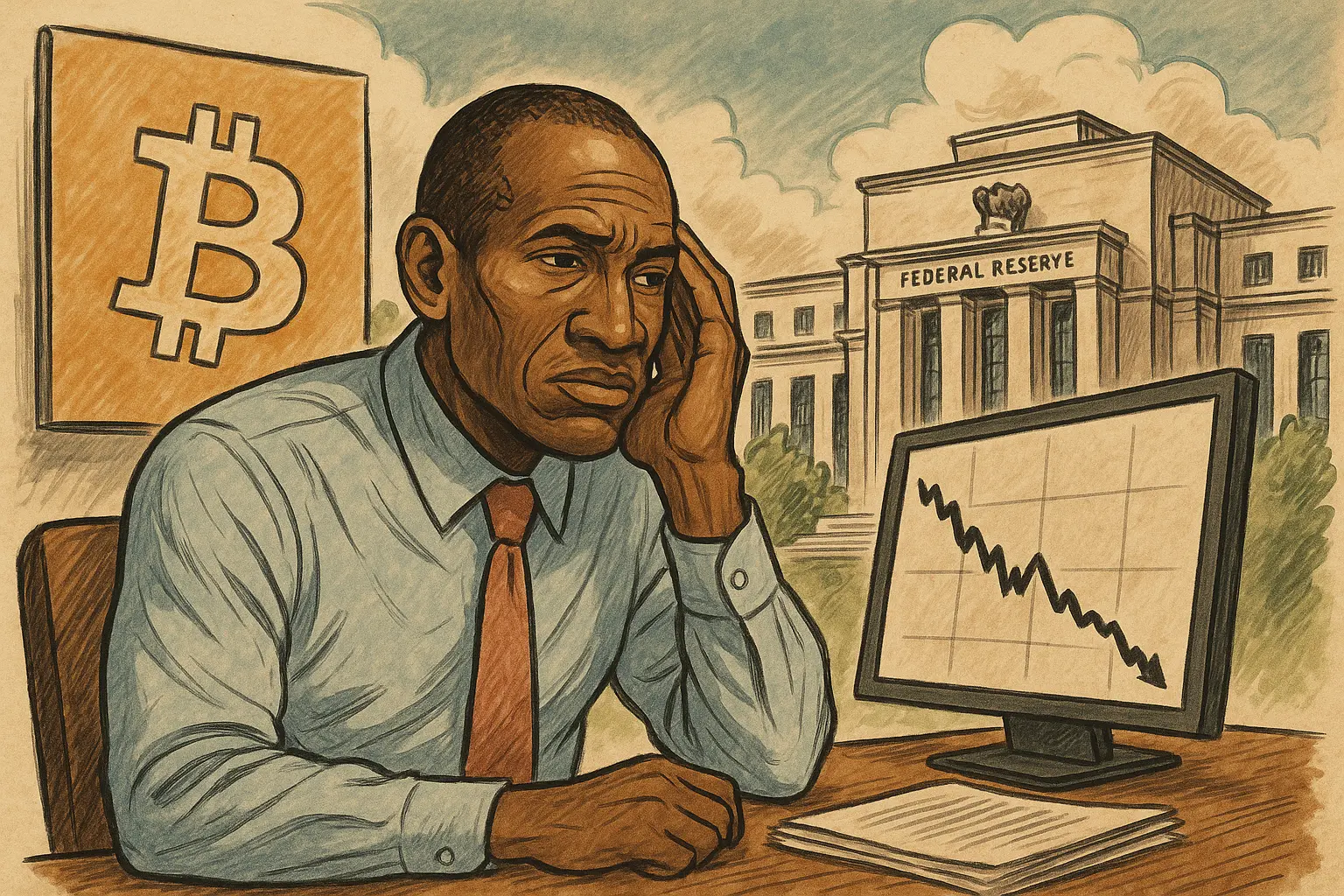
Maelstrom’s capital fund Arthur Hayes published an analytical article on April 15 on his personal blog, saying that before the Federal Reserve (Fed) injects liquidity into the market to fill the gap in banks’ balance sheets, Bitcoin is unlikely to see a significant rally; Hayes also disclosed that he currently holds an unleveraged long position in Bitcoin.
Hayes’ Bitcoin stance: the Fed’s liquidity as the key catalyst
According to Arthur Hayes’ blog post, his current holdings are an unleveraged long position in Bitcoin, and he is optimistic about the overall trend of cryptocurrencies. In the piece, Hayes said that before the Federal Reserve truly injects liquidity, Bitcoin’s short-term rebound target range is roughly between $80,000 and $90,000, and significant gains beyond that range are difficult to achieve.
Hayes explicitly explained that his analysis is based on “public data, fundamental mathematical knowledge, and AI agent tools,” and in the article he said, “I know nothing about war,” emphasizing that he cannot predict how global leaders will make decisions. Hayes also noted that his portfolio objective is: in the best-case scenario, to outperform oil and gas, food, and fuel prices; in the worst-case scenario, to outperform most major assets. His positions track the RMB exchange rate through Bitcoin, gold, and bonds, oil stress, and trends in monetary issuance.
Key data cited by Hayes and three major geopolitical scenarios
According to the data Arthur Hayes cited in the article:
· The Federal Reserve’s foreign securities held have shrunk by $63 billion since the outbreak of the conflict
· Non-monetary gold became the United States’ largest export commodity in four of the past five months, up 342% year over year
· Swiss refiners are reprocessing U.S. gold for China, and CIPS trading volume continues to grow
The median annual unemployment benefit across U.S. states is about $28,000, far below the $85,000 to $90,000 annual income of knowledge workers
In the article, Hayes proposed three major geopolitical scenarios: first, after the conflict eases, AI replacing white-collar jobs becomes the main threat. Hayes cites an example from a crypto gaming company, saying that after testing its AI agent work process, it plans to lay off 50%, and he uses the gap between unemployment benefits and knowledge workers’ income to discuss the potential risk of debt default. Second, Iran controls the Strait of Hormuz, and countries buy gold with RMB to avoid dollar settlement. Hayes cited in the article: “the yuan and gold are likely to become the two main currencies for sovereign trade.” Third, the U.S. military reopens the strait with force. Hayes believes that in this scenario, energy production would be damaged, and central banks around the world would be forced to massively increase money issuance.
Frequently Asked Questions
How exactly does Arthur Hayes currently hold Bitcoin?
According to disclosures from Hayes himself in his recent blog post, he currently holds an unleveraged long position in Bitcoin, is optimistic about the overall trend of cryptocurrencies, and does not use leverage.
What are the sources for the Federal Reserve foreign securities reduction data and the gold export data cited by Hayes?
The above data are cited by Arthur Hayes in his blog post, including that the Federal Reserve’s foreign securities holdings were reduced by $63 billion, and that non-monetary gold became the United States’ largest export commodity in four of the past five months, up 342% year over year. Hayes did not separately indicate the original data source institutions in the article.
What prerequisite does Hayes think must be met for Bitcoin to see a significant rally?
According to Arthur Hayes’ blog post, he says that the key prerequisite for Bitcoin to achieve a significant rally is for the Federal Reserve to inject liquidity into the market; before this condition is met, the short-term rebound target range is roughly between $80,000 and $90,000.
Disclaimer: The information on this page may come from third parties and does not represent the views or opinions of Gate. The content displayed on this page is for reference only and does not constitute any financial, investment, or legal advice. Gate does not guarantee the accuracy or completeness of the information and shall not be liable for any losses arising from the use of this information. Virtual asset investments carry high risks and are subject to significant price volatility. You may lose all of your invested principal. Please fully understand the relevant risks and make prudent decisions based on your own financial situation and risk tolerance. For details, please refer to
Disclaimer.
Related Articles
Crypto Market Rebounds 1.5% to $2.54T as Bitcoin Leads Rally Amid Tech Surge and Policy Progress
The crypto market rebounded 1.5% to $2.54 trillion, led by Bitcoin's 7% gain amid easing geopolitical tensions and strong ETF inflows. Analysts predict further gains if Bitcoin surpasses $76K resistance.
GateNews4h ago
Cardano Traders Watch $0.243 Support Level as ADA Price Faces Critical Decision
Cardano (ADA) is at a crucial support level of $0.243, with potential gains to $0.30 if it holds. A daily close below this could lead to declines toward $0.10. Currently, trading volume is around $500 million, with ADA notably below its all-time high.
GateNews04-15 10:02
XRP Today News: CLARITY Act Pushes Through in May, Standard Chartered Bank Turns Bullish on $8
Ripple CEO Garlinghouse confirmed at the summit that the CLARITY Act’s goal for passage is by the end of May, and said that the controversy surrounding stablecoin yield rates is nearing resolution. If the bill passes, XRP is expected to rise to $5–$10; otherwise, it could fall back to $1.2. The bill’s passage would create a regulatory framework for the digital asset market, clarify XRP’s classification as a commodity, and reduce compliance barriers for institutional investors.
MarketWhisper04-15 02:58
Tim Draper’s prediction: Bitcoin could triple in 18 months; inflation and a weaker U.S. dollar are catalysts
Billionaire Tim Draper predicts that Bitcoin will rise to $250k within 18 months, mainly due to inflation pressure and a weakening U.S. dollar. While his prediction is appealing, it hasn’t been met over the past six years, and his personal holdings may affect the assessment. Market conditions and the impact of regulatory policies on prices must be taken into account.
MarketWhisper04-15 02:04
Why is Bitcoin up today? Trump says Iran is seeking a truce, and risk assets move higher across the board
On April 15, Bitcoin rebounded about 6% after Trump said Iran is seeking to reach an agreement, breaking above $75,000. Expectations for the resumption of U.S.-Iran negotiations warmed up, lifting Asian stock markets. Technically, roughly $6 billion worth of short positions were forced to close, accelerating the rebound. Analysts said that if the U.S.-Iran situation continues to ease, Bitcoin could break through $80,000, and they predicted it may reach $150,000 by year-end.
MarketWhisper04-15 01:06
Bitcoin Reclaims $75,000 for Second Time Since US-Iran Conflict, Up 7% in 24 Hours
Bitcoin surged to $75,000 amid rising U.S.-Iran tensions, adding $98 billion to its market cap and causing $500 million in liquidations. Technical analysts suggest that holding support above $67,000 could lead to an increase toward $80,000, despite highlighting $50,000 as a critical level if support fails.
GateNews04-14 15:10


