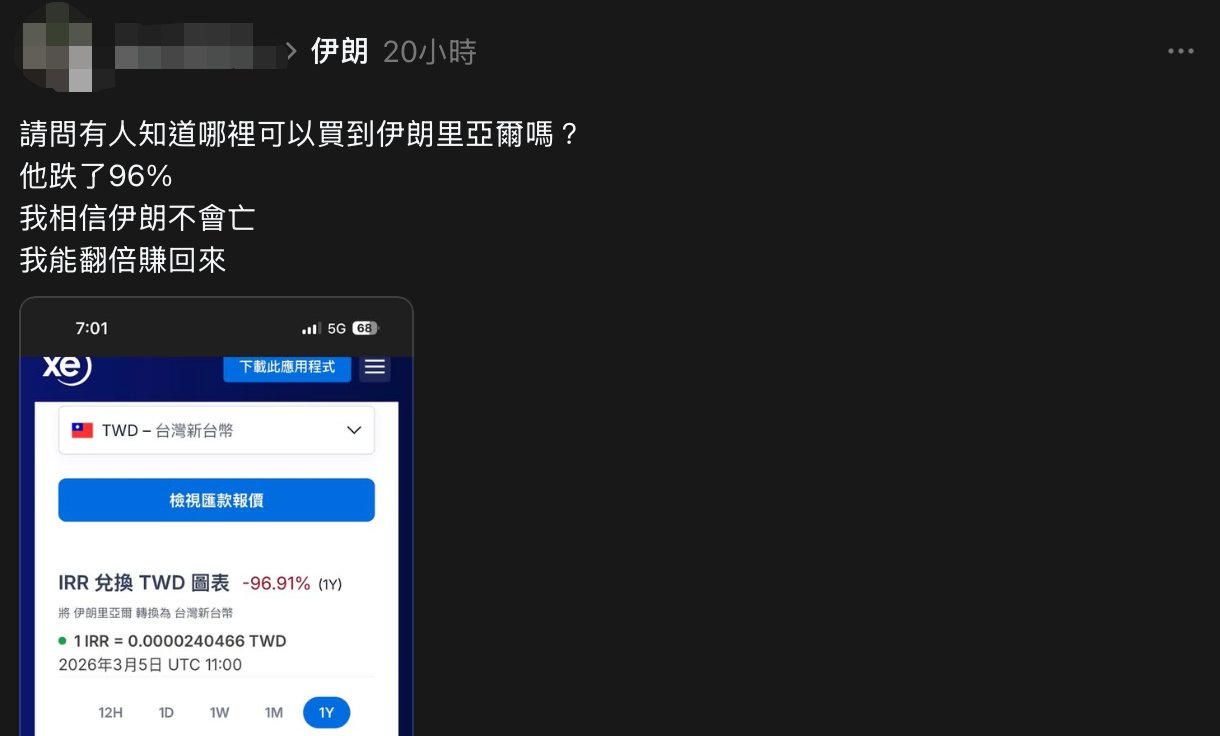
Iranian Rial plummeted over 30 times in just two months, dropping from 42,000 per USD to 1,310,000, hitting a historic low. Online investors are asking whether the Rial could rebound significantly if the Trump administration reaches a nuclear deal with Iran and sanctions are eased.
(Background: AI turns war into a game: U.S. military strikes 1,000 targets in Iran within 24 hours, “machine speed” becomes the standard)
(Additional context: Saudi oil prices surge by the largest margin in two years, Asian central banks rush to raise interest rates, Trump: Will take all measures to suppress oil prices)
The decline of Iran’s currency, the IRR, has surpassed most historical cases of hyperinflation. In early December 2025, 1 USD was about 42,000 IRR; by late February 2026, it had inflated to 1.31 million, a 96.8% drop in two months. Calculated over a 35-year cycle, the IRR has depreciated over 20,000 times against the dollar.
Currently, while protests by merchants in Tehran and the Central Bank governor’s resignation make headlines, another voice has emerged on Taiwanese social media: “Is now the best time to buy IRR?”
If the Trump administration successfully reopens nuclear negotiations with Iran and sanctions are lifted, the frozen oil dollar revenue could return to the market, potentially causing the Rial to rebound sharply. This involves extremely high geopolitical risks, and Iran is unlikely to issue new currency as a result.
The question is how to buy
The IRR is one of the least liquid currencies globally. Here are some known channels we’ve researched, though they are highly difficult and risky:
Physical exchange (Turkey, Dubai, Armenia)
Iran borders or has close dealings with Turkey, Dubai, and Armenia. Some informal currency exchange shops in these cities still handle IRR. Markets around Istanbul’s Grand Bazaar and Dubai’s Deira district have such traders, but transaction sizes are small, liquidity is poor, and quotes are opaque, often with exorbitant premiums. The main hurdle is actually reaching these locations.
-
UK ManorFX (small amounts)
UK forex broker ManorFX is one of the few legitimate providers offering retail IRR exchange, mainly for travel purposes. Transactions are very small and unsuitable for speculation, and their stock levels are unstable.
-
Cryptocurrency pathways (USDT → IRR, gray area)
This is currently the most feasible and controversial route. Iran has an underground crypto economy worth about $7.8 billion, primarily using USDT (Tether) for settlement. Iran’s largest exchange, Nobitex, allows users to deposit USDT and exchange it for IRR.
More notably, the Central Bank of Iran is also involved in such operations. It has purchased at least $507 million worth of USDT in an attempt to buy IRR on the open market and prevent further currency collapse. However, Tether froze multiple wallets related to the Iranian central bank in June 2025, totaling 37 million USDT. Investors engaging in this may find themselves unable to withdraw USDT (no access to funds).
Legal red lines investors must know
According to FAQ Item 608 from the U.S. Office of Foreign Assets Control (OFAC), any financial institution that “knowingly” participates in the buying or selling of IRR, or holds derivatives based on IRR exchange rates, could face sanctions. This regulation discourages U.S. citizens, institutions, and international financial entities with U.S. ties from engaging in such activities.
For individual investors in Taiwan or Asia, although not directly under OFAC jurisdiction, engaging with Iran’s financial system via crypto channels still carries the risk of Iran’s currency reform. The Iranian government has officially approved a plan to remove four zeros and introduce a new currency, the “Toman.” How the old IRR will be exchanged or valued remains uncertain.

Disclaimer: The information on this page may come from third parties and does not represent the views or opinions of Gate. The content displayed on this page is for reference only and does not constitute any financial, investment, or legal advice. Gate does not guarantee the accuracy or completeness of the information and shall not be liable for any losses arising from the use of this information. Virtual asset investments carry high risks and are subject to significant price volatility. You may lose all of your invested principal. Please fully understand the relevant risks and make prudent decisions based on your own financial situation and risk tolerance. For details, please refer to
Disclaimer.


