
Bitcoin’s circulating supply approaches 20 million coins, with over 95% already mined. The final 1 million coins will take a century to mine, drawing renewed attention to its scarcity.
The “King of Cryptocurrency,” Bitcoin, is preparing to reach a significant milestone: the 20 millionth Bitcoin is about to be issued. According to on-chain data platform Clark Moody Dashboard, approximately 19,996,979 Bitcoins have been mined and are in circulation, leaving only about 3,000 coins to reach 20 million. Based on the block production rate, it is estimated to happen in about 7 days.
At that point, over 95% of the total supply of 21 million Bitcoins will be in circulation, while the remaining 1 million will take more than a century to mine completely.
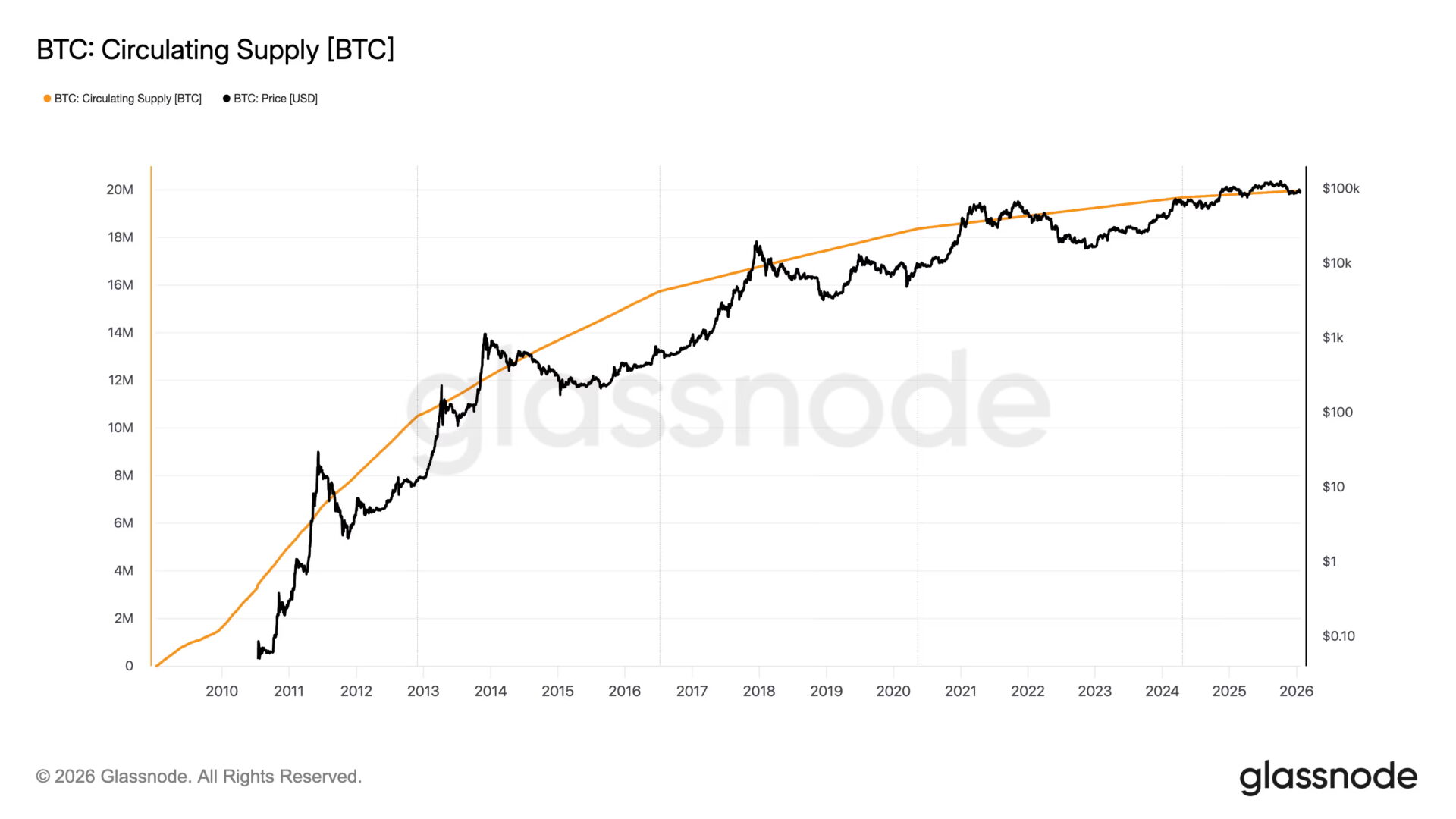
Image source: glassnode
When Bitcoin’s creator, Satoshi Nakamoto, designed the protocol, he set the maximum supply at 21 million coins in the original code, creating a form of currency with “absolute scarcity,” in stark contrast to fiat currencies issued by central banks, which can be increased at any time.
Although Nakamoto never publicly explained why he chose the number 21 million, this immutable cap has become an unshakable belief among Bitcoin enthusiasts. To them, any proposal to change the supply limit is a fundamental betrayal of Bitcoin’s value as a “hard currency.”
Bitcoin’s scarcity is often compared to gold and oil. However, in traditional commodity markets, if gold or oil prices surge, producers typically increase extraction or find new sources to boost supply and stabilize prices. Bitcoin is different; because its issuance curve is transparent and tamper-proof, no matter how wild the market prices become, the supply cannot be accelerated.
Bitcoin’s issuance rate decreases with each “halving event,” which occurs approximately every four years, halving the block rewards for miners and slowing new coin issuance. Currently, Bitcoin’s inflation rate has fallen below 1%, with about 450 new coins produced daily.
At this pace, 99% of the total supply will be mined by January 2035, and the last Bitcoin is expected to be mined around 2105. The remaining smaller fractions will continue to be released gradually until around 2140.
Once all Bitcoins are issued, miners will no longer rely on block rewards but will depend entirely on transaction fees for revenue. This means the long-term security and economic model of the Bitcoin network will ultimately depend on whether transaction demand can sustain miner income.
- This article is reprinted with permission from: “BlockCast”
- Original title: “Bitcoin Circulating Supply Approaching the 20 Million Milestone! The Last 1 Million Coins Will Take 114 Years to Mine”
- Original author: Block Sister MEL
Disclaimer: The information on this page may come from third parties and does not represent the views or opinions of Gate. The content displayed on this page is for reference only and does not constitute any financial, investment, or legal advice. Gate does not guarantee the accuracy or completeness of the information and shall not be liable for any losses arising from the use of this information. Virtual asset investments carry high risks and are subject to significant price volatility. You may lose all of your invested principal. Please fully understand the relevant risks and make prudent decisions based on your own financial situation and risk tolerance. For details, please refer to
Disclaimer.
Related Articles
A certain address deposited 28,970 ETH into a CEX, with a value of approximately 59.05 million US dollars.
Gate News Report, March 11 — According to Lookonchain monitoring, a Gnosis Safe Proxy multi-signature wallet address 0x23A5 just deposited 28,970 ETH into a CEX, worth approximately $59.05 million.
GateNews1h ago
Bitcoin Exchange Supply Drops to Record Low as Winklevoss Twins Move $130M in BTC
Bitcoin supply on exchanges has hit a record low, while the Winklevoss twins recently transferred 1,773 BTC to exchange wallets. This combination of reduced supply and significant investor activity suggests potential market volatility ahead.
CryptometerIo2h ago
Ethereum on-chain activity explodes: daily active addresses approach 2 million, smart contract calls exceed 40 million for a new high, but ETH drops 30% and transaction fees lose to Tron
CryptoQuant March Report indicates that Ethereum on-chain activity has reached a record high, but ETH prices have fallen 30% over the past six months, and transaction fee revenue has lagged behind other public chains. The report analyzes that the factors driving ETH prices have shifted from on-chain usage to capital flows, prompting the market to reconsider Ethereum's value proposition.
動區BlockTempo3h ago
On-chain Perp DEX trading volume declines, Hyperliquid crude oil contracts drop 33%
March 11 Report: The current on-chain Perp DEX market trading volume has declined, while open interest remains high, indicating that leveraged funds have not exited. Hyperliquid's trading volume decreased by 21%, and trading volumes on other platforms such as Aster and EdgeX have also changed. The market is temporarily awaiting further news.
GateNews3h ago
Solana Price Lags Major Cryptos Despite Record On-Chain Activity
There is a strange phenomenon that was recently noticed by CoinMarketCap in the crypto market. This week, Solana provided a high output of blockchain activity. Nonetheless, its market price could not compete with other major digital assets. Although some of the most popular cryptocurrencies, such as
Coinfomania3h ago


