The measures seek to fully integrate crypto exchanges into the established financial system and protect the identity information of the institution’s customers. The Central Bank states that this will promote “transparency, comparability, and predictability of information provided to the market.”
Brazil Issues Resolution Including Crypto Brokerages to Comply With Bank Secrecy Laws
Brazil is moving to integrate crypto exchanges into its financial ecosystem.
The National Monetary Council and the Central Bank of Brazil recently approved Resolution No. 5,280, which brings new compliance rules for virtual asset service providers in the country.
The resolution, which states that virtual asset service providers (VASPs) will be considered financial institutions under the Brazilian Bank Secrecy Act, seeks to establish an equivalent regulatory treatment for all exchanges operating in the local financial system and the mechanisms needed to protect it.
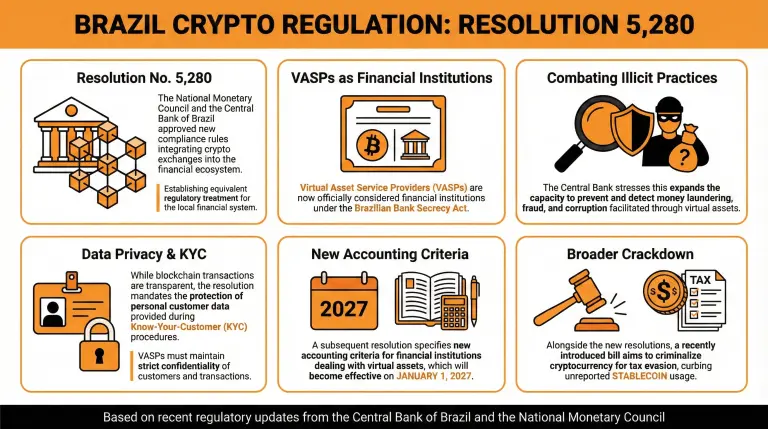
The Central Bank of Brazil stressed that this move “expands the capacity to prevent, detect, and combat illicit practices—such as money laundering, fraud, corruption, and other irregularities—that may be facilitated through the use of virtual assets.”
While blockchain transactions are transparent, given the nature of these structures, experts like Tiago Severo stressed that the identification and personal data of customers, provided when completing Know-Your-Customer (KYC) procedures, is what this resolution seeks to protect.
At the same time, it increases the responsibility of these institutions, which will have to take into account already established provisions regarding the confidentiality of their customers and their transactions.
In a subsequent resolution, the two institutions also approved a new resolution that specifies the accounting criteria that financial institutions dealing with virtual assets must follow.
The central bank states that regulatory clarity will contribute to investor confidence, assigning a clearer role to VASPs about the duties these institutions should fulfill.
The bank secrecy measure is already being applied, while the new accounting rules for financial institutions are set to become effective on January 1, 2027.
Recently, a bill criminalizing cryptocurrency for tax evasion was introduced into Congress, aiming to curb the usage of stablecoins for unreported payments and transactions.
FAQ
- What recent resolution has Brazil approved regarding crypto exchanges?
Brazil approved Resolution No. 5,280, integrating crypto exchanges into its financial ecosystem as virtual asset service providers.
- How does Resolution No. 5,280 affect virtual asset service providers (VASPs)?
VASPs will now be classified as financial institutions under the Brazilian Bank Secrecy Act, requiring compliance with new regulations.
- What is the goal of this regulatory change by the Central Bank of Brazil?
The aim is to enhance the detection and prevention of illicit practices, including money laundering and fraud, associated with virtual assets.
- When will the new accounting rules for financial institutions dealing with virtual assets take effect?
The new accounting criteria for financial institutions will become effective on January 1, 2027.
Disclaimer: The information on this page may come from third parties and does not represent the views or opinions of Gate. The content displayed on this page is for reference only and does not constitute any financial, investment, or legal advice. Gate does not guarantee the accuracy or completeness of the information and shall not be liable for any losses arising from the use of this information. Virtual asset investments carry high risks and are subject to significant price volatility. You may lose all of your invested principal. Please fully understand the relevant risks and make prudent decisions based on your own financial situation and risk tolerance. For details, please refer to
Disclaimer.
Related Articles
Top Ripple Exec Meets Democratic Senator - U.Today
Ripple's Chief Legal Officer, Stuart Alderoty, met Senator Gillibrand to discuss bipartisan digital asset regulation, praising her leadership on cryptocurrency legislation amid Ripple's ongoing legal challenges with the SEC over XRP classification.
UToday3h ago
U.S. Treasury Urges Law Allowing Crypto Exchanges to Freeze Funds
U.S. Department of the Treasury proposed a law allowing exchanges to freeze suspicious crypto funds during probes.
The report says a “hold law” would let platforms pause transfers without a court order while law enforcement investigates.
Treasury also urged clearer AML rules for DeFi
CryptoFrontNews4h ago
Justin Sun Reaffirms Zero-Tolerance Policy on Illegal Activities at Tron
TRON founder Justin Sun says his companies maintains zero tolerance against illegal activities like embezzlement, unauthorised computer access and bribery.
He threatened legal action against those who spread false rumors online and ‘smear judicial organs’ just days after two of his companies
CryptoNewsFlash6h ago
OCC, Fed, and FDIC Clarify Capital Rules for Tokenized Securities
Regulators equalize capital rules for tokenized securities.
Permissionless and permissioned blockchains treated the same.
Tokenized securities qualify as financial collateral.
US banking agencies have clarified that tokenized securities should be treated similarly to the capital treatment
Blockzeit7h ago
US Treasury Turns to AI to Combat Crypto Fraud After $9B in Losses
The United States Treasury plans to utilize artificial intelligence technology.
Blockchain analytics in the fight against cryptocurrency-related fraud after the total loss exceeded $9 billion.
The officials are of the opinion that the technology can help identify fraud patterns at an early
TheNewsCrypto8h ago
BitGo Europe obtains dual authorization from Germany's BaFin, covering both MiCAR and PSD2 licenses
Gate News Announcement, March 9 — BitGo Europe has officially received dual authorization from the German Federal Financial Supervisory Authority (BaFin), holding both a MiCAR license (EU Crypto Asset Market Regulation) and a PSD2/ZAG license (EU Payment Services Directive) specifically for EMT (Electronic Money Token) payment services. BitGo stated that although MiCAR is a milestone for the industry, many in the industry still face challenges when handling EMT.
GateNews8h ago


