Michael Saylor believes the biggest risk to Bitcoin is internal protocol changes rather than quantum computing, advocating for protocol rigidity. Coinbase has established a Quantum Committee, with members including Stanford Professor Dan Boneh and Ethereum researcher Justin Drake. Support for BIP-110 has reached 2.38%, leading to a split; by 2025, over 10% of mailing list discussions involve post-quantum security. The quantum threat is at least 5 years away.
Michael Saylor advocates for protocol rigidity to counter internal change risks
(Source: The Bitcoin Portal)
MicroStrategy co-founder Michael Saylor warns that the greatest risk facing Bitcoin is from ambitious opportunists promoting protocol changes. This statement comes as Coinbase and the Ethereum network take measures to address one of Bitcoin’s most severe long-term threats—quantum computing. Saylor believes that protocol rigidity is Bitcoin’s main defense. He points out that attempts to internally “improve” the network are more dangerous than external technological threats.
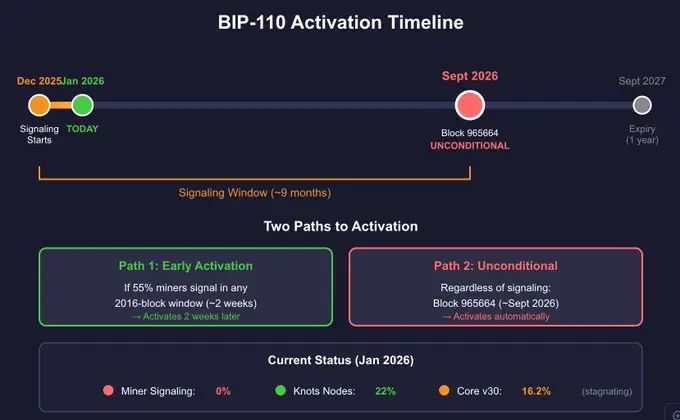
This highlights Bitcoin’s role as a neutral digital currency amid debates like the BIP-110 soft fork proposal. As of January 25, 2026, BIP-110 has gained support from 2.38% of nodes, aiming to temporarily limit transaction data (e.g., OP_RETURN restricted to 83 bytes) to combat non-monetary spam. This discussion has caused community divisions—one side supports Bitcoin Knots purists, the other uses Bitcoin Core for broader applications.
Saylor’s view represents the “rigid” faction within the Bitcoin community. This camp believes Bitcoin’s greatest value lies in its predictable and stable rules. Any protocol change, even well-intentioned improvements, could introduce unknown risks or be exploited by malicious actors. They see Bitcoin as a store of value that should remain unchanged like gold, rather than an evolving technological platform.
Some developers worry about hasty or politically motivated changes, while others emphasize that ignoring emerging risks could itself be a burden. This internal tension has intensified with the emergence of the quantum threat. If the Bitcoin community refuses to upgrade to post-quantum cryptography due to rigidity, it may be caught unprepared when quantum computers become a reality. Conversely, premature upgrades could introduce vulnerabilities from immature technologies or fracture consensus.
Coinbase establishes Quantum Advisory Committee to address 5-year threat
As Coinbase announces the formation of an independent advisory committee dedicated to quantum computing and blockchain security, this tension becomes more pronounced. The committee will study how future large-scale quantum computers could threaten Bitcoin’s cryptographic foundations. They will publish public research reports, risk assessments, and technical guidance for the broader ecosystem.
The core issue revolves around elliptic curve cryptography (ECC), which underpins Bitcoin’s ECDSA and Schnorr signatures. In theory, a sufficiently powerful quantum computer running Shor’s algorithm could derive private keys from public keys, enabling attackers to forge transactions or steal exposed wallets. While such machines are at least 5 years away, the long lead time needed for security protocol transitions makes quantum resilience an increasingly urgent task.
Coinbase’s advisory committee includes top experts in cryptography and quantum research, such as Stanford Professor Dan Boneh, University of Texas quantum theorist Scott Aaronson, Ethereum Foundation researcher Justin Drake, and EigenLayer founder Sreeram Kannan. Coinbase states that the committee will operate independently, releasing position papers on the state of quantum computing. They will also provide guidance to developers and institutions and respond promptly to breakthroughs in the field.
Four main functions of Coinbase’s Quantum Committee
Risk Assessment: Regular reports on quantum computing threats to blockchain
Technical Guidance: Recommendations for post-quantum cryptography migration paths for developers
Real-time Response: Rapid analysis of major breakthroughs in quantum research
Public Research: Publishing independent reports for the entire ecosystem
(Source: X)
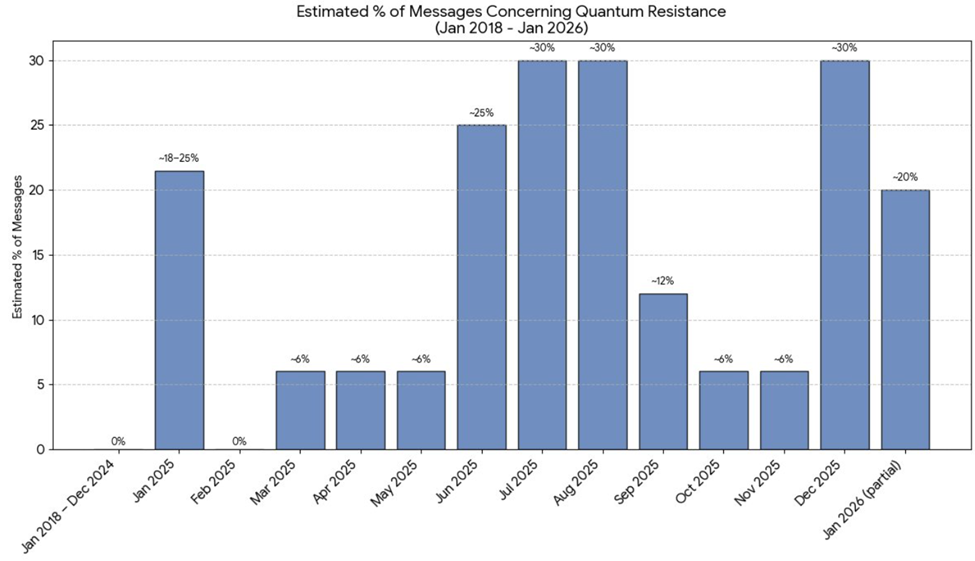
This initiative reflects a broader shift in the Bitcoin development community’s approach to the issue. Data from 2025 shows a significant increase in discussions related to quantum technology on Bitcoin mailing lists, with over 10% of technical exchanges involving post-quantum security. Notably, this occurs after years of near silence. The discussions have shifted from abstract hypotheses to concrete engineering challenges, including how Bitcoin can transition from ECC to post-quantum signatures via soft forks without disrupting the network.
Philosophical conflict between Bitcoin’s rigidity and upgrade advocates
Despite the momentum, most researchers caution against hasty protocol changes. The mainstream view favors waiting until post-quantum cryptography standards, such as those developed by NIST, are fully mature. This contrasts with forced upgrades that could introduce new vulnerabilities. In this sense, Coinbase’s move is seen as a form of preparation rather than panic. It aims to ensure Bitcoin and other blockchains have reliable migration paths before quantum attacks become feasible.
The contrast with Ethereum is also becoming clearer. The Ethereum Foundation recently announced that post-quantum security is a top strategic priority. They have assembled dedicated teams, funded cryptography research, and run real-time post-quantum development networks. Ethereum now joins Coinbase’s advisory committee, highlighting that quantum preparedness is increasingly viewed as a cross-chain, industry-wide challenge.
This contrast underscores the fundamental philosophical differences in governance between Bitcoin and Ethereum. Ethereum embraces rapid iteration and active upgrades, with developers accustomed to regular hard forks to implement new features. Bitcoin, on the other hand, is highly conservative; any protocol change requires extensive discussion and broad consensus. Saylor’s rigid faction sees this conservatism as an advantage, protecting Bitcoin’s stability as a store of value. The upgrade advocates worry that excessive rigidity could make Bitcoin slow to respond to real threats.
As quantum research accelerates and institutions play a more active role in building future-proof cryptographic infrastructure, maintaining this balance may become more difficult. Ultimately, the Bitcoin community will have to choose between “keeping the protocol unchanged” in its purity and “upgrading to address quantum threats.”
Disclaimer: The information on this page may come from third parties and does not represent the views or opinions of Gate. The content displayed on this page is for reference only and does not constitute any financial, investment, or legal advice. Gate does not guarantee the accuracy or completeness of the information and shall not be liable for any losses arising from the use of this information. Virtual asset investments carry high risks and are subject to significant price volatility. You may lose all of your invested principal. Please fully understand the relevant risks and make prudent decisions based on your own financial situation and risk tolerance. For details, please refer to
Disclaimer.
Related Articles
Trader Killa Predicts Bitcoin Bottom Could Form Between $40,740 and $42,680
Gate News message, April 25 — Killa (@KillaXBT), a prominent Bitcoin-focused quantitative trader, has released a price prediction for the current market cycle, citing his track record of accurately forecasting the previous bull market peak. Killa previously predicted Bitcoin would top at $121,362 in
GateNews11m ago
Bitcoin Bonuses Expand as Fold Brings Payroll-Linked Rewards to Employers
Fold Holdings expanded bitcoin workplace compensation with a new employer bonus program. The rollout turns payroll-linked incentives into a potential distribution channel for everyday BTC adoption.
Key Takeaways:
Fold launches BTC bonuses, expanding employer adoption pathways.
Businesses gain
Coinpedia2h ago
Bitcoin Spot ETFs Record $144.49M Net Inflows, Extending 9-Day Streak
Gate News message, April 25 — Bitcoin spot ETFs recorded net inflows of $144.49 million yesterday (April 24, Eastern Time), according to SoSoValue, extending a nine-day streak of positive inflows.
BlackRock's IBIT led all funds with $22.879 million in single-day inflows, bringing its historical tot
GateNews4h ago
Metaplanet Issues 8 Billion Yen Zero-Coupon Bonds to Increase Bitcoin Holdings
Gate News message, April 25 — Japanese Bitcoin Treasury Company Metaplanet announced the issuance of 8 billion yen in zero-coupon ordinary bonds to fund further bitcoin purchases.
The proceeds from the bond offering will be allocated toward expanding the company's bitcoin holdings as part of its
GateNews5h ago
Bitcoin Developer Paul Sztorc Announces eCash Hard Fork with 1:1 BTC Exchange, Sparking Community Controversy
Gate News message, April 25 — Bitcoin developer Paul Sztorc announced the launch of eCash, a Bitcoin hard fork network that will allow BTC holders to exchange their holdings at a 1:1 ratio for eCash tokens following the network's activation. The Layer 1 node software will be a near-replica of the Bi
GateNews5h ago
Liquidity Is Shifting Beyond Bitcoin — Why Altseason 2026 Could Surge and 5 Crypto Picks Gaining Attention
Liquidity rotation is gradually moving across multiple blockchain sectors beyond Bitcoin dominance.
Scaling and infrastructure tokens show steady development activity across developer ecosystems.
Privacy and gaming narratives continue to influence selective market participation trends
CryptoNewsLand5h ago


