The most frequently asked question recently is, how to view the Ethereum narrative?
Indeed, Ethereum in 2017 focused on ICOs and the world computer, while in 2021 it was DeFi and financial settlement layers. However, in 2025, this cycle seems to have few new narratives that can match the old ones in height.
ETFs and Staking ETFs might count as half, but that’s not within the control of Ethereum developers. If we’re talking about the other half, it can only be ZK.
Ethereum is indeed the blockchain that the entire Crypto world has bet on the most for ZK, without a doubt.
A few days ago, Vitalik was quite excited. He announced on Twitter that ZKEVM has now entered the Alpha stage.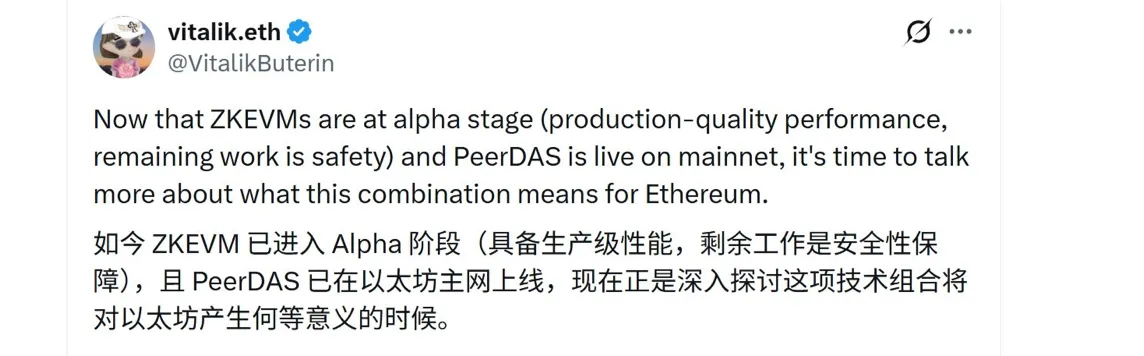
Why is Ethereum so persistent about ZK?
Actually, Ethereum’s TPS is already quite high now, with a theoretical peak reaching over 200 TPS. The reason is that Ethereum has repeatedly increased the Gas limit.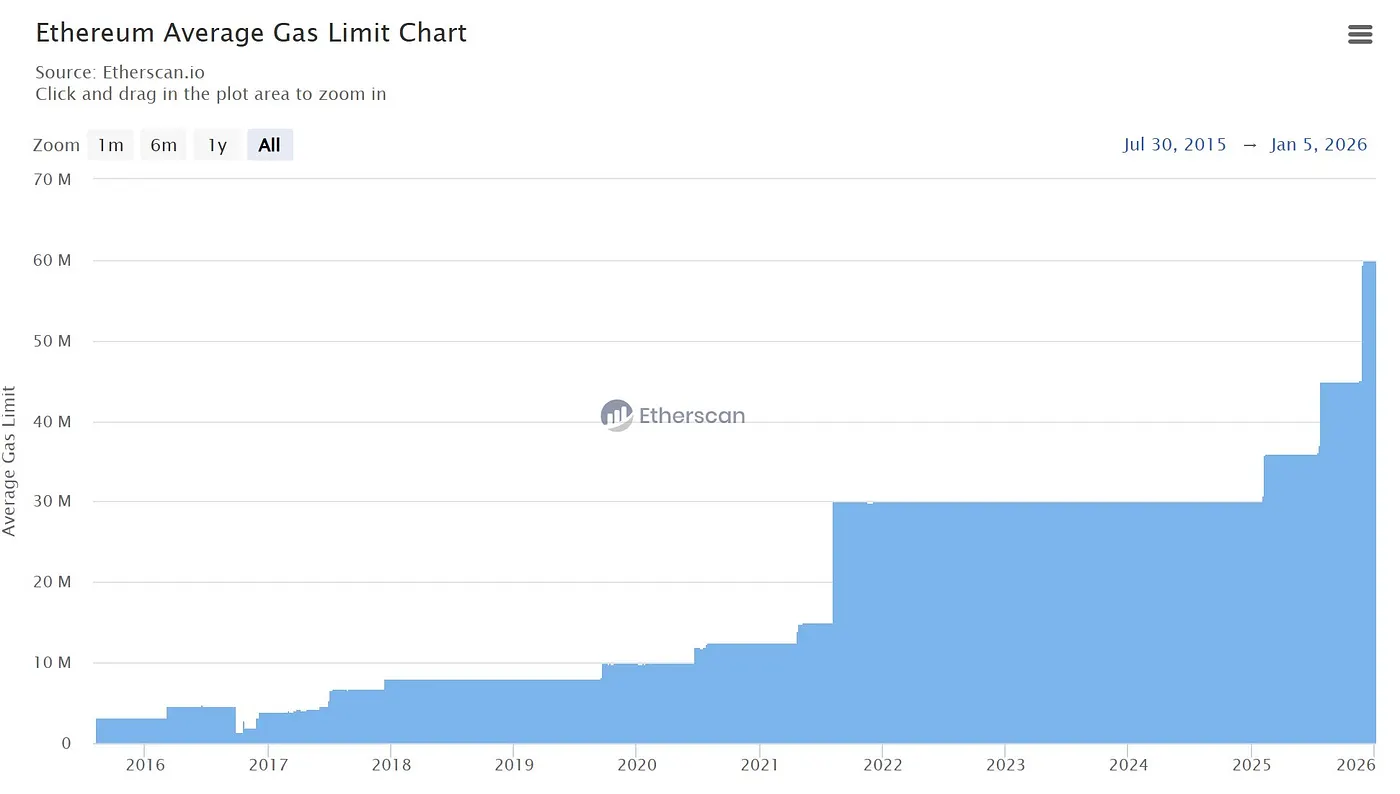 However, raising the Gas limit comes at a cost, and it cannot be increased endlessly. Its cost is that nodes need more expensive servers to run.
But Ethereum also hopes to preserve its proud high level of decentralization, so it cannot push node server performance too high (for reference, a single Solana server is roughly 5–10 times more expensive than an ETH server).
Therefore, on-chain ZK is a must. Note that it’s not just about deploying a few ZK L2s; this is about full on-chain ZK for the L1 mainnet.
So, what are the benefits after ZK?
Those ETH nodes can simply verify these ZK proofs without the need to painstakingly verify each transaction one by one as in the past.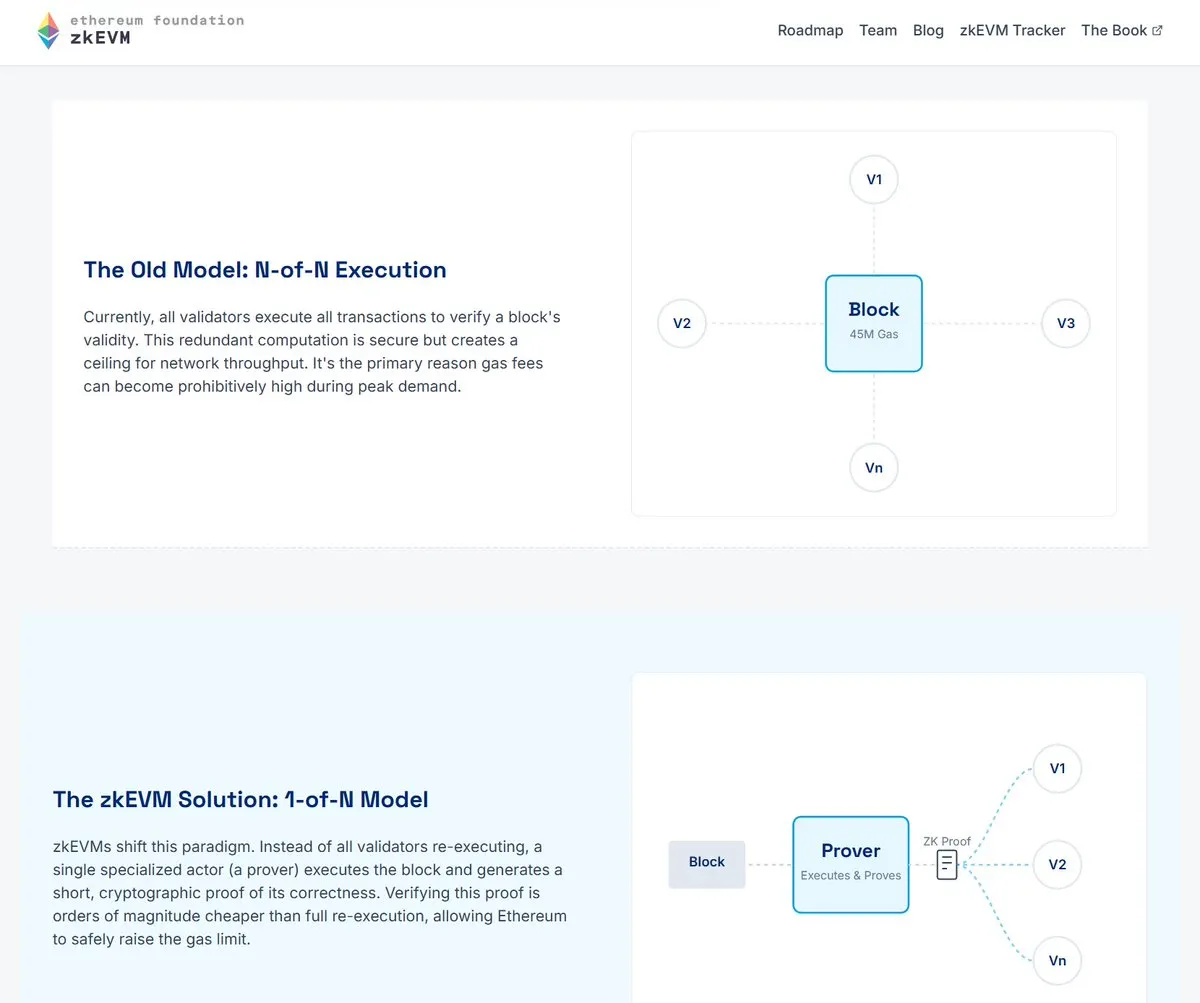
For example, imagine you are a grader (node), and those transactions are students’ exam papers.
Manual grading used to be slow. But since the advent of the answer sheet coloring (ZK) tool, the machine can calculate the total score of students in one second. As a teacher, wouldn’t that make your job much easier?
You become more efficient: previously, one person could grade 50 papers; now, they can grade 1000, with the same person, but a huge increase in efficiency.
Therefore, Ethereum must first achieve on-chain ZK, then it can continue to significantly increase the Gas limit.
ZK itself does not directly increase TPS; it is a prerequisite. Improving performance still depends on raising the Gas limit, but after ZK, nodes don’t need to increase server costs much, making the cost very small.
After the successful upgrade of Fusaka (especially PeerDAS), which runs well, Ethereum has taken another step toward on-chain ZK, which is why Vitalik is so excited.
Imagine a mainnet with TPS exceeding a thousand; for Ethereum, that would indeed be a compelling narrative.
Someone raised a question:
If Ethereum personally develops ZK-EVM for the mainnet, do other ZK teams still have a purpose?
To answer simply, yes, they still have significance.
Why?
First, ZK development is one of the most challenging projects across the entire network, comparable to FHE. It requires a large number of cryptography experts.
The ETH Foundation likely has some reserves in this area, but as an open-source community, Ethereum’s philosophy is that many hands make light work. It needs many third-party ZK teams to experiment and innovate. In return, Ethereum will provide substantial support.
Second, ZK-EVM has four types, from type1 to type4. Several teams, including Polygon, Scroll, ZKsync, and Taiko, are working on different types, each seemingly claiming a task to implement one of these types.
Additionally, there are ZK-VMs, such as Brevis.
In fact, ZK-VMs are more stable than ZK-EVMs.
The reason is that among the four major ZK-EVM types, ultimately, one will likely emerge as the most cost-effective solution, becoming part of Ethereum’s mainnet ZK-EVM, which could influence the other three.
However, ZK-VMs are not EVM-compatible, so they will serve as part of Ethereum’s diversity.
Moreover, because VM does not need to be constrained by EVM limitations, its performance can be very high. Ethereum’s ZK-EVM poses no threat to it; instead, the Ethereum team will continue to encourage its development.
For example, Vitalik previously specifically mentioned the performance of Brevis’s ZK-VM and looked forward to it entering the ZK-EVM space. 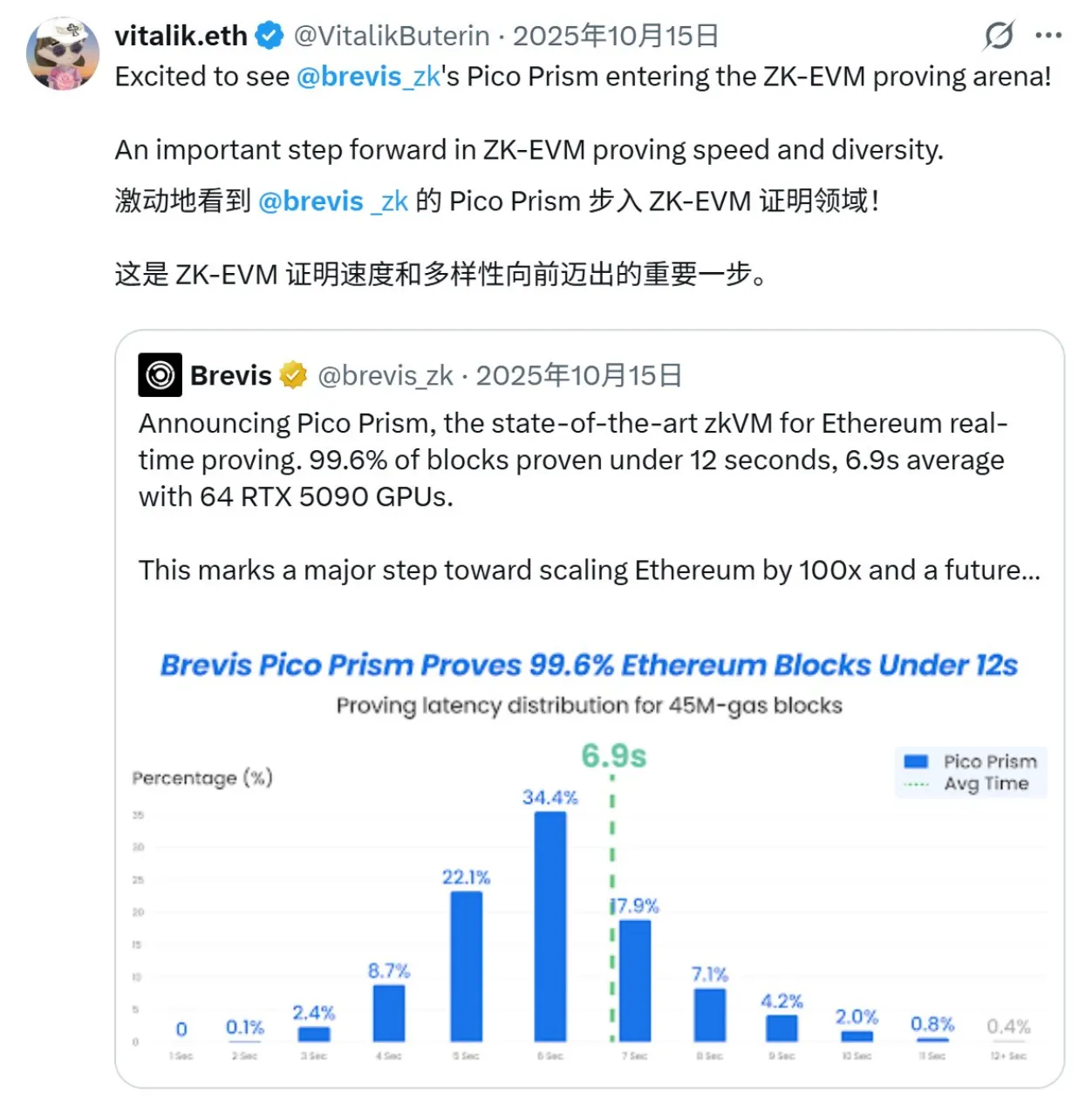
What about L2? It might have some impact, but it’s still limited.
When Vitalik discussed Polygon, he said that ZK and L2 should be considered separately.
The ZK-ized L1 will inevitably attract some users from ZK L2s, after all, if L1 is cheap enough, users might reduce their use of L2s.
But thinking in reverse, L1 is like the foundation, and L2 is like a skyscraper. The foundation should be as solid as possible, so ZK on the mainnet L1 will also reduce costs for L2, which is beneficial.
In addition, Vitalik’s tweet also mentioned Brevis, which is working on ZK-VMs. The reason is that Brevis’s ZK work is not limited to L2, meaning “ZK research and L2 research are separate.”
For example, they have a ZK computing market, helping Uniswap with ZK-based reward distribution, which is application-driven. 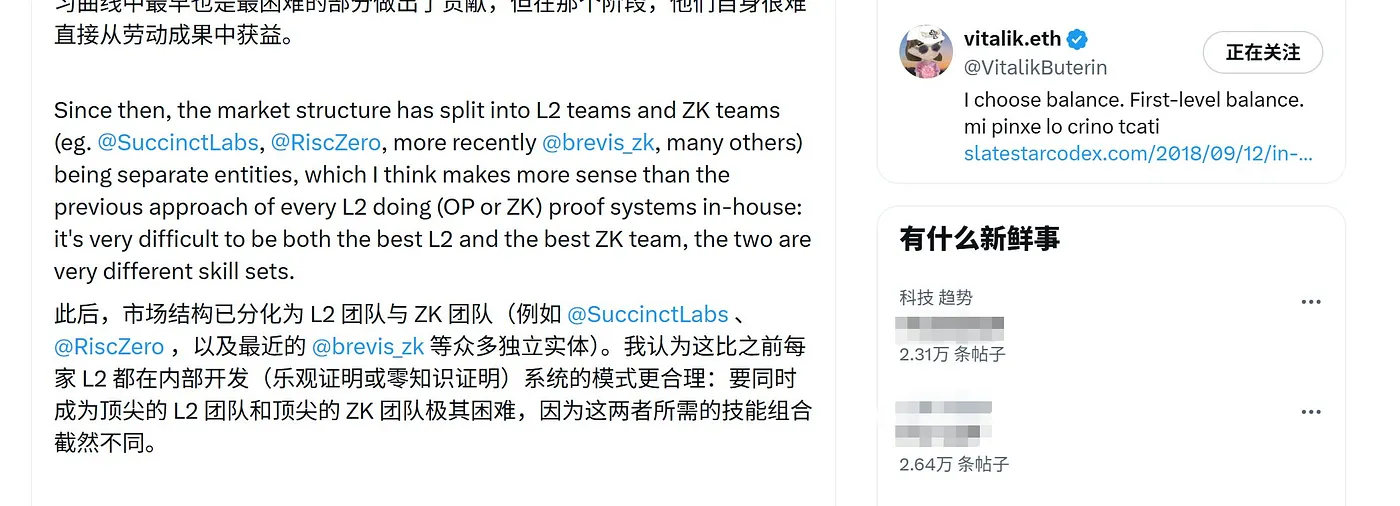
In summary, Ethereum has been around for 10 years, and the idea of ZK has been around for five or six years. After years of effort, ZK has finally entered the Alpha stage, thanks to continuous investment from Ethereum and many third-party ZK teams including Brevis and Polygon.
Related Articles
Wave ETH whale withdrew 6,898.98 ETH from a certain CEX this morning, worth 13.58 million USD
Gate News Report, March 8 — According to on-chain analyst Ai Yi's monitoring, a large trader who made a profit of $185,000 through ETH swing trading on March 3 has made another move. Three hours ago, this address withdrew 6,898.98 ETH, worth $13.58 million, at a withdrawal price of $1,968.58. The last swing buy-in point for this address was at $2,056, with a suspected sell point at $2,083, and the holding period was a total of 3 days.
GateNews6m ago
Price Predictions 3/6: BTC,ETH,BNB,XRP,SOL,DOGE,ADA,BCH,HYPE,XMR
Bitcoin (CRYPTO: BTC) faced a renewed test after a brief relief rally, sliding back below the $68,500 mark as sellers reasserted control. The move comes after the asset briefly flirted with the $74,000 threshold, a level that previously functioned as a ceiling during the latest ascent. Traders now e
CryptoBreaking10m ago
Sky Co-founder Rune opens 7x leveraged short positions on ETH and the NASDAQ 100, planning to add four more positions.
Gate News Report, March 8: According to Onchain Lens monitoring, Sky co-founder Rune has opened a 7x leveraged short position on ETH and the Nasdaq 100 (U.S. Nasdaq 100 Index). Previously, Rune was long on crude oil futures CL (WTI crude oil, U.S. crude oil futures benchmark) and Brent Oil (Brent crude oil, international crude oil futures benchmark). Currently, their account still holds
GateNews50m ago
Ethereum ICO slept for 10 years and suddenly moved 401 ETH
A cryptocurrency wallet that participated in Ethereum's 2014 ICO has moved 401.1 ETH for the first time in over a decade, potentially preparing to sell. Initially purchased for $124, the ETH is now worth around $802,200, reflecting a profit of about 6,469 times.
TapChiBitcoin54m ago
A newly created wallet deposits 2 million USDC into Hyperliquid to open short positions on BTC and ETH.
Gate News Report, March 8th: According to Onchain Lens monitoring, a newly created wallet deposited 2 million USDC into Hyperliquid, opened a 5x leveraged BTC short position and a 20x leveraged ETH short position, with the current position value approximately equivalent to 10 million USD.
GateNews1h ago
Ethereum co-founder Jeffrey Wilcke allegedly sold 79,000 ETH yesterday, worth $157 million
Gate News Report, March 8 — According to on-chain analyst Ai Yi's monitoring, Ethereum co-founder Jeffrey Wilcke allegedly sold 79,258.61 ETH yesterday (March 7), worth $157 million. After 7 months, this address became active again, transferring a large amount of ETH to a certain CEX through 4 addresses. Currently, the address still holds 27,421.73 ETH, with a total value of $54.37 million.
GateNews1h ago


