Author: Deng Tong, Golden Finance
On October 15th, Brevis launched the “Pico Prism” technology product, which garnered a collective shout-out from the Ethereum officials and sparked heated discussions within the community.
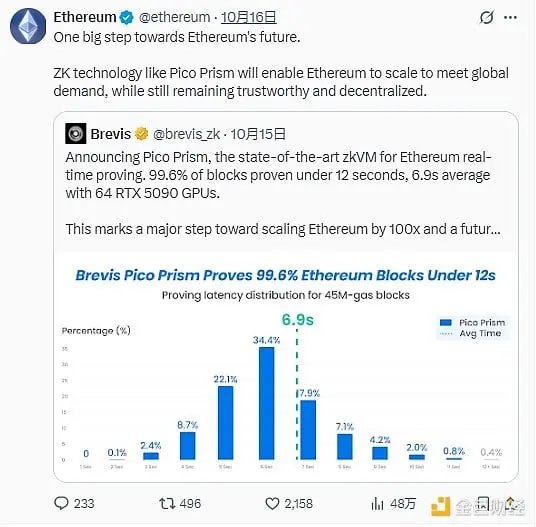
On October 16, the official Ethereum account retweeted Brevis's post about “Pico Prism” with the caption: “This is a significant step towards the future of Ethereum. Zero-knowledge proof technologies like Pico Prism will enable Ethereum to scale to meet global demand while still maintaining credibility and decentralization.”
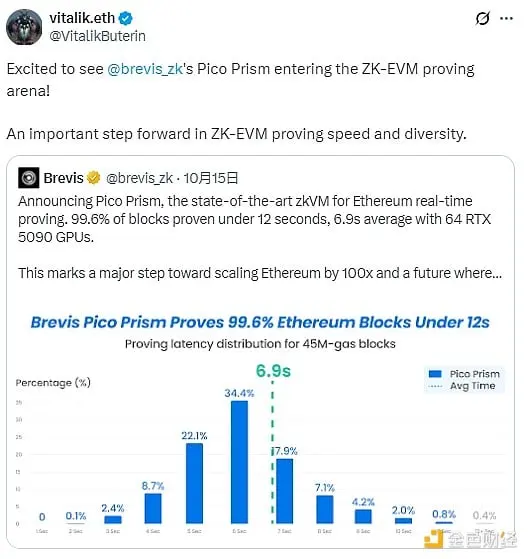
On October 15th, Vitalik retweeted and posted: “Glad to see @brevis_zk's Pico Prism entering the ZK-EVM verification space! ZK-EVM verification speed and diversity have taken an important step forward.”
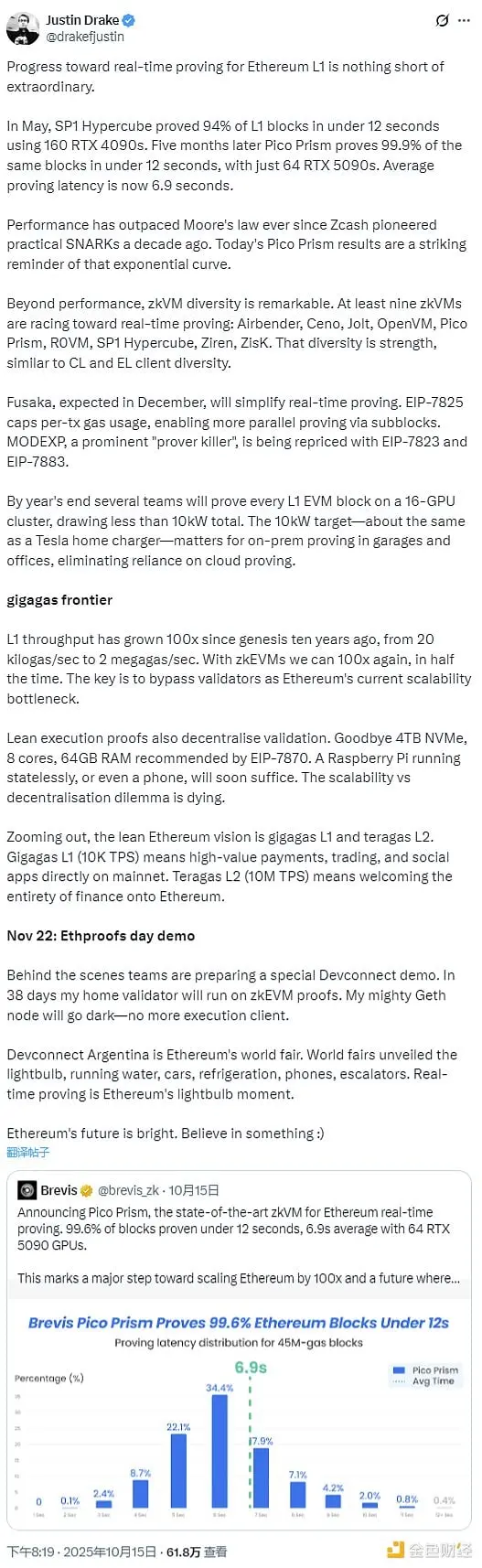
Ethereum core developer Justin Drake has also joined the call.
What is Pico Prism, and why is it making the official Ethereum account go crazy with calls?
1. Technical breakthroughs of Pico Prism
Pico Prism, developed by Brevis, utilizes consumer-grade hardware equipped with 64 RTX 5090 GPUs to achieve real-time proof of Ethereum Layer-1 (RTP). In tests conducted in September, Pico Prism achieved 99.6% real-time proof in under 12 seconds.
Brevis's blog post introduces Pico Prism as follows:
Pico Prism is the first to achieve real-time proof of 45M gas limit blocks using affordable consumer-grade hardware. We benchmarked Pico Prism on 8 servers, each equipped with 8 RTX 5090 GPUs, totaling 64 GPUs. To compare with SP1 Hypercube, we uniformly sampled 1,000 blocks from the same time period of the Succinct benchmark. For the 45M gas limit blocks, we benchmarked each block generated on September 1, 2025.
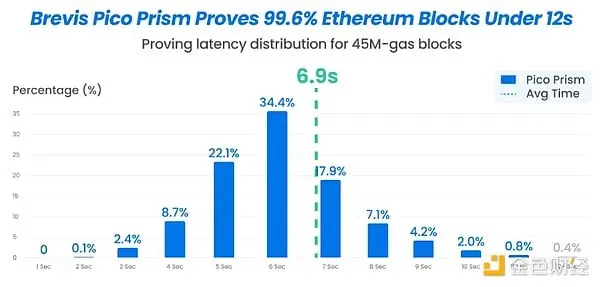
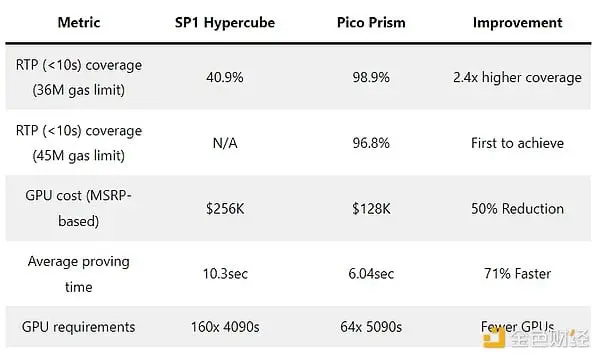
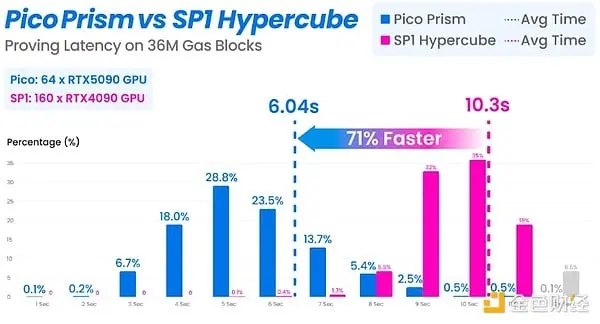
In addition to individual indicators, Pico Prism has achieved a performance advantage of 3.4 times over SP1 in terms of speed and cost efficiency (calculated as average validation time × hardware cost).
Pico Prism uses consumer-grade RTX 5090 GPUs, proving that real-time verification can be achieved without expensive data center hardware.
Multi-GPU and Multi-Machine Proof
The migration from a single GPU prover to a fully distributed multi-machine multi-GPU architecture is a significant breakthrough for Pico. The core of this leap is a complete redesign of the computing pipeline.
Thanks to Pico's modular design, the proof process is broken down into multiple stages, from simulation to layered recursion. Compute-intensive workloads are offloaded to the GPU, while setup tasks remain on the CPU, executed in a highly parallel pipeline, thereby maintaining GPU saturation and operating at peak efficiency. This extreme optimization and parallelization can provide nearly linear acceleration when scaling across multiple machines and GPUs, resulting in transformative and undeniable outcomes: Pico Prism achieves Ethereum-scale true real-time proof using easily accessible consumer-grade hardware.
Future Planning
With the release of Pico Prism, the integration path for Ethereum L1 zkVM has become clearer. Although we are only 2.2% away from the updated real-time validation goal of under 10 seconds, we have begun rolling out some readily accessible new features to easily achieve this goal.
The next important milestone for Pico Prism is focusing on reducing validation costs. We have formulated a roadmap aimed at achieving 99% real-time validation using fewer than 16 RTX 5090 GPUs in the coming months.
2. The Significance of Ethereum
1. Implement Lightweight Verification
This breakthrough means that the costly proof of computation can finally catch up with block production speed using affordable consumer hardware, making lightweight verification practically feasible for the first time. Currently, each validator re-executes each transaction to verify the block, which requires expensive hardware and creates fundamental bottlenecks. However, “real-time proof breaks this pattern. A prover generates a proof, and others verify it within a few milliseconds.”
2. Moving Towards 10,000 TPS
According to the Ethereum roadmap, validators will shift from re-executing transactions to simply validating ZK proofs, allowing the base layer to reach 10,000 transactions per second.
Ryan Sean Adams from Bankless pointed out: “If it expands at a rate of 3 times per year, by April 2029, the TPS of Ethereum L1 will reach 10,000 TPS.”
Bitcoin security researcher Justin Drake ( explains: The Ethereum Fusaka upgrade is expected to take place in December, which will simplify real-time proof. “EIP-7825 limits the gas usage per transaction, allowing for more parallel proof through sub-blocks. By the end of this year, several teams will be proving each L1 EVM block on a 16-GPU cluster, with a total power consumption of less than 10kW.”
3. Node can run on mobile
Tech entrepreneur Mike Warner ) Mike Warner ( stated: “The future of mobile phones as nodes is about to become a reality.”
Adams pointed out that Ethereum is transitioning to a zk chain: Layer 1 will run global DeFi with a TPS of 10,000 for its large blocks, and nodes will be able to run on mobile phones, while Layer 2 will run everything else. “No other blockchain follows this strategy—using zero-knowledge proof technology to achieve maximum scalability and decentralization. Bitcoin remains conservative in the first generation of cryptography. Ethereum is actively transitioning to the second generation of cryptography. Other blockchains use nodes that require data centers for scaling.”
This is essentially the holy grail of blockchain: achieving massive scalability without sacrificing decentralization or security.
) 3. What is real-time proof and why is it important for Ethereum?
Real-time Proving is a new and more efficient technology that allows for transaction verification by generating a small proof, rather than having each node re-execute all transactions, significantly increasing transaction speed and reducing costs. This is important for Ethereum because it enables large-scale scalability without sacrificing decentralization, making Ethereum transactions faster, cheaper, and more secure.
- Significant Expansion: Real-time proof greatly enhances the transaction processing capability of Ethereum without compromising decentralization.
- Lower costs: As nodes do not need to perform complex calculations, the cost of transactions will be significantly reduced.
- Increased Speed: The speed of transaction validation has been greatly improved, providing a better user experience.
- Enhance Security: Real-time proof helps to improve the security of the entire Ethereum network by making transaction validation more efficient and secure.
Mo Dong, CEO and co-founder of Brevis, stated: “The data speaks for itself. The infrastructure we have built can handle the actual production data of Ethereum at present. Faster performance brings economic benefits, making real-time proof practically feasible in production deployments.”
With Pico Prism, the roadmap for Ethereum L1 zkEVM integration is now clearer.


