Helium (HNT) serves as the core token powering the Helium decentralized wireless network, incentivizing node operators, supporting network operations, and driving ecosystem growth. As Decentralized Physical Infrastructure Networks (DePIN) gain momentum, HNT has emerged as a pivotal token model bridging real-world infrastructure with blockchain-based incentive mechanisms.
2026-04-20 11:00:16
Helium (HNT) is a blockchain infrastructure token designed for building decentralized wireless communication networks. By enabling IoT and mobile network connectivity through community-deployed wireless nodes, Helium supports the growth of the Decentralized Physical Infrastructure Network (DePIN) and is widely adopted in IoT communications, smart city applications, and mobile network environments.
2026-04-20 10:50:16
Helium (HNT) is a blockchain infrastructure protocol designed for building decentralized wireless communication networks, delivering wireless coverage and data transmission services through community-deployed Hotspot nodes. As the Decentralized Physical Infrastructure Network (DePIN) evolves, Helium is widely adopted for IoT connectivity, WiFi network expansion, and mobile communication applications.
2026-04-20 10:49:30
The core difference between Filecoin and Arweave is that the former uses a market based, renewable storage model, while the latter uses a one time payment model for permanent storage.
2026-04-17 10:16:23
Filecoin’s economic model is driven by block rewards, storage income, and a collateral mechanism that incentivizes miners to provide storage resources, with FIL distributed as rewards.
2026-04-17 10:09:23
Filecoin is a decentralized storage network that connects storage demand with storage supply through blockchain-based incentives.
2026-04-17 10:02:22
ST is the core utility token in the Sentio ecosystem, connecting the flow of value among developers, data infrastructure, and network participants. As a key part of Sentio’s real time onchain data network, ST can be used for resource consumption, network incentives, and ecosystem collaboration, helping the platform build a sustainable data service model. By introducing the ST token mechanism, Sentio ties network resource usage to ecosystem incentives, allowing developers to access real time data services more efficiently while strengthening the long term sustainability of the broader data network.
2026-04-17 09:26:07
Sentio and The Graph are both used for on-chain data indexing, but they differ clearly in their core design goals. The Graph indexes on-chain data through subgraphs and mainly serves data querying and aggregation needs. Sentio, by contrast, uses a real time indexing mechanism that emphasizes low latency data processing, visual monitoring, and automated alerting, making it more suitable for real time monitoring and risk warning scenarios.
2026-04-17 08:55:07
Sentio’s real-time data indexing mechanism continuously monitors on-chain events, then parses, processes, and outputs data as soon as it is generated, enabling low latency data monitoring. Its real-time data processing flow mainly includes four stages: event monitoring, data parsing, structured processing, and real-time output, supporting DeFi protocol monitoring, security alerts, and on-chain operations analysis. Compared with traditional on-chain data platforms, Sentio places greater emphasis on real-time, event-driven processing, allowing raw blockchain logs to be quickly transformed into visual metrics and automated alert information.
2026-04-17 08:32:24
Sentio (ST) is a real-time on-chain data infrastructure designed for the Web3 ecosystem, providing developers and protocols with instant data indexing, visual analytics, and automated alerting capabilities. Compared to traditional on-chain data platforms, Sentio places greater emphasis on real-time responsiveness and monitoring, enabling DeFi protocols, development teams, and analytics use cases to quickly capture blockchain events and generate actionable insights. By integrating real-time indexing, dashboard visualization, and automated alert mechanisms, Sentio delivers a more efficient data infrastructure layer for Web3 applications, playing a key role in areas such as protocol monitoring, risk alerts, and operational analytics.
2026-04-17 08:12:50
idOS (IDOS) is a Web3 identity layer that provides users with portable identity verification and self-custodied data storage, allowing KYC information to be reused across platforms. By linking identity to blockchain addresses, idOS addresses fragmentation and repetitive verification in Web3, emerging as a critical infrastructure connecting users, applications, and compliance systems within the stablecoin economy.
2026-04-16 01:52:04
Last year, the narrative of DePIN ignited the trend of Helium (Mobile). Although DePIN seemed unremarkable during the “Bitcoin Bull Market,” it still brought surprises to the cryptocurrency industry. At the recent ETHDenver 2024 conference, DePIN was listed as a hot track, and now the success of io.net has once again stirred up the DePIN narrative.
2026-04-07 20:47:34
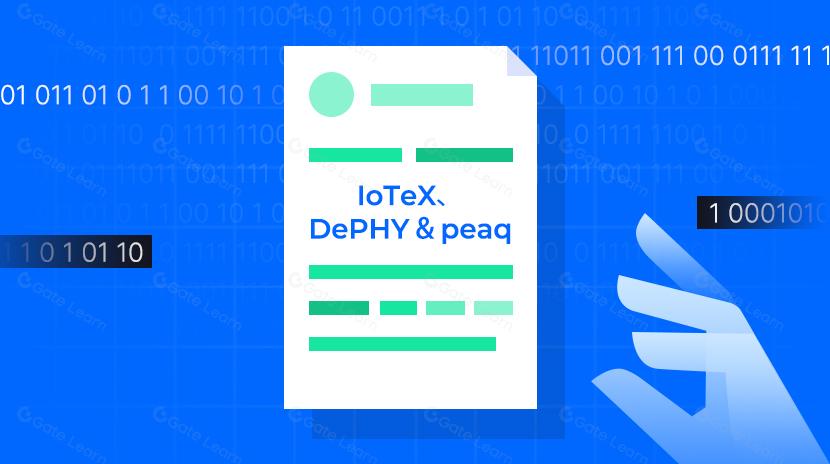
This article reviews the process of IoT devices generating data, storing data, and rolling up to the blockchain. It also introduces the DePIN infrastructure platform, which can help project teams quickly launch DePIN application projects. DePIN utilizes blockchain for incentive distribution and token allocation, requiring the use of public-private keys to generate and verify physical proof of work. To prevent Sybil attacks, DePIN device manufacturers monopolize the generation authority of identity information and expose malicious behavior through social consensus. DePHY provides DID authentication services to ensure the credibility of data sources. DePHY also provides a co-processor to listen to finalized messages on the message network and perform state transitions. Both DePHY and IoTeX choose to collect data off-chain and then roll up to the chain, with DePHY focusing on decentralized data availability layers and IoTeX emphasizing binding handlers to different events.
2026-04-07 20:38:59
Delve into the background of the OORT track, project operation logic, and more, to glimpse the project's prospects and the opportunities and challenges for the AI+DePIN track in 2024.
2026-04-07 20:25:02
DePIN is one of Solana's key user growth strategies, with the potential for widespread adoption similar to DeFi, gaming, and social properties. This article provides a detailed overview of typical cases in the market and their extensive impact on blockchain.
2026-04-07 19:38:59