Kim Jong-seung, CEO of MRI, stated on January 15 at a seminar in Mapo-gu, Seoul, that peg (par value) maintenance is more important than issuer equity composition in stablecoin legislation. The seminar, titled 'US Digital Asset Hegemony Strategy and Korea's Response,' was held at Hotel Naru. Kim argued that the first-half legislative debate focused on issuer equity — specifically the 51% bank ownership requirement — but that this discussion is insufficient. He emphasized that peg stability depends on redemption architecture and crisis resolution mechanisms, not ownership structure alone. Kim provided the 2023 USDC incident as evidence: despite sound reserve assets, USDC's peg fell to 0.874 USD when the redemption pathway was blocked, recovering only after the Federal Reserve and FDIC announced public deposit protection. He stated that stablecoin circulation exceeds 300 billion USD, with on-chain transaction volume reaching 14.7 trillion USD over 12 months, underscoring the systemic importance of peg maintenance design.
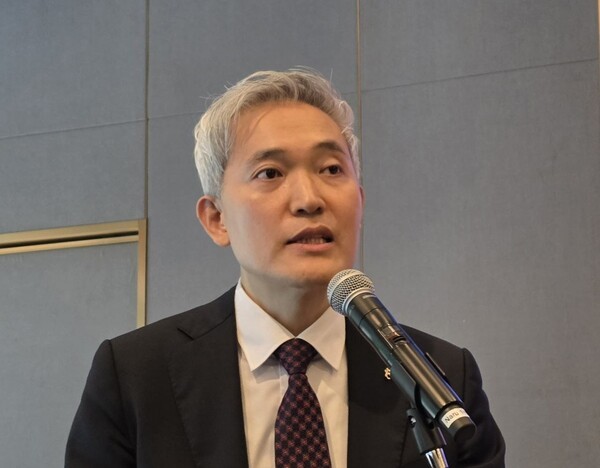 Kim Jong-seung, MRI CEO, speaks at the January 15 seminar in Seoul. Source: Park Bum-soo / Digital Asset
USDC Depeg in 2023 Demonstrates Redemption Pathway Risk
Kim referenced the 2023 USDC incident to illustrate that reserve adequacy alone does not guarantee peg stability. He noted that Circle, the issuer of USDC, maintained reserves with 92% held at institutions other than Silicon Valley Bank and only 8% at the bank. Despite this diversification, USDC's peg fell to 0.874 USD — a 12.6% decline — during a 72-hour period following Silicon Valley Bank's closure. Kim stated that the peg recovered only after the Federal Reserve and FDIC announced they would protect all deposits at the bank. He explained that primary redemption (direct issuer redemption) was blocked, causing panic selling in the secondary market. Arbitrageurs could not restore the peg because they lacked a pathway to redeem tokens at par. Kim concluded that the incident proves reserve assets are necessary but not sufficient for peg maintenance.
Morris-Shin Framework Explains Peg Equilibrium Conditions
Kim applied the Morris-Shin coordination framework, developed by Hyun Song Shin (current Governor of the Bank of Korea) over 20 years ago, to explain stablecoin peg dynamics. He stated that under complete information, two equilibria exist: one where the peg holds, and one where a run occurs. Under incomplete information, holders observe private signals about the issuer's solvency and predict others' behavior, leading to self-fulfilling outcomes. Kim identified a critical zone where solvency exists at maturity but short-term liquidity constraints create losses if redemption is forced immediately. He argued that this zone — between the solvency threshold and the run threshold — is where peg failures occur despite adequate reserves. Kim stated that policy design must narrow this zone by ensuring credible resolution mechanisms, not merely by increasing reserve ratios.
Kim Proposes Resolution Authority and Joint Industry Fund
Kim proposed three policy mechanisms to restore peg equilibrium during crises. First, he called for a resolution-transfer authority that allows regulators to transfer a failed issuer's stablecoin liabilities and reserve assets to a healthy issuer, protecting token holders even if the original issuer becomes insolvent. Second, he recommended establishing a joint industry fund, financed by stablecoin issuers, to provide liquidity during stress events. He stated that the failed issuer should absorb initial losses, followed by the joint fund, with public backstop funds used only as a last resort under strict conditions. Third, he referenced Article 80 of the Bank of Korea Act as a potential legal basis for conditional central bank liquidity support, though he acknowledged this would require careful design to avoid moral hazard. Kim stated that these mechanisms are independent of issuer ownership structure and must be addressed separately in legislation. He noted that current frameworks — including the US GENIUS Act and the EU's MiCA regulation — lack detailed resolution provisions. Kim concluded that the Digital Asset Basic Act under discussion in Korea must prioritize resolution architecture over equity requirements to ensure stablecoin stability.
FAQ
What did Kim Jong-seung say about stablecoin legislation on January 15?
Kim Jong-seung stated at a January 15 seminar in Seoul that peg maintenance is more important than issuer equity composition in stablecoin legislation. He argued that the 51% bank ownership debate is insufficient and that redemption architecture and resolution mechanisms are critical for peg stability.
Why did USDC's peg fall in 2023 despite sound reserves?
Kim explained that USDC's peg fell to 0.874 USD in 2023 because the primary redemption pathway was blocked after Silicon Valley Bank's closure, even though 92% of reserves were held elsewhere. The peg recovered only after the Federal Reserve and FDIC announced deposit protection, demonstrating that reserve adequacy alone does not prevent peg failures.
What policy mechanisms did Kim propose for stablecoin peg stability?
Kim proposed three mechanisms: a resolution-transfer authority to move failed issuers' liabilities and reserves to healthy issuers, a joint industry fund financed by issuers to provide crisis liquidity, and conditional central bank backstop support. He stated these mechanisms are independent of ownership structure and must be designed to avoid moral hazard.


