This price action is not an isolated event. The Philadelphia Semiconductor Index (SOX) fell 2.23% that day, extending the recent downtrend and closing at its lowest level since May 19. NVIDIA fell 4.99%, and ASML dropped more than 5%. Along with individual stocks such as SpaceX, SK hynix became one of the first companies to trade below its issue price among the largest-scale IPOs in U.S. equities in 2026.
However, from a fundamentals perspective, the global HBM leader is currently in the strongest performance cycle in its history. Market consensus shows that SK hynix’s revenue in Q2 2026 is expected to reach 84.06 trillion won, while operating profit is expected to reach 64.09 trillion won, implying a year-over-year increase of nearly 600%. Just last week, Samsung Electronics, SK hynix, and AI chip makers including NVIDIA and Broadcom signed an AI chip cooperation plan with a total value of $840.6k. SK hynix also signed a forward-looking HBM supply agreement with NVIDIA worth $500 billion through 2030. On HBM capacity, all of 2026’s capacity has already been sold out, with regular orders pushed out to Q1 2027.
Orders are growing, earnings are surging, yet the stock price is plunging. Behind this contradiction is a deep shift in the investment logic for AI semiconductors—from a “demand story” to “earnings validation.”
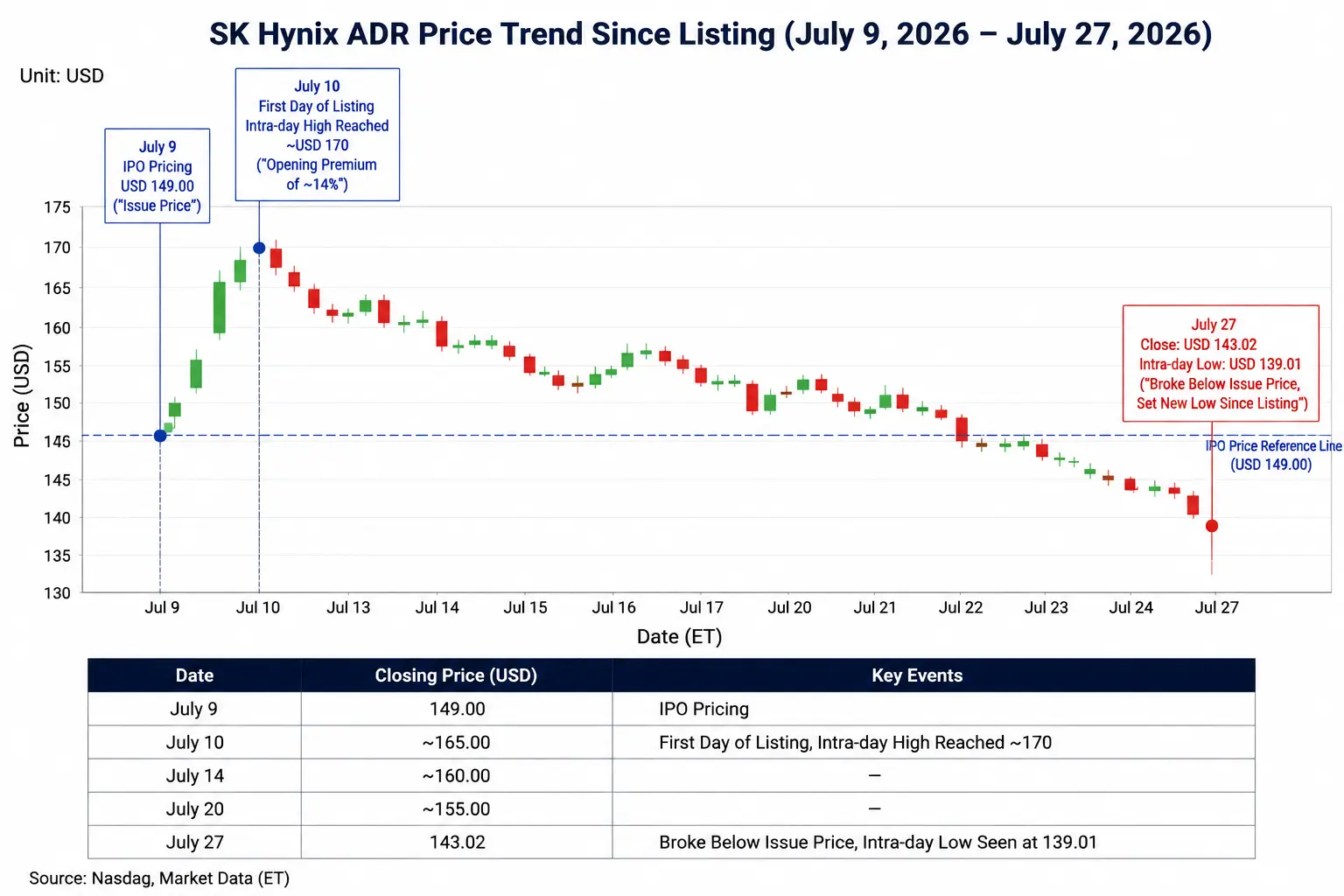
SK hynix ADR price performance since listing and key events annotated
Why the order-size narrative failed?
Over the past 18 months, the core investment logic across the AI chip supply chain has centered on “demand surges.” GPU supply has been tight, HBM capacity has sold out, and CoWoS packaging capacity has been constrained—every supply bottleneck has reinforced the appeal of the “demand story.” SK hynix occupies an almost indispensable position in this narrative: according to Counterpoint Research data, in Q1 2026 the company captured 58% of the global HBM market share; based on sales, SK hynix’s HBM revenue in 2026 is expected to reach $5.95 billion, maintaining its position as the global No. 1.
Within this narrative framework, order size becomes the key pricing factor. A $640.9k AI chip cooperation plan and a $950B long-term supply agreement with NVIDIA—those numbers alone would be enough to drive the stock price higher. In fact, on July 10, when the SK hynix ADR began trading on Nasdaq for the first day, the opening price briefly reached $170, about 14% above the issue price.
But the market’s pricing logic is undergoing a subtle yet fundamental change. When HBM capacity has been sold out for multiple quarters in a row, and when long-term supply agreements are locked through 2030, whether demand is sufficient is no longer the question that needs to be validated. The real issue becomes: given such strong demand, how fast can profits be realized? Can profit margins be sustained at high levels? How much room is there left for growth?
These three questions align precisely with the three dimensions the market is focusing on as it shifts attention from “order size” to “profit realization capability”: gross margin, cash flow, and future growth room.
Three follow-up questions on profit realization ability
Sustainability of gross margin is the first suspense point. Market consensus expects SK hynix’s second-quarter operating margin to reach 75% to 77%, exceeding TSMC for the third consecutive quarter. Such a level is extremely rare in manufacturing—traditional DRAM margins are usually in the 20% to 40% range. The premium pricing of HBM versus traditional DRAM is a source of excess profits, but how long can that premium hold?
On the supply side, expansion is accelerating. Samsung Electronics plans to spend more than 110 trillion won in device investment and R&D in 2026; Micron’s device investment plan is set to grow by more than 90% compared with the previous year. KB Securities noted that Samsung’s aggressive HBM blueprint and Micron’s capacity expansion may compress profit margins by 5 to 10 percentage points over the next four quarters. While SK hynix leads Samsung by 12 to 18 months in the HBM3E field, this window is narrowing. Morningside analyst Jing Jie Yu warned that as large-scale supply is gradually released in 2027 and 2028, the supply-demand relationship in the memory market will improve, weakening manufacturers’ pricing power.
Cash-flow conversion efficiency is the second dimension. There is not a linear relationship between orders and profits. The locking mechanism in long-term agreements (LTA) may safeguard revenue visibility while also limiting the elasticity of profit margins. Korean brokerage KIS previously lowered its Q2 performance expectations for SK hynix. The core reason was that HBM revenue carries a high share and is constrained by long-term contract pricing, with average selling price growth below the market average. In other words, long-term deals lock in volume but also lock up upside pricing potential. When spot market prices increase far outpace contract prices, companies with a higher share of long-term contracts may actually “miss out” on part of the profit elasticity.
Future growth room is the third question. Is the growth expectation implied in the current valuation already saturated? After this round of adjustment, SK hynix’s forward P/E has fallen significantly to 4.4x, below Micron’s 6.2x. On an absolute basis, it appears near historical lows. But a low P/E can mean “undervaluation,” or it can reflect market doubts about whether the earnings peak is sustainable—i.e., current profits may be at the top of the cycle and forward profits could revert to the mean. The cyclical characteristics of the memory industry mean such concerns are not baseless.
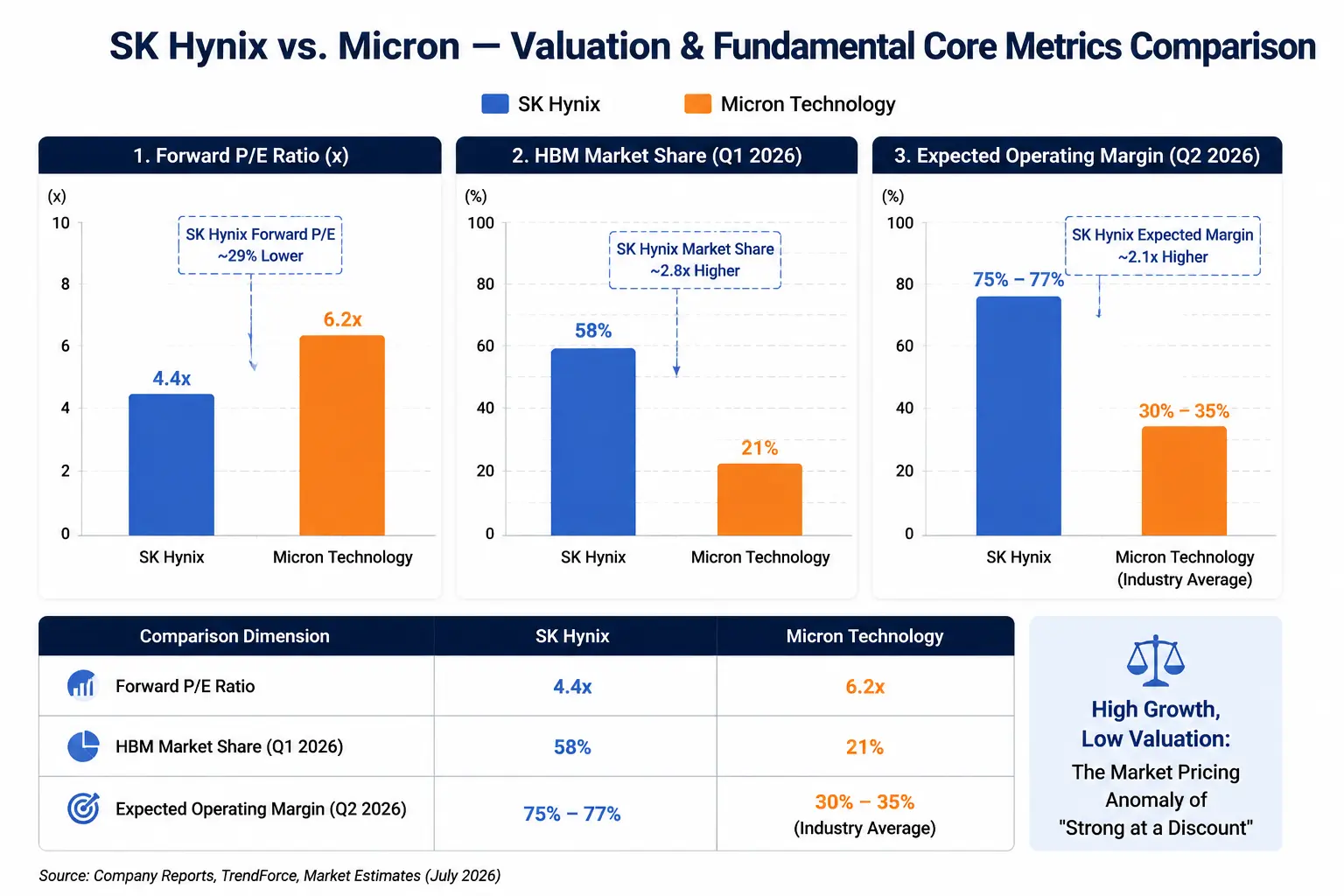
SK hynix vs. Micron — comparison of valuation and core fundamental indicators
A systemic switch in semiconductor valuation logic
SK hynix ADR’s break below the issue price is not an isolated stock-specific event, but a snapshot of the broader AI semiconductor sector’s valuation reshaping.
In recent weeks, the chip sector has undergone a rapid pullback. AI chip leaders including NVIDIA and AMD saw significant declines. The DRAM ETF has retreated about 25% from its June 22 high. Multiple institutions reduced holdings in response to elevated semiconductor valuations, while capital flowed into lower-valued sectors such as software and financials.
Citi attributed this round of SOX adjustment to three factors: rising oil prices increasing risk-avoidance sentiment; higher U.S. Treasury yields suppressing long-term valuations; and concerns that AI capital expenditures are starting to cool. He Li, general manager of private fund Zhiyou Investment, pointed out that hard-technology stocks had gained significantly early on and had their expectations fully priced. Once the market starts expecting a slowdown in price gains, marginal deceleration in capital expenditures, and doubts about the return on AI compute investments, investors first deleverage and kill valuations.
These explanations point to the same conclusion: AI semiconductor valuations are switching from pricing “explosive growth” to pricing “mature growth.” During this transition, the market is no longer satisfied with a story that “orders are huge,” and instead demands evidence that “profits are strong and can keep staying strong.”
Earnings-report window: the moment of validation is coming
SK hynix will release its formal Q2 earnings report on July 29. This report will become a key milestone to test the logic shift described above.
Market consensus is already quite full. Revenue is expected at 84.06 trillion won, operating profit at 64.09 trillion won, and operating margin at 75% to 77%. Any data below expectations could be amplified in interpretation—just as shown by the sharp selloff triggered by a KIS forecast that was 8% below consensus earlier.
Even more worth watching is management’s guidance for performance in the second half. The B2B sales share (directed at large technology companies and AI data centers) is expected to rise from 30% in 2017 to 70% in 2027. Whether this structural change can truly reduce earnings volatility, improve earnings predictability, and thereby support a valuation rebound will be the core proposition assessed by the market.
Meanwhile, SK hynix has returned to a net cash position since Q3 last year. By the end of Q1 this year, its net cash has increased to 35 trillion won. Improvements in the financial structure provide a buffer against cyclical fluctuations, but under current market sentiment, the balance sheet quality is still not enough to offset concerns about profit sustainability.
Logic reconstruction behind the divergence
A $500B AI chip order book, a $950B long-term supply agreement, 58% of the global HBM market share, and operating margins above 75%—these figures point to a company in the strongest cycle in its history. Yet the SK hynix ADR broke below the issue price less than a month after listing, and even fell to $139.01 intraday.
This divergence is not the market “making a mistake,” but a systematic switch in pricing logic. When the “AI demand story” has already been priced in, when HBM capacity sold out becomes the norm, and when long-term agreements lock in revenue but constrain elasticity, the market naturally shifts attention from “how big the orders are” to “how much profit can be realized and for how long.”
The SK hynix ADR’s break below issue price is a signal: AI semiconductor investment has entered an “earnings validation” phase. In this phase, order size is just the ticket; profit realization capability is the core of valuation. The Q2 report on July 29 will be the first large-scale test of this new logic—and the market’s answer will determine the depth and direction of this valuation reshaping.
FAQ
Q1: What is the issue price of SK hynix ADR? How has the stock performed so far?
SK hynix ADR was priced at $149 per share on July 9, 2026, raising about $500B. On July 28 (Beijing time), it plunged as much as 10% to $139.01 intraday, and ultimately closed at $143.02, down about 4% from the issue price. The stock became one of the first companies to trade below the issue price among the largest-scale IPOs in U.S. equities in 2026.
Q2: Has SK hynix’s fundamentals deteriorated?
Based on financial data, fundamentals have not deteriorated. Market consensus expects Q2 2026 revenue of 84.06 trillion won and operating profit of 64.09 trillion won, implying a year-over-year increase of nearly 600% and the possibility of setting a historical record. All HBM capacity for 2026 has been sold out, with orders queued through 2027. The issue is not whether it is profitable, but whether it can “earn as the market previously expected” and how long “high profits” can be maintained.
Q3: Why did the stock fall despite record AI chip orders?
Market attention is shifting from “order size” to “profit realization capability.” A $1.1M order book is certainly large, but the long-term agreement (LTA) locking mechanism may constrain profit elasticity; capacity expansions by Samsung and Micron could compress profit margins in the future; and the cyclical nature of the memory industry makes the market concerned about the pullback after the profit peak. In addition, elevated valuations across the semiconductor sector and capital rotation into lower-valued sectors are important background factors.
Q4: What level is SK hynix’s valuation at right now?
After this round of adjustment, SK hynix’s forward P/E has fallen to about 4.4x, below Micron’s 6.2x. Based on historical ranges, it is at an extremely low level. But a low P/E can be interpreted as “undervaluation,” or it may reflect market concerns about the top of the earnings cycle. SK hynix’s expected price-to-earnings ratio for 2026 is below 6x. This valuation reflects market doubts about whether the memory super-cycle can continue along its current trajectory.
Q5: Why is SK hynix’s upcoming earnings report so important?
SK hynix will release its formal Q2 earnings report on July 29. Market consensus is already quite robust (revenue 84.06 trillion won, operating margin 75% to 77%). Any data below expectations may be amplified in interpretation. More importantly, management’s guidance for the second half of the year—whether the B2B sales share can keep rising and whether earnings predictability can improve—will determine whether the market is willing to grant valuation premium again.