Galaxy Digital research head Alex Thorn said in an X post that Bitcoin’s Q2 dormant trading volume has fallen to the lowest level since Q3 2022, and the “coin days destroyed” metric also declined over the same period. Thorn characterized the collective selling by veteran Bitcoin holders in 2024-2025 as “a one-time large-scale distribution (a big distribution).”
Bitcoin Q2 dormant trading volume falls to the lowest level since Q3 2022
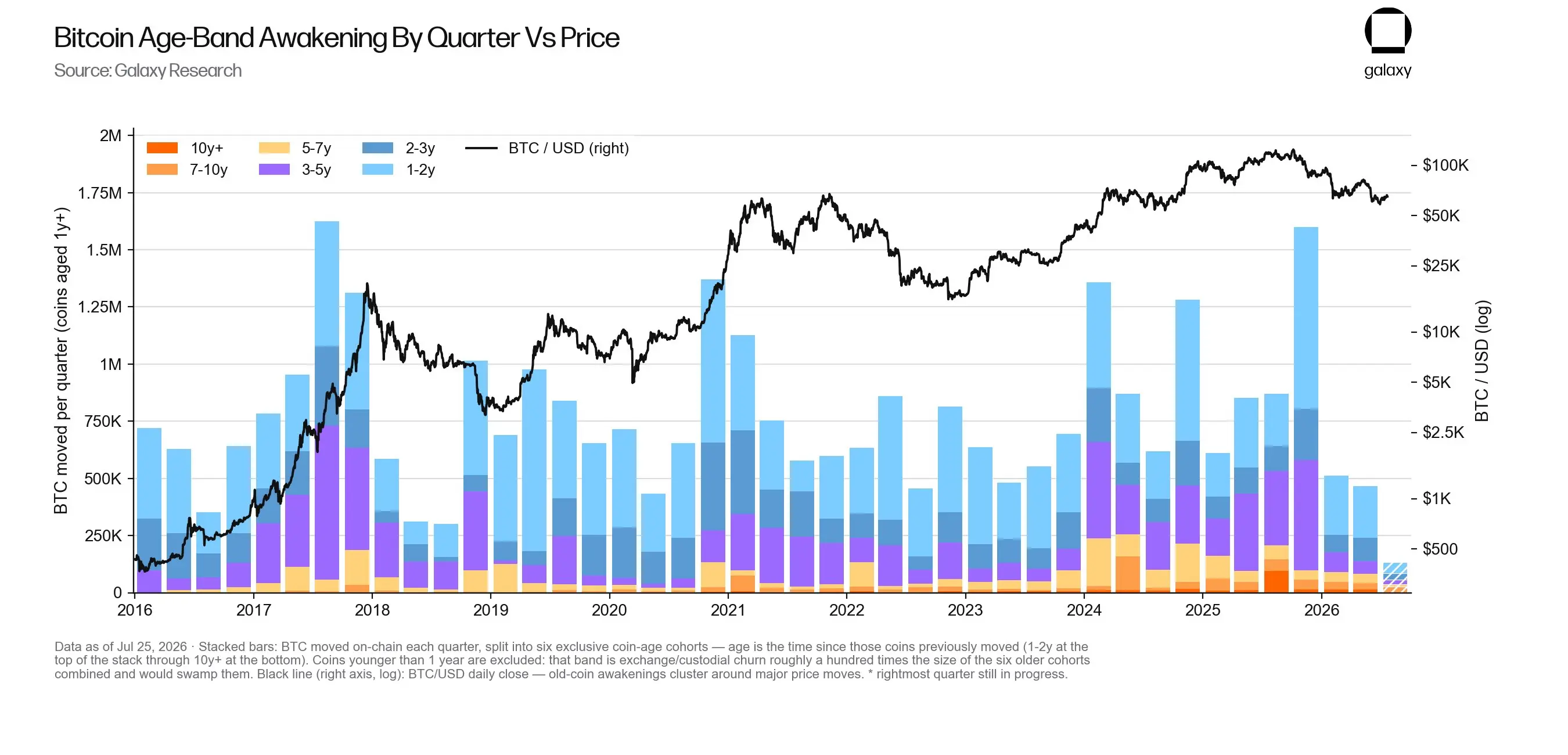 (Source: Galaxy Research)
According to a Galaxy Digital chart (data traced back to 2016), the “revival” history of long-dormant Bitcoin coins shows a clear bull-cycle pattern:
2017: Long-dormant coins revived in large volume for the first time as the bull run kicked off, with long-term holders collectively taking profits
2021: Long-dormant coins became active again in the next bull cycle
2024-2025: The revival volume reached an all-time peak, roughly equal to the size of the entire 2017 bull market; the monthly transfer volume for Bitcoin with a 1-2 year coin age at the end of 2025 was about 900k BTC
2026 Q2: Transfer momentum came to a sudden stop, with dormant trading volume falling to the lowest level since Q3 2022; Thorn expects the full-year revival volume to be less than half of 2025
Two-year scale of the “big distribution”: 2024-2025 revival volume equals the whole 2017 bull run
In mid-July, Thorn referred to 2024-2025 as “a one-time large-scale distribution.” He noted that the number of long-dormant Bitcoins revived in 2024 and 2025 was equivalent to the total of the entire uptrend in 2017, and no other period could match it.
Holders of Bitcoin with a coin age of 1 to 10 years transferred in large amounts during this time (most of it was selling), reaching a peak by the end of 2025: Bitcoin with a 1-2 year coin age transferred about 900k BTC within a single month. Most of the veteran holders who had planned to sell when Bitcoin rose in 2024-2025 had basically completed their sell-offs by then, reducing localized sell pressure in the market.
Clarifying “quantum risk”: none of Galaxy Digital’s institutional partners sold citing quantum risk
Thorn pushed back on the rumor online—that some large Bitcoin holders sold due to quantum risk (quantum computers could threaten the encryption security of Bitcoin). He said, “We work with many large investors, and none of them mentioned quantum risk as the reason for selling”; and none of Galaxy’s institutional investor partners cited quantum risk as a reason to close positions.
Thorn said concerns about quantum risk are often more of a barrier to new external buyers than a trigger for existing holders to sell.
FAQ
What level did Bitcoin’s Q2 dormant trading volume fall to?
According to data published by Galaxy Digital research head Alex Thorn, Bitcoin’s Q2 dormant trading volume fell to the lowest level since Q3 2022. The “Coin Days Destroyed” metric also declined over the same period, indicating that long-term holders have significantly slowed their selling pace.
How does Thorn assess the scale of the large-scale Bitcoin distribution in 2024-2025?
Thorn said the number of long-dormant Bitcoins revived in 2024 and 2025 is equivalent to the total of the entire 2017 bull market uptrend, making it the largest scale in the history Galaxy tracks. The monthly transfer volume for Bitcoin with a 1-2 year coin age reached about 900k BTC by the end of 2025, before momentum abruptly stopped in 2026.
Did Bitcoin holders sell because of quantum risk?
Thorn said none of Galaxy Digital’s large investor partners mentioned quantum risk as a selling reason, and no institutional investor partner closed positions for that reason. He believes quantum risk is more likely to deter new external buyers than to prompt existing holders to sell.


