U.S. lawyer Tyrone Blackburn was reprimanded again by a federal judge after citing AI-fabricated quotes in court filings for the entertainment company Roc Nation, marking the third time he was sanctioned over an AI hallucination issue. Tests of Lexis+ AI and AI tools from Thomson Reuters show that more than 17% of outputs contained incorrect information, and in some tests, the error rate was as high as 34%.
AI-fabricated Quotes in the Roc Nation Lawsuit and Blackburn’s Prior Violations
 (Source: Court Listener)
Per an order from Judge Jennifer Willis, attorney Tyrone Blackburn included what appeared to be AI-generated false quotes in a brief he filed while representing Terence Dixon (a collaborator/partner of rapper Fat Joe) in a lawsuit accusing Roc Nation and Fat Joe of employment-related misconduct. Willis stated the conduct “severely violated his ethical and professional obligations,” and added that Blackburn’s explanation “dishonestly downplayed” his actions.
Blackburn’s prior disciplinary record includes: being sanctioned last December in federal court in New Jersey for citing an AI-fabricated case; and a Pennsylvania federal judge imposing a $5,000 fine on him for inventing citations.
Blackburn said he would respond to the court’s order, but he still denied the allegations. Roc Nation and Fat Joe also denied all claims made by Dixon.
Global AI Hallucination Data: 1,667 Cases
Based on a global database tracked by researcher Damien Charlotin, the following are the AI hallucination case statistics and representative cases:
Mid-2026 case count: 1,667 cases (about seven times higher than the previous year’s 230 cases)
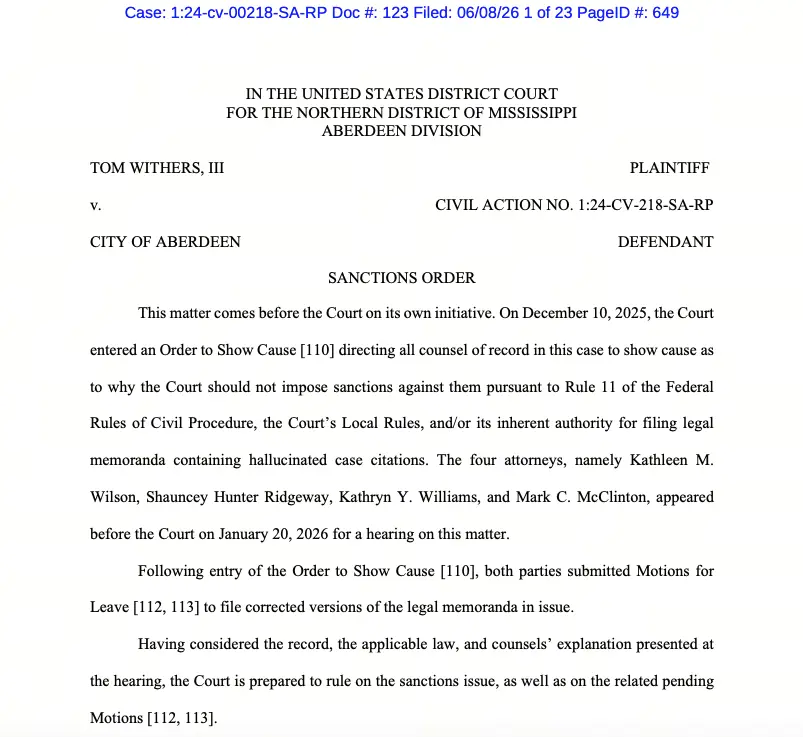
Mississippi cases: Four lawyers had their licenses to appear canceled after submitting documents containing AI hallucinations; each was fined $1,000–$3,500. Williams and Wilson were barred from appearing in court for two years; one of them claimed, “I didn’t know AI could fabricate cases.”
Sullivan & Cromwell apology: In April 2026, the law firm sent a letter of apology to the judge after submitting documents with hallucination errors in Prince Group’s bankruptcy case, including an incorrect citation of the U.S. Bankruptcy Code and incorrect citations to cases.
FAQ
Why do lawyers keep using unverified AI outputs even after they know AI has hallucination problems?
According to reports, reasons include: some lawyers don’t understand the AI hallucination phenomenon (a Mississippi lawyer said, “I didn’t know AI could fabricate cases”); AI tools are used routinely to draft documents without establishing verification procedures (as in the Sullivan & Cromwell case, where it was stated that an “AI policy was not followed”); and there is insufficient rigor in the secondary review before filing. The American Bar Association warned in June 2025 that failing to verify AI outputs may violate duties of competent representation.
How high is the error rate of Thomson Reuters and Lexis+ AI legal tools?
According to reports, tests of Lexis+ AI and AI tools from Thomson Reuters (NYSE: TRI) show that incorrect information appears in more than 17% of instances; in some tests, the error rate was as high as 34%. The specific testing methods and conditions are detailed in the relevant research report.
Is it illegal to draft legal documents using AI tools?
According to reports, the law does not prohibit lawyers from using AI; however, they have ethical duties to ensure that all filed documents are accurate. In February 2026, the National Center for Courts warned that AI hallucinations pose an increasingly serious threat to the judicial system; multiple cases show that lawyers who fail to verify AI outputs face consequences such as fines, loss of authority to appear, and court injunctions.


