Zama Completes Its First Crypto ICO: Dutch Auction Raises Around $118 Million as Innovative FHE Bidding Draws Market Attention

Beginner
Quick Reads
Last Updated 2026-03-25 17:16:33
Reading Time: 1m
Zama has successfully conducted the first encrypted ICO on Ethereum, raising about $118 million via a Dutch auction. More than 11,000 participants actively bid, leveraging FHE encryption technology to ensure privacy and equitable distribution.

Zama ICO Background Overview
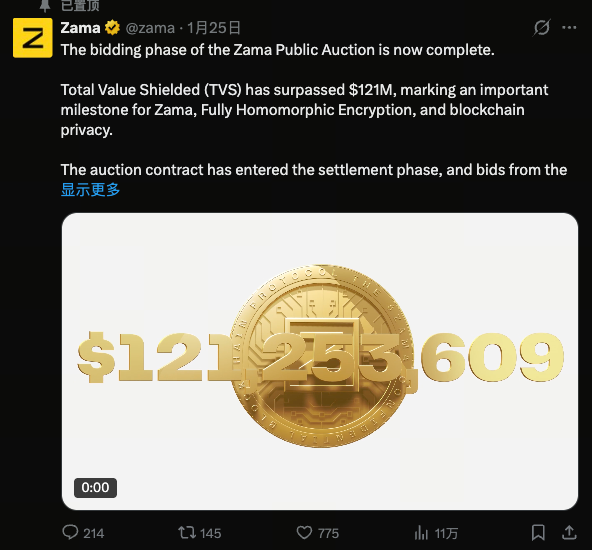

Image: https://x.com/zama

Zama is an open-source cryptography company specializing in Fully Homomorphic Encryption (FHE). This technology enables encrypted computation without exposing the underlying data, providing foundational infrastructure for blockchain privacy and secure computation. At the end of 2025, Zama announced it would launch its native token, ZAMA, on Ethereum through a public auction, drawing significant industry attention.

This public sale marks a major milestone for the industry—not only is it Zama’s inaugural crypto ICO, but it also introduces a novel auction mechanism designed to address challenges common to traditional ICOs, such as rush buying, front-running, and price distortions.

Innovative Auction Model: Fully Homomorphic Encryption and Dutch Auction

A key highlight of the Zama ICO is the integration of Fully Homomorphic Encryption (FHE). FHE allows bidders to submit encrypted bids on-chain, concealing their actual bid amounts while ensuring the process remains verifiable. This approach, rare in previous public token sales, is expected to advance privacy protection in future ICOs and crowdfunding events.

Zama also adopted a Dutch Auction mechanism, where tokens are allocated from the highest to the lowest price until all are sold, with all successful bidders settling at a single clearing price. This structure supports genuine price discovery and mitigates price distortions that can arise from fixed pricing models.

Auction Results and Funding Scale

According to official disclosures, Zama’s first crypto ICO concluded on January 24, 2026, raising approximately $118.5 million. Auction data shows that over 11,000 unique users submitted nearly 24,700 bids, with the final clearing price set at $0.05 per token.

The public sale was significantly oversubscribed, reaching an oversubscription rate of 318%. This outcome demonstrates that market recognition of the Zama project and its technology exceeded expectations.

Bidder Data and Market Performance

Participants spanned the globe and included both institutional investors and individuals. The large number of bids and high demand underscore the crypto community’s interest in privacy chain technology. Within the Ethereum ecosystem, the FHE bidding process offers a fair and highly confidential participation model, encouraging broader investor engagement in innovative sales like this.

Currently, the ZAMA token has not yet been listed or made available for public trading on major exchanges. The token claim process is scheduled for early February 2026, subject to official updates.

ZAMA Token Utility and Unlock Status

ZAMA is the native utility token of the Zama protocol, intended for use in paying privacy computation fees, participating in staking, or delegating network operations. These functions help maintain protocol security and ecosystem operations. Unlike many projects, the tokens sold in this public auction are fully unlocked and can be used immediately within the protocol or for other purposes once claimed.

ICO Impact on the Crypto Market and Privacy Chain Development

Zama’s ICO stands out not only for its large fundraising scale but also as the world’s first ICO to use FHE confidential bidding, setting a precedent in the industry. This model is likely to be adopted by more blockchain projects for token issuance, offering new tools for capital formation and fair pricing.

On a broader scale, privacy protection, on-chain security, and equitable participation remain long-term priorities in the blockchain ecosystem. The auction data shows that the market is increasingly embracing and prioritizing these innovative technologies.

Risk Disclosure and Investment Advisory

While the completion of the Zama ICO represents a successful integration of technology and market forces, participants should remain aware of the risks inherent in ICO investments. Token prices may experience significant volatility during initial public trading. The information presented does not constitute investment advice; investors should carefully assess risks and consult professional advisors before making any decisions.

Author: Max
Disclaimer
* The information is not intended to be and does not constitute financial advice or any other recommendation of any sort offered or endorsed by Gate.
* This article may not be reproduced, transmitted or copied without referencing Gate. Contravention is an infringement of Copyright Act and may be subject to legal action.

Related Articles

AI-Native Settlement Layers: How United Stables Is Building the Next Financial Rail
Beginner

AI-Native Settlement Layers: How United Stables Is Building the Next Financial Rail

Stablecoins were originally designed as dollar substitutes within exchanges, primarily used for asset pricing and trade settlement. As on-chain financial ecosystems have matured, their role has expanded beyond simple payments to include collateral assets, cross-chain liquidity mediums, and unified settlement units. In particular, as AI systems and automated agents begin to participate directly in economic activity, demand has risen sharply for programmable value units capable of instant settlement. This shift is pushing stablecoins toward the role of foundational financial infrastructure.
2026-03-25 03:16:17
The ve(3,3) Flywheel Explained: How AERO Tokenomics Powers Aerodrome’s DeFi Economy
Beginner

The ve(3,3) Flywheel Explained: How AERO Tokenomics Powers Aerodrome’s DeFi Economy

In the competition for DeFi liquidity, high-inflation mining alone is no longer enough to build lasting advantages. Aerodrome applies the ve(3,3) economic model to redesign token emissions, voting mechanisms, and revenue distribution, creating a liquidity flywheel centered on governance and cash flow. This article examines AERO tokenomics, the veAERO locking mechanism, and protocol revenue models to explain how Aerodrome builds a sustainable DeFi economic system.
2026-03-25 06:41:58
Aerodrome Tokenomics: How ve(3,3) Powers Base's Most Profitable DEX
Beginner

Aerodrome Tokenomics: How ve(3,3) Powers Base's Most Profitable DEX

AERO is the native token of Aerodrome Finance, a core decentralized exchange and liquidity protocol in the Base ecosystem. It is primarily used for liquidity incentives and ecosystem operations. veAERO is a governance NFT that users receive by locking AERO, representing both voting power and the right to share protocol revenue. Through a dual track structure of AERO as a utility token and veAERO as a governance credential, Aerodrome separates liquidity usage value from long term governance power, allowing participants to act as liquidity providers, governance decision makers, and revenue sharers within the same system.
2026-03-25 06:40:31
How Does PAXG Work? In-Depth Overview of the Physical Gold Tokenization Mechanism
Beginner

How Does PAXG Work? In-Depth Overview of the Physical Gold Tokenization Mechanism

PAXG (Pax Gold) is a tokenized asset backed by physical gold, issued by the fintech company Paxos and traded on the Ethereum blockchain as an ERC-20 token. The core concept is to tokenize physical gold on-chain, with each PAXG token representing ownership of a certain amount of gold. This structure enables investors to hold and trade gold in the form of a digital asset.
2026-03-24 19:12:51
How is the price of PAXG determined? Pegging mechanism, trading depth, and influencing factors
Beginner

How is the price of PAXG determined? Pegging mechanism, trading depth, and influencing factors

PAXG (Pax Gold) is a tokenized asset backed by physical gold reserves, launched by fintech firm Paxos and issued as an ERC-20 token on the Ethereum blockchain. The core concept is to digitally represent real-world gold assets, allowing investors to hold and trade gold via the blockchain network. Because each PAXG token corresponds to a specific quantity of physical gold, its price is theoretically expected to closely track the global gold market.
2026-03-24 19:11:40
DePIN Identity Network and Real World Applications: How Humanity Protocol Brings on-chain Identity Into the Physical World
Beginner

DePIN Identity Network and Real World Applications: How Humanity Protocol Brings on-chain Identity Into the Physical World

Most Web3 identity systems remain confined to on-chain environments and struggle to achieve meaningful adoption in real world settings. Through a DePIN architecture and physical verification hardware, Humanity Protocol aims to bring decentralized identity into access control systems, hospitality, public services, and offline events, allowing on-chain identity to function not just as a digital credential, but as foundational infrastructure for real world access.
2026-03-25 07:40:53





